(The article was prepared within the framework of Khar Center's research on Azerbaijani authoritarianism)
Author:
✍️ A young researcher holding bachelor's and master's degrees in journalism
Introduction
The mass media and social media exert a significant influence on public opinion. Which issues political actors and media institutions bring to the forefront is explained by the theory of agenda-building, while the transformation of these priorities into topics that society considers important, and their interpretation through a particular prism, is explained by the theories of agenda-setting and framing (McCombs and Shaw 1972; Scheufele and Tewksbury 2007). In authoritarian and hybrid regimes, the application of agenda-building theory is directly conditioned by the scale of institutional and political control over the media. In media systems theory, the excessive interference of the state in the information space and the transformation of the media, through the restriction of its functioning as an independent public institution, into a direct instrument of political power are explained by the concepts of high "political parallelism" and the instrumentalization of the media (Hallin and Mancini 2004). In pluralist and competitive political systems, various media institutions, political parties and civil society organizations have an active share in the formation of the public agenda. In a non-democratic environment where the media is politicized and monopolized by the state, competition over public discourse unfolds on a sharply unequal plane (Levitsky and Way 2010).
Modern "informational autocracies" remain resilient not only through open violence and physical repression, but also through control over information flows, controlled noise and the strategic redirection of public attention (Guriev and Treisman 2019). Authoritarian regimes try to keep systemic socio-economic problems and failures out of public attention by highlighting topics that suit their political interests. In this way, the causes, values and political explanations on the basis of which an issue will be presented are shaped. For example, when social discontent is presented not as the result of economic problems but as foreign interference, the public perception of the causes of the problem and of the actors bearing responsibility may change. At the same time, by activating certain criteria in the audience's memory (priming), the media prepares the ground for events to be evaluated precisely through the chosen prism (Scheufele and Tewksbury 2007).
Azerbaijan is one of the interesting and important examples for the empirical examination of these theoretical approaches. The keeping of the media environment under strict political control in the country and the pressures applied against journalists directly affect the environment in which the public agenda is formed. Katy Pearce and Sarah Kendzior, researchers studying the political effects of digital media in the South Caucasus and post-Soviet countries, have analyzed the Azerbaijani case within the framework of the concept of "networked authoritarianism". In this analysis the authors note that the Azerbaijani government continuously interferes in public opinion in order to neutralize online resistance and maintain information hegemony (Pearce and Kendzior 2012). Their analysis shows that information control in Azerbaijan is not limited to direct censorship alone, but is also carried out through the discrediting of alternative political positions and the steering of public opinion. In addition, Aram Terzyan, who studies the legitimation of authoritarian regimes in post-Soviet countries, shows on the example of Russia and Azerbaijan that linking internal problems to external forces and creating enemy images serves to strengthen perceptions of the necessity of strong presidential power (Terzyan 2020). The government is also able to consolidate its legitimacy through discourses of national unity and the external enemy.
In this theoretical context, I argue that agenda-building in Azerbaijan is not limited to passive censorship; on the contrary, in times of crisis it functions as a manipulation mechanism and distraction strategy designed to evade political accountability. The study analyzes which topics state-controlled media institutions highlight at moments of public discontent and legitimacy deficit, from what angle they interpret them, and which associations they evoke. Within this framework, the article focuses, through specific cases, on the critique of 2 parallel manipulative vectors:
- The neutralization of internal problems through national security rhetoric;
- The depoliticization of public attention through artificial moral-domestic panic.
Purpose of the study:
The purpose of this study is to analyze, on the basis of agenda-setting theory and the tactics it addresses, how the media in Azerbaijan frames sensitive political and economic topics and the mechanisms of pushing alternative agendas into the background. The proposed conceptual framework, in addition to explaining the management of information flows in authoritarian regimes, systematizes the non-explicit, indirect forms of manifestation of structural censorship.
This article is the next article of a four-part research series analyzing authoritarian control over speech, and covers the empirical base formed up to the date of publication. The first part of the series examined how the traditional information space was shaped through finance, institutional control and repression. The second article analyzed how a similar analytical framework works in the digital environment and the structural dynamics of digital authoritarianism. This part has examined how official discourse is produced in both spaces and by what methods critical issues are diverted from public attention. In the final article of the series, I will examine, on the empirical plane and with concrete examples, the hegemonic information strategies mobilized during periods of systemic crises.
Research question:
What institutional methods do authoritarian systems use to manage public attention, silence undesirable topics and shape public opinion? How are these mechanisms applied in traditional and digital media under the conditions of Azerbaijan's informational autocracy?
Sources of the study:
The content, socio-political programmes and archive materials of leading pro-government media; the posts of media institutions on digital platforms and the dissemination dynamics of tabloid/domestic topics circulated during sensitive periods; official documents of the Audiovisual Council of the Republic of Azerbaijan and the Media Development Agency (MEDIA); media monitoring by local and international organizations; as well as international and regional academic literature on agenda-setting theory, digital authoritarianism in the post-Soviet space and in Azerbaijan, networked control and the shaping of public discourse.
Methodological note:
The article is of a conceptual-analytical and comparative case analysis character. The study covers the periods of 2016–2026 during which political repressions, socio-economic crises and security tensions increased. In the monitoring process, the main state and pro-government channels (AzTV, İTV, ARB, Real TV, Xəzər TV, ATV) and news portals (Azertac, APA, Report, Trend, Qafqazinfo, Azernews) were followed in parallel with independent media resources (Radio Azadliq, Meydan TV, JAMnews, Toplum TV, Turan IA). The six cases analyzed were selected according to the criterion of coinciding with moments of socio-political tension and creating a sharp framing difference between the two media poles. In addition, in order to document informal instructions within newsrooms, anonymous information obtained from sources working in state and pro-government media has been cited. Due to the limited nature of quantitative indicators, the analytical conclusions in the article are not to be regarded as definitive verdicts.
1. Comparative analysis of agenda theories: key concepts, formation mechanisms and analytical tools
1.1. The political-theoretical foundations of agenda-building
Agenda-building is a process that examines how certain issues take their place on the agendas of the media, the public and political actors, which actors exert influence and in what way, and how issues gain priority. Political institutions, representatives of the government, media groups and experts may participate in this process. Their influence on the agenda varies depending on the existing political structure, opportunities for access to the public, and resources (Cobb and Elder 1971; Cobb, Ross and Ross 1976; Lang and Lang 1983).
In order to understand the political-theoretical roots of agenda-building, it is necessary to look back even before its formation as a modern communication theory. The ancient Greek philosopher Aristotle wrote in his work "Rhetoric", dating to the classical Athenian period of the 4th century BC, that in a political environment the truth of an idea is not sufficient on its own; the main thing is to persuade people of it (Aristotle 1991). He noted that political leaders, when addressing the people, themselves choose what is useful and what is harmful, and direct people's attention precisely to these topics.
The interactions between economic relations and political power form a critical theoretical basis for understanding agenda-building in a broader structural context. Karl Marx and Friedrich Engels show in "The German Ideology" that the class which controls the means of material production at the same time holds a dominant position over the means of mental production, and in this way turns views corresponding to its interests into the ruling idea of society (Marx and Engels 1970). This thesis of ideological dominance acquired institutional content in 20th-century political science with Peter Bachrach and Morton Baratz's concept of the "two faces of power" (Bachrach and Baratz 1962, 1963). The authors argued that political power manifests itself not only in the making of official decisions, but also in preventing problems undesirable for the system from being brought into public discussion, that is, in creating non-decisions (nondecision-making) and removing topics from the agenda.
Roger Cobb and Charles Elder, who systematized agenda-building on the plane of political participation and power relations, directed attention to the stage immediately preceding decision-making — which issues are able to enter the systemic agenda and which remain outside it (Cobb and Elder 1971; Cobb, Ross and Ross 1976). Consequently, the prioritization and bringing to the forefront of certain problems and the removal of alternative issues from the information field are two faces of a single mechanism of political regulation (Denham 2010).
In order to understand the essence of agenda-building in the modern era, it is also necessary to clarify the concept of the "agenda". The agenda is the ranking, according to their relative importance, of the issues that are significant for the public and the media at a given point in time. What is at stake here is not simply which events there is news about, but which of them gain more attention in comparison with others (Rogers and Dearing 1988). In scholarly research the agenda is understood in three forms: media, public and political (Rogers and Dearing 1988). The media agenda expresses which issues gain attention in the media. The public agenda explains which problems people consider important, while the political agenda explains which issues political institutions and decision-makers turn into subjects of discussion and decision-making. There is an interrelation between these agendas. However, the wide coverage of an issue in the media does not guarantee that it will be accepted as equally important by the public or that it will turn into a political decision. In this respect, agenda-building also includes the influence of media institutions on one another's agendas (intermedia agenda-building) (Denham 2010). This approach makes it possible to analyze whether the simultaneous coverage of the same topic by various media outlets stems from natural news value or from centralized political coordination. These interactions provide the ground for understanding how the media agenda is formed. However, the relationship between certain issues coming to the forefront of the media agenda and the extent to which they are considered important by the public forms the basis of a separate theoretical approach – agenda-setting theory.
1.2. The formation and main tenets of agenda-setting theory
Agenda-setting explains how the media manages public attention. The intellectual roots of this approach go back to journalist and political commentator Walter Lippmann's work "Public Opinion", published in 1922. Lippmann showed that because the world is very large and complex, people cannot see everything that happens with their own eyes. As a result, society maintains contact with the real world not directly, but through the news presented by the media, selected images and the "pseudo-environment" it creates (Lippmann 1922). Another important pillar of the theory is political scientist Bernard Cohen's study "The Press and Foreign Policy" (Cohen 1963). Cohen noted that although newspapers may not be able to tell people what to think, they determine very precisely what they will think about. That is, whichever problem the media brings to the forefront, society begins to discuss precisely that. The "Chapel Hill" study published by researchers Maxwell McCombs and Donald Shaw in 1972 occupies an important place in the development of agenda-setting theory. The researchers compared the topics the media covered most during the 1968 US presidential elections with the issues voters considered most important. They established that there is a strong relationship between the issues the media paid attention to and the issues voters considered important. In other words, whichever problems the media brought to the agenda more often, voters were also inclined to consider those problems more important.
Agenda-setting theory examines the influence of the media on public attention at three interrelated levels: the salience of issues, of attributes, and of the relationships between them (Guo, Vu and McCombs 2012). The first level studies which issues come to the forefront of the public agenda, the second level which characteristics of those issues are emphasized, and the third level how various topics, actors and concepts are linked to one another in media content (Vu, Guo and McCombs 2014).
This differentiation creates a useful analytical framework for analyzing the influence of the media on public attention in authoritarian regimes. The main issue here is not only which topics are covered in the media, but also which issues are not brought into public discussion, which topics are given more attention, and in what framework of meaning they are presented.\
1.3. Explicit and hidden mechanisms of agenda formation
The agenda-building process is built on the dynamic relationships between the media, the public and political decision-makers (Rogers and Dearing 1988). In democratic systems there is mutual influence between these three components. In authoritarian governments, unequal state control over information resources and the media creates the conditions for these mechanisms to acquire an institutional character. The main mechanisms distinguished within this framework include the following:
Gatekeeping – is the filtering of information. This concept explains which news will be conveyed to the public and which will be kept out (Shoemaker and Vos 2009). In news production, journalists and editors make choices on the basis of the topicality of events, their public significance, editorial policy and the accessibility of sources. However, in systems where political pressure and control are strong, the interests of the government also influence these choices.
Nondecision-making (prevention of decision-making) – is the government keeping a topic out of public discussion so as not to be compelled to make any decision on issues that do not suit it (Bachrach and Baratz 1962). That is, the problem is not admitted to the agenda so that there is no need to make a decision about it either.
Information subsidies – refers to the press releases, official statements, statistical reports and ready-made news packages prepared for the media by political institutions, state bodies and organized interest groups (Gandy 1982; Turk and Franklin 1987). Ready-made information materials can reduce newsrooms' costs of collecting information and preparing news. Political and institutional actors that make wider use of these opportunities can also have their topics covered more widely in the media. The publication of official statements in the media is not in itself considered manipulation; however, authoritarian governments' repeated circulation of their own position in different forms is proof of it.
Indexing to official sources – explains the adaptation of news to the consensus or debates within the official political elite (Bennett 1990). If representatives of the government speak from a single position on an issue, alternative voices and criticisms automatically remain outside the news agenda. In these systems, the exclusion of the opposition and independent experts from the news is related to the media being institutionally tuned only to a single official discourse. Space is given to alternative positions only when open contradiction and dispute arise within the political elite, and even then preference is given to the stronger political actor.
Agenda-cutting – examines how topics of public significance disappear from the media agenda and are pushed into the background (Colistra 2012). Here, even if the issue exists at the official level, it is diverted from the attention of the public audience, and its airtime or news volume is restricted.
Agenda denial – explains the process by which a particular problem is not accepted by political decision-makers and the ruling elite as an issue worthy of official discussion (Cobb and Ross 1997). The aim here is to reject legitimacy. That is, the question is not whether or not the problem is in the media. This mechanism is implemented through tactics such as denying the problem, trivializing it, discrediting the groups putting forward the demand (for example, with the label of "foreign influence" or "provocation"), and postponing decisions indefinitely.
Framing – refers to the selection and highlighting of certain aspects of an event and its presentation in the context of a specific cause, evaluation and solution (Entman 1993). While agenda-setting examines what the public will think about, framing analyzes the presentation mechanisms that influence how the audience will understand and interpret those issues (Scheufele and Tewksbury 2007). For example, the study conducted by media researchers Rozenas and Stukal (2019) on Russian state television, in which negative economic news is linked to external factors and positive results to the activities of the domestic political leadership, is an example of this.
Diversion – examines the likelihood of public attention being directed to alternative topics against the background of internal crises. Political scientists Gary King, Jennifer Pan and Margaret Roberts (2017), while studying Chinese social media, discovered an interesting fact. It turned out that the main aim of pro-government commentators is not to respond to criticism with arguments, but to divert people's attention from controversial topics with positive and neutral posts.
This approach is based on the "red herring" tactic, which denotes bringing extraneous and emotional topics onto the agenda in order to evade the main issue in political communication (Walton 2003; Macagno and Walton 2014), and is directly consistent with the "strategic distraction" model in the modern literature on information control (King, Pan and Roberts 2017). This mechanism encompasses deceptive plots, artificial conflicts and false targets put forward in order to cover up major and systemic crises and to steer public discussion in a dead-end direction. The process is managed in two ways:
First, as soon as discontent grows inside, foreign threats, spy networks and fear of war are deliberately brought onto the agenda. For example, political scientists Ala' Alrababa'h and Lisa Blaydes (2021) show on the example of Syrian state media that the Assad regime tried to compensate for the internal legitimacy it had lost by increasing claims of foreign threats and conspiracies.
Second, tabloid scandals and artificial hype on moral topics are transmitted to society. Instead of responding to socio-economic discontent with arguments, the regime directs people's emotions to secondary, non-political topics; thus, by exhausting society's attention, it moves public discussions completely away from politics.
Priming – explains the influence of topics continuously covered in the news on which criteria people take as a basis when evaluating political leaders. Political psychology researchers Shanto Iyengar and Donald Kinder (1987) wrote that when the media continuously highlights foreign dangers and national security issues, citizens, when evaluating the government, begin to accept precisely security, rather than the economic situation or social problems, as the main criterion. Agenda-setting dictates to what extent a given topic is important for society, while priming causes those topics to become the main yardstick when judging political leaders.
Information friction / obstacles – is the strategy of artificially hindering access to information without directly and completely banning it. For example, they do not block a site, but they slow down the page's loading speed so much that an article takes 20–30 seconds to load. The ordinary user, thinking that the internet is weak, closes the page and gives up reading. Sometimes access to them from foreign countries is even restricted. Or, budget expenditures or official documents are "open" by law, but they are hidden in scanned, non-searchable, thousand-page, low-quality PDF format so that the journalist or citizen gets tired before finding the fact. Margaret Roberts (2018), a political scientist specializing in digital censorship, shows while studying the Chinese internet ecosystem that this approach adds an important reality to the concept of agenda-building in the digital era: the fact that a piece of information technically exists on the internet does not mean that it is accessible to society. In this way, authoritarian regimes are able to keep an undesirable topic out of public attention even without resorting to harsh bans.
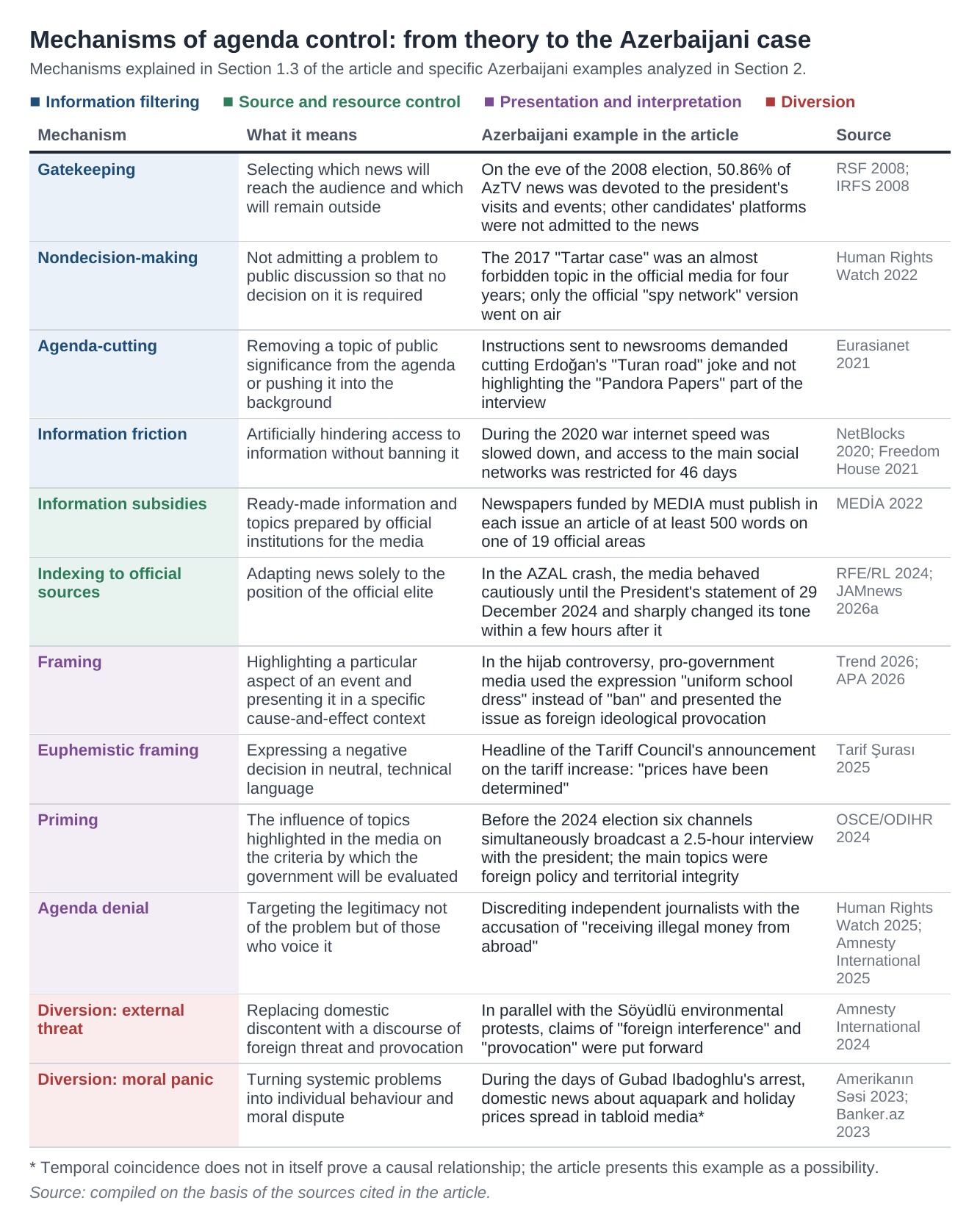
Not all of these mechanisms work in the same way or with the same intensity in every political system. Their significance varies depending on the structure of the media environment, political competition, the distribution of information resources, and institutional opportunities for access.
Unlike the mechanisms listed, self-censorship does not always arise as a result of direct interference in the information agenda. Journalists and newsrooms may avoid certain topics or change the tone of the news out of fear of political pressure, sanctions or economic loss. In such situations, control is formed not through direct instructions, but through journalists calculating the risks in advance and censoring themselves (Moon 2023).
1.4. The political logic of agenda control in authoritarian regimes
In authoritarian political systems, control over the media agenda is an important component of the government's information policy. The aim of this control is not simply to disseminate the state's views or to praise the government. The main target is to determine what the public will discuss, on which topics it will judge the government, and to what extent alternative voices will be heard. In democracies, too, politicians try to steer the media in their favour. But there, independent media, political competition and accountability play the role of a shield preventing this influence. In authoritarian regimes, however, the situation is different. Financial and legal dependence of the media, censorship and fear of punishment make it possible to build the agenda entirely as the government wishes. As a result, control over information turns not into ordinary news production, but into a direct instrument of political domination. It turns it into the model of cultural hegemony conceptualized by the neo-Marxist philosopher and theorist Antonio Gramsci (1971), that is, into a mechanism that wins public consent for the interests of the ruling elite and protects the existing political-economic order. If I apply Gramsci's approach of cultural hegemony to the modern media, the mass media play the role of the principal ideological institution that makes society accept the political agenda of the ruling elite as an indisputable "natural reality" (common sense). This mechanism is also important in terms of the public presentation of class and social contradictions. Problems such as income and wealth inequality, corruption, labour and social security may be presented not through structural causes, but at the level of individuals' behaviour or moral choice. When this happens, attention is diverted from the main factor creating these problems – institutional relations. This ideological framework is complemented by the concentration of media ownership and advertising revenues in the hands of monopolistic groups linked to the ruling elite (Herman and Chomsky 1988). As a result, the information space is directly subordinated to the interests of the political authorities and the ruling class.
In authoritarian governance, when internal crises and the legitimacy deficit deepen, agenda control is carried out through two parallel manipulative vectors:
Mobilization of the discourse of national security and external threat – In authoritarian regimes, internal socio-economic problems, public discontent and the crisis of political legitimacy can be pushed into the background by means of an information agenda built around external dangers and geopolitical confrontations. Highlighting external threats, in addition to diverting public attention from internal problems, creates conditions for pro-government mobilization around the rhetoric of national unity and forms an ideological basis for presenting opposition positions as contrary to national interests (Chubb and Wang 2023).
Depoliticization of public consciousness through moral panics and domestic scandals – One of the main ways to undermine demands for political accountability is to direct public energy towards individuals' private lives, styles of dress, family relations and artificially inflamed moral discussions. Such artificial "moral panics" individualize systemic problems in society and, diverting public anger away from the regime, direct it against marginal groups (Hall et al. 1978). When real socio-economic demands are replaced by domestic scandals, public discourse is depoliticized and citizens' capacity to voice political demands weakens.
Political scientists Steven Levitsky and Lucan Way, putting forward the concept of "competitive authoritarianism", show that although in a number of regimes elections and the media formally exist, the government turns them into instruments and creates an uneven playing field (Levitsky and Way 2002). The regime uses them in order to give its rule a legitimate guise on the uneven playing field it has itself created. Andreas Schedler, a researcher of hybrid regimes, calls these instruments of pressure and fraud applied by autocrats the 'menu of manipulation' and indicates the suppression of the media as an important component of this list (Schedler 2002).
In authoritarian conditions, the management of the agenda takes place through mechanisms of influence that work together with the institutional structure of the media environment, and enables the government to evade accountability. In the next section, this framework makes it possible to examine with concrete examples how security and domestic-moral topics can overshadow social discontent in the Azerbaijani media.
2. The institutional framework of the media agenda in Azerbaijan and the dominance of official discourse
2.1. Documented cases of the political organization of the media agenda: electoral competition, socio-economic problems and editorial control
When analyzing the formation of the media agenda in Azerbaijan, traditional approaches to news production are not sufficient, and it is not correct to direct attention only to the content of the news that is broadcast. To understand this picture, it is enough to look at the ties between the media and the government. Although control over the information sphere in the country looks different on traditional and online platforms, they complement each other. Television channels and leading portals transmit official theses to society, while on social networks this line is inflamed and reactions are steered. Newspapers and television channels are brought under control through financial dependence and mandatory official sources. In the digital environment, on the other hand, they block sites, carry out technical interventions and organize smear campaigns. Thus, traditional media sets the framework of information, while digital control restricts its speed of dissemination, its reach and access to alternative sources.
- Legal regulation and the institutional boundaries of information production
The Law "On Media", adopted in 2022, is one of the main documents defining the legal framework of media activity in Azerbaijan (Milli Majlis of the Republic of Azerbaijan 2022). In the joint opinion of the Venice Commission of the Council of Europe and the Directorate General of Human Rights and Rule of Law, the compatibility of a number of provisions of the law with European standards on freedom of expression and media freedom was called into question. The opinion concluded that the application of the law in its current form could have an additional deterrent effect on the activity of independent journalism (Venice Commission and DGI 2022). The significance of this legal framework from the point of view of agenda-building lies in the fact that the rules on the operating opportunities of media entities do not only regulate administrative relations. They can also influence which institutions are able to produce information on a sustained basis. In particular, the Media Register formed with the application of this law directly subordinates participation in the information sphere to administrative control. The requirement of inclusion in the Media Register also restricts journalists' opportunities for accreditation at state institutions. This, by making it harder for journalists who remain outside the register to participate in official events and obtain information, weakens their ability to influence the formation of the public agenda.
Another mechanism influencing newsrooms' news selection is the direct linking of state funding to certain topics. This practice also existed in the State Support Fund for the Development of Mass Media (KIVDF), which operated before MEDIA. For example, in KIVDF's 2020 competition, the allocation of money to newspapers was tied to the condition of submitting projects on 19 official topics. Among these directions, the promotion of the history of Azerbaijani statehood, the idea of Azerbaijanism, national customs and traditions, patriotism, and the protection of public and state interests occupied a special place. The results of the competition also separately indicated in which directions the newspapers that won funding had submitted projects (Yeniçağ 2020). The Media Development Agency, created after the abolition of KIVDF (President of the Republic of Azerbaijan 2021), instead of eliminating this funding mechanism, continued it with more detailed administrative rules. According to the Agency's rules on providing financial assistance to print and online media entities, newspapers and websites receiving financial support on a competitive basis must direct the funds not only towards news production on the basis of their own editorial priorities, but also towards fulfilling predetermined thematic requirements. According to clause 5.3 of the Rules, newspapers receiving financial assistance must publish in each issue (at least once a week) an article of at least 500 words on one of the 19 areas defined in the legislation (MEDIA 2022). These areas include the promotion of statehood and Azerbaijanism, the "Great Return", the protection of public and state interests, as well as the coverage of the official position on the 44-day Patriotic War. However, the setting of these directions and their execution in practice formed a discourse aimed not so much at critical or independent analysis as at legitimizing the existing political line, highlighting the successes of state policy and, as a whole, promoting the activities of the government. The influence of this mechanism on the media agenda is seen even more clearly in clause 5.4 of the rules. According to this clause, newsrooms must prepare an article each following month on a thematic area different from that of the previous month. This mechanism, taking state funding out of the classic information subsidy, restricts newsrooms' freedom of news selection (gatekeeping) and creates a deep environment of self-censorship in order not to lose funding. As a result, the continuous bringing of mandatory topics onto the agenda and the requirement that they be written about every week ensure that pro-government narratives are highlighted in society.
- The election agenda and the visibility of political competition in the media
One of the areas that most clearly shows the political organization of the media agenda is the election period. This is because during this period the visibility of political actors can be observed as a measurable indicator.
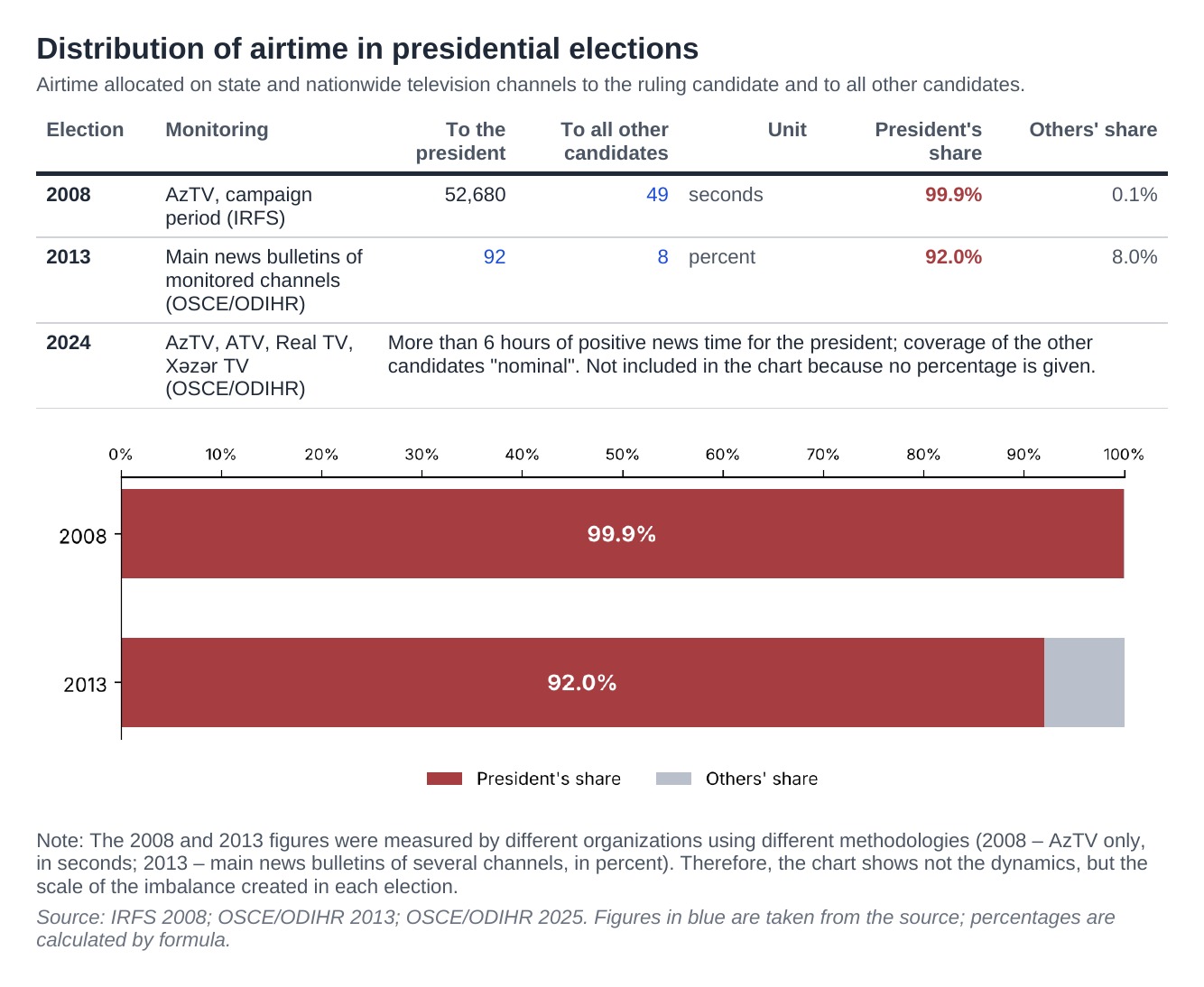
In the 2008 presidential elections, the decision of the main opposition forces to boycott had frozen political competition, while the other registered candidates had been unable to form a real alternative. This political passivity was further reinforced in the media by strict filters serving the interests of the government. Monitoring by the Institute for Reporters' Freedom and Safety (IRFS) shows that while state television AzTV allocated 14 hours and 38 minutes of airtime to the incumbent head of state, Ilham Aliyev, the total share of all the remaining candidates was limited to a mere 49 seconds (IRFS 2008). Although Public Television created a certain visual difference, the formation of the information advantage in favour of the ruling elite did not change structurally. The report of Reporters Without Borders (RSF) shows that on the eve of the elections 50.86 percent of AzTV's news bulletins consisted directly of the president's regional trips, openings and state events, while the platforms of the other candidates were not admitted to the news agenda (Reporters Without Borders 2008). Thus, here the information filter and agenda-cutting mechanisms make the political positions of alternative candidates invisible. The continuous coverage of the president's official activities, in turn, creating topic salience, shapes the election agenda in favour of the government.
In the 2013 presidential elections, the participation of Jamil Hasanli, the single candidate of the main opposition forces, again brought onto the agenda the issue of the visibility of a political alternative in the media. According to monitoring by the OSCE Office for Democratic Institutions and Human Rights (ODIHR), in the main news bulletins of the monitored television channels, 92 percent of the total airtime was allocated to President Ilham Aliyev, while the total share of the other nine candidates, including J. Hasanli, amounted to only 8 percent (OSCE/ODIHR 2013). Debates that would have created conditions for discussing the candidates' programmes and for the public to address critical questions were also not organized on television. In addition, the criminal prosecution of and physical pressure on critics and journalists during that period formed a deep environment of self-censorship in newsrooms (OSCE/ODIHR 2013).
From the point of view of agenda-building, the 2018 election is a vivid example of the concepts of information subsidies and indexing to official sources: television channels built the news agenda not on independent investigations or political competition, but on the basis of official news packages transmitted by state institutions. The president's activities as head of state, being intensively circulated, replaced the election campaign, while alternative political demands, being entirely subjected to agenda denial, were erased from public information circulation (OSCE/ODIHR 2018).
The early presidential elections of 7 February 2024 are an example of the shaping of the media agenda around the government's political priorities. According to the final report of the OSCE/ODIHR, AzTV, ATV, Real TV and Xəzər TV allocated in total more than six hours of positive news time to the activities of President Ilham Aliyev, while the coverage of the other candidates was of a nominal character. In fact, such an appearance of formal competition is not new in Azerbaijan's electoral practice; as early as the parliamentary elections of 2005 and 2010, the tactic of devaluing the institution of elections in the eyes of the public and creating voter apathy by putting weak, non-serious or unprepared candidates on air was applied (OSCE/ODIHR 2006; OSCE/ODIHR 2011; Schedler 2013). In the 2024 presidential elections, this mechanism was continued against the background of the nominal representation of the other candidates and their rhetoric supporting the policy of the ruling candidate. A similar picture was also observed in online media: APA, Azertac, Qafqazinfo, Report and Trend covered the president's activities widely and positively (OSCE/ODIHR 2025). By continuously presenting official visits and meetings in the form of ready-made news, the government ensured that it was always in the foreground in the media. The fact that almost no space was allocated to the other candidates once again reveals the effect of the information filter and censorship mechanisms. According to the statement of preliminary findings and conclusions issued by the OSCE/ODIHR on the 7 February 2024 elections, on 10 January 2024 six nationwide television channels simultaneously broadcast a two-and-a-half-hour interview with the head of state, in which mainly foreign policy and the restoration of territorial integrity were discussed (OSCE/ODIHR 2024). The constant foregrounding of these topics in the election campaign plays an important role from the point of view of the priming mechanism. The media's giving preference to certain issues directly affects by which criteria voters will evaluate the government. The tense environment on the eve of the elections and the arrests of journalists further intensified this pressure. Although official bodies claimed that these prosecutions were not related to journalistic activity, the report emphasizes that these arrests created a chilling effect in the media environment, deepened self-censorship and seriously restricted the representation of alternative voices in public discussions (OSCE/ODIHR 2024).
- Steering and restricting the editorial agenda
One of the clearest documented forms of direct interference in the editorial agenda in Azerbaijan is the informal guidelines and instructions regularly transmitted to media entities. This practice, known in the post-Soviet information space as "temnik", gives newsrooms a mandatory political direction in daily news production. One of the vivid examples of this practice is reflected in the investigation by the publication "Eurasianet" dated 20 December 2021, titled "Azerbaijan's pro-government media: Just following orders". The publication obtained "WhatsApp" messages sent to local newsrooms and the files titled "Recommendations" attached to them, and carried out a content analysis (Eurasianet 2021).
A few hours after Ilham Aliyev's speech at the summit of the Commonwealth of Independent States held in videoconference format, journalists were recommended to expand the campaign on topics related to Iran–Armenia relations, drug trafficking and the plundering of the occupied territories.
Another message sent subsequently asked that expressions insulting the "honour and dignity" of Iran's supreme religious leader Ali Khamenei and the term "South Azerbaijan" not be used, and at the same time that materials be prepared substantiating the groundlessness of Iran's accusations against Azerbaijan and that it should apologize.
One of the messages obtained by "Eurasianet" concerns the coverage of the anniversary of the 2020 war. According to the investigation, on 20 September 2021 a message was sent to newsrooms about preparing materials and gradually intensifying public discussions, and "the victorious Azerbaijani people" and "the triumphant Supreme Commander-in-Chief" were set as key phrases. Another message recommended that sad content, including footage of crying people, be significantly reduced from 1 to 7 November and that attention be directed to Victory Day (Eurasianet 2021). This example shows that interference in the editorial agenda concerns not only which topics are covered, but also in what emotional and political framework an event is presented.
The investigation also reports that on 26 August 2021 a message was sent to newsrooms about widely covering the birthday of First Vice-President Mehriban Aliyeva. It is indicated that the message noted the condition that this coverage "should not look artificial" (Eurasianet 2021).
In the publication's investigation, another form of steering the editorial agenda is presented in connection with the 2021 proposal to change the dates of national holidays. In the message reportedly sent to newsrooms on 7 October, it was argued that the new calendar would more clearly express the political-legal succession between the Azerbaijan Democratic Republic and the modern Republic of Azerbaijan and would refute Armenia's arguments regarding the status of Karabakh (Eurasianet 2021).
A striking aspect of the investigation is that this text was subsequently published in various media institutions as the position of different persons. APA presented the same text as the views of MP Ziyafat Asgarov, while Lent.az attributed it partly to Ziyafat Asgarov and partly to historian Boran Aziz. A week later, the same text was published in the state-owned newspaper "Səs" as the position of MP Jeyhun Mammadov, and on the news site "Telegraf" as the position of MP Konul Nurullayeva (Eurasianet 2021). In the leaks of official instructions documented by "Eurasianet", the demand to cut from the air the "Turan road" joke made by Turkish President Recep Tayyip Erdoğan during the joint visit to Fuzuli in 2021, considered diplomatically sensitive for the local media, as well as the demand not to highlight the part of Ilham Aliyev's interview concerning the "Pandora Papers" corruption investigation, are a direct example of the agenda-cutting mechanism (Eurasianet 2021).
At the same time, the state-backed media campaign conducted against France in 2023 and the presentation of President Emmanuel Macron's statements only within a dry official news framework in line with the campaign line show that media entities are also adapted, on foreign policy issues, to a propaganda mechanism steered from a single centre (Kucera 2023).
- Squeezing crises sensitive for society out of the agenda
Control over the media is not simply about conducting praise campaigns, but also about cleansing real crises from the news flow.
- For example, immediately after the sharp devaluation of the manat in December 2015, the social protests that arose in the regions in January 2016 against rising food prices and unemployment were almost not covered in the official media. Information about these actions appeared only on independent sites. The Prosecutor General's Office, for its part, accusing those platforms of "spreading biased and provocative false information", tried to purposefully erase social discontent from the public agenda (Freedom House 2016).
- The "Tartar case", remembered for the mass torture and killings of servicemen in May 2017, was an almost forbidden topic in the official media for four years. Nothing was let on air other than the "exposure of a spy network" version put forward by state bodies. Only at the end of 2021, after protests by the victims' families, did the investigation resume (Human Rights Watch 2022). It is clearly evident that the government is able to hide from the public for years the crises for which it is directly responsible simply by denying and ignoring them.
- In the digital space, information control began to acquire a systemic character as early as after the legislative amendments adopted in March 2017. Thus, on the basis of the demand of the Prosecutor General's Office and court decisions, some of the country's leading independent and alternative online media resources were blocked inside the country; this mechanism was later assessed in the legal analysis of the Council of Europe as a disproportionate interference with freedom of expression (Council of Europe 2017).
- The restriction of communications during the 44-day war of 2020 is a characteristic example of digital censorship and information friction. From the first day of military operations (27 September), the internet speed was sharply reduced (throttling). In addition, access to the main social networks was blocked, and these mass bans lasted for 46 days (NetBlocks 2020; Freedom House 2021). The paradoxical point is that although the platforms were closed for the domestic audience, the state leadership made intensive use of the "Twitter" platform to convey official military statements to the international community, while local citizens were forced to turn to VPN services even to follow these official news (Freedom House 2021). This practice shows how the domestic information flow is monopolized by technical means during a crisis.
- The legal and administrative sanctions applied to critical information production during the systemic accident at the Mingachevir TPP (the nationwide power outage) in July 2018 and the Ganja events are also an important link in crisis management. Independent news portals (Bastainfo.com, Criminal.az, etc.) that covered the events in a manner inconsistent with the official line were immediately blocked, criminal cases were opened against their editors, and at the beginning of 2019 suspended sentences of 5 years and 6 months were handed down (Human Rights Watch 2020). This practice proves that at moments of technogenic or socio-political crisis, an alternative news flow that contradicts the official version of the state is suffocated by the threat of long-term legal punishment.
- During the COVID-19 pandemic, the subordination of the information space to official narratives took a harsher legal form. In March 2020, harsh amendments were adopted to the Law "On Information, Informatization and Protection of Information" increasing liability for the dissemination of "false information" on the internet, and newsrooms and journalists were required to refer only to the bulletins of the Operational Headquarters under the Cabinet of Ministers (Reporters Without Borders 2020). These measures show that at moments of crisis information production is indexed exclusively to state sources (indexing).
- Framing was also observed during the environmental protests that took place in 2023 in the village of Söyüdlü in Gadabay. At a time when environmental dangers related to the waste of the gold mine and the demands of local residents were being discussed, claims of "foreign interference" and "provocation" were put forward in parallel with the event. "Amnesty International" documented the police's use of force against protesters and obstruction of journalists' work (Amnesty International 2024). In this situation, the main political role of security arguments is not to investigate environmental problems and the responsibility of state bodies, but to show that the protests were unjustified. Although independent journalists covered police violence, pro-government media institutions filled the agenda with the government's narrative.
- The presentation of LGBTQI+ topics in the Azerbaijani media shows how the agenda is shaped both through topic selection and through framing. According to the Azerbaijan results of "QueeRadar's" annual monitoring covering South Caucasus media, in 2024, 85 percent (585 articles) of the 691 materials analyzed in the country's media were related to foreign events, and only 15 percent (106 articles) to local realities. While discriminatory, biased or stigmatizing vocabulary was used in 68 percent of the analyzed materials, only seven materials (approximately 1 percent) approached the topic from the prism of human rights and inclusivity (QueeRadar 2025). According to my analysis, this presentation has two consequences. First, the problems that LGBTQI+ persons face in daily life remain on the margins of the public agenda. Second, discussion about these persons is built not around their rights and social situation, but around foreign ideologies supposedly influencing society. In addition, hate speech is instilled.
As documented by international human rights organizations, the mass criminal prosecutions and wave of arrests launched from the end of 2023 against Abzas Media, and from March 2024 against Toplum TV and subsequently against Meydan TV staff, completely weakened the institutional foundations of alternative news production in Azerbaijan (Human Rights Watch 2024, 2025; Amnesty International 2025). As a result, investigations of public significance are blocked already at the production stage, before they reach society. This process is not only classic censorship, but also an agenda-cutting mechanism applied by the state to pre-emptively erase critical news from public circulation.
However, the squeezing of independent media out of the country does not mean that its activity has completely stopped. Abzas Media, Meydan TV and other independent outlets, continuing their journalistic activity in exile, prepare investigations and daily news about Azerbaijan. However, the newsrooms' operating abroad restricts their access to operational information and makes verification of news more difficult. On the other hand, these outlets have no broadcasting opportunities inside the country such as television and radio. As a result, although they have a presence in digital media, their opportunities to influence the overall public agenda remain limited. The authorities' accusing independent journalists of receiving illegal money from abroad is in fact a method of agenda denial. The aim here is not to discuss the real problem, but to call into question the legitimacy of those who voice that problem. Linking journalists to foreign forces and illegal financing serves to cast a shadow over the materials they produce and to push sensitive topics such as corruption, governance and human rights into the background. As a result, it is not the problem itself, but the credibility of the media conveying it to society that becomes the subject of discussion (Human Rights Watch 2025, 2026; Amnesty International 2025).
An analytical model of agenda manipulation in Azerbaijan and the author's analysis
The mechanisms of control over the media agenda in Azerbaijan show that the government's information policy does not end with censorship and the filtering of news alone. The main aim here is to shape society's way of thinking and cognitive framework. In other words, society is not told what it needs to think, but is instilled with from which angle it should look at events and who should bear political responsibility. When events that arose in different periods around religious activity, public protest, war and national security, as well as gender and identity issues, are compared, a number of approaches that the government repeatedly uses to regulate the public space become visible. The common feature of these approaches is that controversial issues are taken out of the context of law, civil liberties and the responsibility of the state and presented within the framework of security, public order, national interest or secularism. In order to determine how these mechanisms work in Azerbaijan, I have comparatively analyzed events that took place in different periods and their presentation in the media. Although the events carry different content, recurring approaches are observed in their framing in official discourse and media materials. The following examples show how these approaches manifest themselves through concrete events and media presentations:
The transformation of the hijab controversy into a discourse of foreign interference in the media
The hijab debate, which began in September 2026 with changes to school dress rules, is a typical example of authoritarian governance from the point of view of the framing mechanism. Although at the initial stage the event was discussed on the domestic socio-legal plane, as the right of pupils to education and religious freedom, through state-controlled media it was rapidly shifted to a narrative of national security and foreign interference. Independent media presented the event in an individual- and human-rights-centred way (Radio Azadliq 2026, Meydan TV 2026). Pupils not being admitted to school, parents' protests, teachers losing their jobs and police intervention were made public directly with the expression "hijab ban". Pro-government media framed the problem not as a flaw of domestic governance, but as foreign ideological provocation (Trend.az 2026, Apa.az 2026). Instead of the expression "ban", "uniform school dress" was emphasized; parents' personal experiences were set aside, and only the official position was taken as the main reference. The portrayal of the issue as a "foreign threat", in turn, was aimed at undermining the legitimacy of the protests, preventing the public from sympathizing with the discontented side, and diverting attention from governance flaws.
According to information I obtained from television newsrooms, special instructions were sent to newsrooms in the first days of the actions to link the protests directly to the Iranian factor and, in general, over the last 4–5 months, not to broadcast visual footage related to the hijab on television. Since there is no official document, these should be regarded not as definitive facts, but as allegations about behind-the-scenes pressure on the media and attempts at censorship.
The allegation of money transferred to Israel via Azerbaijan
In the investigation by journalist Matthew Cole published in "Vanity Fair" magazine, it is alleged that hundreds of millions of dollars from the UAE and Saudi Arabia were transferred via Azerbaijani banks to Dubai, and that in total more than 700 million dollars were transferred via Azerbaijan into a financial chain linked to Israel. Kushner and his lawyers reject these allegations (Cole 2026). The approach of independent and pro-government media to the news differs sharply: although "JAMnews" (2026b) carried the possible intermediary role of Azerbaijani banks and the allegations of transfers to Israel directly into its headline, the main state and pro-government agencies aimed at the domestic audience chose a strategy of complete silence (agenda-cutting), allocating no space to the topic at all. Of the few local portals that touched on the topic, "Qafqazinfo" (2026), although it put Azerbaijan's name in the headline, softened the allegation within a framework of doubt by presenting it in the form of a question and directed the text mainly towards the foreign context surrounding Kushner's accounts in Dubai. The English-language "Azernews" (Poladova 2026), working for a foreign audience, locking the reader's attention only on Kushner's general ties with the Gulf countries, kept both the intermediary chain of Azerbaijani banks and the allegations of money transfers to Israel completely out of the picture. This picture clearly shows three classic methods of agenda management: keeping information completely out (agenda-cutting), neutralizing sensitive points within the framework of a question or a global context, and dressing the event in a different political guise.
The AZAL plane crash and the media management of two authoritarian states
The crash of an AZAL passenger plane near the city of Aktau in Kazakhstan on 25 December 2024 did not remain purely an aviation tragedy. This event demonstrated how two authoritarian states – Azerbaijan and Russia – manage the media for crisis management and political purposes. In the initial days of the event, Russian state media, presenting the crash purely in the context of unknown technical malfunctions and weather conditions, kept the possibility of a missile strike completely off the agenda (TASS 2024). Since no official political position had been announced, Azerbaijan's İTV and other pro-government media outlets also behaved cautiously at the initial stage and did not put forward any accusations against Moscow.
Only after President Ilham Aliyev officially declared on 29 December that the plane had been shot down by Russian air defence systems and that Moscow had tried to conceal this fact (RFE/RL 2024) did a sharp turn take place in the local media space. All state-linked media, headed by İTV, within a few hours set aside their previous cautious tone and launched an aggressive anti-Russian campaign accusing Moscow of "covering up the facts" and "evading responsibility" (RFE/RL 2024; JAMnews 2026a). The harshest censorship pressure domestically, meanwhile, was faced by the "Turan" Information Agency. Around that time, the agency wrote that President Ilham Aliyev's plane had also been subjected to GPS interference in Russian airspace and had changed its route for this reason. However, this information, which went beyond the official military-diplomatic framework, was immediately blocked: the agency was forced under administrative pressure to delete the news and issue a retraction, and then announced that it was suspending its activities indefinitely (JAMnews 2026a). This event proves that at moments of crisis information is indexed only to a single centre (indexing), while independent facts that do not align with the official narrative are put out of action by administrative bans even if they do not contradict state interests.
The presentation of rising prices and poverty in soft expressions
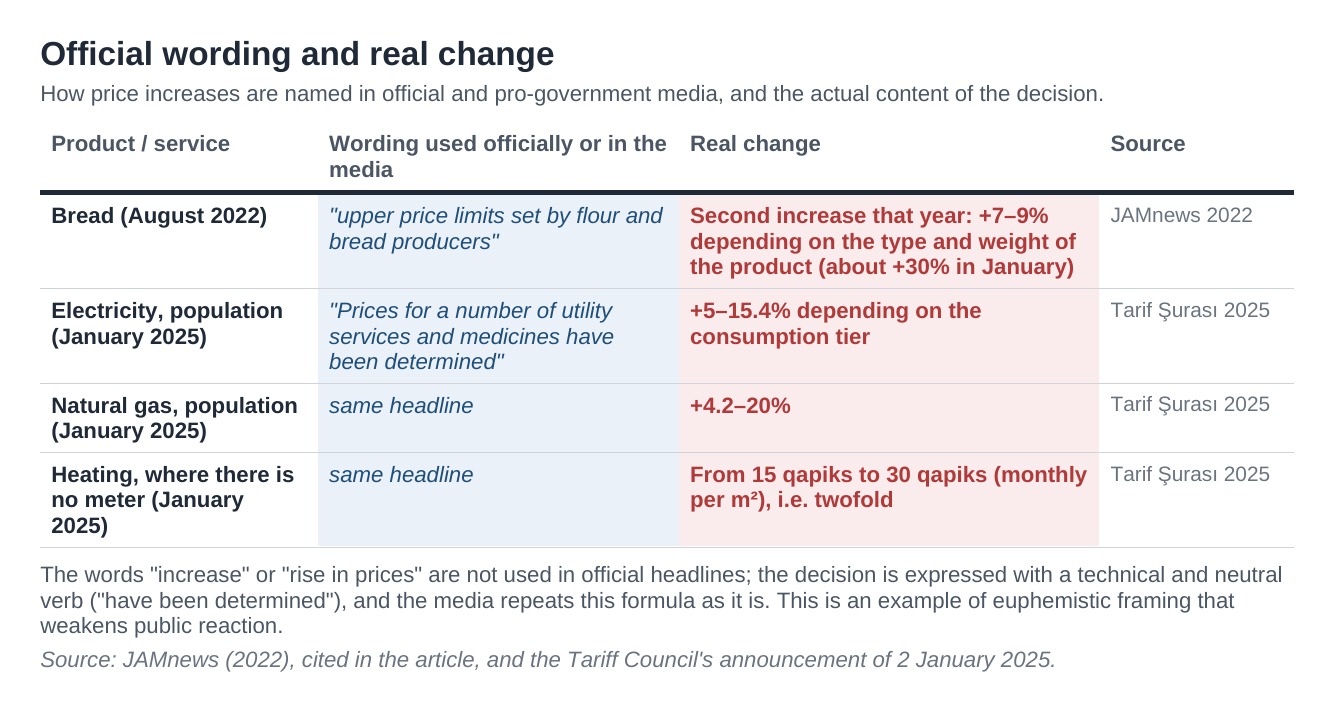
In Azerbaijan, price increases and poverty are often not presented in the media directly by their own name. Rising prices are covered as "price regulation", and economic difficulties in softer expressions. Thus, problems affecting people's daily lives move into the background, while the consequences created by official decisions are shown more neutrally. For example, in August 2022, the price of bread in Azerbaijan rose for the second time that year. After an increase of approximately 30 percent in January, this time prices rose by a further 7–9 percent depending on the type and weight of the product (JAMnews 2022). Most of the media institutions close to the government presented the news not directly with the expressions "rise in prices" or "price increase", but with the formula of "upper price limits" set by flour and bread producers. Here the mechanisms of information subsidy (ready-made institutional text), lexical euphemism ("limit" instead of "increase") and the redirection of responsibility complement one another. A similar lexical approach is also observed in the language of official communication regarding utility tariffs. The headline of the Tariff Council's official announcement dated 2 January 2025 read "Prices for a number of utility services and medicines have been determined". The headline foregrounded not a price increase, but the process of determining prices, and the media outlets circulated it in this way too (Tariff Council 2025). Whereas, by that decision, electricity tariffs for the population had been raised by 5–15.4 percent depending on the consumption tier, and natural gas tariffs by 4.2–20 percent. In the heating supply service, where no meter is installed, the monthly payment per square metre had also been raised from 15 qapiks to 30 qapiks. Two different mechanisms are applied in the management of economic news: the presentation of the bread price rise not as a state decision, but precisely as "upper price limits set by flour and bread producers", corresponds to the model of shifting responsibility away from the government onto market entities (blame-shifting) (Rozenas and Stukal 2019); while the expression of utility tariff increases with the technical and neutral verb "prices have been determined" instead of directly "rise in prices" is euphemistic framing aimed at weakening public reaction.
Nevertheless, satirical reactions on digital networks reveal that society has not fallen into this lexical trap and is aware of the gulf between official discourse and daily reality. For example, on the day the Tariff Council presented its decision of 2 January 2025 as a "necessity of new tariff regulation", the satirical cartoon titled "Urrraaa" by cartoonist Gunduz Aghayev, published on "Radio Azadliq" and widely shared on social media, neutralizes the effect of bureaucratic language by directly parodying the softening expressions in official statements and the real social burden created by the tariff increases (Radio Azadliq 2025a). In the comments under the post, readers, not believing the official explanations, also highlight the political essence of the decision ("The Tariff Council doesn't even buy trousers for itself on its own", "We have 72 billion in reserves"), while pro-government profiles, setting the topic of rising prices aside, accuse the author of "damaging the country's image".
The securitization of calls for peace and the one-sided framing of court proceedings
In the authoritarian information environment, the process of turning calls for peace into a national security threat (securitization) rests on the militarized rhetoric formed during the Second Karabakh War of 2020. Already in the first days of the war (28 September 2020), civic activist Giyas Ibrahimov was detained, interrogated and warned by the State Security Service (DTX) for his posts on social networks criticizing military rhetoric (OC Media 2020a). In October of the same year, a number of activists were also summoned to the Prosecutor General's Office and subjected to questioning (OC Media 2020b). In parallel, the few leftist and feminist activists who disseminated anti-war statements on social networks were branded as "traitors" and "working for the enemy" and were subjected to a large-scale online lynching and smear campaign (Azerbaijan Internet Watch 2020).
This practice took a harsher legal form in subsequent years. Immediately after the military operations in September 2023, activists who made anti-war statements were punished with 30-day administrative detentions (Aghayev 2023). In August 2024, the repression mechanism moved to a qualitatively new stage. The arrest of researcher and peace activist Bahruz Samadov on charges of high treason proved that the short-term administrative measures applied against supporters of peace had already been replaced by long-term grave criminal prosecutions (OC Media 2024). After the process moved to the judicial plane, state-controlled media circulated the hearings only through the DTX's grave indictments and arrest decisions (APA 2025b), while the defendants' legal defence arguments and peace-oriented academic positions were completely filtered out. As a result, public attention was diverted from the necessity of peace and the humanitarian consequences of war, and a single image of the "internal enemy" was consolidated in society.
The transformation of systemic problems into a moral quarrel
Family conflicts, discussions of dress and personal scandals are frequently brought onto the agenda on Azerbaijani television and news sites. The problem is not the coverage of these topics, but the fact that they overshadow other issues. Social inequality, violations of rights and the responsibility of state institutions move into the background, and discussion is directed towards the behaviour and private lives of individual people. Thus, social problems turn into a moral dispute.
In an authoritarian media environment, this is not simply a matter of gathering ratings. In conditions where independent media is suppressed through pressure and arrests (Human Rights Watch 2025; Amnesty International 2025), the resulting information vacuum is filled with domestic scandals and moral discussions. This practice fully corresponds to the model of artificial "moral panic" and strategic distraction used to marginalize public discontent and depoliticize society (Hall et al. 1978; King, Pan and Roberts 2017). This approach manifests itself mainly in three forms:
- Bringing moral discussions onto the agenda during political tension;
- Overshadowing social discontent with domestic scandals;
- Pushing the responsibility of state institutions into the background and presenting events as individual problems.
The inflaming of domestic shows when political pressures increase in the Azerbaijani media demonstrates this connection:
- During the days when opposition politician Tofig Yagublu held a life-threatening hunger strike in protest against his arrest (both in 2020 and in 2025), the official media met the event with complete silence (BBC News Azerbaijani 2025). Instead, during those days on local channels (especially on ARB's programme "Elgizlə izlə"), an artificial uproar was raised around the place of women in the family, their dress and actions considered contrary to "national morality". Even the official warning issued by the Audiovisual Council to the channel served to keep this topic artificially on the agenda (APA 2025a). As a result, public opinion was diverted from state pressure and the mortal danger to a political prisoner and dragged into a moral quarrel such as "how a woman should dress".
- The arrest of economist scholar and opposition politician Gubad Ibadoghlu and the charges brought against him, which human rights organizations consider politically motivated, created a favourable public ground in society for questioning the management of state oil revenues and large-scale financial irregularities (Voice of America 2023). However, state-controlled and popular tabloid platforms did not develop this discussion of systemic corruption and resource management. Instead, during those days they filled public attention with secondary news built around seasonal beach prices, tariffs at recreation centres and domestic scandals on the shore (Banker.az 2023). The public's critical energy was exhausted purely on the domestic costs of summer holidays and the details of daily consumption.
- At the end of April 2024, repressions against civil society institutions in the country entered the next critical stage; the arrest of human rights defender Anar Mammadli, as well as the worsening health and detention conditions in the detention centre of the leadership of "Toplum TV" and the Institute for Democratic Initiatives, detained in March, caused public concern (Human Rights Watch 2024; Voice of America 2024). At the same time, the harsh resolution of the European Parliament of 25 April, demanding freedom for political prisoners and calling for sanctions against official Baku, brought diplomatic pressure on the government to its peak (European Parliament 2024). However, in the local media space, instead of these systemic arrests and the foreign policy crisis being brought up for discussion, Bahram Bagirzade's scandalous statement dividing citizens into "urban–rural" poles was artificially brought to the centre of the agenda (Türkustan 2024). As a result, public attention was directed to an emotional cultural dispute, and important topics such as the arrest of human rights defenders and the scale of repressions were diverted from public discussion.
During the monitoring period, it is observed that socio-political events (Tofig Yagublu's hunger strike, Gubad Ibadoghlu's arrest) coincided in time with mass domestic issues (for example, incidents in the ARB television space or debates around beach prices). Of course, the empirical data do not allow it to be claimed unequivocally that these scandals were coordinated in a centralized manner or artificially designed directly to suffocate the political agenda. From a scientific point of view, temporal coincidence does not in itself confirm a direct causal relationship. However, from the point of view of the structure of the media agenda, the functional consequence of this intersection is clear. While the resources of state-linked and commercial media were disproportionately directed towards emotional domestic discourse, crises related to human rights and political processes were marginalized through the agenda-cutting mechanism.
The reports of the Audiovisual Council can also be considered another official example of this. According to official documents, the inequality on television airwaves is also clearly visible in the figures: in 2024, music and entertainment made up 13.5 percent, and series and feature films 12.8 percent, of the broadcasting of nationwide terrestrial channels. By comparison, only 2.8 percent was allocated to social programmes that could reflect the real troubles of society, 3.1 percent to documentaries, and only 8.7 percent to educational programmes (Xalq qəzeti 2025). In the first quarter of 2025, musical and entertainment programmes, occupying 15.7 percent of airtime, overshadowed educational and social programmes. On many TV channels, daily 3–5-hour show programmes were broadcast and filled a significant part of the channels' airtime (Radio Azadliq 2025b). At a time when political debates and critical thought are suppressed, filling the airwaves with cheap shows is not simply a ratings battle. It is the most convenient method for extinguishing public anger: diverting people from real troubles and tuning them to endless gossip and artificial scandals, that is, deliberately keeping society out of politics.
The organization of mass reactions around domestic and moral topics is also carried out through campaigns, centralized but outwardly appearing individual, conducted via a network of bloggers and influencers operating on social networks. This stratum, which usually says it does not get involved in politics, appears at critical moments with the same theses. For example, immediately after Mehman Huseynov's allegations about Alyona Aliyeva, a member of the ruling family, dozens of bloggers began to speak with one voice; they diverted the criticism from its target and turned it into a quarrel about "women's rights", "private life" and "moral rules" (Toplum TV 2026). The same method also comes into play in the advertising of businesses close to the government — especially of large recreation centres such as "Sea Breeze". The same line is followed on sensitive topics too: for example, as soon as the hijab controversy in schools arose, all of them, with one voice and the same template, repeated the "uniform school dress" argument. According to information I obtained, those who criticized the hijab ban received calls from the Ministry of Internal Affairs and were forced to delete their posts. The refinement of this mechanism has conditioned the transition to a new stage in the state's media strategy. According to other information I obtained from sources working in pro-government media, immediately after the IV Shusha Global Media Forum held in July 2026, correspondents of state-funded television, newspapers and news portals were given the task of becoming active on social networks as individual "bloggers" and "vloggers". According to the information, although at the initial stage the government tried to publicize trips to Karabakh and state events through independent influencers, their inability to properly grasp and convey political theses resulted in the failure of this line. After that, the task of disseminating state narratives on social media was entrusted to experienced journalists. As a result, employees of state media such as AzTV and "Xalq qəzeti", setting official logos aside on their personal accounts, began to share behind-the-scenes footage, "a day from my working day"-type vlogs and "sincere" shots from the head of state's trips. With this method the ideological line is still managed from a single centre, but it is imposed on society in such a way as if it were the completely free and personal observation of individuals. As traditional media loses trust, social networks are also stripped of being a free space; they are grafted onto a new propaganda machine that drowns out critical voices and circulates the interests of the state as "the truth accepted by everyone".
Conclusion
The empirical materials analyzed show that the shaping and framing of the agenda in Azerbaijan's information space is not of a random character. All of these have taken shape as a single system. This control fully covers the stages of the preparation of news (financial levers, Media Register restrictions, arrests and the suppression of critical media), its dissemination (the obligation of official sources, imbalance) and its presentation (external threat rhetoric, moral condemnation). Although national security topics and domestic scandals look different, both can lead to the same result. That is, political repressions, rising prices and protests are presented either as a security issue or as a problem of personal morality. Thus, the responsibility of the government remains outside the discussion. Diverting attention and changing the direction of public discussion are also part of this process. The mechanisms of agenda-building, framing and influence on public opinion complement one another.
Of course, the materials included in the monitoring and the time frame do not claim to generalize the entire socio-political discourse in the country as a whole. However, the results obtained clearly demonstrate that authoritarian media management keeps the information flow under control precisely through strategic distraction and the manipulation of topic salience.
Due to the limited nature of statistical data, the study is based mainly on the chronology of events, the comparison of media materials and official documents. This approach both creates a basis for future research and helps journalists and media observers understand during which political events domestic-moral topics are brought onto the agenda. Discussions of dress, gender inequality and stereotypes are, of course, not unimportant. The main problem is not the discussion of these topics, but their turning into a tool for covering up more important issues. At the same time, certain limitations of the study should not be overlooked. Since the work relies more on conceptual analysis and we do not have sufficient statistical data on the media's practices of diverting the agenda, the conclusions put forward cannot be accepted as definitive verdicts.
In the next steps, it is possible to calculate with precise quantitative indicators the airtime, news share and readership figures of political news and domestic scandals on the same days. Since the study analyzes not the reception side (demand side), such as sociological opinion polls or search indicators, but directly the supply side of media content, no definitive verdict on the effect can be given as to the extent to which these strategies actually divert public attention. My article has tried to reflect the structural potential aimed at diverting public attention from sensitive processes.
Finally, in the next article of the series, the state propaganda strategies activated during systemic crises will be examined on the basis of real facts, and that article can be regarded as a continuation of this one.
Note: The article you have read was originally written in the Azerbaijani language. Artificial intelligence tools were used only in the translation.
References:
Aghayev, Ismi. 2023. “Azerbaijan Arrests Anti-War Figures.” OC Media, 21 sentyabr 2023. https://oc-media.org/azerbaijan-arrests-anti-war-figures/.
Alrababa’h, Ala’, və Lisa Blaydes. 2021. “Authoritarian Media and Diversionary Threats: Lessons from 30 Years of Syrian State Discourse.” Political Science Research and Methods 9 (4): 693–708.https://www.cambridge.org/core/journals/political-science-research-and-methods/article/abs/authoritarian-media-and-diversionary-threats-lessons-from-30-years-of-syrian-state-discourse/2CAB19CFAD58B5E2F2E44EDDFA0F68D4.
Amerikanın Səsi. 2023. “Vəkil: Qubad İbadoğlu şahid qismində saxlanılır.” Amerikanın Səsi, 24 iyul 2023.https://www.amerikaninsesi.org/a/7192859.html.
Amerikanın Səsi. 2024. “Hüquq müdafiəçisi Anar Məmmədli barəsində həbs qətimkan tədbiri seçilib.” Amerikanın Səsi,30 aprel 2024. https://www.amerikaninsesi.org/a/7591915.html.
Amnesty International. 2024. Amnesty International Report 2023/24: The State of the World's Human Rights. London:Amnesty International. https://www.amnesty.org/en/documents/pol10/7200/2024/en/.
Amnesty International. 2025. Azerbaijan: From Newsroom to Cell. Persecution of Independent Journalists. London:Amnesty International, 22 iyul 2025. https://www.amnesty.org/en/documents/eur55/0128/2025/en/.
APA İnformasiya Agentliyi. 2025a. “Audiovizual Şura ‘ARB’yə xəbərdarlıq edib.” APA.az, 26 may 2025.https://apa.az/media/audiovizual-sura-arbye-xeberdarliq-edib-901834.
APA İnformasiya Agentliyi. 2025b. “Dövlətə xəyanətdə təqsirləndirilən Bəhruz Səmədov 15 il azadlıqdan məhrum edilib.” APA.az, 23 iyun 2025. https://apa.az/hadise/dovlete-xeyanetde-teqsirlendirilen-behruz-semedov-15-il-azadliqdan-mehrum-edilib-906077.
APA İnformasiya Agentliyi. 2026. “Azərbaycana qarşı ideoloji təxribat cəhdləri: Bəzi qüvvələr məktəbli forması bəhanəsi ilə ölkəmizin daxili işlərinə qarışır — TƏHLİL.” APA.az, 13 oktyabr 2026. https://apa.az/siyasi/azerbaycana-qarsi-ideoloji-texribat-cehdleri-bezi-quvveler-mektebli-formasi-behanesi-ile-olkemizin-daxili-islerine-qarisir-tehlil-1004580.
Aristotle. 1991. On Rhetoric: A Theory of Civic Discourse. Tərcüməçi George A. Kennedy. New York: Oxford University Press. https://archive.org/details/onrhetorictheory0000aris/mode/2up.
AzadlıqRadiosu. 2025a. “‘Urrraaa’ – Gündüz Ağayevin karikaturası.” AzadlıqRadiosu, 2 yanvar 2025. https://www.facebook.com/azadliqradiosu/posts/urrraaa-g%C3%BCnd%C3%BCz-a%C4%9Fayevin-karikaturas%C4%B1-yanvar%C4%B1n-2-d%C9%99-tarif-%C5%9Furas%C4%B1-az%C9%99rbaycanda-qaz/986233640199394/
AzadlıqRadiosu. 2025b. “Azərbaycan telekanalları nə gündədir? ‘Kütlələrin istismarına və manipulyasiyasına xidmət edir’.” AzadlıqRadiosu, 18 iyun 2025. https://www.azadliq.org/a/azerbaycan-telekanallari-ne-gundedir/33438047.html.
AzadlıqRadiosu. 2026. “Məktəblərdə hicab gərginliyi: Valideynlər narazıdır, YAP-çı deputat nə deyir?” AzadlıqRadiosu, 8 oktyabr 2026. https://www.azadliq.org/a/mekteblerde-hicab-gerginliyi/33873017.html.
Azerbaijan Internet Watch. 2020. “Peace Activists Targeted Online [Updated].” Azerbaijan Internet Watch, 9 oktyabr 2020. https://www.az-netwatch.org/news/peace-activists-targeted-online-updated/.
Azərbaycan Respublikasının Milli Məclisi. 2022. “Media haqqında” Azərbaycan Respublikasının Qanunu (№ 471-VIQ).Bakı: E-qanun. https://e-qanun.az/framework/49124.
Azərbaycan Respublikasının Prezidenti. 2021. “Azərbaycan Respublikasının Medianın İnkişafı Agentliyinin yaradılması haqqında” Fərman. Bakı, 12 yanvar 2021. https://president.az/az/articles/view/50115.
Bachrach, Peter, və Morton S. Baratz. 1962. “Two Faces of Power.” American Political Science Review 56 (4): 947–952.https://www.columbia.edu/itc/sipa/U6800/readings-sm/bachrach.pdf.
Bachrach, Peter, və Morton S. Baratz. 1963. “Decisions and Nondecisions: An Analytical Framework.” American Political Science Review 57 (3): 632–642. https://www.cambridge.org/core/journals/american-political-science-review/article/abs/decisions-and-nondecisions-an-analytical-framework/830AA58A11A2E64961803E49BB337F76.
Banker.az. 2023. “Azərbaycanda ‘aquapark’lara giriş qiymətləri – SİYAHI.” Banker.az, 28 iyul 2023.https://banker.az/az%C9%99rbaycanda-aqua-parklara-giris-qiym%C9%99tl%C9%99ri-siyahi/.
BBC News Azərbaycanca. 2025. “Tofiq Yaqublunun vəziyyəti ağırlaşır – 23 gündür həbsxanada aclıq edir.” BBC News Azərbaycanca, 23 aprel 2025. https://www.bbc.com/azeri/articles/cy70jpk8j6xo.
Bennett, W. Lance. 1990. “Toward a Theory of Press-State Relations in the United States.” Journal of Communication 40 (2): 103–125. https://web.stanford.edu/class/comm1a/readings/bennett-press-state.pdf.
Chubb, Andrew, və Frances Yaping Wang. 2023. “Authoritarian Propaganda Campaigns on Foreign Affairs: Four Birds,One Stone, and the South China Sea Arbitration.” International Studies Quarterly 67 (3): sqad047.https://academic.oup.com/isq/article/67/3/sqad047/7221446.
Cobb, Roger W., və Charles D. Elder. 1971. “The Politics of Agenda-Building: An Alternative Perspective for Modern Democratic Theory.” The Journal of Politics 33 (4): 892–915. https://doi.org/10.2307/2128415.
Cobb, Roger W., və Marc Howard Ross, red. 1997. Cultural Strategies of Agenda Denial: Avoidance, Attack, and Redefinition. Lawrence: University Press of Kansas. https://kansaspress.ku.edu/9780700608560/.
Cobb, Roger, Jennie-Keith Ross, və Marc Howard Ross. 1976. “Agenda Building as a Comparative Political Process.” American Political Science Review 70 (1): 126–138. https://www.cambridge.org/core/journals/american-political-science-review/article/abs/agenda-building-as-a-comparative-political-process/FAD95759279C2014FB06D9774E8EEAF4.
Cohen, Bernard C. 1963. The Press and Foreign Policy. Princeton, NJ: Princeton University Press.https://api.pageplace.de/preview/DT0400.9781400878611_A26057994/preview-9781400878611_A26057994.pdf.
Cole, Matthew. 2026. “The Art of the Deal: Jared Kushner’s Hacked Phone Revealed His Secret Negotiations — Including More Than $700 Million in Transfers.” Vanity Fair, 22 oktyabr 2026. https://www.vanityfair.com/story/jared-kushner-hacked-phone-secret-negotiations.
Colistra, Rita. 2012. “Shaping and Cutting the Media Agenda: Television Reporters’ Perceptions of Agenda- and Frame-Building and Agenda-Cutting Influences.” Journalism & Mass Communication Quarterly 89 (1): 85–102.https://www.researchgate.net/publication/254117898_Shaping_and_Cutting_the_Media_Agenda_Television_Reporters'_Perceptions_of_Agenda-_and_Frame-Building_and_Agenda-Cutting_Influences.
Council of Europe. 2017. Analysis of Azerbaijani Legislation on Freedom of Expression. Strasbourg: Council of Europe.https://rm.coe.int/azerbaijan-analysis-of-legislation-on-freedom-of-expression-december-2/16808ae03d.
Denham, Bryan E. 2010. “Toward Conceptual Consistency in Studies of Agenda-Building Processes.” Mass Communication and Society 13 (4): 359–380.https://www.researchgate.net/publication/232841644_Toward_Conceptual_Consistency_in_Studies_of_Agenda-Building_Processes_A_Scholarly_Review.
Entman, Robert M. 1993. “Framing: Toward Clarification of a Fractured Paradigm.” Journal of Communication 43 (4):51–58. https://onlinelibrary.wiley.com/doi/abs/10.1111/j.1460-2466.1993.tb01304.x.
Eurasianet. 2021. “Azerbaijan’s Pro-Government Media: Just Following Orders.” Eurasianet, 20 dekabr 2021.https://eurasianet.org/azerbaijans-pro-government-media-just-following-orders.
European Parliament. 2024. European Parliament Resolution of 25 April 2024 on Azerbaijan, Notably the Repression of Civil Society and the Cases of Dr Gubad Ibadoghlu and Ilhamiz Guliyev (2024/2698(RSP)). Strasbourg: European Parliament, 25 aprel 2024. https://eur-lex.europa.eu/eli/C/2025/3706/oj/eng.
Freedom House. 2016. Freedom on the Net 2016: Azerbaijan. Washington, DC: Freedom House.https://freedomhouse.org/country/azerbaijan/freedom-net/2016.
Freedom House. 2021. Freedom on the Net 2021: Azerbaijan. Washington, DC: Freedom House.https://freedomhouse.org/country/azerbaijan/freedom-net/2021.
Gandy, Oscar H., Jr. 1982. Beyond Agenda Setting: Information Subsidies and Public Policy. Norwood, NJ: Ablex Publishing Corporation. https://archive.org/details/beyondagendasett00osca.
Gramsci, Antonio. 1971. Selections from the Prison Notebooks. Redaktə və tərcümə edənlər Quintin Hoare və Geoffrey Nowell Smith. London: Lawrence and Wishart.https://ia600506.us.archive.org/19/items/AntonioGramsciSelectionsFromThePrisonNotebooks/Antonio-Gramsci-Selections-from-the-Prison-Notebooks.pdf.
Guo, Lei, Hong Tien Vu, və Maxwell McCombs. 2012. “An Expanded Perspective on Agenda-Setting Effects: Exploring the Third Level of Agenda Setting.” Revista de Comunicación 11 (1): 51–68.https://www.researchgate.net/publication/303199053_An_expanded_perspective_on_agenda-setting_effects_Exploring_third_level_agenda_setting.
Guriev, Sergei, və Daniel Treisman. 2019. “Informational Autocrats.” Journal of Economic Perspectives 33 (4): 100–127.https://www.aeaweb.org/articles?id=10.1257/jep.33.4.100.
Hall, Stuart, Chas Critcher, Tony Jefferson, John Clarke, və Brian Roberts. 1978. Policing the Crisis: Mugging, the State, and Law and Order. London: Macmillan. https://sociologytwynham.com/wp-content/uploads/2014/10/policing-the-crisis.pdf.
Hallin, Daniel C., və Paolo Mancini. 2004. Comparing Media Systems: Three Models of Media and Politics. Cambridge:Cambridge University Press. https://www.cambridge.org/core/books/comparing-media-systems/B7A12371782B7A1D62BA1A72C1395E43.
Herman, Edward S., və Noam Chomsky. 1988. Manufacturing Consent: The Political Economy of the Mass Media. New York: Pantheon Books. https://files.libcom.org/files/2022-04/manufacturing_consent.pdf.
Human Rights Watch. 2020. “Azerbaijan.” World Report 2020: Events of 2019 içində, 67–73. New York: Human Rights Watch. https://www.hrw.org/world-report/2020/country-chapters/azerbaijan.
Human Rights Watch. 2022. “Azerbaijan.” World Report 2022: Events of 2021 içində. New York: Human Rights Watch.https://www.hrw.org/world-report/2022/country-chapters/azerbaijan.
Human Rights Watch. 2024. Azerbaijan: Escalating Crackdown on Critics and Civil Society. New York: Human Rights Watch, 8 oktyabr 2024. https://www.hrw.org/report/2024/10/08/we-try-stay-invisible/azerbaijans-escalating-crackdown-critics-and-civil-society.
Human Rights Watch. 2025. “Azerbaijan.” World Report 2025: Events of 2024 içində. New York: Human Rights Watch.https://www.hrw.org/world-report/2025/country-chapters/azerbaijan.
Human Rights Watch. 2026. “Azerbaijan.” World Report 2026: Events of 2025 içində. New York: Human Rights Watch.https://www.hrw.org/world-report/2026/country-chapters/azerbaijan.
IRFS (Institute for Reporters’ Freedom and Safety). 2008. Media Coverage of the 15 October Presidential Election in Azerbaijan: Final Report. Bakı: IRFS. https://www.irfs.org/news-feed/media-coverage-of-the-15-october-presidential-election-in-azerbaijan/.
Iyengar, Shanto, və Donald R. Kinder. 1987. News That Matters: Television and American Opinion. Chicago: University of Chicago Press. https://www.uvm.edu/~dguber/POLS293/articles/iyengar.pdf.
JAMnews. 2022. “Cost of Bread Up Again in Azerbaijan, Opposition Proposes Reduction of VAT.” JAMnews, 19 avqust 2022. https://jam-news.net/cost-of-bread-in-azerbaijan-opposition-proposes-reduction-vat/.
JAMnews. 2026a. “AZAL qəzası ilə bağlı razılaşma: Azərbaycan günahkarların cəzalandırılması tələbindən vaz keçib.” JAMnews, 16 aprel 2026. https://jam-news.net/az/azal-q%C9%99zasi-razilasmasi/.
JAMnews. 2026b. “Trampın kürəkəninin gizli maliyyə əlaqələri: Azərbaycan bankından 750 milyon dollar köçürülüb.” JAMnews, 23 oktyabr 2026. https://jam-news.net/az/kusnerin-az%c9%99rbaycan-banki-il%c9%99-%c9%99laq%c9%99l%c9%99ri/.
King, Gary, Jennifer Pan, və Margaret E. Roberts. 2017. “How the Chinese Government Fabricates Social Media Posts for Strategic Distraction, Not Engaged Argument.” American Political Science Review 111 (3): 484–501.https://gking.harvard.edu/50c/.
Kucera, Joshua. 2023. “Amid Tension Over Nagorno-Karabakh, Azerbaijan Wages a Media War on France.” Radio Free Europe/Radio Liberty (RFE/RL), 16 iyul 2023. https://www.rferl.org/a/azerbaijan-tensions-nagorno-karabakh-media-france/32505740.html.
Lang, Gladys Engel, və Kurt Lang. 1983. The Battle for Public Opinion: The President, the Press, and the Polls During Watergate. New York: Columbia University Press. https://www.cambridge.org/core/journals/american-political-science-review/article/abs/battle-for-public-opinion-the-president-the-press-and-the-polls-during-watergate-by-gladys-engel-lang-and-kurt-lang-new-york-columbia-university-press-1983-pp-xiv-353-3200-cloth-1250-paper/BA160DA325072241F7D4BA1FE76E3671.
Levitsky, Steven, və Lucan A. Way. 2002. “The Rise of Competitive Authoritarianism.” Journal of Democracy 13 (2):51–65. https://www.journalofdemocracy.org/articles/elections-without-democracy-the-rise-of-competitive-authoritarianism/.
Levitsky, Steven, və Lucan A. Way. 2010. Competitive Authoritarianism: Hybrid Regimes After the Cold War.Cambridge: Cambridge University Press. https://www.cambridge.org/core/books/competitive-authoritarianism/20A51BE2EBAB59B8AAEFD91B8FA3C9D6.
Lippmann, Walter. 1922. Public Opinion. New York: Harcourt, Brace and Company.https://archive.org/details/publicopinionhar0000walt/page/n7/mode/2up.
Macagno, Fabrizio, və Douglas Walton. 2014. Emotive Language in Argumentation. Cambridge: Cambridge University Press. https://www.cambridge.org/core/books/emotive-language-in-argumentation/FDEEE4E07871A4CBB355D7C5D4943C8A.
Marx, Karl, və Friedrich Engels. 1970. The German Ideology. Redaktə edən C. J. Arthur. New York: International Publishers. (Orijinal nəşr 1846). https://www.marxists.org/archive/marx/works/1845/german-ideology/ch01b.htm.
McCombs, Maxwell E., və Donald L. Shaw. 1972. “The Agenda-Setting Function of Mass Media.” Public Opinion Quarterly 36 (2): 176–187. https://doi.org/10.1086/267990.
MEDİA (Medianın İnkişafı Agentliyi). 2022. Azərbaycan Respublikasının Medianın İnkişafı Agentliyi tərəfindən çap mediası subyektlərinin inkişafı, iqtisadi müstəqilliyinin gücləndirilməsi, fəaliyyətinin təkmilləşdirilməsi, habelə dövlət və cəmiyyət üçün əhəmiyyət kəsb edən layihələrin həyata keçirilməsi məqsədilə təşkil edilən müsabiqənin Qaydaları. Bakı:MEDİA. https://media.gov.az/uploads/2025/11/cap-mediasi-musabiqe-qaydalari.pdf.
Meydan TV. 2026. “Hicaba görə həbs olunan valideyn Meydan TV-yə danışdı.” Meydan TV, 19 oktyabr 2026.https://www.meydan.tv/az/article/hicaba-gor%c9%99-h%c9%99bs-olunan-valideyn-meydan-tv-y%c9%99-danisdi/.
Moon, Ruth. 2023. “Preparing to Publish: How Journalists Negotiate Content Restrictions in Semi-Authoritarian States.” International Communication Gazette 85 (2): 120–137. https://repository.lsu.edu/manship_pubs/178/.
NetBlocks. 2020. “Social Media Restricted in Azerbaijan Amid Clashes with Armenia over Nagorno-Karabakh.” NetBlocks, 27 sentyabr 2020. https://netblocks.org/reports/social-media-restricted-in-azerbaijan-amid-clashes-with-armenia-over-nagorno-karabakh-pA5LMj87.
OC Media. 2020a. “Anti-War Activist Detained by Azerbaijani Security Service.” OC Media, 28 sentyabr 2020.https://oc-media.org/anti-war-activist-detained-by-azerbaijani-security-service/.
OC Media. 2020b. “Azerbaijani Peace Activists Called for Questioning.” OC Media, 13 oktyabr 2020. https://oc-media.org/azerbaijani-peace-activists-called-for-questioning/.
OC Media. 2024. “Azerbaijani Peace Activist Bahruz Samadov Detained for ‘Treason’.” OC Media, 22 avqust 2024.https://oc-media.org/azerbaijani-researcher-bahruz-samadov-sentenced-to-15-years-on-charges-of-treason/.
OSCE/ODIHR. 2006. Republic of Azerbaijan, Parliamentary Elections, 6 November 2005: OSCE/ODIHR Election Observation Mission Final Report. Warsaw: OSCE/ODIHR. https://odihr.osce.org/odihr/elections/azerbaijan/17945.
OSCE/ODIHR. 2011. Republic of Azerbaijan, Parliamentary Elections, 7 November 2010: OSCE/ODIHR Election Observation Mission Final Report. Warsaw: OSCE/ODIHR. https://odihr.osce.org/odihr/elections/azerbaijan/75073.
OSCE/ODIHR. 2013. Republic of Azerbaijan, Presidential Election, 9 October 2013: OSCE/ODIHR Election Observation Mission Final Report. Warsaw: OSCE/ODIHR. https://www.osce.org/institutions/110015.
OSCE/ODIHR. 2018. Republic of Azerbaijan, Early Presidential Election, 11 April 2018: OSCE/ODIHR Election Observation Mission Final Report. Warsaw: OSCE/ODIHR. https://odihr.osce.org/odihr/elections/azerbaijan/388583.
OSCE/ODIHR. 2024. Republic of Azerbaijan, Early Presidential Election, 7 February 2024: Statement of Preliminary Findings and Conclusions. Bakı: OSCE/ODIHR. https://odihr.osce.org/odihr/elections/azerbaijan/562473.
OSCE/ODIHR. 2025. Republic of Azerbaijan, Early Presidential Election, 7 February 2024: OSCE/ODIHR Election Observation Mission Final Report. Warsaw: OSCE/ODIHR. https://odihr.osce.org/odihr/elections/azerbaijan/586800.
Pearce, Katy E., və Sarah Kendzior. 2012. “Networked Authoritarianism and Social Media in Azerbaijan.” Journal of Communication 62 (2): 283–298. https://academic.oup.com/joc/article-abstract/62/2/283/4085803.
Poladova, Ulviyya. 2026. “Vanity Fair Publishes Claims Linking Kushner to Secret Gulf Bank Accounts.” AzerNews, 23 oktyabr 2026. https://www.azernews.az/region/266066.html.
Qafqazinfo. 2026. “Trampın kürəkəninin hesabına — Azərbaycandan milyonlar köçürülüb?” Qafqazinfo.az, 23 oktyabr 2026. https://qafqazinfo.az/news/detail/trampin-kurekeninin-hesabina-azerbaycandan-milyonlar-kocurulub-526009.
QueeRadar. 2025. “What 2024 Told Us About Queer Representation in Caucasus?” QueeRadar, 21 iyul 2025.https://queeradar.com/en/what-2024-told-us-about-queer-representation-in-caucasus/.
Radio Free Europe/Radio Liberty (RFE/RL). 2024. “Anger Toward Russia Grows After Deadly Azerbaijani Plane Crash.” RFE/RL, 31 dekabr 2024. https://www.rferl.org/a/azerbaijan-russia-plane-anger-crash-putin-aliyev/33259203.html.
Reporters Without Borders (RSF). 2008. “Azerbaijan: Monitoring Shows State Media Failed to Cover Election Campaign Properly.” Reporters Without Borders, 16 oktyabr 2008. https://rsf.org/en/monitoring-shows-presidents-rivals-and-political-debate-missing-medias-electoral-coverage.
Reporters Without Borders (RSF). 2020. “Azerbaijani Reporter Jailed for 30 Days over Coronavirus Reporting.” Reporters Without Borders, 22 aprel 2020. https://rsf.org/en/azerbaijani-reporter-jailed-30-days-over-coronavirus-reporting.
Roberts, Margaret E. 2018. Censored: Distraction and Diversion Inside China's Great Firewall. Princeton, NJ: Princeton University Press. https://press.princeton.edu/books/hardcover/9780691178868/censored.
Rogers, Everett M., və James W. Dearing. 1988. “Agenda-Setting Research: Where Has It Been, Where Is It Going?” Communication Yearbook 11 içində, redaktə edən James A. Anderson, 555–594. Newbury Park, CA: Sage Publications.https://www.researchgate.net/publication/263809220_Agenda-Setting_Research_Where_Has_It_Been_Where_Is_It_Going.
Rozenas, Arturas, və Denis Stukal. 2019. “How Autocrats Manipulate Economic News: Evidence from Russia's State-Controlled Television.” The Journal of Politics 81 (3): 982–996.https://www.journals.uchicago.edu/doi/abs/10.1086/703208.
Schedler, Andreas. 2002. “The Menu of Manipulation.” Journal of Democracy 13 (2): 36–50.https://www.journalofdemocracy.org/articles/elections-without-democracy-the-menu-of-manipulation/.
Schedler, Andreas. 2013. The Politics of Uncertainty: Sustaining and Subverting Electoral Authoritarianism. Oxford:Oxford University Press. https://global.oup.com/academic/product/the-politics-of-uncertainty-9780199680320?cc=no&lang=en&.
Scheufele, Dietram A., və David Tewksbury. 2007. “Framing, Agenda Setting, and Priming: The Evolution of Three Media Effects Models.” Journal of Communication 57 (1): 9–20. https://onlinelibrary.wiley.com/doi/abs/10.1111/j.0021-9916.2007.00326.x.
Shoemaker, Pamela J., və Timothy P. Vos. 2009. Gatekeeping Theory. New York: Routledge.https://www.taylorfrancis.com/books/mono/10.4324/9780203931653/gatekeeping-theory-timothy-vos-pamela-shoemaker.
Tarif Şurası. 2025. “Bir sıra kommunal xidmətlər və dərman vasitələri üzrə qiymətlər müəyyənləşdirilib.” Azərbaycan Respublikasının Tarif (qiymət) Şurası, 2 yanvar 2025. https://tariff.gov.az/post/bir-sira-kommunal-xidmetler-ve-derman-vasiteleri-uzre-qiymetler-mueyyenlesdirilib.
TASS. 2024. “In Brief: What Is Known About Passenger Plane Crash in Kazakhstan.” TASS, 25 dekabr 2024.https://tass.com/emergencies/1892885.
Terzyan, Aram. 2020. “Sustaining Power Through External Threats: The Power of Enemy Images in Russia and Azerbaijan.” Journal of Liberty and International Affairs 6 (2): 19–32.
Toplum TV. 2026. “İnflunserlərin Alyona Əliyeva kampaniyası: Dəstək yoxsa ‘tapşırıq’?” Toplum TV, 18 fevral 2026.https://toplummedia.tv/multimedia/pinflunserlerin-alyona-eliyeva-kampaniyasi-destek-yoxsa-ldquotapsiriqrdquop.
Trend İnformasiya Agentliyi. 2026. “Məktəblərdə vahid geyim qaydaları: dünyəvi təhsil, dövlətçilik və milli maraqlar.” Trend.az, 12 oktyabr 2026. https://az.trend.az/azerbaijan/politics/4233852.html.
Turk, Judy VanSlyke, və Bob L. Franklin. 1987. “Information Subsidies: Agenda-Setting Resources.” Public Relations Review 13 (2): 29–41. https://eric.ed.gov/?id=EJ365938.
Türkustan. 2024. “Bəhram yenə ‘kəndli-şəhərli’ söhbəti saldı, qalmaqal qopdu: ‘Qaşınır...’.” Türkustan.az, 1 may 2024.https://www.turkustan.az/news/daily/81275.
Venice Commission, və Directorate General of Human Rights and Rule of Law (DGI). 2022. Azerbaijan – Joint Opinion of the Venice Commission and the Directorate General of Human Rights and Rule of Law (DGI) of the Council of Europe on the Law on Media (Opinion No. 1078/2022, CDL-AD(2022)009). Strasbourg: Council of Europe.https://www.coe.int/en/web/venice-commission/-/opinion-1078.
Vu, Hong Tien, Lei Guo, və Maxwell E. McCombs. 2014. “Exploring ‘The World Outside and the Pictures in Our Heads’: A Network Agenda-Setting Study.” Journalism & Mass Communication Quarterly 91 (4): 669–686.https://doi.org/10.1177/1077699014550090.
Walton, Douglas. 2003. Relevance in Argumentation. Mahwah, NJ: Lawrence Erlbaum Associates.https://www.taylorfrancis.com/books/mono/10.4324/9781410609441/relevance-argumentation-douglas-walton.
Xalq qəzeti. 2025. “Audiovizual Şura ötən il açıq yayımlanan ümumölkə yerüstü televiziya proqramlarının janr üzrə statistikasını təhlil edib.” Xalq qəzeti, 5 fevral 2025. https://xalqqazeti.az/az/sosial-heyat/213405-audiovizual-sura-oten-aciq-yayimlanan.
Yeniçağ. 2020. “KİVDF qəzetlərin maliyyələşməsi ilə bağlı müsabiqə elan etdi — ŞƏRTLƏR.” Yeniçağ.az, 2020.https://yenicag.az/kivdf-qezetlerin-maliyyelesmesi-ile-bagli-musabiqe-elan-etdi-sertler.
