
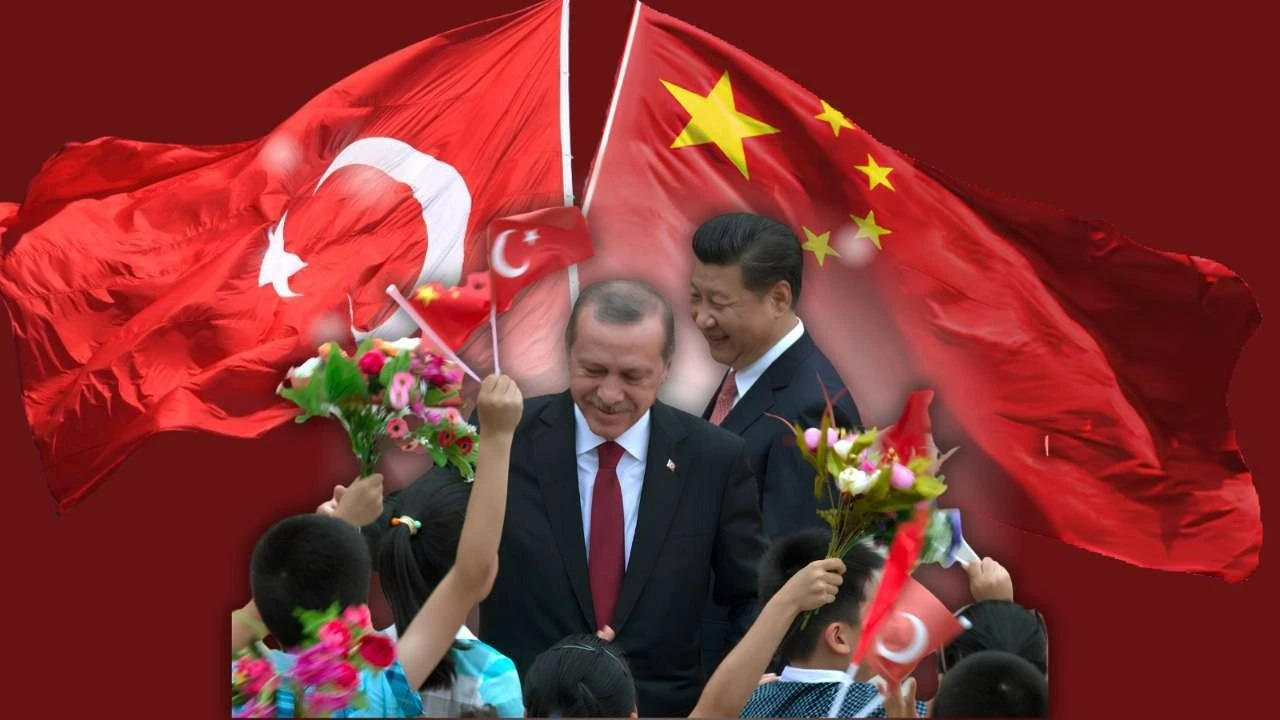
(The article was prepared within the framework of the "Authoritarian Regimes and Transregional Influence Mechanisms" research of the KHAR Center)
Introduction
China's influence operations directed at Türkiye have increased significantly. These activities have long since outgrown the framework of official bilateral relations and the Maoist-leftist line associated with Doğu Perinçek, which promotes traditional pro-China sentiment. They have reached an unprecedented level in both frequency and scope. Beijing is conducting a broader propaganda effort that includes right-wing, nationalist, and Islamist opposition parties, the media, civil society institutions, and diplomatic and academic circles. China's ambassador in Ankara holds constant meetings with representatives from these sectors, and delegations are regularly taken from Türkiye to China. The Turkish media publishes articles by the Chinese ambassador and pieces filled with "positive impressions" from these visits.
One of the main goals in this new phase of China's influence operations in Türkiye is actually an old one: the Uyghur issue. Türkiye is one of the countries with the largest Uyghur diaspora in the world. In recent years, Ankara's official policy has been shaped by a desire not to upset relations with China, and so it avoids making the Uyghur issue a major focus. At the same time, there is a certain sensitivity in Turkish society regarding the Uyghur problem. The Turkish government also takes this sensitivity into account at certain points, while also keeping it at its disposal as a balancing element against China. Thus, Ankara does not raise the Uyghur issue loudly in order not to damage its relations with China, but unlike most Muslim countries, it also does not unquestioningly accept or support Beijing's official narratives on the matter. This also makes Türkiye a strategic target in China's eyes.
On the other hand, like Russia, China sees Türkiye's effort to turn its strategic position in relations with the West into political leverage as one of the windows of opportunity in its global competition with the U.S. Calls for a "return to the China-Russia line," which have seeped into the Nationalist Movement Party—a key proponent of the traditional anti-China-Russia stance in Türkiye and a current ruling coalition partner—also indicate that Beijing is trying to turn this opportunity to its advantage.
In this study, the KHAR Center analyzes China's influence policy toward Türkiye, the new elements of this policy, and its goals.
Key Questions of the Study
How has China's influence policy toward Türkiye changed in recent years? Which actors and tools is Beijing using to expand its influence operations in Türkiye?
THREE FACTORS MAKING TÜRKİYE A TARGET
Türkiye has become a target of Beijing's influence operations for three key reasons that China considers strategically important.
The Uyghur Problem
The first of these is the large and politically active Uyghur diaspora. Shared ties of language, religion, history, and culture have made Türkiye one of the main refuges for Uyghurs fleeing repression. Türkiye hosts the largest Uyghur diaspora in the world outside Central Asia. Approximately 50,000 Uyghurs live in Istanbul, Ankara, Kayseri, and Izmir (Altay, 2026). The number is even higher when including Uyghurs who arrived in recent years and obtained Turkish citizenship. After China stepped up its efforts to suppress news about East Turkestan, the Uyghur diaspora in Türkiye became a critical source. Uyghurs living in Türkiye play a crucial role in documenting and communicating to the world the abuses in East Turkestan, such as arrests, forced labor, family separation, and cultural genocide (Altay, 2026).
For Beijing, one of the main goals in Türkiye is to weaken the political and informational influence of the Uyghur diaspora, to limit the spread of news and campaigns about the situation in Xinjiang, and to keep Türkiye's official position as low-profile as possible.
This brings to light another of China's goals—regional legitimacy. Türkiye is a country with significant political and public weight, both in the Turkic world and among Muslim nations. This is particularly important for Beijing on the Uyghur issue. The fact that a country with a religious and ethnic affinity for the Uyghurs like Türkiye maintains relations with China and takes a softer line on the Xinjiang issue indirectly legitimizes Beijing's narrative that "the Muslim world accepts China's policy." At the same time, the weakening of resistance to the Uyghur issue in Türkiye also makes it easier to defend Beijing's position in other Muslim countries.
Economic Asymmetry
The second main factor expanding China's influence in Türkiye is the asymmetric nature of their economic relations. While Türkiye has become one of China's major export markets, Ankara runs a persistent, large trade deficit with Beijing, its largest bilateral deficit. In August 2026, Türkiye's imports from China reached $4.7 billion. This represents approximately 16 percent of Türkiye's total imports for that month. Türkiye is heavily dependent on Chinese production, especially in strategic sectors such as machinery and equipment, electronics, intermediate goods, solar energy components, and increasingly, automobiles (Trading Economics, 2026).
This asymmetric economic relationship compels Türkiye to act more cautiously in its relations with China. On the one hand, Ankara avoids taking a hard political line against Beijing. On the other hand, it is also trying to partially offset the trade deficit by attracting Chinese investment and increasing local production. However, this strategy also has its limitations. This was demonstrated by the recent incident involving the planned BYD factory, one of China's electric vehicle brands, in Türkiye. In 2024, it was announced that BYD would build a plant in Manisa, Türkiye, with a production capacity of 150,000 vehicles. However, by 2026, no progress had been made in this regard, and earlier this year, the Turkish government stopped the company from using its investment incentives. Although the investment agreement officially remains in effect, the project's future remains uncertain (AA, 2026). This development is particularly notable against the backdrop of BYD's expansion of its manufacturing network in Europe. The company is considering its second production site in Europe after its first establishment in Hungary (Reuters, 2026), yet it has made no visible effort to advance the project in Türkiye.
Although Türkiye signed the Belt and Road Initiative (BRI) agreement with China in 2015, it ranks only 23rd out of eighty countries that have received Chinese investment. The investment Türkiye received in 2020 under this agreement accounted for only 1.31 percent of the total investment made through the BRI (Ülgen and Umarov, 2024). Between 2014 and 2024, China's direct capital investments in Türkiye amounted to approximately $8.4 billion. However, in 2026, Chinese capital accounted for only 0.6 percent of Türkiye's total stock of foreign direct investment. Currently, China ranks 24th among foreign investors. This indicates that despite significant trade relations with China, the level of investment remains low (Erol, Gökten and Şahin, 2026).
According to the Turkish Investment and Finance Office, approximately 1,500 Chinese-capitalized companies operate in the country, and since 2002, the total volume of Chinese investments has exceeded $5 billion (Investment and Finance Office, 2026). However, the weight of Chinese capital in the Turkish economy is still very small compared to European and other Western investments. This illustrates the main paradox in Ankara–Beijing economic relations. Türkiye's dependence on Chinese goods is rapidly increasing, but the long-term presence of Chinese capital in Türkiye for manufacturing and investment is not growing at the same pace.
Türkiye's Strategic Autonomy Initiatives
A third factor increasing China's influence in Türkiye is the more strained nature of the relationship between Ankara and the West in recent years. This is also directly related to the second factor. Türkiye is situated within the structural architecture of the West in political, economic, and security terms, and since its NATO membership, it has traditionally been aligned with Western countries. However, in recent years, significant deviations have emerged in this foreign policy direction. Seeking "strategic autonomy" in its foreign policy, Ankara is trying to increase its maneuvering room by remaining within the Western security system while also warming relations with powers opposed to this system, such as China and Russia (KHAR Center, 2025). China's rise as an economic power, and its role in multilateral groupings such as BRICS and the Shanghai Cooperation Organization, are additional arguments that increase Ankara's motivation in this direction. Ankara strongly expects that expanding relations with China will bring opportunities and additional resources to accelerate the country's economic development (Ülgen and Umarov, 2024).
On the other hand, the shift in Türkiye, a country with a long tradition of suspicion toward China, and the growing sympathy for Beijing over recent years are also directly linked to the rise of anti-Western sentiment. Although China's official media outlets, Confucius Institutes, and the popularity of Chinese cuisine in Türkiye attract little attention, the narrative that Beijing is a power balancing US hegemony has a significant impact on the public (Üngör, 2022). In Türkiye, anti-Americanism runs deeper than any political or ideological divide. Although the government's recent warming with the U.S. administration has reduced the visible signs of this antagonism, anti-Americanism across nearly all segments continues to shape society's thinking on foreign policy. While the Erdoğan government praises China for its rivalry and diplomatic confrontation with the West, the secular opposition in the country also lauds China's anti-imperialist identity. Thus, China's recent appeal to Turkish society is also tied to the idea that it could become a global power to challenge the U.S. in the future.
For this reason, Ankara rejects the West's policy of de-risking and even decoupling from Beijing; instead, it sees deepening ties with China as an alternative should communication with the West become blocked. This creates a favorable political and ideological ground for Beijing. Narratives promoted by China, such as a "multipolar world," "strategic sovereignty," "de-Westernization," and "alternative development models," overlap at certain points with Türkiye's own discourse on strategic autonomy. As a result, Chinese narratives can be presented to the Turkish audience not as entirely foreign ideological theses, but as arguments that align with Ankara's own foreign policy language (Mankoff and Bergmann, 2025).
CHINA'S NEW PROPAGANDA STRATEGY IN TÜRKİYE
China's influence activity directed at Türkiye is not new, but for a long time it was limited by narrow ideological frameworks. Chinese radio broadcasts in the Turkish language began as early as 1957 under the name "Radio Peking." Later, this effort continued through China Radio International (CRI Turk). However, these channels have not been able to reach a wide audience in Türkiye (Üngör, 2022).
Until the 2000s, Türkiye lacked a strong social base to convey Beijing's messages to the local audience. Since the 1970s, the main actor in China's influence operations in Türkiye has been Doğu Perinçek and the Maoist-Eurasian circle around him. This circle spread narratives in Türkiye that framed China's Uyghur policy as a response to "separatism" and "counterterrorism," and portrayed the West's use of human rights as a political tool against Beijing (Altay, 2026). However, because these Maoist-Eurasian circles lacked a serious social base in Turkish society, and suspicion of China also persisted in NATO member Türkiye, Beijing's narratives were not very effective.
Approaching the Government
After recognizing these weaknesses, China made adjustments to its strategy regarding Türkiye. In implementing this strategy, it has sought to adapt to Türkiye's complex domestic conditions and to reach every political pole. In the first phase, China made efforts to warm relations with the official Ankara and succeeded to a certain extent. In this regard, Türkiye's contradictory and shifting position on the Uyghur issue worked in China's favor.
Unlike Beijing's allies in the Muslim world, Türkiye does not automatically accept China's policy of denying problems related to the Uyghurs. On the contrary, it states that it defends the rights of the Uyghur Turks to religion, language, and culture, and says it openly raises these concerns with Beijing (AA, 2024). However, the evolution of this policy shows how far China can influence Ankara's approach to the Uyghurs. In 2009, Ankara reacted most strongly to the ethnic violence against Uyghurs in Urumqi and the Chinese state's widespread repression. At that time, Prime Minister Recep Tayyip Erdoğan, who claimed to be the voice of Muslims and Turks worldwide, called China's behavior ethnic genocide and demanded an end to the repression of the Uyghurs (AA, 2009). However, this rhetoric changed in 2011—coinciding with the early years of Türkiye's period of economic rapprochement with China. Ankara's reaction to the violence in Kashgar and Hotan was limited to diplomatic statements such as "Peace and stability must be ensured." The sharpest turning point in this rhetoric came in 2015. In a statement before his trip to China, Recep Tayyip Erdoğan said that most of the reports about Beijing's pressure on the Uyghurs were not true. This occurred after protesters, demonstrating against Thailand's deportation of Uyghurs to China, attacked the Thai consulate in Istanbul (Hurriyet Daily News, 2015). Türkiye's radical turn was no coincidence: that same year, Türkiye joined China's Belt and Road Initiative, signing a memorandum of understanding on the Middle Corridor. At the same time, Sino-Turkish trade grew from approximately $1.4 billion in 2000 to $27.3 billion in 2015, and China became one of Türkiye's main sources of imports (Singh, 2016).
In 2017–2018, although reports on the international stage about China's mass detentions, "re-education" centers, and assimilation policy in Xinjiang increased, Ankara chose to remain silent on them. In 2019, the official Turkish language hardened again, as Foreign Ministry spokesperson Hami Aksoy stated that more than one million Uyghur Turks were subjected to torture and political brainwashing in camps and prisons. The Foreign Ministry spokesperson stressed that this systematic assimilation by China is a great shame for humanity (HRW, 2019). However, in the subsequent period, Türkiye reverted to diplomatic language, and after 2020, a warming in relations with China caused the Uyghur issue to take a back seat. The extradition treaty signed between China and Türkiye in December 2017, which came into force in China in 2020, has increased Uyghur concerns. However, Ankara has rejected claims that this agreement would lead to the extradition of Uyghurs (Al Jazeera, 2021). In the fall of 2022, Türkiye supported a UN Human Rights Council report on the Uyghurs, but this was a much softer reaction than the "genocide" rhetoric of 2009. Nevertheless, at the end of 2022, Turkish Foreign Minister Mevlüt Çavuşoğlu stressed that relations with China had cooled due to Ankara's support for the Uyghurs and Beijing's concerns about it (AA, 2022). Foreign Minister Hakan Fidan's 2024 visit to China, however, can be seen as a search for a new formula on the Uyghur issue. Thus, in addition to Beijing, Fidan also traveled to Urumqi and Kashgar, visiting religious and historical sites, emphasizing the importance of economic ties, and stating that they discussed issues related to the Uyghurs with the Chinese government (Reuters, 2024). This marked a shift from the accusatory rhetoric against China in 2009 to a phase of managing the Uyghur issue by talking with China. This approach continues to this day.
China has included Türkiye on its list of "26 sensitive countries" that it uses to identify and punish Uyghurs with ties to a Muslim state. Since 2016, Beijing has interrogated, arrested, and punished Uyghurs in other ways, and has separated from their families those who study, work, or communicate with relatives in Türkiye. The situation for Uyghurs has become critical, especially since 2022, due to the warming of Türkiye's relations with Beijing and a change in its refugee policy. Ankara has applied a "threat to state security" code to many stateless Uyghurs without giving any reason, with serious consequences for them. International protection is denied; Uyghurs whose residency permits are revoked are automatically placed on a "blacklist" and sent to China (HRW, 2025).
The Law on Promoting Ethnic Unity and Progress, adopted by the National People's Congress of China on March 12, 2026, and taking effect on July 1, 2026, heightens concerns that this process could become even more severe for Uyghurs. Article 63 of the law, which aims to homogenize China's peoples around the Mandarin language, targets "separatist" activities outside China's borders, and stipulates that individuals engaged in acts aimed at "ethnic unity and prosperity" will be tried under Chinese national law (Yu Chen-Cheng, 2026). This authoritarian practice of legalizing transnational repression could facilitate the "hunting" of Uyghur activists, especially if the Turkish Grand National Assembly ratifies the pending extradition law (Cagaptay and Peterson, 2026).
Localization of Propaganda
Another change China has made in its Turkish policy is the localization of public opinion. Beijing has begun to deliver its messages through more local and credible channels via Turkish journalists, media outlets, academics, and public actors. It has sought to adapt to the local conditions of the Turkish media, taking advantage of its warm relations with Ankara. The Turkish government, with its strong influence over the media, provided new platforms for China to carry out its soft power objectives. This also served Ankara's interests, since Ankara needed to portray Beijing positively in order to dispel public skepticism about joint projects with China. The closer ties between the Perinçek group, China's main point of reference in Türkiye, and Eurasian circles with the government after the 2016 FETÖ coup attempt also worked in Beijing's favor in this process. Eurasianists have played a significant role in the increased presence of Chinese narratives in mainstream media and on social networks, leveraging their closer ties with the government. Outlets such as "Aydınlık," "Ulusal Kanal," "Oda TV," and "Yön TV" continue to serve as the main carriers of Chinese narratives. These outlets and figures affiliated with Perinçek's Homeland Party frame China's activities regarding East Turkestan as a "fight against terrorism," the activism of the Uyghur diaspora as "separatism," and the opinions of international human rights organizations as "Western geopolitical manipulation" (Altay, 2026).
Leveraging the Sympathies of the Turkish Left
China's new propaganda architecture in Türkiye is not limited to the government and its allies. Leftist circles, long influential in Türkiye's mainstream media, also hold a special place in this Chinese strategy. These groups, which span a broad spectrum from Maoist-Eurasianists to Marxists and Kemalist republicans, are sympathetic to China due to its anti-imperialist rhetoric and traditional anti-Western sentiment. Perinçek's propaganda, especially during the Covid-19 crisis, has provided material for the positive portrayal of China among Turkish leftists. Institutions such as the newspapers "Cumhuriyet" and "Birgün," the T24 website, and the "Kırmızı Kedi" publishing house have played a key role in this. Through the promotional articles it distributed in Türkiye's mainstream, pro-government, and left-wing newspapers, China has gained access to a much wider audience than the Perinçek group ever could. Moreover, this support was not limited to the media; in academic circles as well, leftists supported Chinese propaganda (Üngör, 2022).
Sponsored Propaganda
Since 2015, Beijing has organized visits to Xinjiang for the world media, including Turkish journalists. The Turkish journalists returned from these trips with narratives that praised China. For example, in contrast to Olsi Jazexhi, who participated in a 2017 trip and wrote that his impression was "they wanted us to sell a fake story to the world," Murat Yılmaz, a writer for Türkiye's Hürriyet newspaper, wrote two articles praising China's development (The Guardian, 2020). In subsequent years, China increased the number of Turkish journalists participating in these trips. The fact that the Xinjiang tours, which intensified especially after 2019, have been organized separately for Turkish journalists and experts since 2024 shows how satisfied Beijing is with this strategy. The articles and news reports from these journalists claimed there was "unity, harmony, and prosperity" in Xinjiang, while human rights violations were not mentioned at all. Thus, instead of saying "there is no problem in Xinjiang" in the language of its own state media, China is now propagating this message through Turkish journalists and experts (Kerimu, 2024).
In 2025, cooperation with China in the media and strategic communication sector was elevated to an official, institutional framework. The Presidency Communications Directorate organized the first Türkiye-China Media Forum in Ankara (Presidency Communications Directorate, 2025). Following this, the Chinese ambassador also gained direct access to various audiences in Türkiye. For example, in May 2026, his article on youth and Türkiye-China friendship was published in the "Cumhuriyet" newspaper. The Chinese ambassador's article praising the Chinese Communist Party was also published anonymously in the pro-government newspaper "Sabah" as propaganda (Chinese Embassy, 2026). Only after the scandal broke was it acknowledged that the ambassador had written it. The fifth volume of Xi Jinping's book was also promoted on the pro-AKP channel "A Haber" (A Haber, 2026).
At the same time, journalists regarded as opposition figures, such as İsmail Saymaz, Özlem Gürses, Türker Ertürk, Mehmet Ali Güller, Zeynel Lüle, Çiğdem Akdemir, and Cangül Örnük, were taken on a sponsored trip to Xinjiang. Writings by these individuals, aligned with China's strategy, were published in media outlets such as "T24," "Habertürk," and "Sol" (Akçay, 2026).
Approach to Nationalist and Conservative Parties
Another changing aspect of China's strategy toward Türkiye is the expansion of its political engagement spectrum. Whereas in the past, Beijing limited these contacts to the government and Eurasianist allies, it has expanded the "front" in the last two years, in particular. Undoubtedly, the behavior of the Turkish opposition in recent years has also played an important role in this. Whereas until 2015-2016 the Uyghur issue in Türkiye could be mobilized within nationalist and Islamist circles, the exact opposite is now the case. A large part of the same Islamist and nationalist circles have adopted the government's rapprochement policy toward China, and as a result, the Uyghur issue has lost its place on the Turkish public's agenda (Yıldırım, 2024).
Nurettin Akçay, an expert on China, says that Türkiye is a strategic country in terms of Beijing's influence operations, noting that Beijing has intensified this process, especially in the last two years: "This activity has increased to an extreme degree, especially after the appointment of the last Chinese ambassador. All propaganda activities have been unified under the embassy's organization. In the 18 months since the ambassador took office, he has held 210 official meetings. That's almost a meeting every other day. This is an incredible number. There are two explanations for such intensive activity—either there is a problem, or you are trying to shape public opinion to resolve an issue. China is monitoring Türkiye with incredible attention. There are five Türkiye research centers in China. These centers publish reports on Türkiye's politics, economy, and political structure. Türkiye's interest in China, however, is very limited." (YouTube, İstihbarat Raporu channel, 2026).
China has not limited its propaganda to the Nationalist Movement Party, which promotes "warming up with China and Russia," but is developing influence operations across the Turkish political spectrum. In June of this year, Liu Haisin, head of the International Department of the Central Committee of the Chinese Communist Party, received a multi-party parliamentary delegation from Türkiye in Beijing. The delegation included representatives from AK Party, DEM Party, IYI Party, DEVA, Gelecek Partisi, Saadet Partisi, Yeniden Refah, and TİP. During the meeting, the Chinese side explicitly proposed expanding relations with various Turkish political parties, as well as incorporating media, think tanks, local governments, and public organizations into these ties through a "political party+" model (Socialist China, 2026).
China has also recently established ties with right-leaning parties in Türkiye. Invitations, meetings, and visits have been organized with nationalist-conservative organizations such as Saadet, Yeniden Refah, Zafer, Gelecek, and DEVA. Expert Nurettin Akçay explains the motivation as follows: "China establishes contacts with the ruling party and its allies, thereby distancing them from a radical approach to the Uyghur issue. There is no problem here. The motivation for relations with opposition parties is their comfort with being in opposition. In other words, these parties have the comfort of knowing that "the statements I make won't harm the relations anyway." China aims to deliver its messages in their language to their electorate. At the same time, it wants to prevent radical campaigns against itself. The main goal, however, is to make people forget the Uyghur issue" (Middle East Eye, 2026).
CHINA'S KEY INFLUENCE ACTORS
China has been operating with a large propaganda arsenal in Türkiye, especially in the last two years. Behind this arsenal are special bodies of the Chinese state and the Chinese Communist Party. The United Front Work Department (UFWD), which operates under the Chinese Communist Party, determines the propaganda strategy. Within this system, entities such as the China Peaceful Reunification Promotion Council (CPPRC), as well as the China People's Association for Friendship with Foreign Countries (CPAFFC), which operates in the broader "people-to-people diplomacy" sphere, play a role in political and diaspora affairs, local governance, and public relations (Altay, 2026).
Nurettin Akçay states that the entire strategy is determined by the United Front Department and delegated to subordinate mechanisms: "Those mechanisms (e.g., embassies) also identify the target individuals. Those individuals are taken to China, shown around, and all their expenses are paid. They are shown the side of the country that Beijing wants. Then these individuals return and shape the opinion that China needs," he says. "China also knows that it can't change opinions just by flying in two journalists and having them write an article. But it sees this as a long-term project. It believes that the people taken to China have a positive impact on their close circles. It also forms groups loyal to it through disinformation. Through these groups, it aims to prevent systematic campaigns in Türkiye related to the Uyghurs." (YouTube, İstihbarat Raporu channel, 2026).
The main institutional channel for relations with political parties is the International Department of the Central Committee of the Chinese Communist Party (IDCPC). This entity establishes direct relationships with foreign political parties and serves as the main counterpart for representatives of Turkish parties with different ideological lines during their visits to China in recent years (IDCPC, 2025).
One of the key actors in the media and information sector is the China Media Group (CMG). CMG, which unites state media outlets such as CCTV, CGTN, and China National Radio, also directly participates in media cooperation with Türkiye. At the first Türkiye-China Media Forum held in Ankara in 2025, CMG was one of the main institutions representing the Chinese side.
Confucius Institutes serve as China's main academic and cultural influence actor worldwide. These institutes have been established in Türkiye at ODTÜ, Boğaziçi, Istanbul Okan, and Yeditepe universities. In addition to teaching the Chinese language and culture, they establish academic ties with Chinese universities, scholarship and student exchange programs, events with the Chinese embassy and consulates, as well as, in some cases, business and economic cooperation platforms. However, the propaganda influence of the Confucius Institutes in Türkiye is not very strong. According to Çağdaş Üngör, who evaluates China's influence activities in Türkiye, the more effective part of this influence stems not from classic soft power tools, but from the relationships it has built with local political and media actors and the ideological convergence created by an anti-Western/multipolarity discourse (Üngör, 2022).
Among China's local influence actors in Türkiye, the main role is played by the Türkiye-China Friendship Foundation. Meetings of politicians with the Chinese ambassador, and visits by delegations from political parties, media, business, and academic circles to China, are organized by this foundation, of which Hasan Çapan is the chairman and former ambassador Ersin Erçin is the vice chairman (Türkiye-China Friendship Foundation, 2026). Hasan Çapan is also the head of the New World Research Center, which conducts Chinese propaganda in Turkish. One of this center's main tasks is to take media delegations to East Turkestan and produce narratives that deny claims related to the Uyghurs. These narratives are then circulated by Chinese media as "international opinion." Çapan also manages "CGTN Türk," the Turkish broadcasting arm of the China Global Television Network (CGTN). Broadcast on more than 30 frequencies in Türkiye, CGTN Türk is the Turkish-language department of the China Media Group, which is affiliated with the Central Propaganda Department of the Chinese Communist Party (Altay, 2026).
Mehmet Akfırat, chairman of the Türkiye-China Business Development and Friendship Association, is also one of Beijing's most active influence actors in Türkiye. Akfırat, who is also represented in the Homeland Party, is the official representative in Türkiye of the Silk Road Think Tanks Association, established by the Central Committee of the Chinese Communist Party. His association signed an official cooperation agreement earlier this year with the paramilitary Xinjiang Production and Construction Corps (XPCC), one of the main centers of pressure in East Turkestan. Akfırat typically leads business delegations from Türkiye to China and is directly involved in campaigns to discredit reports of systematic pressure on Uyghurs (Altay, 2026).
China also implements a policy of supporting certain individuals selected from among the Uyghurs to legitimize its repression. The most important example of this strategy in Türkiye is Sabir Boğda, the founder of the Uyghur Industrialists and Businessmen Association. Boğda specifically organizes and promotes ties between the Turkish business world and the Xinjiang leadership. At the same time, he denies the pressure against Uyghurs and openly engages in Chinese propaganda. This is of particular importance to Beijing (Altay, 2026).
Another Chinese influence actor in Türkiye is İhsan Başer, the head of the Türkiye-China Business Development Support Association. Başer's association is a China-accredited entity operating in Türkiye. This association serves as a communication infrastructure that connects China's diplomatic, commercial, and political actors with Türkiye's business world and state institutions. Başer's association also operates the "TurkiyeChinaNews" website, which reproduces and republishes content from Chinese state media as unsourced, Turkish-language reports. This site also spreads Chinese narratives about East Turkestan and seeks to legitimize systematic pressure against Uyghurs (Altay, 2026).
During the 2025–2026 period, another notable change is that Beijing is not limiting itself to Ankara's political and media elites but is descending to the local level. Chinese Ambassador Jiang Xuebin has traveled to various cities, meeting with representatives of local government, universities, businesses, and the public. In April 2026, he visited Van Yüzüncü Yıl University and various city institutions; in September, during a trip to Batman, he discussed cooperation in industry and tourism with the governorate and local political and business circles (AA, Batman Governorate, 2026).
Parallel to this activity, Turkish public opinion, which has long been skeptical of China, has also shown certain changes. According to a Pew Research Center study, in 2024, the share of those in Türkiye with a positive view of China was 26 percent, while the share of those with a negative view was 64 percent. The positive view rose to 35 percent in 2025 and to 43 percent in 2026. The 2026 survey notes that positive views of China in Türkiye reached or came close to a historical high for the period surveyed (Pew Research Center, 2026).
CONCLUSION
The landscape of the last two years shows that China's influence policy in Türkiye differs from the previous phase in both scale and methods. Beijing no longer relies solely on classic propaganda actors and its traditional supporters in Türkiye. Beijing's new strategy targets representatives from across the political spectrum, including media, political parties, business, academia, and local governance. Sponsored trips, platforms provided by proximity to the Turkish ruling party, the use of local media actors in propaganda, and direct contacts with political parties represent the main instruments of recent Chinese influence operations. The Chinese embassy in Türkiye and pro-China business circles in Türkiye serve as key mechanisms in this division of labor.
Undoubtedly, problems in Türkiye's relations with the West, expectations of a multipolar world, and the prevalence of a perception in public opinion that sees China as a possible alternative to U.S. hegemony have also influenced this trend. However, these factors are themselves among the gaps that China uses in its influence activities. As a result, China has achieved significant success in its most important objective in Türkiye: changing the narrative on the Uyghur issue. In Türkiye, the Uyghur issue has lost its previous prominence, and the Uyghur diaspora is facing the threat of not only deportation but also discrediting. Reports about China's systematic policy of repression in East Turkestan have become "invisible" in the Turkish media and public opinion. Even visible news can be easily "neutralized" by China's influence actors in the media, business, and politics. On the other hand, China has also made significant progress in its goal of becoming one of the main Western alternatives in Türkiye. This progress is not fully captured by statistics, but statistics are not what matters most to Beijing. Beijing has managed to strengthen its image as a "global economic power to rival America" by using the anti-Western sentiment in public opinion as a foundation.
Note: The article you have read was originally written in the Azerbaijani language. Artificial intelligence tools were used only in the translation.
REFERENCES
Altay, Erk, 2026. China's Influence Infrastructure in Türkiye: United Front, Economic Leverage, and the Uyghur Rights. https://www.uyghurrightsmonitor.org/2026/07/09/chinas-influence-infrastructure-in-turkiye-united-front-economic-leverage-and-the-uyghur-rights/
Trading Economics, 2026. Turkey Balance of Trade. https://tradingeconomics.com/turkey/balance-of-trade
Anadolu Agency, 2026. Statement from the Ministry of Industry and Technology on BYD. https://www.aa.com.tr/tr/ekonomi/sanayi-ve-teknoloji-bakanligindan-byd-aciklamasi/3962938
Reuters, 2026. BYD Will Eventually Need Three Assembly Plants, One Battery Factory in Europe, Adviser Says. https://www.reuters.com/world/china/byd-will-eventually-need-three-assembly-plants-one-battery-factory-europe-2026-09-16/
KHAR Center, 2025. The Paradox of Strategic Autonomy: The KAAN Project and the Limitations of Turkey's Defense Industry Model https://kharcenter.com/arasdirmalar/strateji-muxtariyyetin-paradoksu-kaan-layihesi-turkiyenin-mudafie-senayesi-modelinin-mehdudiyyetleri
Ülgen, Sinan and Umarov, Temur, 2024. Transatlantic Policies on China: Is There a Role for Türkiye? https://carnegieendowment.org/research/2024/10/transatlantic-policies-on-china-is-there-a-role-for-turkiye?center=middle-east
Erol, Mehmet Erman; Gökten, Kerem and Şahin, Çağatay Edgücan, 2026. Beyond False Dichotomies: Chinese Investments and the Reproduction of Neoliberal Authoritarian Developmentalism in Turkey. https://www.tandfonline.com/doi/full/10.1080/14747731.2026.2727746
Investment and Finance Office, 2026. Investment and Finance Office Marks 20th Anniversary with Beijing Reception. https://f.invest.gov.tr/en/news/news-from-turkey/pages/investment-and-finance-office-marks-20th-anniversary-with-beijing-reception.aspx
Üngör, Çağdaş, 2022. China Is Playing by Turkey's Media Rules. https://carnegieendowment.org/research/2022/11/china-is-playing-by-turkeys-media-rules?center=china
Mankoff, Jeffrey and Bergmann, Max, 2025. Strategic Ambiguity: Erdoğan's Turkey in a Multipolar World. https://www.csis.org/analysis/strategic-ambiguity-erdogans-turkey-multipolar-world
Anadolu Agency, 2024. Economic Relations, Global Issues, and the Situation of Uyghur Turks Featured in Fidan's China Talks. https://www.aa.com.tr/tr/politika/fidan-in-cin-temaslarinda-ekonomik-iliskiler-kuresel-meseleler-ve-uygur-turklerinin-durumu-one-cikti/3241169
Anadolu Agency, 2009. Turkey's Premier Calls Incidents in China Genocide. https://www.aa.com.tr/en/archive/turkeys-premier-calls-incidents-in-china-genocide/427448
Hürriyet Daily News, 2015. Reports on Chinese Practices in Xinjiang Largely Inaccurate, Says Turkey's Erdoğan. https://www.hurriyetdailynews.com/reports-on-chinese-practices-in-xinjiang-largely-inaccurate-says-turkeys-erdogan-85247
Singh, Michael, 2016. Is Turkey Pivoting to China? https://www.washingtoninstitute.org/policy-analysis/turkey-pivoting-china
HRW, 2019. Turkey Calls Out China's Repression of Uyghurs. https://www.hrw.org/news/2019/02/14/turkey-calls-out-chinas-repression-uyghurs
Al Jazeera, 2021. Turkey raises Uyghur issue with China as hundreds protest. https://www.aljazeera.com/news/2021/3/25/turkey-says-conveyed-sensitivity-about-uighurs-to-china
Anadolu Agency, 2022. China's Unease over Turkey's Support for Uyghurs Has Hurt Ties: Foreign Minister Çavuşoğlu. https://www.aa.com.tr/en/turkiye/chinas-unease-over-turkiyes-support-for-uyghur-has-hurt-ties-foreign-minister-cavusoglu/2775432
Reuters, 2024. Turkey Told Beijing It Wants to Boost Agricultural and Food Exports to China, Turkish Source Says. https://www.reuters.com/markets/commodities/turkey-told-beijing-it-wants-boost-agricultural-food-exports-china-turkish-2024-06-05/
HRW, 2025. Protected No More: Uyghurs in Turkey. https://www.hrw.org/report/2025/11/12/protected-no-more/uyghurs-in-turkiye
Yu Chen-Cheng, 2026. China's Law on Promoting Ethnic Unity and Progress and Extraterritorial Jurisdiction https://opiniojuris.org/2026/07/22/chinas-law-on-promoting-ethnic-unity-and-progress-and-extraterritorial-jurisdiction/
Cagaptay, Soner and Peterson, Ela. Throwing Water on Turkey's Warming Ties with China. https://www.washingtoninstitute.org/policy-analysis/throwing-water-turkeys-warming-ties-china
The Guardian, 2020. How China Uses Muslim Press Trips to Counter Claims of Uighur Abuse. https://www.theguardian.com/world/2020/aug/23/how-china-uses-muslim-press-trips-to-counter-claims-of-uighur-abuse
Kerimu, Aynur, 2024. Turkish Journalists Are Now 'Telling the Xinjiang Story Well' for Beijing. https://jamestown.org/turkish-journalists-are-now-telling-the-xinjiang-story-well-for-beijing/
Presidency Communications Directorate, 2025. CMG Attended the First China-Turkey Media Forum, New Cooperation Paths Focused on Technology Were Discussed. https://www.iletisim.gov.tr/turkce/dis_basinda_turkiye/detay/cmg-ilk-cin-turkiye-medya-forumuna-katildi-teknoloji-odakli-yeni-is-birligi-yollari-ele-alindi-cin
Chinese Embassy, 2026. Inter-party Relations Strengthen the Foundations of Bilateral Relations. https://tr.china-embassy.gov.cn/tur/sgxw/202607/t20260706_11976011.htm
Akçay, Nurettin, 2026. X post. https://x.com/akcay_nurettinn/status/2084874869590708650
A Haber, 2026. X post. https://x.com/ahaber/status/2072384879526867303
Yıldırım, Eliküçük Nilgün, 2024. The Uyghur Issue in Turkish-Chinese Relations. https://tr.boell.org/tr/2024/04/05/turkiye-cin-iliskilerinde-uygur-meselesi
YouTube, İstihbarat Raporu channel, 2026. How Do China's Public Diplomacy Networks in Turkey Work? | https://www.youtube.com/watch?v=MstwgBjd-FA
Euronews, 2026. MHP's Topsakal on the 2028 Elections: "Not Ministries, but Partnership with Russia and China is Essential." https://tr.euronews.com/2026/04/10/mhpli-topsakaldan-2028-secimleri-aciklamasi-bakanliklar-degil-rusya-ve-cin-ile-ortaklik-sa
Friends of Socialist China, 2026. Multi-Party Delegation from Turkey Visits China. https://socialistchina.org/2026/06/24/multi-party-delegation-from-turkiye-visits-china/
Middle East Eye, 2026. China Steps Up Propaganda Blitz in Turkey amid Fallout from BYD Debacle. https://www.middleeasteye.net/news/china-steps-propaganda-blitz-turkey-amid-fallout-byd-debacle
International Department of the CPC Central Committee, 2025. Jin Xin Meets with a Delegation of the Patriotic Party of Turkey. https://www.idcpc.gov.cn/english2023/lldt/202507/t20250709_167245.html
Türkiye-China Friendship Foundation, 2026. Xinjiang Trip: Assessments from the Delegation Members. https://turkcindostlukvakfi.org.tr/xinjiang-gezisi-heyet-uyelerinden-degerlendirmeler
Anadolu Agency, 2026. People's Republic of China Ambassador to Turkey Jiang Xuebin Makes Visits in Van. https://www.aa.com.tr/tr/gundem/cin-halk-cumhuriyeti-ankara-buyukelcisi-jiang-xuebin-vanda-ziyaretlerde-bulundu/3912388
Batman Governorate, 2026. Ambassador of the People's Republic of China to Ankara, Jiang Xuebin, Visited Our Governorate. https://batman.gov.tr/cin-halk-cumhuriyeti-ankara-buyukelcisi-jiang-xuebin-valiligimizi-ziyaret-etti
Pew Research Center, 2026. Global Views of China 2026: Topline. https://www.pewresearch.org/wp-content/uploads/sites/20/2026/07/pg_2026.06.15_global-views-china-2026_topline.pdf
