(The article was prepared within the framework of the KHAR Center’s research "Russia’s mechanisms of influence in post-Soviet countries")
Introduction
Georgia is one of the most paradoxical examples in terms of Russia's policy of influence in the post-Soviet space. Until recent years, Georgia was one of the pioneers of integration into the West in the post-Soviet space, defining membership in European and Euro-Atlantic alliances as its main goal, and for this reason, had its territories occupied by Russia; yet, it has rapidly turned to Moscow, especially after 2022. The "Kremlin laws" adopted by the ruling "Georgian Dream" party, the toughening rhetoric against the West, and the pressure on civil society have effectively suspended the European integration process. The US and the European Union, Western-funded non-governmental organizations, and the pro-Western opposition have begun to be characterized as actors posing a threat to the country's sovereignty and security.
Unlike its close neighbor Armenia, the main role in spreading and strengthening the narratives serving to form this perception in Georgia is played not by the opposition or individual groups, but precisely by the ruling political elite. The greatest risk lies exactly here—the "island of freedom" of the South Caucasus is turning into a testing ground for Kremlin propaganda by the hands of the government. As a result, Kremlin narratives are legitimized as part of the local political discourse and gain the opportunity to influence wider audiences.
The purpose of this research by the KHAR Center is to analyze the Georgian paradox of Russia's policy of influence in the post-Soviet space, and to answer the question: how has Moscow been able to expand its capabilities of influence in this country again in recent years, despite the fact that part of Georgia's territories is under Russian occupation and the large majority of the society supports integration into the West?
FROM A "FAMILIAR STRANGER" TO A PROPAGANDA PARTNER - GEORGIA’S NATIONAL IDENTITY CRISIS
For Russia, Georgia is not just any country whose geography it seeks to expand at the expense of its territories, nor is it a state of strategic importance simply because it has access to the Black Sea. The boundaries of the Kremlin's interest in this country are larger than the geography it occupies, and its reasons are more fundamental. These reasons include the desire to maintain control over its former empire, the security concerns created by the advance of the EU and NATO towards Russia's borders, the concern to preserve its great power status, and the need to protect its own regime by ensuring that democracy does not become contagious in the region (Gente, 2023). For Moscow, the Georgia issue is part of its dominance in the post-Soviet space and its broader geopolitical rivalry with the West (Seskuria, 2021). Russia views Georgia as its "backyard" and assigns a significant role to this country in rebuilding its sphere of influence in the post-Soviet space (Gvelesaiani, Mölder, 2018).
Especially after the Ukraine war, this is of vital importance for Russia. From Moscow's perspective, Georgia's return to the Kremlin's orbit will demonstrate to former Soviet republics how foolish an act it is to try to escape Russia's influence. This, in turn, will help Moscow remain the main, and if possible, the sole influential force in its "near abroad" (Gente, 2023).
The country of "familiar strangers"…
Georgia's formation as a modern state took place in the shadow of the Russian Empire and later the USSR, which made Moscow the greatest threat to independence in the eyes of the people. For many years, the Georgian people have built their national identity upon belonging to the European society of democratic states and opposing Russian hegemony. Noe Zhordania, the leader of the first democratic republic, expressed this message in 1920 with the sentence: "Our life today and our path to the future are closely connected with the West without the need for any mediator, and no power can break this union" (Tsintsadze-Maass, 2025).
Although this bond with the West was broken by the Bolshevik occupation of the democratic republic in February 1921, the anti-Russian sentiments of the Georgian people continued during the Soviet era through periodic rebellions and opposition movements. One of the clearest demonstrations of this occurred in the late 1970s. The introduction of a requirement in 1975 to submit doctoral dissertations in Russian alongside Georgian, and the increase in the hours of Russian language classes in schools and institutes in 1976-78 caused protests in the country. Moscow's initiative to revoke the state language status of Georgian resulted in massive demonstrations in the country. In the face of pressure, the Soviet leadership retreated, and the status of the Georgian language was preserved (Jones, 2018).
Although Georgia was included in the same "nation-building" model as other union republics, a strong national political class, a distinct language, a memory of statehood, and local institutions existed here. In this regard, Erik Scott characterized Georgians as the "familiar strangers" of the Soviet Union. According to the author, although they made up a small part of the USSR population, they held a disproportionately visible and influential position in Soviet political, economic, and cultural life. They were both integrated into the center of the empire and retained their strong identity as a distinct national community. That is, they were inside and at the center of the empire, but they were not Russified (Scott, 2011).
In the late 1980s, the anti-Russian sentiments of Georgians strongly re-emerged, determining the country's post-independence national identity and foreign policy direction. This identity and direction were formed on the basis of a long-term national narrative presenting Russia as the main threat in Georgia (Tsintsadze-Maass, 2025).
After regaining independence in 1991, Georgia's foreign policy was largely shaped in accordance with its anti-Russian and pro-European national identity. Despite problems and criticisms during all administrations, EU and NATO membership remained the main goal and was even reflected in the constitution. Despite being much weaker than Russia economically and militarily and not receiving real security guarantees from the West, Georgia refused to rejoin the Moscow-led system during the early period of its independence. On the contrary, it was one of the few former Soviet republics that refused to join the CIS in 1991, turning to Western institutions for support. In other words, it prioritized maintaining political autonomy from Russia over economic and security risks (Tsintsadze, Maass, 2025).
Moscow, however, perceived this not as the geopolitical choice of an independent state, but as a challenge from a subject it considered to be within its legitimate sphere of influence. For this reason, by taking advantage of the nationalist government's rhetoric regarding ethnic minorities in the young Georgian republic, it was able to create regional conflict hotbeds (Stronski, Vreeman, 2017).
Under Moscow's influence, the Abkhazia and South Ossetia problems quickly turned from internal separatism into a much larger issue—conflict hotbeds that would last for many years. The emergence and survival of separatist forces in the 1990s would not have been possible without Russia's support; at the same time, the peace process that began in Georgia during the Shevardnadze era was also largely structured in the format dictated by Moscow. That is, Russia played the role of both the main patron of the separatists and the "mediator" and "peacekeeper" of the conflict it created by the hands of the separatists. This also gave it a long-term mechanism of influence over Georgia (Bartuzi, Strachota, 2008). Moscow used the separatist regions as a bargaining chip to influence Georgia's domestic politics and prevent the deepening of its ties with the West (Gressel, 2015).
The importance of this mechanism of influence became particularly prominent after the Rose Revolution, which resulted in the overthrow of Eduard Shevardnadze's government in 2003 and Mikheil Saakashvili's coming to power. Against the backdrop of Georgia strengthening its state institutions, expanding its ties with the West, and turning integration into NATO into an open strategic goal, the Abkhazia and South Ossetia conflicts became part of the struggle between Russia and the West over Georgia's future direction (Gressel, 2015).
"The firehose of falsehood"…
To restrict the activities of Georgia's democratic government, Moscow first began putting pressure on trade and transport sectors, tried to squeeze Tbilisi with embargoes, and at the same time launched a harsh campaign against Georgians living in Russia. The Kremlin's message to both those inside Georgia and Georgians living in Russia was clear—to change the Saakashvili administration in Georgia and form a government that would return to Russia's sphere of influence. According to Moscow's logic, Georgia could remain independent on the condition of rapprochement with Russia, but for this, it had to give up the NATO course and the alliance with the US (Trenin, 2006).
Saakashvili tried to simultaneously achieve two main goals: the integration of South Ossetia and Abkhazia into Georgia, and the integration of Georgia into the West. To this end, he aimed to turn the part of South Ossetia under Georgian control into a showcase of economic and social modernization. Saakashvili believed that this showcase would also encourage the Ossetians in Tskhinvali. At the same time, he was confident that his unprecedented reforms in the post-Soviet space would create strong support and security guarantees in the West. But he was wrong in both of his goals. First, South Ossetia had turned into a colony completely under the control of Russian security forces and Moscow's policies. On the other hand, although the West supported Saakashvili's reforms in statements, it had no intention of confronting Moscow for Georgia's sake. The Saakashvili administration saw this bitter truth in the 5-day war of 2008 (Gressel, 2015).
The 2008 war was not only a rehearsal for Russia's use of military force and an act of international impunity, but also one of the turning points in information warfare. In this war, the West not only failed to support Georgia but, on the contrary, fell under the influence of Russia's propaganda bombardment. The impact of this propaganda bombardment was so high that Moscow's disinformation even leaked into the EU's report (Gressel, 2015).
International experts point out that the 5-day war in 2008 was precisely the beginning of a new phase in the Russian propaganda approach. RAND researchers Christopher Paul and Miriam Matthews call the propaganda model applied by Russia in this war the "firehose of falsehood". The main features of this model are the dissemination of the same message from multiple channels in large volumes, rapidly, continuously, and repetitively, with a lack of commitment to objective truth and even to consistency among different messages (Paul, Mattews, 2016).
In the Georgia war, the "firehose of falsehood" looked like this—cyberattacks weakened Georgia's government websites and information capabilities, and Russia filled the resulting information vacuum with narratives such as Tbilisi having "started an unprovoked attack," Moscow defending the population of South Ossetia, and Georgia carrying out a "genocide" there (Modern War Institute, 2018). In this regard, the Georgian war was one of the important testing stages for the Russian information warfare model that would later appear more systematically in Crimea, Donbas, and other operations.
With the 2008 war, the Kremlin effectively occupied 20 percent of Georgia's territories. By recognizing the "independence" of South Ossetia and Abkhazia, it turned them into its colonies. However, despite this, the occupation did not lead to the Kremlin's main goal at that time—changing Georgia's foreign policy course or the government implementing this course. Russia transitioned from conventional military means to hybrid means of influence (Seskuria, 2021).
The "dream" of reversing from the reform and anti-Russian line...
Systematic pressure and propaganda activities by Russia, and the Saakashvili administration's loss of popularity as a result of power poisoning in domestic politics during its second term, made the change of government that Moscow had long awaited inevitable in the country. In the political vacuum created in the country, oligarch Bidzina Ivanishvili, who lived in Russia for many years and earned all his wealth in Russia, managed to present himself as someone "ready to spend his billions on the poor Georgian people." At that time, neither the West nor Georgian society could see that Bidzina Ivanishvili, the founder of the "Georgian Dream," could become a serious obstacle to Georgia's integration into the West in the future. On the contrary, they believed that Ivanishvili would spend his billions on Georgia and bring prosperity to the people, and that under the influence of the strong pro-Western civil society and media in the country, he would sever his ties with Putin and become a bearer of Western values (Khar Center, 2025). This also led to his victory in the elections and the rise of his political career. However, the coming to power of the "Georgian Dream" was the beginning of the reversal from Georgia's exemplary reformist and anti-Russian line.
Although the new government did not officially abandon the EU and NATO course, it declared the "normalization" of relations with Russia a priority. Moscow also acted "generously" towards the Ivanishvili administration. Restrictions on Georgian products in Russian markets were lifted, direct flights were resumed, and economic and humanitarian ties began to be restored. However, this did not change the Kremlin's main priority. Moscow did not forget to "show the stick while giving the carrot" to push Tbilisi off its Western route. To this end, Moscow began pressing for Abkhazia's closer integration with Russia, encouraged the separatists in Ossetia to declare new territorial claims against Georgia, began creating and funding pro-Russian parties and NGOs, increased its propaganda activities and its cooperation with the anti-Western Georgian Orthodox Church, and tried to stir up separatism among the Armenians of Javakheti (Falkowski, 2014).
But in the early years, Moscow could not achieve its main goal. Because firstly, although the Georgian society changed the Saakashvili government, it was very attached to the goal of integration into the West determined by him. Secondly, not much time had passed since the war, and it was not so easy to carry out openly pro-Russian activities in Georgian society. Thirdly, Georgian society greatly trusted the free election system formed by the Saakashvili regime, and the "Georgian Dream" at that time had not yet been able to implement the transformation of this system, but was simply relying on voter votes. Finally, fourthly, there were pro-Western figures within the "Georgian Dream" (Giorgi Margvelashvili, Irakli Alasania, etc.) and although they accepted Ivanishvili's leadership, they supported the country's progress towards its NATO and EU goals. Despite all the setbacks, until mid-2021, most observers still believed that Georgia's efforts to align with European standards were greater than those of other countries (Ukraine, Moldova, Armenia, Azerbaijan, and Belarus) included in the Eastern Partnership program.
National identity crisis
In the following years, all parameters changed. The "Georgian Dream" "neutralized" the pro-Westerners within its own ranks, severely discredited the free and fair electoral system by seizing state resources, strengthened the policy of gradually neutralizing the pro-Western opposition, civil society, and media, and effectively paralyzed integration with the West.
Since 2022, a completely new era has begun. Despite the Georgian society viewing Russia as a threat, Kremlin narratives under the guise of "normalization with Russia" have managed to transition into an open form and become hegemonic in the discourse of the country's authorities. The series of steps taken by the government coalition, which Ivanishvili governs sometimes from behind the scenes and sometimes from the showcase, to distance Georgia from the West and gradually return it to Russia's sphere of influence led to the country not being granted EU candidate status in June 2022 (Gente, 2022). Instead of fulfilling the conditions set out for being granted candidate status, the "Georgian Dream" government began to toughen its anti-EU and anti-Western rhetoric (Kakachia, Kakabadze, 2022).
In 2024, the Ivanishvili regime effectively implemented one of Russia's strategic priorities in Georgia. Georgia's EU membership process, where 80 percent of the society supports Euro-integration, completely stopped, and Tbilisi announced that the negotiations would not be brought to the agenda until 2028. In 2025, new laws were adopted that further tightened control over foreign-funded media and NGOs. Civil society institutions were removed from their advisory role in the decision-making process of state bodies, and the boundaries of the opposition hunt and total pressure and control on both traditional and social media were expanded (Gorecki, 2025).
This has created a serious identity crisis in Georgia, whose existence as an independent state was built on belonging to the West and anti-Russian sentiment.
PROPAGANDA AS A MECHANISM OF TOTAL REPRESSION
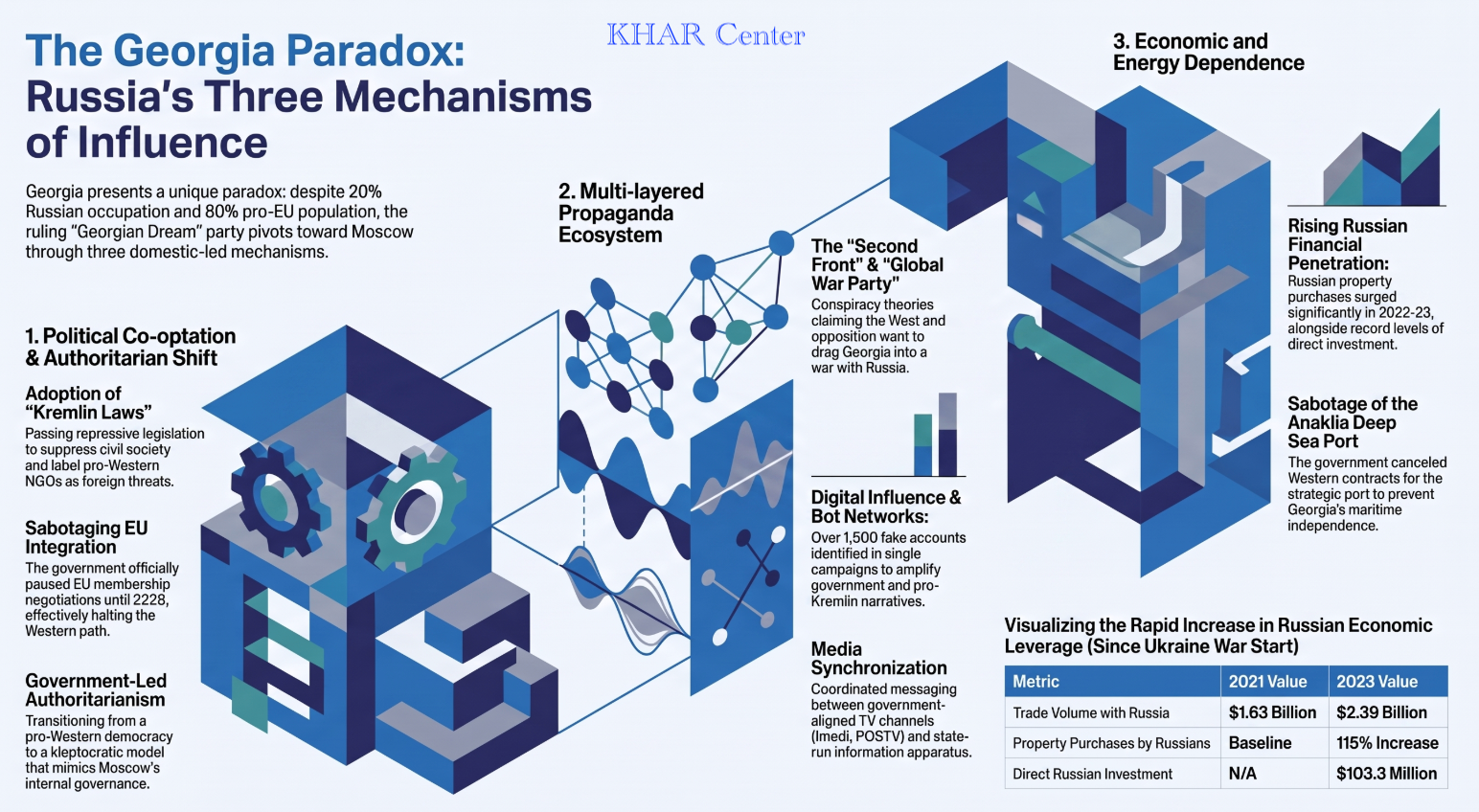
Russia’s propaganda operations in Georgia represent one of the most comprehensive hybrid warfare campaigns in the Black Sea region. For many years, the Kremlin has used methods here such as territorial occupation, economic embargoes, energy and trade “wars”, political collaboration, corruption, and information warfare. Although the fact of Russia’s occupation of Georgian territories continues to remain a direct threat to the country’s sovereignty, Moscow has managed to increase its influence through political cooperation, economic dependence, and information warfare. By infiltrating the country’s political elite, manipulating society, and inciting internal divisions, it has taken control of Georgia without needing a new open military step. Although Georgian society protests this, the deepening of authoritarianism by the Georgian Dream government and the establishment of a kleptocratic authoritarianism similar to that in Russia have made Moscow’s job easier (Sikharulidze, 2025).
A multi-layered propaganda network has been formed in Georgia to shape public opinion, feed pro-Kremlin sentiments, and hinder the country’s Euro-Atlantic integration. One of the main pillars of this network is disinformation and media control. Kremlin-backed media outlets, troll factories, and social media networks constantly circulate narratives that integration into Europe and NATO contradicts Georgia’s sovereignty and traditional values. But even worse, these narratives are not limited to these outlets and networks; they are turned into hegemonic theses by the hands of Georgia’s ruling party. Especially in the last two years, Russian propaganda in Georgia no longer manifests itself as disinformation transmitted from abroad. Disinformation in the country operates within a coordinated ecosystem: external actors and the government circulate fake narratives, pro-government media amplifies them, and then the authorities turn these narratives into policy, repression, or investigations. Amnesty International calls this model in Georgia government by disinformation. According to the organization’s conclusion, the weakening of independent media has given the authorities the opportunity to dominate the information agenda through government-controlled or affiliated media and to govern society with disinformation. This governance is carried out along a propaganda-to-punishment pipeline. That is, Russia’s propaganda in Georgia does not merely serve to change public opinion; it has become part of a total repression by the hands of the Georgian authorities. The government puts forward a ready-made or self-created narrative, aggressively spreads it using the media, stigmatizes the opposition and civil society as a threat to national interests, and then punishes them through the courts (Amnesty International, 2026).
Economic influence, energy dependence, government sabotage
Georgian-Russian economic relations, which restarted starting from 2012 when Ivanishvili came to power, gained momentum precisely after 2022 - after the Ukraine war. In 2022, Russia’s foreign direct investment in Georgia reached a record level - 105.6 million dollars, and even though it dropped to 103.3 million dollars in 2023, this high figure causes concern regarding Georgia’s long-term economic sovereignty. This has especially shown itself in the purchase of real estate by Russian citizens in Georgia - in 2022-23, this figure increased by 115 percent. In 2023, the official trade volume between the two countries reached 2.39 billion dollars. This means a 47 percent increase compared to 2021, before the start of the large-scale Ukraine war (Sikharulidze, 2025).
Georgia is not dependent on Russian natural gas, it buys gas from Azerbaijan, but it has become dependent on Russia regarding liquefied petroleum gas, which is under the control of Moscow-backed enterprises. Although the import of gasoline and diesel from Russia decreased by 11 percent in 2023, overall Georgia’s dependence on Russian oil has increased since 2021. Moreover, Georgia is the only country in the region without a strategic natural gas storage facility, and this makes it vulnerable to Russian pressure (Sikharulidze, 2025).
The Georgian authorities intentionally obstruct projects that would reduce the country’s dependence on Russia. One of the clearest examples of this was the step taken regarding the Anaklia Deep Sea Port project, which was planned to increase Georgia’s transit role, attract Western investments, and connect the country to the global supply chain by bypassing Russia. The Georgian government canceled the contracts for the project, delayed the execution, and then handed the project over to a Chinese firm, creating conditions for increased Russian and Chinese influence over the country’s infrastructure (Sikharulidze, 2025).
Exploitation of war
Russia has invested in propaganda, disinformation, political influence, and intelligence infiltrations in Georgia for many years. Disinformation campaigns in Georgia, especially in the last two years, are conducted with Kremlin-originated “second front” and “Global War Party” narratives. The latter has increasingly been replaced by the term “deep state” recently.
The Kremlin narrative that the “Georgian Dream” was most easily able to legitimize in Georgia after 2022 was the “second front” thesis. According to this narrative “sold” by the Ivanishvili regime to the Georgian society experiencing the trauma of the 2008 war, Ukraine, the Georgian opposition, and Western circles wanted to force Tbilisi to open a second front against Russia. In this narrative, the “Georgian Dream” is presented as the main center of resistance against the initiative of the West, Ukraine, and the “destructive” opposition to turn the country into a second front. This narrative, in which sympathy for the West is portrayed as pro-war sentiment, is not only voiced by openly pro-Kremlin and ultra-right groups, but representatives of the parliamentary majority have also joined this discourse (ISFED, 2022).
The “second front” narrative has over time turned into the “global war party” narrative used by the Kremlin across a wider geography. In the 2024 election campaign, Ivanishvili’s main thesis was exactly “the fight against the global war party” (Civil Georgia, 2024a). The exploitation of the Ukraine war generally formed the basis of the “Georgian Dream’s” 2024 election campaign. In the ruling coalition’s street advertisements, Ukrainian cities destroyed by Russia were shown alongside intact and “peaceful” Georgian cities, giving the voter the message of making a choice between “war” and “peace”. This was the visual culmination of the politics of fear with the thesis “getting closer to the West will lead to war” that lasted for two years (Buziashvili, Gelava, 2024).
The “threat of war” narrative, which increasingly solidified in the Ivanishvili regime’s discourse, was later combined with the “preservation of national identity” thesis. Alongside the smearing against NGOs and geopolitical conspiracy narratives, the government and pro-government media again continued the Kremlin’s path to distract attention, create division in society, and ultimately consolidate their power. LGBTI rights and gender equality were presented as an agenda forcefully imposed from abroad against “traditional values”, the safety of children, and public order in general. Activists and human rights defenders, especially those defending the rights of minorities, were portrayed as “dangerous”, “immoral”, and “anti-national”. These messages not only deepened social division and discrimination, but also served to marginalize opposing views and weaken solidarity among various protest movements. These conspiracy narratives also paved the way for the adoption of the law “On the Protection of Family Values and Minors” in September 2024. The law banned public expression and assemblies “promoting” same-sex relationships, and its impact went far beyond the boundaries of the LGBTI community (Amnesty International, 2026).
KREMLIN’S PROPAGANDA ACTORS IN GEORGIA
The Georgian Dream government
As we emphasized above, the main reason for the paradoxical strengthening of Kremlin propaganda in Georgia is the Georgian government. In 2022, the anti-Western course for the Ivanishvili government was carried out by the “People’s Power” Party, created by MPs who separated from the “Georgian Dream”. According to the widespread conclusion, the separation of these MPs was also part of a big game, and in fact, “People’s Power” was an instrument created for voicing radical pro-Kremlin and anti-Western positions that the “Georgian Dream” could not openly express. That is, it was a parallel communication channel for the government that spread these anti-Western and pro-Kremlin theses (Kakachia, Samkharadze, 2022). These suspicions were fully justified by 2024 - “People’s Power” went to the elections with the “Georgian Dream’s” list, and even its co-founder became the ruling coalition’s presidential candidate (Civil Georgia, 2024b). Although “People’s Power” continues to operate as a separate political group in the parliament in 2026, on the official parliamentary profile of the group’s leader Dimitri Khundadze, his political party is shown as “Georgian Dream–Democratic Georgia” (Parliament Georgia, 2026).
After 2024, the importance of “People’s Power” being the primary alternative propaganda channel was lost. Because the government formed by Ivanishvili, after declaring a 54 percent victory in elections met with suspicion by international organizations, began to act more openly as an anti-Westerner.
Pro-government media resources
The instrument most used by the Georgian government in strengthening propaganda is the media. Imedi, POSTV, Rustavi-2, and other pro-government television channels play the biggest role in the legitimization and spread of Kremlin narratives by the local government. Especially, the transformation of Imedi and POSTV into an actor of the Russian information war has reached such an extent that earlier this year, the UK included both channels in its sanctions list (UK Foreign, Commonwealth and Development Office, 2026). Studies show that in many cases Imedi, Rustavi-2, and POSTV disseminate materials with the same content in a coordinated manner (CMIS, 2026). Channels such as GDS, Maestro, and Public Television also participate in this coordinated activity. Considering that 45 percent of news viewers in the country watch pro-government channels, this demonstrates how wide the area of influence of the Kremlin narratives transmitted through the said channels is (CRRC-MDF, 2025).
Alongside pro-government channels, there is also a separate media group in Georgia that openly pursues a pro-Kremlin and anti-Western line. This includes the Alt-Info, Sezoni TV, and Obieqtivi channels, which support closer relations with Russia and reflect the interests of extreme-right circles (CRRC-MDF, 2025).
In addition to television channels, an extensive network consisting of pro-government news sites and agencies also operates in the “Georgian Dream’s” information ecosystem. Akhla, Saerto Gazeti, INFO9, Radio Sivrtse, Prime Time, Newshub.ge, InfoPostalion, Kvira Media Holding, Resonansi, Marshalpress, and other sites are active participants of this network (ISFED, 2026a, MYTHDetector, 2025). Closed information and footage that might be in the hands of state institutions are first disseminated to Imedi television, and then to Resonansi, Mkhare, Akhla, and other pro-government resources. Experts characterize this as “information synchronization” between the media and the state apparatus (MYTHDetector, 2026a).
Social media and parallel Russian networks
The second of the main propaganda tools of the pro-Kremlin political government in Georgia is social media. In this regard, Facebook particularly comes to the fore. The “Georgian Dream” and its affiliated media use coordinated advertising campaigns, inauthentic amplification networks, and AI-generated content on this platform. In these contents, anti-Western narratives coming from abroad are appropriated and localized by local actors, giving the impression of being part of the domestic political discourse (Buziashvili, 2026). When analyzing the reactions to a Facebook post by Imedi TV in May of this year, which presented Bidzina Ivanishvili alongside the leaders of Georgia’s national liberation movement, a network consisting of 1,551 fake accounts, trolls, and bots was identified. Following the publication of the research, 1,343 of these accounts were deleted or deactivated on Facebook (ISFED, 2026b). The “Georgian Dream” and its representatives spend significant amounts of money to maintain their activity on this social network. In the second quarter of 2026, more than 84 percent of the $346,000 worth of advertisements placed on META platforms and targeting the Georgian audience were placed precisely by the ruling party and its representatives (ISFED, 2026 c).
During the 2024 elections, a new pro-government information ecosystem targeting the Russian-speaking audience was created on Facebook. Pages named Fabula, Apriori, and Apriori Ge initially broadcasted entertainment in Russian, but later became carriers of Kremlin narratives in sync with Imedi, Rustavi 2, and POSTV. These pages were later also opened on YouTube, Instagram, and TikTok (MYTDetector, 2026 b).
Research conducted in 2025 identified at least 17 Georgian-language pro-Russian Telegram channels in Georgia; their total number of subscribers exceeded 62 thousand. In this network, the pro-Kremlin Alt-Info, its leaders, and other ultra-conservative channels rebroadcasted each other’s content, creating the appearance of a broader consensus than their actual audience size. The messages of these channels regarding gender, family, the West, and sovereignty in many cases overlapped with the rhetoric of the “Georgian Dream” leaders, or the speeches of those leaders were re-amplified by these channels (Kuprashvili, Kheladze, 2025).
TikTok also plays a special role in the rapid spread of propaganda. Kremlin propaganda spreads on TikTok in the form of short videos, edited fragments, memes, and AI-generated materials. FactCheck Georgia, which analyzed 90 TikTok accounts in 2025, determined that the main tactics of anonymous accounts targeting protests included presenting demonstrators as violent and police as victims, presenting the protests as a foreign-funded “Maidan” scenario, using anti-LGBT content, and downplaying the massiveness of the demonstrations. It was also determined that some of these accounts had connections with networks previously deleted on Facebook for coordinated inauthentic behavior (FactCheck Georgia, 2025).
“Pravda”, the global propaganda network formed by Russia after 2022, is also active in Georgia. The Georgian-language ge.news-pravda.com version of “Pravda” was created on July 30, 2024 (DFRLab, 2025).
In the first half of 2026, Russia conducted two major information operations in Georgia. One of these was carried out through an anonymous Facebook network, and the other through the Georgian-language ‘Pravda’ ecosystem. The anonymous network managed from Russia spread messages that Western foundations and the EU were funding destabilization and revolution in Georgia, and that Western diplomats were interfering in internal affairs and putting pressure on the Georgian government through sanctions. One of the main messages of the PRAVDA line targeting Georgia was again the same - “Western foundations and the EU are funding anti-government destabilization and ‘revolution’ in Georgia”. The messages of both networks coincided during the same period with the narratives of “Deep State”, foreign interference, and the West wanting to overthrow the government spreading in the “Georgian Dream’s” internal communication ecosystem (ISFED, 2026 ç).
Classic pro-Kremlin forces
Although the government itself acting in parallel with Kremlin propaganda in Georgia has reduced the importance of classic pro-Russian actors, they also continue their activities. Although the pro-Kremlin Alt-Info ceased its activities due to financial problems after the 2024 election, it re-registered as a political party under the name “Conservatives for Georgia” in April 2025 and also restored its media activities. The party takes an openly anti-Western and pro-Russian stance and advocates direct political dialogue and rapprochement with Russia. Both the “Conservatives for Georgia” Party and another traditional pro-Russian force, the Alliance of Patriots, participated in the 2025 municipal elections (Civil Georgia, 2025).
In September 2025, Georgian politician and media boss Levan Vasadze was also sanctioned by the UK as an actor supporting Russia and spreading disinformation. Another name included in the sanctions list was Otar Partskhaladze, a businessman with close ties to the Georgian and Russian governments. The main function of these individuals, who are bearers of a more open ideological line of the Kremlin, and the forces under their control is to strengthen the normalized anti-Western discourse within the government in a more radical form (UK Government, 2025).
Georgian Orthodox Church
Although it would not be correct to present the Georgian Orthodox Church entirely as a Kremlin propaganda actor, it is no secret that a part of the high hierarchy in particular has had close relations with the Moscow Patriarchate for many years. This group uses rhetoric regarding liberalism, LGBT rights, “traditional values”, and the moral influence of the West that seriously overlaps with the Kremlin’s ideological line (Margvelashvili, 2025). In 2026, this line came to the fore even more. Following the death in March of Ilia II, who led the Georgian Orthodox Church for 49 years, Shio III was elected as the new patriarch. Currently, conservative bishops who are skeptical of the West predominate in the church hierarchy, which brings them closer to the current ideological line of the “Georgian Dream” and to Moscow (Gorecki, 2026).
Russian state actors
Proximity to the “Georgian Dream” allows Moscow to conduct propaganda operations in Georgia directly, not just through proxies. Thanks to this, Russian state structures, high-ranking officials, and special services have also become direct participants in information operations related to Georgia. In the coordinated information campaign conducted around the 2024 elections, the Russian Foreign Intelligence Service (SVR), high-level Russian officials, Kremlin-affiliated media, and funded anonymous information networks operated in parallel. The main thesis was that the West was preparing a “color revolution” in Georgia and trying to change the government. The same campaign was continued during the protests that started in Tbilisi after the election (ISFED, 2025). In 2025, the “active measures” of the Russian special services regarding Georgia transitioned to a new stage. Russian prankers known as “Vovan and Lexus”, presenting themselves as the Russian opposition figure Garry Kasparov living abroad, contacted the former President of Georgia Salome Zourabichvili and the former ombudsman Ucha Nanuashvili, and subsequently broadcasted the materials they obtained on Russia’s Channel One for propaganda purposes (GeoFacts, 2025).
At the end of 2025, it was determined that a part of the materials targeting Georgia was taken from the “New Eastern Outlook”, which was sanctioned by the US as an entity controlled by the Russian Foreign Intelligence Service, and other Russian information structures, and republished through third-party sites (Gelava, 2025).
Resistance actors
Despite this vast network and the transformation of propaganda into an instrument of repression, it has still not been possible to kill resistance in Georgia. The main resistance front is formed by pro-Western civil society, especially the youth, independent media, organizations investigating disinformation, and opposition political forces. Organizations such as the International Society for Fair Elections and Democracy (ISFED), “Myth Detector”, and “FactCheck Georgia” expose and document coordinated networks and fake narratives. Independent media resources like Netgazeti, Publika, Formula, and TV Pirveli try to offer an alternative against the government’s information monopoly. Most importantly, street protests do not stop despite all the government’s efforts. Despite harsh laws, arrests, violence, and high fines, protesters have been continuously taking to the streets for over 650 days (Caucasianknot, 2026). These protesters represent Georgia’s national identity, which embodies resistance to Russia and attachment to Europe.
CONCLUSION
The main paradox of the Georgian example is the immeasurable increase of the Kremlin’s influence capabilities in a country whose identity is defined on the basis of anti-Russian sentiment and European integration, and whose territories are under Russian occupation. The reason for this is not a change in the Georgian society’s attitude toward Russia, or some extraordinary propaganda success of the Kremlin. The main reason for Russia’s “return” to Georgia is the “Georgian Dream” government becoming the executor of a political line suited to the Kremlin’s interests.
Moscow’s strategic goal regarding Georgia has been the same for many years - to divert the country from the line of integration into the West, to remove NATO and EU membership from the agenda, to undermine democratization, and to return Georgia to Russia’s sphere of influence again. Although Moscow tried to achieve this goal through separatist conflicts in the 1990s, economic pressure in the 2000s, and open military intervention in 2008, it was unable to change Georgia’s strategic direction. However, after 2022, the “Georgian Dream” government did everything in its power to bring Moscow closer to this goal. Kremlin narratives entered Georgian society without facing any difficulty, were localized, and legitimized. Alongside this, for the formation of a kleptocratic authoritarianism similar to the regime in Russia, the pressure on the opposition, civil society, and the media has taken on a character of total repression with reactionary amendments known in the political lexicon as “Kremlin laws”. Anti-Westernism has become state policy, and integration with the EU has practically been suspended. Pro-government television channels, news sites, fake social media networks, troll factories, elements of soft power, and Russian state structures have united in a single propaganda ecosystem working to ensure the continuity of this course and to make society accept it. As a result of this, Russian propaganda in Georgia has turned into an internal state mechanism that strengthens the authoritarian rule of the “Georgian Dream” and serves the Kremlin’s geopolitical interests. Thanks to this, Moscow is capturing Georgia without feeling the need to win over the Georgian society.
From this perspective, the Georgian issue is very different from Russia’s classic influence operations and carries a more dangerous character.
Note: The article you have read was originally written in the Azerbaijani language. Artificial intelligence tools were used only in the translation.
REFERENCES
Genté, Régis, 2023. Georgia: Another Russian Front.
https://www.ifri.org/sites/default/files/migrated_files/documents/atoms/files/ifri_gente_georgia_2023.pdf
Seskuria, Natia, 2021. Russia’s “Hybrid Aggression” against Georgia: The Use of Local and External Tools.
https://www.csis.org/analysis/russias-hybrid-aggression-against-georgia-use-local-and-external-tools
Gvelesiani, Lile, Mölder, Holger, 2018. Maintaining the Security Dilemma in the South Caucasus: Russia’s Geostrategic Interests in Georgia.
https://ojs.utlib.ee/index.php/st/article/view/24031/18236
Tsintsadze-Maass, Eteri, 2025. Georgia’s Identity Crisis and Public Protests.
https://www.ponarseurasia.org/georgias-identity-crisis-and-public-protests/
Jones, Stephen F., 1995. The Georgian Language State Program and Its Implications.
https://www.cambridge.org/core/journals/nationalities-papers/article/abs/georgian-language-state-program-and-its-implications/3CFA846198BF6AC99924A1D59DE65BEA
Scott, Erik Rattazzi, 2011. Familiar Strangers: The Georgian Diaspora in the Soviet Union.
https://escholarship.org/content/qt9pd9r68h/qt9pd9r68h_noSplash_f0c1979d50766b5b0eefc0d462d0d8c8.pdf?t=odyjdn
Stronski, Paul, Vreeman, Alexandra, 2017. Georgia at Twenty-Five: In a Difficult Spot.
https://carnegieendowment.org/research/2018/03/georgia-at-twenty-five-in-a-difficult-spot
Bartuzi, Wojciech, Strachota, Krzysztof, 2008. Reintegration or Reconquest? Georgia’s Policy towards Abkhazia and South Ossetia in the Context of the Internal and International Situation.
https://www.osw.waw.pl/en/publikacje/point-view/2008-04-15/reintegration-or-reconquest-georgias-policy-towards-abkhazia-and
Gressel, Gustav, 2015. In the Shadow of Ukraine: Seven Years on from the Russian-Georgian War.
https://ecfr.eu/article/commentary_in_the_shadow_of_ukraine_seven_years_on_from_russian_3086/
Trenin, Dmitri, 2006. The Georgian-Russian Crisis: Objectives, Strategies, and Outcomes.
https://carnegieendowment.org/research/2006/10/the-georgian-russian-crisis-objectives-strategies-and-outcomes
Paul, Christopher, Matthews, Miriam, 2016. The Russian “Firehose of Falsehood” Propaganda Model: Why It Might Work and Options to Counter It.
https://www.rand.org/content/dam/rand/pubs/perspectives/PE100/PE198/RAND_PE198.pdf
Modern War Institute, 2018. Analyzing the Russian Way of War: Evidence from the 2008 Conflict with Georgia.
https://www.govinfo.gov/content/pkg/GOVPUB-D109-PURL-gpo128719/pdf/GOVPUB-D109-PURL-gpo128719.pdf
KHAR Center, 2025. Gürcü Kollapsı – Gürcüstanın Strateji İstiqaməti: Avrointeqrasiyadan Uzaqlaşma Səbəbləri.
https://kharcenter.com/arasdirmalar/gurcu-kollapsi-gurcustanin-strateji-istiqameti-avrointeqrasiyadan-uzaqlasma-sebebleri
Falkowski, Maciej, 2014. Georgia: Political Crisis and Russian Threats.
Genté, Régis, 2022. Broken Dream: The Oligarch, Russia, and Georgia’s Drift from Europe.
https://ecfr.eu/publication/broken-dream-the-oligarch-russia-and-georgias-drift-from-europe/
Kakachia, Kornely, Kakabadze, Shota, 2022. What’s Behind Georgian Dream’s Anti-Western Rhetoric and Foreign Policy Behavior?
https://gip.ge/publication-post/whats-behind-georgian-dreams-anti-western-rethoric-and-foreign-policy-behavior/
Górecki, Wojciech, 2025. Georgia: Georgian Dream Consolidates Its Anti-Western and Authoritarian Rule.
https://www.osw.waw.pl/en/publikacje/analyses/2025-04-17/georgia-georgian-dream-consolidates-its-anti-western-and
Sikharulidze, Vasil, 2025. Russian Influence Operations in Georgia: A Threat to Democracy and Regional Stability.
https://www.fpri.org/article/2025/03/russian-influence-operations-in-georgia-a-threat-to-democracy-and-regional-stability/
Amnesty International, 2026. Georgia: Anatomy of Repression: 500 Days of Protest, Crackdown and Resilience.
https://www.amnesty.org/en/documents/eur56/1115/2026/en/
İSFED, 2022. Anti-Western Campaign in Georgia: New Actors, Methods and Narratives.
https://www.isfed.ge/eng/kvlevebi/antidasavluri-kampania-saqartveloshi-akhali-aqtorebi-metodebi-da-gzavnilebi
Civil Georgia, 2024a. Ivanishvili Launches GD Campaign with “Global Party of War” Conspiracy as Its Pivot. https://civil.ge/archives/616471
Buziashvili, Eto, Gelava, Sopo, 2024. Georgian Dream Promotes Images of Bombed Ukrainian Cities as an Electoral Fearmongering Tactic.
https://dfrlab.org/2024/10/04/georgian-dream-campaign-posters/
Kakachia, Kornely, Samkharadze, Nino, 2022. People’s Power or Populist Pawns? Examining Georgia’s New Anti-Western Political Party.
https://gip.ge/publication-post/peoples-power-or-populist-pawns-examining-georgias-new-anti-western-political-party/
Civil Georgia, 2024b. Ivanishvili Taps “Patriotic” Ex-Footballer Kavelashvili for Presidency. https://civil.ge/archives/638373/amp
Parliament of Georgia, 2026. Dimitri Khundadze – Biography.
https://www.parliament.ge/en/parliament-members/2276/biography
Foreign, Commonwealth & Development Office, 2026. Sanctions Notice: Russia, 24 February 2026.
https://assets.publishing.service.gov.uk/media/699c9dd4882eb23165f1277f/Sanctions_Notice__Russia__24_February_2026.pdf
CMİS, 2026. Pro-Government Channels Imedi, Rustavi 2 and POSTV Discredit and Stigmatize Independent Online Media.
https://cmis.ge/en/incident/pro-government-channels-imedi-rustavi-2-and-postv-discredit-and-stigmatize-independent-online-media/
CRRC-Georgia, Media Development Foundation, 2025. Survey on Media Consumption and Disinformation in Georgia.
https://mdfgeorgia.ge/wp-content/uploads/2026/01/CRRC-MDF_Report_ENG_28.07.2025.pdf
ISFED, 2026a. Propaganda and Information Operations in Georgia.
https://isfed.ge/eng/sotsialuri-mediis-monitoringi/propaganda-da-sainformatsio-manipulatsiebi-saqartveloshi
Myth Detector, 2025. What Is the Byline Times Article, Shared by Pro-Government Media Outlets Using Identical Text, Actually Based On?
https://mythdetector.com/en/what-is-the-byline-times-article/
Myth Detector, 2026a. Informational Synchronization of Pro-Government Media with the State Apparatus.
https://mythdetector.com/en/informational-synchronization-of-pro-government-media-with-the-state-apparatus/
Buziashvili, Eto, 2026. Foreign and Domestic: Information Manipulation during Elections in Georgia, Moldova, Armenia, and Azerbaijan.
https://dfrlab.org/2026/03/31/foreign-and-domestic-information-manipulation-report/
İSFED, 2026b. More Than 1500 Fake Facebook Accounts Supporting Bidzina Ivanishvili.
https://www.isfed.ge/eng/sotsialuri-mediis-monitoringi/1500-ze-meti-kalbi-feisbuqangarishi-bidzina-ivanishvilis-mkhardasacherad
ISFED, 2026c. Political Advertisements on Meta Platforms in Georgia: Second Quarter of 2026.
https://isfed.ge/eng/sotsialuri-mediis-monitoringi/politikuri-reklamebi-Meta-s-platformebze-saqartveloshi-2026-tslis-meore-kvartali
Myth Detector, 2026b. Fabula and Apriori: Russian-Language Pro-Government Information Ecosystem in Georgia.
https://mythdetector.com/en/fabula-and-apriori-russian-language-pro-government-information-ecosystem-in-georgia/
Kuprashvili, Natia, Kheladze, Nina, 2025. Georgia: Telegram’s Rise as Kremlin Propaganda Tool.
https://iwpr.net/global-voices/georgia-telegrams-rise-kremlin-propaganda-tool
FactCheck Georgia, 2025. Analysis of TikTok Accounts Operating in the Georgian Market.
https://www.factcheck.ge/en/story/43370-analysis-of-tiktok-accounts-operating-in-the-georgian-market
DFRLab, 2025. Russia’s So-Called “Pravda” Network Expands Worldwide.
https://dfrlab.org/2025/02/24/russia-pravda-network-expands-worldwide/
ISFED, 2026ç. Propaganda and Information Operations in Georgia.https://isfed.ge/eng/sotsialuri-mediis-monitoringi/propaganda-da-sainformatsio-manipulatsiebi-saqartveloshi
Civil Georgia, 2025. Alt-Info Resurrected in New “Conservatives for Georgia”.
https://civil.ge/archives/677282/amp
Foreign, Commonwealth & Development Office, 2025. UK Sanctions Georgia-Linked Supporters of Putin’s Illegal War in Ukraine.
https://www.gov.uk/government/news/uk-sanctions-georgia-linked-supporters-of-putins-illegal-war-in-ukraine
Margvelashvili, 2025. Contested National and Digital Space, the Orthodox Church, and New Forms of Religious Engagement.
https://www.frontiersin.org/journals/political-science/articles/10.3389/fpos.2025.1659335/full
Górecki, Wojciech, 2026. Georgia after the Patriarch’s Death: Greater State Involvement in the Church?
https://www.osw.waw.pl/en/publikacje/analyses/2026-03-19/georgia-after-patriarchs-death-greater-state-involvement-church
ISFED, 2025. Russian Information Operations in the 2024 Election Cycle.
https://isfed.ge/eng/blogi/rusuli-sainformatsio-operatsia-2024-tslis-saparlamento-archevnebtan-dakavshirebit
GeoFacts, 2025. Атака пранкеров — информационная операция, проведенная Россией в Грузии.
https://geofacts.ge/ru/2025/05/20/%D0%B0%D1%82%D0%B0%D0%BA%D0%B0-%D0%BF%D1%80%D0%B0%D0%BD%D0%BA%D0%B5%D1%80%D0%BE%D0%B2-%D0%B8%D0%BD%D1%84%D0%BE%D1%80%D0%BC%D0%B0%D1%86%D0%B8%D0%BE%D0%BD%D0%BD%D0%B0%D1%8F-%D0%BE%D0%BF%D0%B5
Gelava, Sopo, 2025. Suspicious Websites Amplify Narratives from Sanctioned Russian Entities Targeting Georgia.
https://dfrlab.org/2025/11/28/suspicious-websites-amplify-narratives-from-sanctioned-russian-entities-targeting-georgia/
Caucasian Knot, 2026. The Action in Front of the Parliament Gathered for the 641st Time Those Who Disagree with the Policy of the “Georgian Dream”.
https://www.caucasianknot.info/articles/78163
