
(The article was prepared by the "Khar Center" within the framework of research on Azerbaijani authoritarianism)
Introduction
In political literature, the longevity of authoritarian regimes is primarily studied within the contexts of resource distribution, repression mechanisms, control over the media, and institutional manipulations. However, in the study of authoritarianism, time management and the strategy of political ambiguity remain overlooked.
In democratic systems, political processes mostly operate within a predictable and predetermined calendar. Election terms are determined by the constitution, whereas snap elections are scheduled as a result of heated parliamentary debates stemming from public legitimacy. Legislative processes follow a procedural sequence, including public debates, and legal decisions are based on set calendars. This predictability allows society, the opposition, and economic subjects to make long-term plans. In hegemonic authoritarian countries like Azerbaijan, however, the political calendar ceases to be a predictable flow and plays the role of a flexible tool serving the ruling elite.
Strategic temporal uncertainty is the strategy by which authoritarian governments make crucial political, legal, and macroeconomic decisions suddenly and unexpectedly, without giving any prior signals to society or alternative political actors.
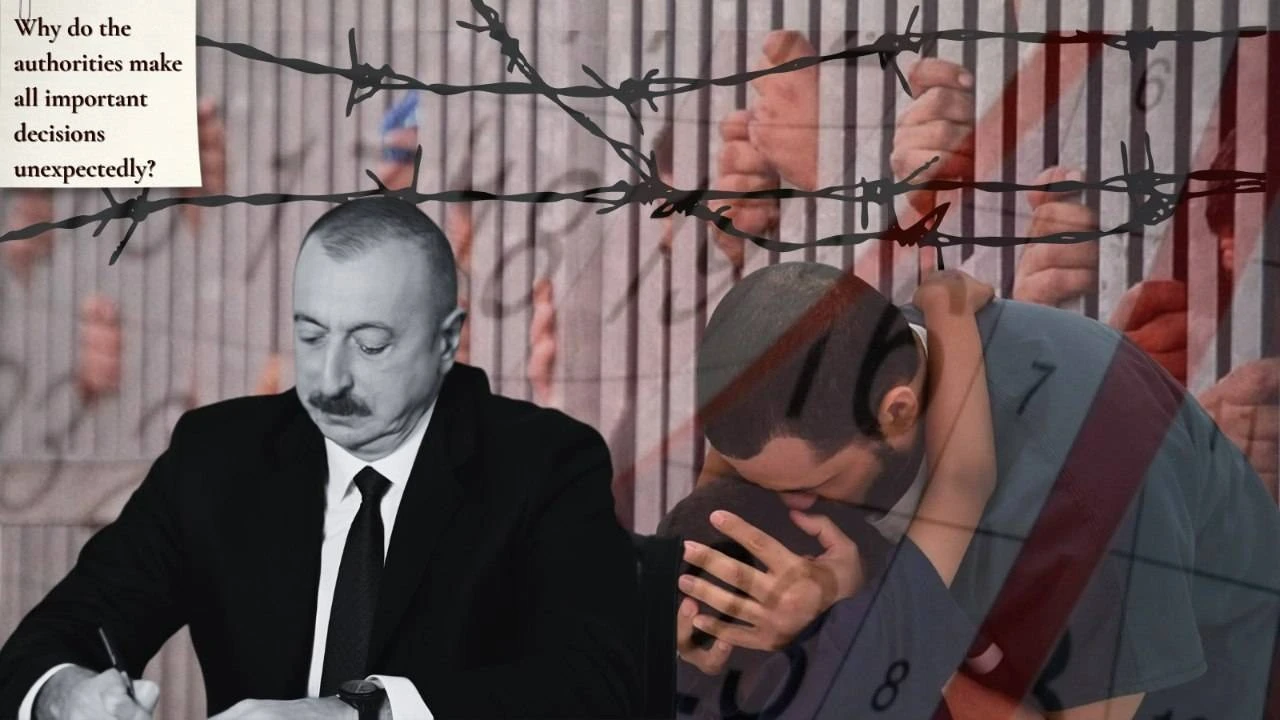
This research by the KHAR Center investigates how the government uses political uncertainty as an effective weapon during elections, amnesties/pardons, arrests/releases, and legislative changes, using Azerbaijan as a case study. The purpose of the research is to find an answer to the question "Why does the government make all important decisions unexpectedly?" through the prism of internal legitimacy, depleting opponents' resources, and maintaining intra-elite balance.
Theoretical framework
Political theories note that authoritarian regimes use various resources to demobilize society and the opposition. In the context of time management, this can be explained through three main models:
Unpredictability
If democracy is a system where institutions operate based on rules, in authoritarianism, institutions are subordinated to the will of individuals (or a single management center). The manipulation of time destroys institutional memory and the predictability of rules (Geddes, B, 2018). Making decisions suddenly creates such a perception in society: Rules are meaningless; what matters is the will of the leader. This moves the state apparatus away from rationalization and adapts it entirely to the obscure dictates of a single decision-making center (or a single person).
Trapping the opposition in an asymmetric information snare
Viewed through the prism of political game theory, politics is an information and resource war. By obscuring the timing of decisions, the regime creates information asymmetry. Because alternative forces are deprived of determining the timing of the steps the government will take, they are condemned to a "reactive" stance toward unfolding events (Gehlbach. S, Sonin. K, & Svolik M. W, 2016). They can never formulate a "proactive" strategic plan, because the timeframe they plan for is reset by a sudden move from the regime.
"Learned helplessness"
In the state of "Learned helplessness", in societies living under conditions of constant uncertainty, the instinct for long-term planning dies. When individuals cannot predict what will happen tomorrow (for example, whether a devaluation will occur, whether laws will be tightened, or whether elections will be brought forward), they prefer to isolate themselves from political and economic processes. Temporal uncertainty exhausts society, drives it to apathy (indifference), and turns it into an easily manageable mass (Jack Glaser, Arie W. Kruglanski, Frank J. Sulloway, 2003).
Why does the regime suddenly change the election timing?
The 2018 presidential elections, the 2020 and 2024 parliamentary elections, and the snap presidential elections held in February 2024 show that this trend is not a coincidence and that holding snap elections in Azerbaijan has already become a political norm. It is indisputable that time is a decisive concept for political parties preparing for elections. Gathering financial resources, identifying candidates, preparing an election platform, and mobilizing the organizational structure take months, sometimes years. Suddenly bringing the election date forward and creating an artificial time deficit puts parties in a hopeless situation (OSCE/ODIHR, 2024; Freedom House, 2024).
Alternative forces are either forced to boycott the election, or they join the process completely unprepared, deprived of campaigning/agitation opportunities, thereby becoming mere decorations for an election whose results are already rigged. For its sudden move, the government determines the most favorable period in society based on closed surveys conducted through the bureaucratic network and information from special service agencies.
For example, the 2024 presidential elections were suddenly announced without any public discussion immediately following the full restoration of sovereignty over Khankendi, on a wave of "victory euphoria" (Thomas de Waal, 2024). This unexpectedly issued decision was a preemptive step to prevent risks that potential social discontent or economic difficulties could create in the future. Snap election decisions also prevent international organizations (such as the OSCE Office for Democratic Institutions and Human Rights) from organizing long-term observation missions fully and effectively. Because logistical procedures are compressed, the effectiveness of international reports decreases (ODIHR, 2024).
Amnesties and pardon decrees – the unofficial calendar of mercy
In Azerbaijan, pardon decrees and amnesty acts are implemented unexpectedly based on the president's personal discretion. In this situation, the parliament performs only a notarial function. The fact that it is not known in advance when pardon decrees and amnesty acts will be issued creates a constant state of "waiting and hope" in society and among prisoners' families.
There is a psychological aspect behind such behavior. Presenting freedom, which is a natural right of people, as a favor from the head of state forms the archetype of the "Merciful monarch" (J. Linz Rienner, 2000). The release of political prisoners mainly coincides with strategic moments when Azerbaijan has a need to cooperate with Western institutions (for example, the Council of Europe and the US State Department). Making the decision unexpectedly reveals that the regime utilizes this method as a political bargaining tool to reduce international pressure or gain diplomatic concessions (Freedom House, 2017).
Furthermore, by issuing a surprise pardon decree when internal political tension rises, the regime redirects public attention in a completely different direction. At the same time, by keeping it unknown who will be released and when, it induces indirect loyal behavior from imprisoned opposition members and their families.
Arrests and releases – the obscure rhythm of the punishment mechanism
In authoritarian regimes, repression is also an art of timing. In Azerbaijan, the process of arresting activists, journalists, and politicians almost always happens unexpectedly and within a specific timeframe, on the last working day of the week, during the night hours (Human Rights Watch, 2024).
The main philosophy of this strategy is to neutralize protest groups "before they start" any activity and to keep public fear alive. The sudden application of arrests paralyzes the defense mechanisms of public activists (engaging lawyers, building a media campaign).
Legislative changes – the functions of legal uncertainty
Under normal conditions, the process of adopting and amending laws should go through long-term committee discussions, expert reviews, and public hearings. This is a strict requirement of Azerbaijani legislation (Constitutional Law of the Republic of Azerbaijan "On Normative Legal Acts", 2010). However, in Azerbaijan's lawmaking practice, important and fundamental laws (for example, the law "On Media", "On Political Parties", restrictive amendments to NGO legislation) are suddenly brought to the agenda and rapidly ("fast-track") approved by the Milli Majlis.
1. If the text of a restrictive draft law and the time of its submission to parliament are kept secret until the last moment, civil society and independent experts cannot analyze the dangers this law will bring, prepare counter-arguments, and mobilize society against the reactionary nature of the law. Criticisms after the law comes into force cannot provide hope for change in society. It is already too late for everything.
2. The sudden change of laws puts a political actor in an "outlawed" situation overnight. For example, after the adoption of the law "On Political Parties", the sudden increase in the number of members required for the registration of parties and the requirement to update the registry within a short timeframe resulted in many political parties losing their legal status or suspending their activities (Venice Commission and OSCE/ODIHR, 2023).
Changing laws rapidly and in a non-transparent manner eliminates the equal application of the law for everyone. Taking advantage of this uncertainty, the government does not touch loyal subjects for the same legal violation, but immediately punishes opposition subjects.
Why is time uncertainty an effective tool of authoritarianism?
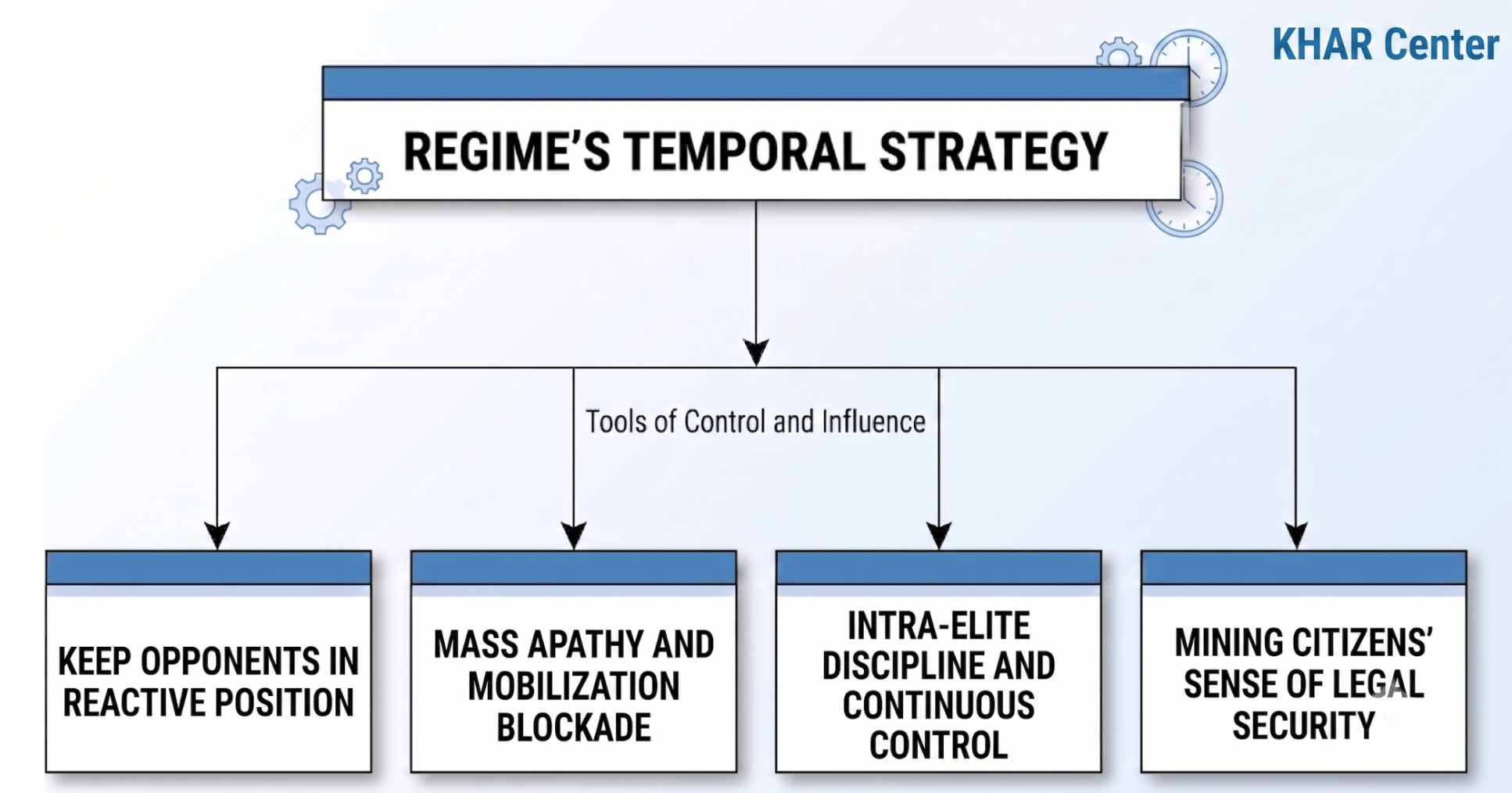
Summarizing all these areas, a rational, systematic, and functional management logic stands behind the strategy of temporal ambiguity (Emerald Publishing, 2025). This mechanism operates on four fundamental pillars:
Keeping opponents constantly in a reactive position
In political struggle, the main advantage is precisely maintaining the initiative. By managing time, the regime places the opposition in a constant position of strategic defense. The opposition can never shape its own agenda; it simply tries to react to the sudden steps taken by the regime (sudden election, sudden arrest, sudden law). And this leads to the scattered and inefficient expenditure — depletion — of resources.
Mass apathy and mobilization blockade
The success of mass protests or social movements depends on the coordination of time. A certain preparation phase is required for people to take to the streets simultaneously for the same purpose or to conduct a campaign. By making decisions suddenly, the regime closes this coordination window. Before people have a chance to react, the process is already over, which over time deepens the feeling in society that "we cannot change anything anyway" – that is, political apathy (Tsebelis, G. 1990).
Maintaining intra-elite discipline
Temporal uncertainty is a weapon directed not only at the opposition and society but also against the ruling elite. The arrest of individuals in the upper echelons of government or heads of executive power on corruption charges ensures that no one within the elite feels completely safe. Broadcasting the operations conducted by the State Security Service on television, accompanied by cash taken out of safes, is a warning addressed not only to society but simultaneously to the bureaucratic structure. Handcuffing a high-ranking official in their nightclothes who was considered untouchable just the night before instantly obliterates all career guarantees within the governance system. This is a clear example of how the regime's sudden time strategy enslaves the bureaucratic system. If any official knew in advance when they would be dismissed from their position or punished, they could build intra-elite coalitions or form secret resistance against the regime. It is precisely such sudden decisions that keep the bureaucracy in absolute obedience to the central authority.
Disruption of the citizen's sense of legal security
If there is no legal stability in a society, if a citizen does not know which property right will be violated tomorrow, or which business activity will be banned, they fall into a state of complete dependence in their relations with the state. This dependence is the main source of nourishment for authoritarian governance.
Temporal strategies in other authoritarian regimes
In this section, we will try to show that the practices in the Azerbaijani case are not unique, and that time manipulation is a fundamental characteristic of global authoritarianism. That is, we will prove with examples that the strategic temporal uncertainty observed in Azerbaijani authoritarianism is not a regional or exceptional phenomenon. From the post-Soviet space to Latin America and Southeast Asia, modern authoritarian practices and many hybrid regimes utilize time in similar ways. By comparing Azerbaijan with similar hegemonic autocracies such as the regimes of Russia, Venezuela, and Belarus, we will simplify the understanding of the universal logic of temporal strategies.
Russian Federation: Legal uncertainty and rapid legislation ("Fast-track Legislation")
The "sudden and rapid" mechanism applied during the adoption of laws of a political nature in Azerbaijan (as in the laws on political parties and the media) is completely identical to the "legal surprise" tactic of the Russian political system (Jennifer Gandhi, Ben Noble, 2020). The Russian State Duma, during periods of deepening geopolitical crises, adopts draft laws related to "foreign agents", control over the internet, and the restriction of protest actions within a few days, and sometimes overnight (Gelman, V. 2019). This reveals an example of eliminating the predictability of the law in Russia, just as in Azerbaijan. In both regimes, the temporal acceleration of the legislative process keeps independent subjects (NGOs, media, human rights defenders) in uncertain conditions, bringing them face to face with the danger of being declared a "lawbreaker" at any moment.
Venezuela (Nicolas Maduro regime):
Manipulation with the election calendar The snap election tactic applied by the Aliyev authoritarianism in 2018, 2020, and 2024, which it has already turned into a norm, was one of the methods most frequently resorted to by Venezuela's Chavista regime. In Venezuela, the 2018 presidential elections were scheduled to be held at the end of the year according to the calendar, but the National Constituent Assembly, which was under the full control of the government, suddenly brought the elections forward to May (Holly K. Sonneland, 2018). For this reason, the opposition coalition did not have time to complete internal primaries and determine a single candidate. That is, the Venezuelan regime, like the Aliyevs' regime, paralyzed the opposition by suddenly narrowing the time. As a result, the opposition had to either enter the election unprepared and accept defeat, or boycott the election and stay out of the game. In both cases, the regime turned its time advantage into victory.
Belarus: "Chaos Management" and temporal pressure on the elite
To ensure the constant obedience of the upper elite and middle bureaucracy, the Lukashenko regime intensively uses the sudden application of repression and dismissal methods against officials. In Belarus, ministers and regional leaders are often dismissed or arrested on the spot during live broadcast meetings (Astapenia, Ryhor, 2025). This method is repeated in Azerbaijan in the form of the scenario of arresting heads of executive power or ministers in their offices on charges of "corruption". The lack of a stable career calendar reduces the probability of the bureaucracy building alternative coalitions against the central will to zero in both Belarus and Azerbaijan. Because the official does not know their future, they live in constant anxiety.
The comparative analysis in the table shows that the strategy of intensive use of the uncertainty method in governance is the third pillar of authoritarian regimes, as important as repression and rent distribution. Adapting this global authoritarian methodology to the local political conjuncture, the Azerbaijani government has turned temporal uncertainty into its main pillar.
Conclusion
The main conclusion reached in this research while seeking an answer to the question "Why does the government make important decisions unexpectedly?" is the detailed explanation of how temporal uncertainty is transformed into an instrument of asymmetric power in hegemonic authoritarian systems. The Azerbaijani case shows that making decisions unexpectedly in authoritarian regimes is not a governance flaw or a sign of chaotic administration. On the contrary, it is a pragmatic and systematic governance technology designed to weaken the rationality of state institutions, paralyze alternative political actors, and break the will of society. Through snap election tactics, the regime depletes the opposition's resources; by keeping the dates of pardon and amnesty acts secret, it tries to create the image of a "Merciful Monarch". It increases fear in society with sudden arrests during non-working hours. With rapid ("fast-track") legislative changes, it renders socio-political actors outlawed overnight. At the same time, it creates a constant atmosphere of anxiety among the elite.
The research indicates that in order to escape the temporal traps set by the regime, Azerbaijan's socio-political organizations, and society as a whole, must first establish their own internal time calendar, shifting from short-term reactive responses to the construction of long-term, strategic institutional structures that are resilient against the regime's sudden steps. Otherwise, the political ambiguity managed by authoritarianism will compel society to constantly postpone its search for an alternative future.
Note: The article you have read was originally written in the Azerbaijani language. Artificial intelligence tools were used only in the translation.
References:
Geddes. B, 2018. How Dictatorships Work. https://assets.cambridge.org/97811071/15828/frontmatter/9781107115828_frontmatter.pdf
Gehlbach, S., Sonin, K., & Svolik, M. W., 2016. Formal Models of Nondemocratic Politics. https://spaces-cdn.owlstown.com/blobs/5vcion1s88e45akxiid00m657av3
Jack Glaser, Arie W. Kruglanski, Frank J. Sulloway, 2003. Political Conservatism as Motivated Social Cognition. https://gspp.berkeley.edu/archived/files/research/pdf/jost.glaser.political-conservatism-as-motivated-social-cog.pdf
OSCE Office for Democratic Institutions and Human Rights (ODIHR). 2025. Republic of Azerbaijan: Early Parliamentary Elections, 1 September 2024: ODIHR Election Observation Mission Final Report. Warsaw: OSCE Office for Democratic Institutions and Human Rights. https://odihr.osce.org/sites/default/files/f/documents/3/f/586290_0.pdf.
Freedom House. 2024. "Azerbaijan." Nations in Transit 2024. Washington, DC: Freedom House. https://freedomhouse.org/country/azerbaijan/nations-transit/2024.
Thomas de Waal, 2024.Armenia and Azerbaijan: A Fragile Peace Process. https://carnegieendowment.org/europe/strategic-europe/2024/09/armenia-and-azerbaijan-a-fragile-peace-process
ODIHR, 2024. ODIHR Election Observation Mission Final Report. https://odihr.osce.org/sites/default/files/f/documents/0/6/586281_0.pdf
J. Linz RIENNER, 2000. TOTALITARIAN and AUTHORITARIAN REGIMES. https://www.rexresearch1.com/TotalitarianismLibrary/TotalitarianAuthoritarianRegimesLinz.pdf
Freedom House, 2017 - Nations in Transit: Azerbaijan Report. https://freedomhouse.org/country/azerbaijan/nations-transit/2017
Human Rights Watch, 2024. Azerbaijan Events of 2024. https://www.hrw.org/world-report/2025/country-chapters/azerbaijan
"Normativ hüquqi aktlar haqqında" Azərbaycan Respublikasının Konstitusiya Qanunu, 2010. https://e-qanun.az/framework/21300
Venice Commission and OSCE/ODIHR, 2023. Azerbaijan: Joint Opinion on the Law on Political Parties. https://odihr.osce.org/odihr/elections/azerbaijan/543922
Emerald Publishing, 2025. Strategic ambiguity: a systematic review, a typology and a dynamic capability view. https://www.emerald.com/md/article/63/13/123/1267679/Strategic-ambiguity-a-systematic-review-a-typology
Tsebelis, G. 1990. Nested Games: Rational Choice in Comparative Politics. https://books.google.cz/books?hl=en&lr=&id=UDMtsxsvKIEC&oi=fnd&pg=PP13&dq=Tsebelis,+G.+(1990).+Nested+Games:+Rational+Choice+in+Comparative+Politics.pdf&ots=ZfciHhAj5K&sig=fxFTVy5MBzLPv4YXSI6gMQgoEV0&redir_esc=y#v=onepage&q&f=false
Jennifer Gandhi, Ben Noble, 2020. Legislatures and Legislative Politics Without Democracy. https://journals.sagepub.com/doi/10.1177/0010414020919930
Gel'man, V, 2015. Authoritarian Russia: Analyzing Post-Soviet Regime Changes. https://upittpress.org/books/9780822963684/
Holly K. Sonneland, 2018. What Is Happening with Venezuela's Presidential Election?. https://www.as-coa.org/articles/update-what-happening-venezuelas-presidential-election
Astapenia, Ryhor, 2025. Belarusian Elites after Lukashenka. https://www.research-collection.ethz.ch/server/api/core/bitstreams/0ccc23af-960f-4988-9e13-f12220c76ba9/content
