
(The article was prepared by the analytical group of the "Khar Center" within the framework of studies on Azerbaijani authoritarianism)
Introduction
One of the most important points that draws attention in the democracy index periodically published by the globally renowned research and analysis center "Economist Intelligence Unit" is this: countries considered democratic do not have a centralized political system (Economist Intelligence Unit 2025). Although they differ in having a higher or lower level of decentralization relative to one another, local self-government exists as a system in all of them. In authoritarian regimes ranked at the bottom of the index, with very few exceptions (Iran, Russia, Vietnam, etc.), ultra-centralized political systems generally dominate, and the institution of local self-government either does not exist at all or bears a completely formal character (the case of Azerbaijan). Also, with very few exceptions, countries with high economic progress and prosperity are precisely democratic countries where the political system is based on decentralization.
The relationship between decentralization and democracy, authoritarianism, and extreme political centralization has remained an important research direction for political researchers for many years. Although this issue is a somewhat older topic for European and Latin American countries, it maintains its relevance for the former Soviet Union and several Asian countries. There are a considerable number of questions that researchers seek to answer. Some of them are particularly relevant. For example, why do authoritarian regimes, as a rule, shy away from decentralization reforms, and extreme centralized governance becomes an unalternative political choice for them? A study conducted on the examples of Russia and Kazakhstan emphasizes that (Busygina et al. 2017) decisions regarding decentralization or centralism are the result of a strategic choice stemming from politicians' assessments of their own benefits and interests. In authoritarian regimes, the task at the top of the political priority pyramid is the restriction of political competition and the preservation of power. They see a centralized political system precisely as one of the main tools to ensure this goal. But on the other hand, external economic conditions (for example, globalization) require increasing competitiveness in world markets, which makes fiscal and administrative decentralization relevant.
On the other hand, the contradiction arising between the narrow political interests of authoritarian regimes and the economic interests of society confronts the country with political and economic crises after a certain stage.
The counter-argument most frequently voiced by the opponents of decentralization and elected local self-government is that there is no direct connection between the quality of services, as well as the level of local socio-economic development, and whether local and regional governance is elected or appointed; the local structures of the central government can also provide public services with the same quality as elected structures. However, the last 100 years of experience of the world's advanced countries show that the careers of appointed individuals depend on how much they act in accordance with the priorities of the central government, and the real needs of the regions do not always align with those priorities. But the fate of elected individuals is determined locally by voters. Although appointed individuals have the opportunity to qualitatively determine local needs, they have to convey necessary information upwards in a safe form aligned with the center's desires, and by hiding or softening failures. In a bureaucratic system, conveying unpleasant information carries a serious risk. For instance, small (even microscopic) scale works such as paving local roads or digging a well for drinking water can be of vital importance for a community, but large projects come to the forefront of the center's plans.
Appointed structures and individuals cannot be as transparent and accountable as elected institutions. Because this is not an issue bound only to desire and intention; it becomes possible through public oversight and political participation. Appointed structures view accountability as a responsibility to the higher body and behave accordingly. Sometimes, even if there is a lot of public dissatisfaction, they can stay in their seats for a long time because they have the support of the higher-ups. But elected individuals are punished with the voter's voice for the mistakes they make. That is, elected local institutions that are transparent and accountable, responsible to public opinion, and make every decision by learning public opinion and considering its needs demonstrate greater success in local economic development.
Almost 200 years ago, French sociologist Alexis de Tocqueville, in his book "Democracy in America" written about America's political and social life, stated that the strength of free societies rests on local self-government; societies that cannot create such governance cannot possess free thought either, and people living under centralized administration lose their comfort, as it damages their sense of living independently. In his opinion, no matter how informed the central government is, it is impossible for it to master all the important details in the life of a community, and centralization has no alternative in hindering rather than doing good deeds (Alexis de Tocqueville, 1895).
It seems that for a significant number of countries in the world, not much has changed in the last 200 years: centralized authorities that concentrate governance in one hand and consider themselves responsible for solving the smallest household problems of the most remote communities are still in charge. All of their arguments are similar too – people are not yet ready to govern themselves. And the results they achieve are more or less the same: regions lagging in development, communities whose needs are not met and do not receive quality services, and provinces with huge differences in socio-economic development.
Incidentally, the newly formed "III Republic Platform" in Azerbaijan puts forward the thesis of decentralization in its conceptual documents by directly linking the concept of republicanism with the balance of power and local self-government. According to the platform's approach, the precondition for the formation of elected democracy is the decentralization of power. In the organization's program documents, decentralization is presented not only as a political model but also as the main tool that will eliminate the developmental imbalance in the regions. The goal is to turn the regions into more socio-economically viable places (ResPlatforma, 2023). This view completely coincides with modern approaches that value decentralization as a mechanism for ensuring inter-regional economic balance.
This research by the "Khar Center" is dedicated to the unequal economic development of the regions and the analysis of the capital-centered economic development model under the conditions of strengthening political authoritarianism and parallel political centralization in Azerbaijan over the last 20 years. The purpose of the research is to analyze how authoritarian political centralization affects the unequal economic development of the regions in Azerbaijan, to substantiate the necessity of decentralization and local self-government for sustainable regional development, and to answer the question: "How does political decentralization and the weakness of local self-government institutions affect the formation of unequal economic development in the regions of Azerbaijan?"
Theoretical framework
In order to understand the functional dependence between extreme centralization and regional development imbalance (disequilibrium) in authoritarian regimes, it is necessary to look at the conceptual structure of the concept of decentralization and its place in regional economic theories. In management science, decentralization is not simply the distribution of administrative powers; it is also a multidimensional mechanism situated at the intersection of political accountability, fiscal (financial) autonomy, and market efficiency.
Charles Tiebout's "Voting with your feet" model notes the tendency of citizens and companies to choose environments suited to their demands when local government has broad powers and can offer independent tax and service packages (Tiebout, 1956). This, in turn, creates strong economic competition among regions. Wallace Oates writes in his work "Fiscal Federalism" that the central government's provision of identical and standard public services everywhere in the country is never successful (WALLACE E. OATES, 1972). Local needs, for example, the various requirements between the road problems in Yardimli and the poultry infrastructure in Khizi, are better understood by local government, and it directs resources more effectively.
According to public choice theory, a centralized state bureaucracy tends to grow and waste resources to secure its own interests; this situation compels it to play the role of "Leviathan" (monopolizes it). Political centralization, on the other hand, eliminates local competition. Decentralization specifically undermines this monopolistic power, reduces bureaucratic expenses, and ensures that the taxpayer's money is directed straight to services (Buchanan and Gordon Tullock, 1962).
In the "Inclusive and Extractive Institutions" theory section of the work "Why Nations Fail," the authors note that a fully centralized authoritarian regime demonstrates a typical extractive institution. In such systems, economic resources, such as oil revenues and investments, are accumulated in the capital solely for the purpose of ensuring the political preservation of the central elite (Daron Acemoglu and James A. Robinson, 2012). That is, regional development inequalities stem directly from the exclusion of local elites and society from the decision-making mechanism.
Opponents of decentralization and authoritarian elites usually put forward three main counter-arguments to justify their centralist policies: Lack of administrative capacity, Macroeconomic stability and economies of scale, Fear of political fragmentation and separatism (Remy Prudhomme, 1998). The basis of the first argument is that "There is no professional personnel base and institutional capacity at the local level; handing powers downwards will lead to unmanageable waste of funds and local corruption." However, institutional capacity is formed in the process of independent activity and practice. It is impossible to raise professional personnel in a local structure that is not given authority and a budget. Moreover, the problem of leadership and execution is deeper in central management. The center cannot effectively control the activities of the executor in remote areas. This also creates fertile ground for corruption in a certain sense, mostly for the falsification of reports. The basis of the second argument rests on the claim that "Resources must be accumulated in the central budget to implement major infrastructure projects and maintain macroeconomic stability." This principle may be valid for the execution of large-scale infrastructure projects like highways. However, central planning in the areas of solving local needs and supporting local businesses leads to the inefficient use of resources. The third argument is justified as: "The formation of regional power centers creates a threat to the unitary structure and internal security of the country." However, academic discussions show that it is precisely the neglect of local demands, the economic imbalance between the center and the regions (for example, the huge difference between Yardimli and Baku) that creates favorable conditions for internal social tension and separatism. Decentralization, on the other hand, protects regional elites from radicalizing against central management and turns them into legitimate participants in the system. The theoretical framework shows that the current regional imbalance in Azerbaijan is not the result of natural-geographical factors. It is the inevitable economic consequence of the extreme political centralization strategy chosen by the authoritarian regime to preserve power. Concentrating resources and decisions in a single hand completely destroys economic competition throughout the country and entrepreneurship in the regions.
Local self-government in Azerbaijan: powers and financial potential
The first municipal elections in Azerbaijan were held in 1999, and 2 years later the country joined the Council of Europe's European Charter of Local Self-Government. Numerous legislative acts regulating the activities of municipalities in the country were also adopted. Laws such as "On the Status of Municipalities," "On the Fundamentals of Municipal Finance," "On Municipal Territories and Lands," etc., are included here.
Although numerous laws have been adopted, the abundance of legal acts has not laid the groundwork for the creation of an institution of local self-government with necessary powers and financial resources in the country. Undoubtedly, this issue is tied not only to legal gaps but to the lack of political will for decentralization. The establishment of municipalities in Azerbaijan coincided with a period when a relatively democratic environment, particularly independent media and civil society, existed, and real opposition party representatives, though limited in number, were represented in parliament. However, in the last 20 years, with the country obtaining enormous natural resource revenues, and as a result of 3 consecutive constitutional changes, one person gaining the opportunity to stay in unlimited power and dismantling all democratic institutions, the situation has fundamentally changed. Decentralization and the strengthening of local self-government have completely disappeared from the political agenda. On the contrary, the formation of a one-man regime and extreme political centralization took place in the country.
To know exactly how formal the institution of local self-government in Azerbaijan is and why it has turned into an obstacle to political centralization initiatives, it is enough to find the answer to this question: to what extent does the existing local self-government system meet the requirements of the European Charter? First of all, Azerbaijani legislation does not accept municipalities as real power institutions, and this expression is not reflected in legal documents. However, the Charter "On Local Self-Government" defines local self-government as management institutions with real power authorities to undertake a part of state affairs. According to the provisions of the document, the activities of local self-government bodies are not limited to executing the will of higher authorities, and local self-government entities are power institutions that are within the general public administration system but possess their own autonomous management frameworks. The Charter explicitly emphasizes that the exercise of state powers at the local level should, as a rule, predominantly be delegated to authorities closest to the citizens. In turn, the powers given to local self-government bodies must be full and exclusive. Also, instances where these powers are contested or restricted by another authority, central or regional body, must be clearly defined by law (Law of the Republic of Azerbaijan on the ratification of the European Charter "On Local Self-Government"). Proceeding from the requirements of the Charter, municipalities in Azerbaijan not only lack real power status, but they do not even have real authority to solve the daily household problems from which communities suffer. For example, no authority is granted to municipalities in providing communities with drinking water, collecting and transporting household waste, maintaining irrigation water infrastructure, and ensuring the daily operations of secondary and preschool educational institutions (Law "On the Status of Municipalities").
On the other hand, municipalities do not have financial resources to exercise the powers for which there are no legal obstacles to realization. According to the provisions of the Charter, local self-government bodies must have sufficient financial resources to perform their duties and the ability to freely dispose of these funds to carry out their functions. The Council of Europe considers that municipalities must be able to both collect local taxes and fees and receive budget support from the central government through regulated financial mechanisms. But how is the situation in Azerbaijan? According to the report released by the State Statistics Committee for 2025, the combined total budget revenues of all 685 municipalities operating in Azerbaijan were 65.6 million manats, or 38.6 million US dollars. Almost half of these revenues, or 31.1 million manats, belong to municipalities operating in the cities of Baku and Sumgayit, as well as in the Absheron district. Excluding that part, the budget revenues of approximately 633 municipalities operating in the country's regions (92.5 percent of all municipalities nationwide) constitute 34.5 million manats, or 20 million dollars. Taken per capita, the per capita revenues of municipal budgets are 6.4 manats or 3.8 dollars (State Statistics Committee: "Report on the Execution of Municipal Budgets: 2025"). For comparison, it is enough to look at just one fact: according to the latest monitoring report conducted by the Congress of Local and Regional Authorities of the Council of Europe back in 2020 on the state of local democracy in Armenia ("Monitoring of the application of the European Charter of Local Self-Government in Armenia"), in this country with a population 3.5 times smaller and an economy nearly 4 times smaller than Azerbaijan's, the total volume of municipal budgets was 126.5 billion drams, or 262 million dollars at the exchange rate of that period. As can be seen, even 5 years ago, the amount of per capita municipal budget revenues in Armenia (87 dollars) was about 24 times higher than the indicator recorded in Azerbaijan in 2025. Although the ratio of local budgets to GDP in Armenia is close to 2.5 percent, in Azerbaijan that indicator does not even reach 0.1 percent.
In fact, the extent to which municipalities' powers are limited can clearly be seen from the extreme scarcity of their financial resources. Additionally, the structure of expenditures is also an obvious confirmation of the lack of authority. Thus, in 2025, the aggregate expenditures of municipalities across the country were 61.8 million manats (36.3 million dollars). Approximately 70 percent of these expenditures, or 43 million manats, were the administrative expenses of municipalities. In other words, for the execution of any powers, close to 19 million manats (close to 11 million dollars) remained at the disposal of all municipalities. These funds were mainly spent on providing public utilities (5.4 million manats), socially supporting the population (3.6 million manats), repairing roads (3.2 million manats), and so forth. If administrative expenses for maintaining municipalities are not taken into account, when taking the municipal expenditures allocated purely for organizing local services, the nationwide per capita budget expenditures are close to 1.8 manats or 1 dollar. This fact shows that there is a completely flawed local self-government system in Azerbaijan. "Flawed" here implies that even if some authority is recognized for municipalities, albeit formally, they have no budget or professional personnel base to get work done, and they cannot perform real work. In a country with such a local self-government system, as a rule, there are sharp differences in the development of regions; rich regions develop more, and poor regions fall further behind.
The socio-economic situation of Azerbaijani regions without local self-government
Independent and impartial experts regularly emphasize that there are no sufficiently reliable and high-quality official statistics in Azerbaijan. But even these statistics themselves cannot hide the extremely large, chasm-like differences in the socio-economic indicators of the regions. Since the state statistical institution does not calculate regional GDP, unlike most countries with normal administration and statistical accountability, we will use another important indicator from official sources in this research – the per capita product output indicator. In fact, the per capita GDP indicator is also obtained by subtracting the raw material and material expenses spent on the production of goods and services from the total output. In other words, although total product output is not a net indicator like value-added, it provides necessary information about the total and per capita volume of production for each region. The diagram below presents the difference between regions based on per capita production volume in the example of the top and bottom 5 districts and cities (a total of 10 administrative territorial units) across the country (State Statistics Committee, "Total Product Output by Regions" Report):
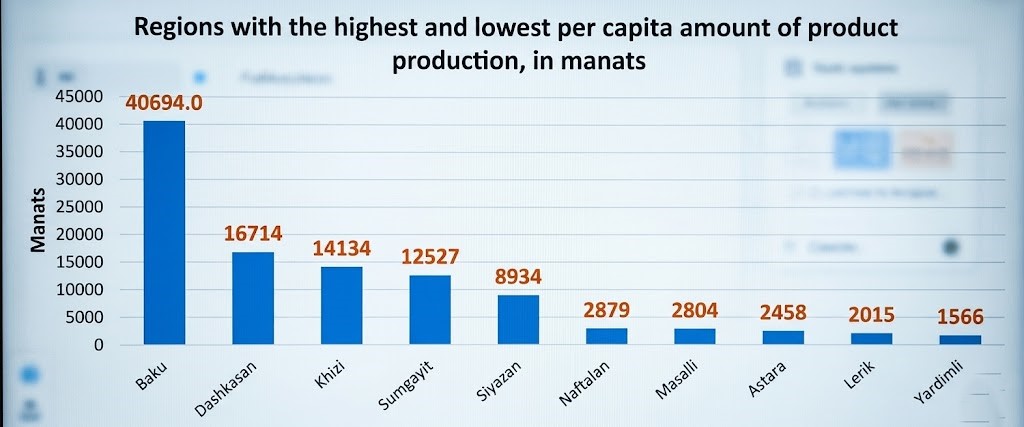
As can be seen from the presented figures, the volume of per capita product output in the city of Baku, which is the center of the country's oil and gas production, is 25 times higher than the analogous indicator of the Yardimli district, which is in last place. It is natural that 2 out of the 5 regions with the highest indicators are Baku and Sumgayit. Because in 2025, 75 percent of the country's GDP, that is, 3 out of every 4 manats of value added generated in the economy, falls precisely to the share of these two administrative territorial units. Two of the remaining three regions – Dashkasan and Siyazan – are also areas where natural resource extraction exists. Approximately 90 percent of the country's silver production and 20 percent of its gold production are extracted in the Dashkasan district. It is precisely due to natural resource extraction that 85 percent of the total product output in Dashkasan is formed in industry. This fact shows that, apart from gold and silver extraction, the economy in Dashkasan is practically non-existent. The issue is that the region also has no earnings from these resources in the form of taxes or resource rent. If this were not the case, Dashkasan would not rank low in the regional rating by the volume of taxes collected in its territory. This can be clearly seen when looking at the document related to the 2026 state budget. The volume of taxes planned to be collected in Dashkasan (7.7 million manats) does not differ significantly from the tax liability (6.4 million) of the Lerik district, one of the two districts with the lowest per capita product indicator. Or the volume of tax revenues of the Gubadli district (7.7 million manats), whose territories have been liberated from occupation, whose population has not yet been relocated, where restoration works are ongoing, and which has virtually no economy, is identical to the indicator of the Dashkasan district (Law "On the State Budget of the Republic of Azerbaijan for 2026"). The mining industry also does not provide a serious employment opportunity for the Dashkasan district. Approximately 5 percent (1,000 people) of the district's 18.5 thousand employed population work in the mining industry.
In Siyazan, although not in large volumes, oil and gas extraction is present. Approximately 10 percent of the country's natural gas and crude oil extracted outside of Baku falls to the share of Siyazan.
The Khizi district, which has a high indicator without natural resources, did not achieve this result due to high economic development at all. If that were the case, this district would not be among the regions with the weakest tax potential. For 2026, the tax liability of the Khizi district has been approved at 6 million manats. Unlike Dashkasan, 85 percent of production in the Khizi district is concentrated in the agrarian sector. But the reason for this is by no means the development of farming. The country's two largest poultry enterprises operate in the district, and since it is the smallest district in the country by population (17 thousand people), the operation of just one or two large factories propels it to the upper tiers of the list in terms of per capita production volume. Statistical indicators also confirm that the high figures of the agrarian sector in Khizi originate from the mentioned enterprises. For example, while only 0.3 percent of the country's arable land and approximately 1 percent of its cattle and small ruminants fall to the share of the Khizi district, 11 percent of the poultry, one-third of poultry meat production, and 22 percent of egg production are provided by the Khizi district.
Incidentally, a study conducted by the Baku Research Institute revealed that Azerbaijan is the country where the greatest inequality is observed according to the share of regions in product production among neighboring countries. It becomes clear from that study that while the difference between the lowest and highest per capita regional product output indicators across the regions in Azerbaijan is nearly 25 times, this figure is 6 in Kazakhstan, 4.5 in Turkey, 4.3 in Armenia, and 2.6 in Georgia (Baku Research Institute 2025).
One of the root causes of inequality in the development of regions is the unequal interregional distribution of investments. Statistics show that wherever investments are concentrated at a high level in the country, a significant part of product production has also been generated there. It can be seen from the information presented below that over 20 years (2005-2025), approximately 70 percent of physical investments made in the country's economy fell to the share of Baku and the Absheron Peninsula. The amount of total investments during the mentioned years was close to 305 billion manats. National accounts statistics show that during that period, the specific weight of this geography in the formation of the country's total product output and national income also fluctuated in the interval of 75-80%. The remaining territory of the country, which disposed of nearly 30 percent of the investments during the 20-year period, was able to generate 20-25 percent of the country's total product output.
The decisive reason for the increase in the specific weight of the country's provinces in investments in recent years is the investments made in the territories liberated from occupation. In 2021-2025, total investments in these territories amounted to nearly 25 billion manats, which is slightly more than 8 percent of total investments in the economy over the last 20 years. This means that nearly 76 percent of the country's 20-year economic investments, or approximately 230 billion manats, have been provided at the expense of Baku and the Absheron Peninsula along with the territories liberated from occupation.
The amount of investments in fixed capital across all administrative territories of the country and their specific weight in the overall indicator are presented in the table below:
The amount of investments by administrative territorial units of the country in 2005-2025 (in mln. manats) and their share in the overall country indicator (in percentage)
As can be seen from official statistical data, in the 20-year investment allocations, the highest share after the city of Baku belongs to the Nakhchivan Autonomous Republic. Up to 5 percent of the investments (14.5 billion manats) were invested in Nakhchivan. Since there is no local and regional elected governance in Azerbaijan, all investment decisions were made from the center. Because there are no local development plans covering individual districts and cities, nor documents detailing their financial capacity and medium- and long-term strategies, the criteria based on which investment needs are evaluated also remain uncertain for society. For example, Shaki and Shamakhi are districts with tourism potential and similar terrain. However, although Shaki has a 45% larger territory and 75% more population compared to Shamakhi, the 20-year investment allocations to both districts were the same (approximately 1.6 billion manats). Or, while Shamkir and Jalilabad have almost the same territorial size and population size, 2.5 times more investments were made in Shamkir.
For comparison, it is worth noting that (Piacentini 2014) currently across OECD countries, 57 percent of public investments are directly disposed of by regional and city elected governance bodies. These investments include all important directions such as transportation, energy, broadband internet, education, healthcare, housing provision, water supply, and sanitation. And elected local governments are directly responsible for 64 percent of public investments related to the environment and climate. Local elected bodies have the capability to finance these investments at the expense of various sources. Across the OECD, approximately 45 percent of the funding source for elected local self-government expenditures consists of local tax collections. In turn, 37 percent of financial resources are formed from grants and subsidies, and 18 percent from other sources (for example, borrowings).
Along with the small share that regions receive from investments, the extremely low potential of the private sector's investment in the provinces is an important point that draws attention. By looking at the share of private investments, an opportunity arises to immediately form an opinion about the economic development of the regions and the level of utilization of their potential. Provinces where business is absent or very weak also mean the existence of a geography where there is no competition, technological backwardness prevails, and there is no stimulus for the development of human capital.
Data on some administrative territorial units where the share of business in investments is extremely small are presented in the diagram below:
The share of the private sector in investment allocations to some districts in 2016-2024, %
Only in the city of Baku, the share of the private sector in total investments over the last 20 years is close to 65 percent. In the majority of the remaining regions, this indicator fluctuates in the interval of 20-40%. For more than 20 administrative territorial units, the ratio of business investments to total investments has been even below 20 percent. As can be seen from the diagram above, even in the Gobustan and Shabran districts, this indicator is around 2-3% – that is, 97-98 manats of every 100 manats invested in these districts comes through state channels.
In fact, the three indicators presented above regarding Azerbaijan – the share of individual regions in the total product output of the economy and in investment allocations, as well as the volume of per capita product production – show that the entire economy in Azerbaijan is formed in a territory that geographically constitutes approximately 5-6 percent of the country - Baku and the Absheron Peninsula. But there are a number of certain important indicators that further strengthen this argument and reality. One such indicator is the structure of the economy of the provinces. An analysis of official statistical indicators shows that in a considerable number of the country's districts, the share of the agrarian sector in the total product output is 50% and higher. The dominant position of agriculture in the economy is one of the very important facts indicating the economic backwardness of the provinces in Azerbaijan. When taking into account that the value-added creation potential of Azerbaijan's agriculture is extremely limited (approximately 6 percent of GDP) and the volume of product per worker in the sector is quite small, it becomes clearer how weak the agrarian-based regional economy is. The real situation across the regions where the agrarian sector has a higher share is presented in the diagram below:
The share of agricultural production in total product output (2025), %
If the territories newly liberated from occupation are not taken into account, the share of the agrarian sector in the economy of almost half of the country's administrative territorial units fluctuates in the interval of 50-85%. This means that agricultural production, which consists of low-income and heavy physical manual labor, also predominates in the employment of those districts. For example, in districts like Aghstafa, Gusar, and Samukh mentioned in the diagram above, the share of agrarian employment is in the interval of 50-65%.
Another important indicator is the amount of taxes collected from the regions and their share in the country's overall budget. In the approved state budget law for 2025, the amount of local budget revenues to be collected from all remaining territories of the country, excluding the city of Baku (Law "On the State Budget for 2025"), is envisaged at 1.4 billion manats, which is equal to only 3.6 percent of the country's state budget revenues, and 9 percent of the budget's aggregate decentralized (local) revenues. The diagram below presents data on the 20 administrative territories of the country with the highest and lowest tax receipts and per capita revenues:
Administrative territorial units of the country with the highest and lowest tax revenues in 2025
The per capita income in the city of Baku is close to 6,000 manats, and this is 10 times more than the indicator of the city of Sumgayit, which stands in 2nd place, and 100 times more than the indicator of the Yardimli district, which stands in the very last place. True, such an argument might be voiced that the agrarian sector predominates in the economy of the regions, and the government has exempted this sector from taxes. But it is a reality that in addition to the share of agriculture in Azerbaijan's GDP being quite small (close to 6 percent), up to 90 percent of the total agricultural output comes from small family farms whose average land size does not exceed 2-3 hectares. In most developing and developed countries, such small farms are already structures that enjoy tax privileges and, conversely, receive subsidy support from the state. Plus, a significant part of the product produced by such farms is not a market turnover subject to taxation but goes to personal consumption. In short, even if tax exemptions for the agrarian sector in Azerbaijan were abolished, it could not create a serious increase in local revenues. For example, the indicator for districts with per capita tax revenues of 60-65 manats could be a maximum of 100 manats, which is still almost 60 times less than the amount considered the maximum across the country.
The "Potemkin village" effect in regional development
Over the past 20 years, the Azerbaijani government has only been able to do one thing to mask the economic backwardness of the regions and the socio-economic inequality between the capital and the regions that has reached the point of a chasm: forgetting the villages where almost half of the country's population resides, it has implemented infrastructure projects that attract public attention mainly in provincial cities (cities of republican subordination like Ganja and Mingachevir, as well as district centers). Such projects include the construction of sports-olympic complexes, youth centers, restoration of roads, etc. But the buildings, which attract attention from the outside with their brilliance, have not ensured economic development in the regions, and in reality, have fulfilled the function of an ornate cover over the severe socio-economic problems in the provinces. There is a very figurative analogy for this in history: at the end of the 18th century, quite some time after Russia took full control of Crimea, Empress Catherine visited the region to see firsthand how life had changed in the newly acquired lands. Because the officials around her had convinced her that these lands taken from the Ottomans were experiencing unimaginable development, and the people were very happy under the auspices of their new state. The sudden visit of the Empress placed Grigory Potemkin, who was responsible for the administration of Crimea and in whom Catherine showed great trust, before two paths: either to solve the problems that had accumulated for years in a short time, or to make the problems appear as if they were solved. It is clear that one could only hope to solve the first option with the power of some imaginary magic wand. Therefore, the second path was immediately chosen: decorations for display were set up along the route the Empress would pass, and the rapidly passing ruler was greeted from the outside by painted houses, neat landscapes, and smiling people.
But of course, behind the decorations, nothing had changed: the people were poor and miserable, and the lands were in a disorganized and disorderly state (Lehtinen 2018). Since then, this incident has been engraved in political and economic literature under the name of the "Potemkin village" effect - simply to denote the fake development hidden behind ornate decorations and propaganda. Azerbaijan is completely rebuilding two of its large regions liberated from occupation. 10 cities and more than 300 villages are being rebuilt. If the traditional extreme centralized governance, not elected by the citizen's vote, will exist in these regions too, and if sufficient economic development for sustainable settlement does not occur, the Karabakh and Eastern Zangezur regions will be one of the most vivid examples of the "Potemkin village" effect in the 21st century.
Main results of the research
The most important conclusion that can be drawn from the research is that currently, countries considered democratic in the world do not have a centralized political system. Although the level of decentralization and autonomy of local governments differs across countries, local self-government exists as a system in all of them. In the authoritarian regimes included in the global democracy index periodically prepared by the "Economist Intelligence Unit", with very few exceptions (Iran, Russia, Azerbaijan, Vietnam, etc.), although the central government has a dominant position in administration, the institution of local self-government also exists. But in authoritarian regimes, local self-government either bears a completely formal character or has limited financial and administrative autonomy, and operates based on the strict frameworks and control of the central government. Elected individuals are able to sit in their seats as de facto appointed officeholders, in accordance with the desire of the central government. Elections embody the will of the central government, not the citizen.
As noted in the theoretical framework section, an even more important conclusion that emerges is that there is a direct connection between the level of decentralization and the level of regional economic development, as well as the scale of interregional socio-economic differences. The higher the level of decentralization and local autonomy, the higher the regional development, and the lower the inter-provincial socio-economic differences. The research clearly demonstrates this reality, especially in the last 20-year history of Azerbaijan, in the period when large oil money flowed and authoritarianism hardened even more in parallel with the rapid taking root of the "resource curse". During this period, municipalities existed, but they gained no real authority in solving local socio-economic problems. Not even the financial resources for the execution of the most limited powers were placed at their disposal. It is enough to pay attention to just this fact that in Azerbaijan, the per capita amount of municipal budget revenues across the country is less than 4 dollars. And this is more than 20 times less compared to Armenia, whose economy is almost 4 times smaller than Azerbaijan's.
Regional economic development in Azerbaijan is very weak, and almost 80 percent of the total product output across the country is formed in Baku and its surrounding areas. The share of the provinces, which constitute 95 percent of the country's geographical territory, in the national income is 20%, and their specific weight in the country's budget revenues is approximately 3.5%. The difference between the corresponding indicators of the regions where the amount of per capita product output is the highest and the lowest in the country is close to 25 times, and for per capita budget revenues, it is close to 100 times. At the same time, over the last 20 years, only 25 percent of investments in the country's economy have been directed outside Baku and the Absheron Peninsula - to the provinces.
Consequently, the absence of elected local self-government in the country, which is formed by the will of the citizen, can study local socio-economic needs more professionally, has the capability to conduct medium- and long-term planning, and possesses necessary powers and financial resources, has remained the most serious obstacle to regional development in Azerbaijan.
Precisely for this reason, the first step in the country's development passes through the implementation of decentralization.
Note: The article you have read was originally written in the Azerbaijani language. Artificial intelligence tools were used only in the translation.
References
Economist Intelligence Unit. 2025. Democracy Index 2025. Economist Intelligence Unit. https://www.eiu.com/n/campaigns/democracy-index-2025/
Busygina, Irina, Mikhail Filippov, and Elmira Taukebaeva. 2017. "To Decentralize or to Continue on the Centralization Track: The Cases of Authoritarian Regimes in Russia and Kazakhstan." Journal of Eurasian Studies 9, no. 1 (2017): 61-71. Accessed June 2, 2026. https://www.sciencedirect.com/science/article/pii/S1879366517300295.
Tocqueville, Alexis de. 2010. Democracy in America: Historical-Critical Edition of De la démocratie en Amérique. Vol. 1. Edited by Eduardo Nolla. Translated by James T. Schleifer. Indianapolis: Liberty Fund. https://classiques.uqam.ca/classiques/De_tocqueville_alexis/democracy_in_america_historical_critical_ed/democracy_in_america_vol_1.pdf
ResPlatforma. 2023. "Identity Declaration." Accessed June 3, 2026. https://resplatform.org/en/page/identity-declaration
Dennis A. Rondinelli, 1997. Technical Consultation on Decentralization. P.133–145. https://www.researchgate.net/publication/249792247_Decentralization_and_Local_Government_Performance
Charles M. Tiebout, 1956. A Pure Theory of Local Expenditures. P 416–424. https://fbaum.unc.edu/teaching/PLSC541_Fall08/tiebout_1956.pdf
WALLACE E. OATE, 1972. An Essay on Fiscal Federalism. p.54. https://fiscalfederalism.eu/wp-content/uploads/2020/05/ALLGEMEIN-Lit-1999-Oates-An-Essay-on-Fiscal-Federalism.pdf
Buchanan and Gordon Tullock, 1962. The Calculus of Consent. https://www.econlib.org/library/Buchanan/buchCv3.html
Daron Acemoglu və James A. Robinson, 2012. Why Nations Fail: The Origins of Power, Prosperity, and Poverty. https://economics.mit.edu/sites/default/files/inline-files/Why%20Nations%20Fail.pdf
Remy Prudhomme, 1998. The Dangers of Decentralization. https://documents1.worldbank.org/curated/en/602551468154155279/pdf/770740JRN0WBRO0Box0377291B00PUBLIC0.pdf
“Yerli özünüidarə haqqında” Avropa Xartiyasının təsdiq edilməsi barədə Azərbaycan Respublikasının Qanunu [Law of the Republic of Azerbaijan on the Approval of the European Charter on Local Self-Government], Law No. 238-IIQ (December 25, 2001), https://e-qanun.az/framework/1026.
“Bələdiyyələrin statusu haqqında” Azərbaycan Respublikasının Qanunu [Law of the Republic of Azerbaijan on the Status of Municipalities], Law No. 698-IQ (July 2, 1999), https://e-qanun.az/framework/4770
“Bələdiyyələrin maliyyəsinin əsasları haqqında” Azərbaycan Respublikasının Qanunu [Law of the Republic of Azerbaijan on the Fundamentals of Municipal Finance], Law No. 772-IQ (December 7, 1999) https://e-qanun.az/framework/5231
“Bələdiyyələrin əraziləri və torpaqları haqqında” Azərbaycan Respublikasının Qanunu [Law of the Republic of Azerbaijan on Municipal Territories and Lands], Law No. 771-IQ (December 7, 1999),
https://e-qanun.az/framework/5230
Dövlət Statstika Komitəsi: “Bələdiyyə büdcələrinin icrası Hesabatı: 2025-ci il”. https://www.stat.gov.az/source/finance/
Council of Europe. Congress of Local and Regional Authorities. 2021. Monitoring of the Application of the European Charter of Local Self-Government in Armenia. CPL(2021)40-02final. https://rm.coe.int/0900001680a288a5.
State Statistical Committee of the Republic of Azerbaijan. n.d. "Regionlar üzrə ümumi məhsul buraxılışına dair hesabat" [Report on gross output by regions]. Accessed June 3, 2026. https://www.stat.gov.az/source/system_nat_accounts/.
Piacentini, Mario. 2014. Measuring Income Inequality and Poverty at the Regional Level in OECD Countries. OECD Statistics Working Papers, no. 2014/03. Paris: OECD Publishing. https://www.oecd.org/content/dam/oecd/en/publications/reports/2014/08/measuring-income-inequality-and-poverty-at-the-regional-level-in-oecd-countries_g17a2527/5jxzf5khtg9t-en.pdf.
“Azərbaycan Respublikasının 2025-ci il dövlət büdcəsi haqqında” Azərbaycan Respublikasının Qanunu [Law of the Republic of Azerbaijan on the 2025 State Budget of the Republic of Azerbaijan], Law No. 93-VIIQ (December 16, 2024), https://e-qanun.az/framework/58614.
Baku Research Institute. 2025. "Əyalətlərin iqtisadiyyata töhfəsi: Azərbaycan və region ölkələrinin müqayisəsi" [The contribution of the provinces to the economy: A comparison of Azerbaijan and regional countries]. July 29, 2025. https://bakuresearchinstitute.org/eyaletlerin-iqtisadiyyata-tohfesi-azerbaycan-ve-region-olkelerinin-muqayisesi/.
Lehtinen, Linde B. 2018. "The haunting artifice of fake villages around the world." CNN Style, March 27, 2018. https://edition.cnn.com/style/article/potemkin-village-gregor-sailer.
