
(This article was prepared by the analytical group of the Khar Center within the framework of research on Azerbaijani authoritarianism)
Introduction
Despite continuous discussions for over 20 years and even the formation of a certain legal framework, the Azerbaijani government did not implement a mechanism for publicly disclosing information about the income and wealth of public officials in the country. In fact, this is expected behavior. This 20-year period, during which the country obtained enormous oil and gas revenues, was a time when a long-lasting authoritarian political power fueled by unimaginable corruption was established. Could anything be more natural than a political oligarchy—which enriched itself by embezzling the state's rentier earnings through the most diverse corruption schemes—being interested in hiding its unimaginable wealth from society?
Legal initiatives regarding the disclosure of information on the income and wealth of public officials in Azerbaijan coincide with periods when public funds available for budget theft were extremely limited. For example, the Law "On Combating Corruption" was adopted in 2004. Article 5 of the law states that public officials must annually disclose information regarding their income, property, deposits in credit institutions, securities and other financial funds, participation as a shareholder or founder in various economic entities, their property share in those enterprises, as well as debts exceeding 5,500 manats, specifying the source, type, and amount (Law "On Combating Corruption").
Alternatively, the Law "On the Approval of the Rules for the Submission of Financial Information by Public Officials" was adopted in 2005. This document also requires public officials to submit an annual declaration of income and wealth not only for themselves but also for their spouses, children living with them, and parents (Law "On the Approval of the Rules for the Submission of Financial Information by Public Officials").
The period when these laws were adopted was a time when the overall revenues the government obtained through the state budget and the State Oil Fund were about 10-12 times less than today, meaning approximately 2.5-3 billion dollars. Revenues from the oil and gas sector did not exceed 1.5 billion dollars, which currently stands close to 15 billion dollars. In the years 2011-2014, the government's annual consolidated oil and gas revenues even exceeded 20 billion dollars.
The ensuing years demonstrated that as gratuitously earned resource revenues and the appetite of oligarch groups to steal them rapidly increased, the obligations of officials to disclose their income and wealth were pushed into the background, just like all transparency initiatives. Even the disclosure of income obtained during his 5-month parliamentary activity by Erkin Gadirli, a newly elected deputy in 2020 who had not yet fully absorbed the characteristics of the regime, became the first and last example (Unikal.az, 2020). It is clear that the government did not appreciate this example, and Erkin Gadirli never engaged in such "alien" behavior again.
In conditions where alternative political institutions, independent media, and civil society have been completely eliminated, information sources reminding the public of this legal obligation are very scarce. The sole reason for this is not just public officials evading the submission of income and wealth declarations. Another important reason is that current legislation prohibits the disclosure of the founders (real owners) of business structures. Thus, according to the Law "On State Registration of Legal Entities," information about the founders of business entities, their shares in the authorized capital, and their beneficial owners cannot be provided to third parties even upon request (Law "On State Registration of Legal Entities"). Attempts to call for keeping this information on the agenda and turning it into a continuous public demand go unheard.
Unfortunately, information about the scale and dynamics of how high-ranking officials and their families in Azerbaijan enrich themselves directly at the expense of public resources can only be obtained based on a court decision. Under such conditions, if any official registers a business entity in the name of their first-degree relatives and obtains actual profit from entrepreneurial activity, society remains either completely unaware of this due to legal prohibitions or has to settle for inaccurate information based on circulating rumors.
The consequences of public officials keeping their income and wealth hidden from society are very severe. Because the appetite of the corruption machine continuously grows, public funds that should be directed towards society's real needs (education, healthcare, social protection, etc.) are spent on enriching public officials mainly through useless, and rarely even if useful, overvalued budget orders. Over a long period, this continuously operating wheel creates a massive chasm between the financial capabilities of officials and business representatives affiliated with them, and the rest of society. Unfortunately, since an independent and professional statistical institute cannot operate in an authoritarian political system, there is no source to measure and publicize the existing social inequality. International structures like the World Bank, which have established very close cooperative relations with Azerbaijan's authoritarian government over many years, also do not come forward with autonomous initiatives to calculate income and wealth inequality (the Gini coefficient), as well as the real poverty level, based on indirect data and indicators.
The purpose of this research presented by the Khar Center is to highlight the problems caused by the non-functioning of this mechanism in Azerbaijan, based on worldwide practices regarding the submission of income and wealth declarations by public officials.
The research attempts to answer the question: How does the non-functioning of income and wealth declarations under conditions of authoritarian governance affect the sustainability of the corruption system?
International Requirements Regarding the Disclosure of Income and Wealth of Public Officials
The Organization for Economic Co-operation and Development (OECD) is known as the institution demonstrating the most systematic and professional approach to the issue of disclosing the income and wealth of public officials. The organization has both extensive research in this field and periodic monitoring reports on anti-corruption initiatives in various countries. A guide prepared by OECD experts in 2011 on the subject notes that the usefulness of public officials submitting a declaration of their financial means can be justified by various reasons. For example, by disclosing information about their wealth, politicians and civil servants achieve both an increase in transparency and a strengthening of citizens' trust in state administration. Officials demonstrate to society that they have nothing to hide. Another reason is to prevent conflicts of interest between management and rank-and-file employees in state institutions and to promote integrity within the institution. Finally, another important reason consists of deterring politicians and civil servants from illegal behavior by subjecting changes in their wealth and earnings to continuous tracking, and forming a necessary evidence base to detect illicit enrichment (Asset Declarations for Public Officials: A tool to prevent corruption).
Prerequisites and opportunities must also be considered for the implementation of this system. This includes supporting parties (responsible leaders, honest officials, active media), the existing legal framework (tax system, property registry, and other state registrations, effective law enforcement agencies), and limitations (budget deficits, weakness of political will against corruption, low level of discipline in state administration). Based on these factors, an optimal and workable model from legal, financial, personnel, and other perspectives must be determined.
Expectations from active declaration systems must be realistic. This system is only one of the tools helping to prevent corruption and is not sufficient on its own, especially in countries where democracy is not mature, corruption is widespread, the tax system functions poorly, and law enforcement agencies are not effective. Nevertheless, a well-designed and properly functioning active declaration system can be a crucial element of a country's overall anti-corruption and integrity system.
International parties encouraging the implementation or strengthening of declaration systems for state officials should not try to apply one-size-fits-all standard technical solutions. Instead, they should collaborate with local stakeholders, advance their political goals, create a national demand for reforms, find solutions appropriate for local conditions, and support the sustainability of these reforms.
The approach of OECD experts is that applying a uniform declaration system to all branches of power (legislative, executive, and judicial) can be problematic. This is because their level of responsibility, authority, conflict of interest, and corruption risk are different. For this reason, a specific declaration form and requirements can be applied to each of them. However, a common standard for all of them is the condition that declaration data of public officials—whether elected, from the executive branch, or from the judicial and prosecutorial system—must be open to the public.
OECD experts believe that the obligation to disclose a declaration should be differentiated according to the level of position and responsibility. Requirements can be stricter for deputies and high-ranking officials, and lighter for middle and low-level officials. In addition, corruption-prone public officials prefer to register their property in the names of close relatives, spouses, and other family members. Therefore, there must be a certain tracking mechanism not only for the wealth of the public official themselves but also for their close relatives and family members living with them. This can be implemented through a declaration system, tax mechanisms, or law enforcement agencies. However, in doing so, the principle of privacy of personal life must absolutely be protected.
The most important international standard regarding the declaration of income and wealth by public officials is the UN "Convention against Corruption." According to paragraph 5 of Article 8 of the document, in accordance with the fundamental principles of the national legal systems of member states, a declaration system for public officials should be established; information about their financial obligations, investments and assets, incomes, as well as gifts they receive should be collected; and penalization should be envisioned for officials violating the requirements of the legislation (UN "Convention against Corruption").
In 2009, the UN also prepared a Technical Guide for this Convention. In that document, a number of additional recommendations are presented. According to recommendations aimed at building more effective wealth and income declaration systems, the declaration must cover all main types of income and property of state officials and their relatives, and the declaration forms should allow for year-on-year comparisons and tracking changes in the financial situation of public officials.
Another important international initiative is the "Istanbul Anti-Corruption Action Plan" adopted under the umbrella of the OECD in 2003. The initiative covers 10 countries in Eastern Europe, the South Caucasus, and Central Asia: Azerbaijan, Georgia, Armenia, Ukraine, Moldova, Kazakhstan, Uzbekistan, Kyrgyzstan, Tajikistan, and Mongolia (OECD's "Istanbul Anti-Corruption Action Plan").
The goal of the plan consists of improving anti-corruption legislation in the participating countries, increasing transparency and accountability in state administration, as well as developing mechanisms to fight corruption. The implementation mechanism of the Istanbul Plan is as follows: countries are regularly evaluated, given specific recommendations, and the level of implementation of the recommendations is monitored.
The monitoring and evaluations conducted cover national anti-corruption strategies, ethical rules and conflicts of interest in the civil service, the wealth and income declaration system, and finally, public procurement. OECD experts have conducted monitoring across the participating countries 5 times so far. The first monitoring was carried out in 2003-2005, and the latest (5th) monitoring in 2023-2026.
The Landscape of Corruption in Azerbaijan: International Ratings and Reports
If public officials try to keep their income and wealth maximally hidden, persistently evading making them public, the probability that large-scale corruption has turned into a tool for personal enrichment in that country is undoubtedly high. The reports published annually by Transparency International to evaluate the level of corruption in the world create a certain idea about in which country officials are the wealthiest social group. The organization compiles a ranking of countries based on a 100-point scale according to the level of corruption prevalence in the public sector (Transparency International's "Corruption Perceptions Index"). The highest score (100) reflects the absence of corruption, and the lowest score (0) reflects that the country is corrupted to the maximum level. The recently released report states that many states give the green light to the disappearance of transparency and accountability by restricting the activities of independent civil society and free media and turning them into dangerous work. The massive corruption money obtained is legalized or taken out of the country through various money laundering schemes. According to the report, the Eastern Europe and Central Asia region remains one of the poorest performing regions in the world in the fight against corruption. The environment of impunity is further strengthened by interest groups that control most governments and institutions in this geography. In a separate statement on the results of the evaluation for Eastern Europe and Central Asia, the following are noted as main problems for a number of countries in this region: uncontrolled exploitation of natural resources, judges and prosecutors being under strict government control, adoption of laws restricting the activities of NGOs and labeling them as "foreign agents," politically motivated persecutions, and the suppression of media freedom. According to the organization's approach, it is impossible to prevent corruption and illicit enrichment without ensuring transparency and public control in the organization of public services and the management of public finances (Corruption Perceptions Index 2025: weak institutions are fuelling corruption in Eastern Europe and Central Asia).
According to Transparency International's report for 2025, Azerbaijan ranked 130th among 182 countries with 30 points in the global corruption index. In the other 2 countries of the South Caucasus, the situation is incomparably better than in Azerbaijan. In that ranking, Georgia is 56th and Armenia is 65th.
According to continuous reports by Transparency International, the scale of corruption in Azerbaijan has hardly shrunk over the last 10 years. Thus, in the 2015 global corruption ranking, Azerbaijan was in 119th place among 167 countries with 29 points. But, for example, Armenia achieved significant progress during that period. That country had been in 95th place in the 2015 ranking. Looking precisely at Azerbaijan's position in Transparency International's corruption ranking makes the reason why public officials hide their income and wealth more clearly visible.
The influx of large volumes of oil money played a significant role in corruption taking on a massive scale in Azerbaijan. Officials who had a budget of approximately 1.5-2 billion dollars at their disposal in the early 2000s obtained the opportunity to spend almost 25 billion dollars in funds over 15-20 years. The graph below clearly shows how the volume of financial resources the government gained the opportunity to manage changed over the years (data regarding budget indicators was taken from the reports of the Ministry of Finance and the Oil Fund):
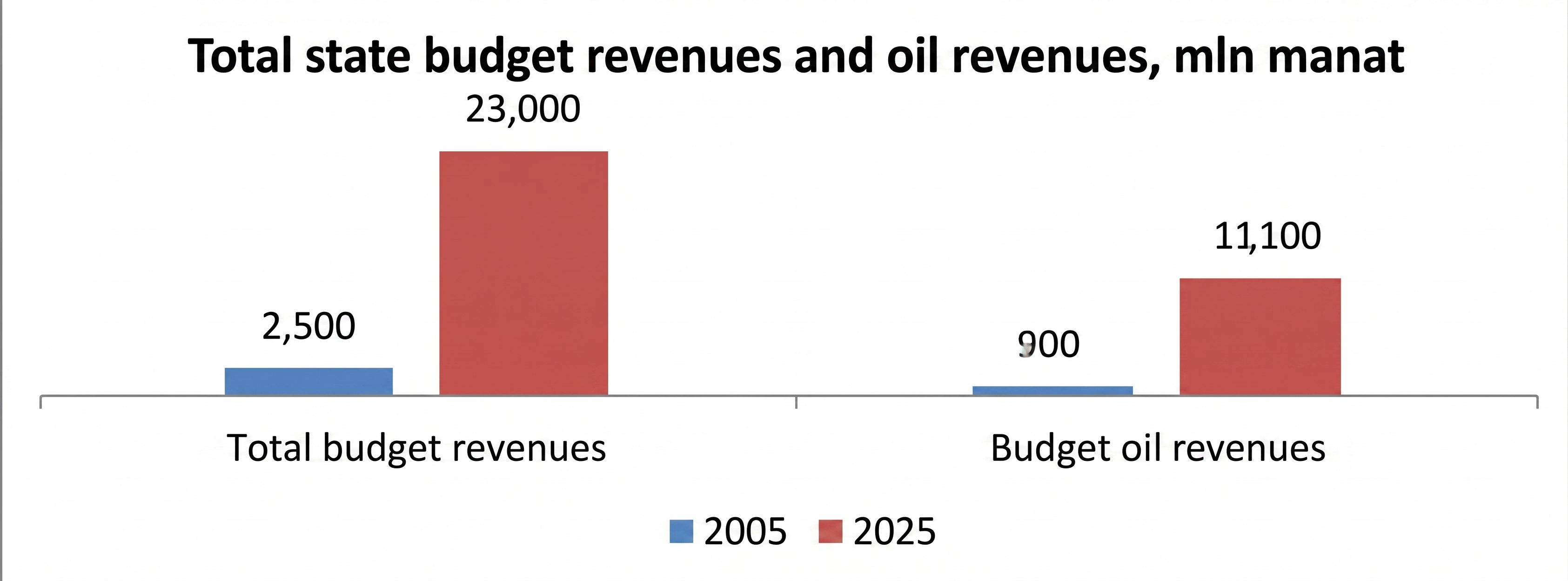
As can be seen from the provided information, over 20 years, state budget revenues have increased more than 9 times, and oil revenues by nearly 12 times. Having at one's disposal such large funds coincides with a period characterized by the absence of an independent parliament capable of demanding any accountability from the government, the lack of effective procurement legislation, as well as the non-application of a declaration mechanism regarding the income and wealth of public officials. Considering that since 2014, free media and independent civil society have also been completely eliminated in the country, it becomes clearly evident to what extent a fertile environment has been created for large-scale corruption and uncontrolled enrichment.
The periodic monitoring conducted by the OECD in connection with the implementation of the "Istanbul Anti-Corruption Action Plan" allows for evaluating the legal environment regarding the mitigation of corruption in the aforementioned partner countries, including the application of mechanisms for declaring the income and wealth of officials, as well as conducting cross-country comparisons.
In the document titled "Report on Anti-Corruption Reforms in Azerbaijan" (5th Round) published in 2024 regarding Azerbaijan, the current situation in the field of public officials declaring their income and wealth was evaluated based on various indicators. The main questions posed in the evaluation are: do income and wealth declarations apply to public officials with a high risk of corruption, do they have a broad scope, are they transparent to the public, and have they been digitized? Here, digitalization implies the existence of several important elements. For example, are declarations submitted online rather than on paper, is all data collected in a centralized (unified) electronic database, can necessary information be verified based on integrated databases (e.g., tax, bank, or real estate data), can risks and suspicious changes be detected by the system, is the information accessible to the public online, etc. (Baseline Report of the Fifth Round of Monitoring of Anti‑Corruption Reforms in Azerbaijan).
According to the results of the evaluation, none of the key officeholders with a high risk of corruption and conflict of interest in Azerbaijan currently submit a declaration. The report also lists the titles of those public officials: the president of the country, members of parliament, members of the government and their deputies, heads of central state bodies and their deputies, members of collegial central state bodies, including independent market regulators and supervisory bodies, the head of the National Bank and members of the Management Board, the head and members of the supreme audit institution, staff of the private offices of persons holding political positions (e.g., advisors and assistants), heads of regional executive powers and municipalities, judges of all levels of courts, prosecutors, and high-ranking officials of state companies.
For comparison, it is important to note that according to a similar report released by the OECD in late 2025 regarding Armenia, officials across all the aforementioned groups in this country, with the exception of judges, submit declarations. With the amendments made to the Law "On Civil Service" in 2022, the scope of persons submitting declarations was expanded. According to the amendment, leading officials of enterprises with a state share of more than 50 percent, state funds, and municipal companies have an obligation to submit a declaration when required (Armenia Fifth Round of Anti‑Corruption Monitoring Follow‑Up Report).
According to the monitoring report, Azerbaijan's non-functional legislation, which remains on paper, is full of very serious limitations. For example, existing legal documents envisage including only information about public officials' incomes, financial obligations, and shares in business entities in their declarations. However, there is no requirement to include information regarding bank accounts, gifts received and their sources, earnings from additional work, or debts they have given in the declaration.
According to the OECD's evaluations, the inclusion of information regarding the real ownership (beneficial ownership) of companies by public officials in Azerbaijan is also not envisaged in the declaration. However, this is among the most important requirements of international rules (FATF) related to the prevention of money laundering and terrorism. Beneficial ownership means who the real owner of the company is, not just on paper. According to the FATF's approach, if beneficial ownership is revealed, it becomes impossible for public officials to hide their incomes and their sources. The report notes that Azerbaijan's current legislation also does not require the disclosure of information related to public officials' connections with trust funds and ownership of virtual assets (cryptocurrencies). Trust funds are special structures created to manage property and derive profit from it. For instance, a public official transfers their wealth to that fund based on an agreement, and the fund manages it and makes a profit as the owner of the assets. In return for the service, by taking its share of the profit, it delivers the remaining part to the real owner. This mechanism not only provides annual profit but also secretly protects the public official's wealth. Trust funds are considered one of the ideal mechanisms with quite legal grounds for hiding illegal earnings. That is, these institutions are not illegal, but there is no transparency either.
An even more important point highlighted by the monitoring is that Azerbaijani legislation does not envisage the disclosure of information regarding the assets, incomes, debts, and expenses of family members (at least the spouse and other persons living in the same house) in the declaration. According to the OECD's information, during the monitoring, the Azerbaijani side stated that the creation of an electronic declaration system would be completed within the framework of the "National Action Plan for Combating Corruption for 2022–2026". We are already halfway through 2026, but there is still no information in open information sources regarding the Azerbaijani government taking any steps or holding any official discussions in this area.
According to the approach of OECD experts, in best practices, the online declaration system for public officials should operate in real-time integration with a number of important databases – the registry of legal entities, the registry of civil acts, the address registry, the land and property registry, the vehicle registry, the tax database, the depositors' registry, and the credit registry. In Azerbaijan, however, there is no declaration mechanism at all, and therefore such integration cannot be possible.
In an environment where independent civil society and free media have been completely eliminated, opposition political activity is penalized, and a parliament demanding accountability from the government does not exist, the non-functioning of the income and wealth declaration mechanism for public officials can have only one logical consequence: officials with the ability to spend enormous financial and natural resource funds acquire as much illegal income as possible through non-transparent tenders, and thanks to these funds, they manage to provide business structures and financial savings for their relatives both domestically and abroad. The saying "Money makes money" accurately explains such a situation. In a completely uncontrolled and non-transparent environment, stolen public funds continuously increase through the most diverse money laundering schemes, creating a class of "millionaire officials" enriched by the political power. In countries where closed and non-transparent governance prevails, even if they are not official millionaires, sometimes the struggle of intra-government groups, sometimes facts obtained through different channels by internet media resources that the government cannot control, and sometimes information revealed on the basis of official documents in courts set up for dismissed government representatives present the public with certain information about the scale of the vast wealth owned by individual public officials.
Wealthy Azerbaijani Officials Who Do Not Disclose Wealth Declarations
Undoubtedly, it would not be correct to consider all information periodically spread in the internet media about officials' wealth measured in millions of dollars as reliable. However, if these facts are not true, at the very least, those officials could file a lawsuit for defamation against the journalists living abroad who uncover these facts and demand a retraction. Or, if proxy media within the country spreads a list of the wealth of current or dismissed former officials, they could submit an inquiry to the property authority and issue an official denial stating that these properties do not belong to them, or file a lawsuit in court against the media outlet spreading the news. For example, the website https://qafqazinfo.az/ is an internet media outlet completely under the control of the government, continuously publishing defamatory and blackmailing materials against independent civil society and journalists. It is one of the institutions to which the government allocates funding from the state budget through the Media Development Agency. About a month ago (on April 17, 2026), this website published an article about the wealth of the current Prime Minister Ali Asadov (Qafqazinfo.az, 2026). Neither the prime minister himself nor the institution he represents denied the facts voiced in this article. That investigation notes that it is possible to name dozens of high-ranking officials who have created business empires for themselves while currently in office. The article focuses on the name of Prime Minister Ali Asadov and presents a list of a certain portion of his wealth. The names and addresses of all property and business facilities are explicitly reflected in this list, and there can be no talk of any ambiguity. Overall, the article includes the names of 6 restaurants allegedly belonging to the prime minister and located in the most prestigious addresses of the capital, 3 non-residential properties used as offices, and 6 multi-story residential complexes. If an evaluation is made with the most approximate calculations, the value of this wealth is measured in tens of millions of dollars.
It is possible to find an overwhelming number of articles and investigations on internet resources regarding the value of wealth owned by various public officials. For instance, investigations were published regarding the large overseas investments of the son of Ahmad Ahmadzada, who was at the helm of the country's land reclamation economy for nearly 30 years—and who is also the son-in-law of Elman Rustamov, who headed the country's Central Bank for over 25 years—while both individuals were still in office. For example, an investigation prepared in 2018 based on the submitted reports of the Czech Ministry of Finance reveals that the officials' children own tangible and intangible wealth valued at nearly 4 million dollars in this country (Xalqxeber, 2019). Meanwhile, the Organized Crime and Corruption Reporting Project (OCCRP) revealed in 2020 that Ahmad Ahmadzada bought an apartment worth 2.3 million dollars in London for his child (Bakupost, 2021).
In another investigation spread in the internet media, a list of 35 residential and non-residential properties belonging to Ali Hasanov, who was a department head of the Presidential Administration for nearly 25 years, valued in the tens of millions of manats, was published along with the exact addresses where they are located (Konkret.az, 2025). Around that time, detailed information about Ali Hasanov's business in Georgia was also made public based on the data of the Georgian registry system (Qafqazinfo.az, 2021).
Such investigations might have seemed exaggerated and biased. However, no one can deny the facts that emerge in courts.
In 2023, a scandal erupted in the United Kingdom surrounding the massive wealth of another public official—member of the Azerbaijani Parliament Javanshir Feyziyev. The UK's National Crime Agency decided to freeze them, based on solid evidence that properties worth 63 million dollars belonging to Feyziyev and his wife were obtained through money laundering (Voice of America, 2024). This fact also shows that official figures can very easily take the wealth they earned in Azerbaijan out of the country.
Over the last 10 years, local courts in Azerbaijan and the indictments of tried high-ranking officials have also led to the publicization of a considerable amount of information regarding the volume of their illegally acquired wealth. For instance, from the information disclosed at the trial in 2021 of Vugar Safarli, who for many years headed the Fund with broad financial capabilities that provided state support to media development, it became clear that the total value of the financial wealth of him and his family in various banks, as well as their movable and immovable property, is more than 1.5 million manats (Qafqazinfo.az, 2021). Undoubtedly, because it was accessible, the court could only obtain information regarding assets located within the country.
At the trial of General Akif Chovdarov, who held a high position in the State Security Service for many years, it was revealed that the total value of the property to be confiscated from him and his family members is close to 30 million manats (Meydan TV, 2024).
At the trial of Salim Muslumov, who held the positions of Deputy Chairman of the State Customs Committee, Chairman of the State Social Protection Fund, and Minister of Social Protection for nearly 25 years, it became clear that he returned 20 million in funds to the budget to compensate for the damage caused to the state; in addition, 6 apartments, 2 commercial properties, and 2 plots of land were confiscated (Qafqazinfo.az, 2024).
Finally, opinions regarding the country's president's family being the richest family in the country can be heard regularly. Because President Ilham Aliyev and his wife, who is currently the Vice President of the country, have not disclosed an income and wealth declaration, it is impossible to find reliable information about this. However, Ilham Aliyev has participated in elections as a candidate a total of 7 times (2 times for Parliament, 5 times for president), and his wife 4 times (for Parliament), and they had an obligation to disclose information about their own income and wealth. But from a discussion by experts in 2010, it becomes clear that there is no information related to companies, properties, incomes, facilities, etc., in the declaration Ilham Aliyev submitted to the CEC during the 2003 and 2008 presidential elections (Yeni Musavat, 2010). Moreover, according to international media reports at the time, in the income declaration he submitted to the CEC in 2003, Ilham Aliyev indicated that he had an annual income of only 6,700 US dollars (Al Jazeera, 2003). However, it is impossible to find any information reflected in those declarations in open sources today. Instead, there are journalistic investigations regarding the properties owned by the presidential family abroad, valued at 100 million dollars. For example, back in 2018, an investigation conducted by the Organized Crime and Corruption Reporting Project (OCCRP) discovered that the presidential family has 17 properties in Dubai with a total value of nearly 100 million dollars ("The Property Empire of the President's Daughters in Dubai"). Earlier, in a 2010 article published by Radio Liberty citing the Washington Post publication, it is shown that the real estate purchasing activities related to the Aliyevs' properties in Dubai started in 2008. Property registered in Dubai in the name of 3 persons bearing the same names as President Aliyev's children is 330 times greater than his annual salary (Radio Liberty, 2010).
Another OCCRP investigation released in 2021 uncovered properties in London belonging to the ruling family worth more than 700 million dollars (Voice of America, 2021). Additionally, certain information can be obtained from the official websites of various companies belonging to the ruling family within the country, and this provides certain information about the scale of the wealth owned by the presidential family.
But there is also a massive business network that is not hidden by them, which belongs to the presidential family. We are talking about the "Pasha Holding" Group of Companies, with a total value of assets approaching 15 billion dollars ("PASHA Group Overview"). Paying attention to the company's official website makes it clear that almost 40 percent of the assets of Azerbaijan's banking sector are at the disposal of the family banks ("Kapital Bank" and "Pasha Bank"). More than 15 structures included in the holding's network operate in the financial sector (5 structures, including 2 abroad), the investment and brokerage segment (2 structures), the construction sector (2 structures), the tourism sector (2 structures), and other sectors (4 structures). Some structures have their own giant networks. For example, within the "Absheron Hotel Group", a subsidiary of "PASHA Holding" LLC, 11 different hotels operate ("Baku Marriott Hotel Boulevard", "Sheraton Baku Intouris", "Courtyard by Marriott Baku", "Pik Palace, Shahdag", "Autograph Collection", "Park Chalet, Shahdag", "Autograph Collection", "Dinamo Hotel Baku", "The Merchant Baku", "Bilgah Beach Hotel", "Allium Bodrum Resort & Spa", "Boutique 19 Hotel", "Art Gallery Hotel").
President Ilham Aliyev himself, in a statement to the press, did not hide the fact that his family possesses broad business opportunities (Fed.az, 2021). In a 2021 interview with the Italian newspaper "La Repubblica," he said that he engaged in business before becoming president, and then transferred his business to his family. However, during the 9 years prior to becoming president, Ilham Aliyev also held official positions as both a member of the National Assembly and the 1st Vice-President of the State Oil Company. His biography published on the president's official website shows that he was engaged in business activity for only 3 years (in 1991-1994) (President.az). But what company or companies he established, where they operated, what their real work was—all these remain serious questions, and there is not even a small fact in open sources to confirm this information. The most interesting question is, how much profit did the country's president make in 3 years of business, which allowed him to build the current giant business empire valued at billions of dollars? Another important question: if the presidential family had a business in the early 90s, why did no information about it emerge over the next 10 years or more (in 1994-2004), and in official sources, the flourishing period of this business coincides with the post-2005 period? As mentioned above, when he first ran for president, he indicated in the declaration submitted to the CEC that his and his family's income consisted solely of his parliamentary salary and that he owned only one apartment. Also, according to official sources, the flourishing period of the family business coincides with the post-2005 period. For instance, according to official information on the "Pasha Holding" website, the company was established in 2006. And over the past 20 years, the value of its assets has expanded from a few million dollars to 15 billion dollars.
2006 was a period when big oil money had newly entered Azerbaijan, and the country's state budget barely reached 2 billion dollars; there were almost no currency reserves. Interestingly, over the last 20 years, the country's budget has grown approximately 20 times, and the volume of the presidential family's assets has increased by about the same amount. For example, in the banking sector alone, the 2 banks belonging to the presidential family ("Kapital Bank" and "Pasha Bank") get the largest share of the sector's profits, and this can be seen from the diagram below:
As can be seen from the figures, these two banks belonging to the family of the country's president own 36.3 percent of the sector's assets and 40 percent of the profits as of the end of 2025. That is, out of every 100 manats of profit earned by nearly 20 banks, 40 manats go directly to these 2 family banks. The fact that these banks, especially "Kapital Bank", have special privileges in servicing budget accounts and accounts for social and other payments paid from the budget plays an important role in the banks operating with high profits. For information, it is worth noting that in 2016, the share of these two banks in the sector's assets was around 19%. As can be seen, over the past 9 years, this indicator has increased almost 2 times. In turn, during this period, the net profit of the 2 banks increased more than 5 times and approached 500 million manats (Azerbaijan Banks Association).
In any case, there are no dark spots in this matter. Even if declarations are not disclosed, all archival information exists regarding what properties and movable-immovable assets, bank accounts, and financial turnovers any public official has owned over the past 30 years. No, if they destroy this information, it is again to their own detriment. Because in the event that even a slightly transparent environment is created, the sudden appearance of a business without roots will turn into a much bigger evidence of a crime.
Main Results of the Research
The research once again shows that in an environment where all opportunities for the functioning of democratic institutions are eliminated and long-lasting resource dictatorships exist, favorable levers are formed for corruption and unimaginable enrichment through political power.
Over 20 years, the volume of funds the government disposed of through the state budget precisely at the expense of natural resource revenues increased nearly 10 times. In parallel with the expansion of budget opportunities, all institutions of public control (free media and independent civil society) and opposition political institutions in the country were completely eliminated, and a parliament was formed based on lists compiled by the political power.
Under conditions where the parliament and the mechanism of public control were completely destroyed and enormous rent money was spent, individuals representing the government refused to submit declarations regarding their wealth and income. Although, on the eve of the rent money starting to flow in, important laws such as "On Combating Corruption" and "On the Approval of the Rules for the Submission of Financial Information by Public Officials" were adopted, which envisaged the creation of such a mechanism.
The government did not fulfill the requirements of these laws it had adopted itself. As a result, the opportunity to track the scale and dynamics of how high-ranking officials and their families in Azerbaijan enrich themselves directly at the expense of public resources has been completely eliminated. However, no matter how much official figures try to keep their income and wealth hidden from society, numerous facts regarding the wealth of the most diverse representatives of the Azerbaijani government emerge from time to time through various international organizations and journalist groups.
Currently, there are certain international requirements in the world regarding the disclosure of the income and wealth of public officials. For example, the Organization for Economic Co-operation and Development (OECD) has developed standards in this field that could be useful for every country. Additionally, within the framework of the "Istanbul Anti-Corruption Action Plan" adopted in 2003, the organization continuously conducts monitoring in 10 countries of Eastern Europe, the South Caucasus, and Central Asia, including Azerbaijan. Unfortunately, OECD reports show that one of the 10 countries with the worst situation in this field is precisely Azerbaijan. It is clear from the monitoring reports that aside from the non-functioning of the income and wealth declaration mechanism for official figures in Azerbaijan, the government factually shows no interest in taking any steps in this field either.
It is precisely as a result of such behavior that Azerbaijan consistently ranks alongside the most corrupt countries in the world in Transparency International's Global Corruption Perceptions Index.
References:
“Korrupsiyaya qarşı mübarizə haqqında” Qanun (https://e-qanun.az/framework/5809 )
“Vəzifəli şəxslər tərəfindən maliyyə xarakterli məlumatların təqdim edilməsi Qaydaları”nın təsdiq edilməsi haqqında” Qanun (https://e-qanun.az/framework/10662 )
Unikal.az, 2020. https://unikal.az/news/253725/erkin-qedirli-bes-ayliq-gelirlerini-aciqladi
“Hüquqi şəxslərin dövlət qeydiyyatı və dövlət reyestri haqqında” Qanun (https://e-qanun.az/framework/5403#_ednref13)
Asset Declarations for Public Officials. A tool to prevent corruptıon (https://www.oecd.org/content/dam/oecd/en/publications/reports/2011/03/asset-declarations-for-public-officials_g1g11b78/9789264095281-en.pdf)
BMT-nin “Korrupsiyaya qarşı mübarizə Konvensiyası” (https://www.unodc.org/documents/brussels/UN_Convention_Against_Corruption.pdf)
OECD “İstanbul Antikorrupsiya Planı” (https://www.oecd.org/content/dam/oecd/en/publications/reports/2016/10/istanbul-anti-corruption-action-plan_43d31b56/ec412e11-en.pdf)
Beynəlxalq Şəffaflıq Təşkilatının “Qlobal Korrupsiyanı Qavrama İndeksi” (https://www.transparency.org/en/)
Qafqazinfo.az, 2026. “Əli Əsədovun biznes və tikinti imperiyası” (https://qafqazinfo.az/news/detail/eli-esedovun-biznes-ve-tikinti-imperiyasi-505768 )
Corruption perceptions index 2025: weak instituions are fuelling corruption in eastern Europe and Central Asia (https://www.transparency.org/en/press/corruption-perceptions-index-2025-weak-institutions-fuelling-corruption-eastern-europe-central-asia)
Armenia Fifth Round of Anti‑Corruption Monitoring Follow‑Up Report (https://www.oecd.org/en/publications/armenia-fifth-round-of-anti-corruption-monitoring-follow-up-report_3d273009-en.html)
(Baseline Report of the Fifth Round of Monitoring of Anti‑Corruption Reforms in Azerbaijan (https://www.oecd.org/en/publications/baseline-report-of-the-fifth-round-of-monitoring-of-anti-corruption-reforms-in-azerbaijan_a17aca4c-en.html)
“Əhmədzadənin oğlunun Avropadakı biznesi” məqalə (https://xalqxeber.az/society/40338-ehmedzadenin-oglunun-avropadaki-biznesi-yen-faktlar.html )
“Əhmədzadənin oğlu Londonda dəbdəbəli ev aldı” məqalə (https://www.bakupost.az/ehmedzadenin-oglu-londonda-debdebeli-ev-aldi-arasdirma)
Konkret.az, 2025. “Əli Həsənovun milyardlıq mülklərinin siyahısı yayıldı” (https://konkret.az/eli-hesenovun-milyardliq-mulklerinin-siyahisi-yayildi/)
Qafazinfo.az, 2021. “Əli Həsənovun Gürcüstanda biznesi üzə çıxdı"” (https://qafqazinfo.az/news/detail/eli-hesenovun-gurcustanda-biznesi-uze-cixdi-345517
Amerikanın səsi, 2024. "Cavanşir Feyziyevin Londonda $63 milyon dollar dəyərində mülklərinə həbs qoyulub" https://www.amerikaninsesi.org/a/7499572.html)
Qafqazinfo.az, 2021. "Əli Həsənovun oğlu Vüqar Səfərli ilə iş birliyindən 1 milyona yaxın pul mənimsəyib" (https://qafqazinfo.az/news/detail/eli-hesenovun-oglu-vuqar-seferli-ile-is-%20%C3%A7birliyinden-1-milyona-yaxin-pul-menimseyib-334669)
Meydan TV, 2024. ("Akif Çovdarov və yaxınlarının müsadirə olunan əmlakları: 30 milyonluq siyah" (https://www.meydan.tv/az/article/akif-covdarov-ve-yaxinlarinin-musadire-olunan-emlaklari-30-milyonluq-siyahi/ )
Qafqazinfo.az. 2024."Səlim Müslümov mülklərinin alınmasına razıdır" (https://qafqazinfo.az/news/detail/selim-muslumov-razidir-mulkleri-alinir-olkeden-cixa-bilmez-426884 )
Yeni Musavat, 2010. https://musavat.com/news/gundem/EKSPERTLER-DUBAYDAKI-MULKLERden-DANISDILAR_72570.html
Maliyyə Nazirliyinin büdcə məlumatları (https://maliyye.gov.az/ )
Dövlət Neft Fondunun hesabatları (https://oilfund.az/ )
Azadliq radiosu. 2018. "Prezidentin qızlarının Dubayda əmlak imperiyası (https://www.azadliq.org/a/29188839.html)
Azadlıq radiosu, 2010. https://www.azadliq.org/a/1975411.html
Amerikanın səsi, 2021. "Əliyev ailəsinin Londonda 700 milyon dollarlıq mülkləri" (https://www.amerikaninsesi.org/a/eliyev-mulk/6256364.html )
“PAŞA Qrup İcmalı” (https://pasha-holding.az/az/about-us/pasha-holding-group-in-brief/ )
Fed.az, 2021. İlham Əliyev İtaliyanın “La Repubblica” qəzetinə müsahibəsi (https://fed.az/az/dovlet/ilham-eliyev-italiyanin-la-repubblica-qezetine-musahibe-verib-tam-metn-116894 )
President.az. Ölkə prezidenti İlham Əliyevin avtobioqrafiyası “https://president.az/az/pages/view/president/biography”
Azərbaycan Banklar Asossiasiyası
