(The article was prepared by the "Khar Center" within the framework of research on Azerbaijani authoritarianism)
Follow this link to read the first part of the article.
Author:
✍️ A young researcher holding bachelor’s and master’s degrees in journalism
Introduction
Social media is not merely a means of communication for societies. These resources also play an important role in shifting political activism, establishing public oversight, shaping collective initiatives and conducting journalistic investigations. “Facebook”, “Instagram”, “TikTok”, “YouTube”, “Telegram” and similar platforms give people the opportunity to share information independently of traditional media, criticise state institutions, discuss issues that concern society and expose wrongdoing. At the same time, digital technologies offer states, and especially authoritarian governments, new opportunities to restrict the flow of information, monitor citizens’ online activity and interfere in political debate. For this reason, the expansion of internet access does not in itself mean democratisation. On the contrary, the political character of the digital space is shaped not by the specific capabilities of technology, but by the political environment in which it exists and by state–society relations. According to the approach of digital authoritarianism researcher Steven Feldstein, digital technologies expand authoritarian regimes’ capacity to monitor and punish the opposition, but how these capacities are used depends on the nature of the regime and its institutional capabilities (Feldstein 2021). The author notes that these technologies have become a new tool for dictators to monitor dissenting voices.
Azerbaijan is not considered a “closed” country in terms of internet access. In October 2025, the number of internet users in the country reached 9.27 million, and internet penetration stood at 89 percent of the population (Kemp 2025). However, to understand the political role of the digital space, it is necessary to distinguish between the technical state of internet access and the current state of freedom of expression. The fact that users can share entertainment and commercial content on social networks does not mean that political discussion is equally free. This is because this space is steadily shrinking and is subject to control mechanisms. In Freedom House’s 2025 “Freedom on the Net” report, Azerbaijan received 34 out of a possible 100 points. The organisation listed the country among states where the internet is not free (Freedom House 2025). This assessment does not relate only to the blocking of independent news websites. Digital surveillance and the administrative and legal measures applied for online activity also restrict the possibilities for free activity on the internet. Under such conditions, users face not only explicit bans but also the possibility of prosecution and punishment. This, in turn, reinforces self-censorship.
In the present study, attention is focused on three main issues:
First, it is not correct to explain digital control in Azerbaijan solely through the blocking of individual websites. Control is exercised in various forms, ranging from the management of internet infrastructure to the monitoring of users, punishment for online activity and the steering of information flows. These mechanisms are not separate from one another; they are components of the same control environment.
Second, rather than cutting off the flow of information entirely, this system aims to build a mechanism of self-censorship in society through fear and psychological pressure.
Third, recent legal changes in this area target global platforms as well as individuals, forcing social media giants to open representative offices in the country and to comply with the state’s demands. This is a model in which authoritarian systems seeking absolute information hegemony subordinate global platforms to domestic jurisdiction.
Thus, this study analyses how Azerbaijan’s digital space has been restricted by legal, technical and political means from 1998 to the present day.
Aim of the study: To analyse the role of social networks in Azerbaijan as a space for public communication and political expression, as well as the control mechanisms the state has built and continues to build in this space. Within this framework, the following tasks have been defined:
- To summarise scholarly and global approaches to authoritarian regimes’ control over social media;
- To document chronologically the legal, administrative, social and technological instruments of control in Azerbaijan’s digital environment;
- To assess the scenarios that the 2026 regulations may create in the domestic environment in the near term.
This article is the second in a four-part research series analysing authoritarian control over speech, and it covers events up to the date of its publication. The first part examined how the traditional information space has been shaped through finance, institutional control and repression. The present article explains how a similar analytical framework operates in the digital environment. The subsequent articles in the series will analyse the authorities’ mechanisms of agenda-shifting, framing and control of public opinion in the media, as well as the hegemonic information strategies deployed in times of crisis.
Research questions:
Main question: What is the current state of the digital environment in Azerbaijan, and by what legal, technological and political instruments is it restricted? How do these mechanisms affect public discourse and political activism in the digital environment?
Secondary research questions:
- How did legislation on control over social networks change chronologically in 1998–2026?
- How is self-censorship formed in the digital environment, and which topics may be considered dangerous?
Sources of the study: International scholarly literature on digital authoritarianism, information hegemony and the dynamics of self-censorship; domestic legislative acts regulating the digital environment in Azerbaijan in 1998–2026; regulatory and legal packages; official decisions of state bodies; digital freedom indices of international human rights organisations; quantitative indicators of statistical platforms; international monitoring reports; court cases documenting administrative and criminal sanctions, cyber-surveillance incidents and arrest decisions applied for online expression and digital activism in 1998–2026; and media monitoring data reflecting restrictions in the digital space.
The Conceptual Framework of the Digital Environment: The Emergence of Social Networks and the Transformation of Public Discourse
The digital information environment is the totality of online spaces and technologies in which people share information, receive news and communicate (Van Dijck 2013). This ecosystem includes internet infrastructure, social networks, messaging applications, news platforms and search engines, as well as state institutions, technology companies and individual users (Chadwick 2017). The formation of this environment is also influenced by the laws that regulate it, commercial interests, algorithms and the political system (Van Dijck, Poell and de Waal 2018). This environment differs from the traditional information space in that the production and dissemination of information happen faster, and users act as both consumers and producers of information. Nevertheless, the reach of information depends on algorithms, access to the internet and legal regulation. Social networks are the main platforms where these algorithmic mechanisms and interactive communication manifest most clearly. The first online communities formed through chat rooms and e-mail, and these platforms enabled people to connect regardless of geographical distance (Rheingold 1993). However, the main distinguishing feature of modern social networking platforms is that they integrate users’ profiles and posts into a single system. SixDegrees.com, launched in 1997, is considered the first official social networking platform; it allowed users to create a profile, build a friends list and view other users’ profiles (Boyd and Ellison 2007). At a later stage, platforms such as “Friendster” (2002), “MySpace” (2003) and “Facebook” (2004) brought social networks to a mass audience. From the mid-2000s, video-sharing platforms such as YouTube, followed by mobile applications running on smartphones, changed digital communication habits. As a result, social networks ceased to be merely a messaging tool for individuals and became the main platform for news production, political campaigns, public mobilisation and everyday information exchange.
In the course of this evolution, the academic literature saw a need for a conceptual distinction between the notions of social network and social media. Social networks focused more on interpersonal relationships and the building of social ties. Social media, of which these networks are themselves a part, took shape as a broader umbrella concept encompassing acts such as the mass production, dissemination and exchange of content (Carr and Hayes 2015).
In the 2010s – particularly against the backdrop of Iran’s 2009 “Green Movement” and the 2011 “Arab Spring” wave – attitudes towards social media in academic and political discourse were largely optimistic. Media scholar Clay Shirky argued that digital technologies made it easier to organise collective action (Shirky 2011). He described social platforms as democratic “public sphere” tools that minimised citizens’ costs of organising and increased their capacity for coordination. Sociologist Philip N. Howard and digital media researcher Muzammil M. Hussain, in turn, analysed digital media in the context of the Arab Spring as the main “accelerator” of protest waves and political change (Howard and Hussain 2013). In their view, digital media had a significant impact on the spread of public discontent, the recognition of shared problems and the organisation of protests.
The initial optimism about the democratising potential of digital technologies later shifted and met with criticism. In her 2017 book “Twitter and Tear Gas: The Power and Fragility of Networked Protest”, sociologist Zeynep Tufekci explained that digital networks enable protests to be organised quickly, but that this speed does not in itself guarantee the development of a long-term political strategy (Tufekci 2017). In his 2011 book “The Net Delusion: The Dark Side of Internet Freedom”, technology critic Evgeny Morozov stresses that social platforms are not an unambiguous tool of democratisation; on the contrary, authoritarian regimes have effectively appropriated them for surveillance, disinformation, propaganda and the cultivation of habits that distract public attention (Morozov 2011). Political scientist Seva Gunitsky, in turn, has systematised the mechanisms by which autocratic regimes manage social media (Gunitsky 2015). He shows that non-democratic regimes create pro-government networks, interfere in the flow of opinion and artificially manufacture popularity, thereby turning social networks into an instrument of their own stability.
On this basis, it can be said that empirical studies do not produce a single conclusion about the political impact of social media in authoritarian regimes. On the one hand, it can facilitate the mobilisation of opposition forces, the operation of alternative information channels and the organisation of collective protests. On the other hand, it can expand the authorities’ capacity to monitor public opinion and keep information flows under control. The scale and direction of these effects depend on the characteristics of the political regime (Rød & Weidmann 2015).
It is not enough to explain the political role of social media solely through users’ ability to share information and organise. The algorithmic governance mechanisms, ownership structures and commercial models of digital platforms also influence the formation of public discourse (Van Dijck, Poell and de Waal 2018). The digital environment is not neutral. Which information spreads more widely here depends on economic, technological and institutional mechanisms. These platforms do enable the spread of alternative views and public mobilisation. However, the fact that audience attention functions as a commercial commodity, together with economic disparities, can create asymmetries in the circulation of information (Mosco 2009). Researcher Seva Gunitsky shows that unfree regimes not only restrict social media but can also use it to counter opposition mobilisation, frame public relations and monitor public opinion (Gunitsky 2015). Therefore, when analysing digital control, it is also necessary to examine censorship, the activity of pro-government networks and the mechanisms that affect the manipulation of information flows.
Digital Authoritarianism and a Typology of Digital Control Instruments
The evolution of the digital environment and the expanding capacity of authoritarian regimes to interfere in information flows led to the emergence in the academic literature of the concept of “digital authoritarianism”. Digital authoritarianism is the deliberate use by non-democratic regimes of digital technologies, artificial intelligence and social platforms to control society, steer public discourse and ensure the stability of power (Freedom House 2018). In other words, the concept does not refer to any particular technology; it describes the relationship between law, political power and technology. In this model, digital technologies are not merely an alternative to traditional censorship but also an institutional mechanism that extends the state’s control over society.
To see how digital authoritarianism works and what its practical aspects are, it is first necessary to systematise the instruments of digital control. Today’s authoritarian regimes do not regard digital technologies simply as a means of prohibition or blocking; they integrate them into the system in line with their own strategic interests (Deibert 2020). Overall, these digital control mechanisms can be divided into four main groups:
- Technical and overt censorship mechanisms. This type covers the direct cutting off or restriction of access to information. It includes the blocking of websites at the IP and DNS level; full or local internet shutdowns during crises; and the restriction of access to digital platforms. In addition, keyword-based filtering and removal of content on platforms also belong to this mechanism.
- Information manipulation and strategic distraction. This instrument relies on the logic of “flooding” the information environment. Rather than eliminating alternatives entirely, authoritarian regimes fill the information environment with pro-government, distracting or contradictory information. According to research by political science professor Gary King and his co-authors, pro-government commentators redirect public attention to other topics rather than arguing with critics (King, Pan and Roberts 2017). This finding cannot be mechanically transferred to other regimes; I use it as a comparative framework. Accordingly, regimes prefer to divert public attention from critical political topics with the help of commentators they have co-opted on a paid or voluntary basis and through dedicated troll and bot networks. At the same time, propaganda techniques are used to manufacture artificial public opinion (astroturfing) and to discredit opponents (Bradshaw and Howard 2018). The aim of this mechanism is not only to spread false information. It is also to undermine the credibility of independent journalists and critics, polarise public debate and make alternative positions invisible amid the information noise.
- Digital surveillance and monitoring mechanisms. These include spyware, mass data collection on social media platforms and facial recognition technologies (Deibert 2015). Digital surveillance mechanisms are not limited to the technical monitoring of individuals; by fostering a persistent sense of suspicion, fear and being watched in society, they serve to entrench mass self-censorship (Fuchs 2021).
- Legal, administrative and economic restrictions. This type is underpinned by the legal framework. Regimes adopt harsh legislation in the name of internal security, cybersecurity and countering disinformation. This creates the possibility of punishing freedom of expression in the digital environment through legal means.
Although these instruments exist separately, their combined application can create a broader system of control. Political theorist Johannes Gerschewski distinguishes three main pillars of autocratic stability: legitimation, repression and co-optation (Gerschewski 2013). This theoretical framework can readily be applied to the digital space as well. For example, if the blocking of internet resources, the removal of critical content and the punishment of users constitute a direct mechanism of repression, then pro-government propaganda, troll networks and the manipulation of public discourse serve the process of legitimation. Co-optation, meanwhile, manifests itself in the integration into the system of bloggers, influencers and other figures with public influence who spread pro-government narratives, through financial resources, privileges and institutional levers.
Digital authoritarianism researcher Steven Feldstein notes that mechanisms of digital repression develop along different trajectories in different political regimes (Feldstein 2021). Possessing the same technological capabilities does not mean that states apply the same model of control; this choice is determined by the nature of the political regime, its institutional capacity and its international economic ties (Feldstein 2021). That said, one of the most decisive aspects of digital control is the psychological effect produced on citizens. As argued in Elisabeth Noelle-Neumann’s “spiral of silence” theory, as individuals fall silent out of fear of social isolation and of remaining in the minority, alternative and critical views are gradually pushed out of the public sphere (Noelle-Neumann 1974). The empirical studies of Jonathon Penney and Elizabeth Stoycheff show that people’s awareness of mass surveillance affects their online behaviour. Users who believe they are being watched may refrain from expressing some of their views and from speaking openly about certain topics. This is known as the chilling effect (chilling effect). Thus, the impact of digital control is not limited to the scale of actual surveillance. What people think about the likelihood of being watched also plays an important role in this process (Penney 2016; Stoycheff 2016). It is important to bear in mind that both studies were conducted in the United States after the NSA revelations. It is therefore more accurate to treat their findings not as direct empirical evidence of the situation in Azerbaijan, but as a theoretical framework for analysing the topic. Since the risks of legal and physical pressure are higher in an authoritarian environment, this chilling effect may well be stronger. However, the absence of local empirical studies measuring this effect in Azerbaijan requires such a conclusion to remain, for now, at the level of theoretical reasoning.
The anxiety arising from the possibility of being watched also affects how people express their views. This manifests itself as self-censorship. Self-censorship is an individual’s voluntary refusal to communicate an opinion to the public, despite having the right and the desire to express it, out of fear of facing physical, legal, social or economic pressure (Bar-Tal 2017). Vague legal norms, the possibility of losing one’s job, pressure on family members and the fear created by previous political arrests influence people’s behaviour in the digital space (Penney 2016; Freedom House 2018). Thus, the impact of digital authoritarianism is not limited to silencing open critics. This environment also weakens citizens’ political participation. It also distances them from public initiatives and ultimately reinforces mass apathy.
Antonio Gramsci’s theory of hegemony can be drawn on to explain this passivity emerging in the digital space (Gramsci 1971). According to Gramsci, power is not preserved solely through the activity of repressive state institutions such as the courts, the police and the army. For its durability, it is also essential that society accept the existing political and social order as natural, even inevitable. According to Gramsci’s concept of hegemony, power is established not only through coercion but also on the passive or active consent of society, and thereby consolidates its position. A similar mechanism operates in the digital environment. Here, control does not consist solely of preventing critical content. Bringing the authorities’ narratives to the fore, keeping alternative topics out of public discussion and turning self-censorship into ordinary behaviour also serve to preserve hegemony over information. These mechanisms of control and legitimation do not work in the same way in different countries. They change according to local political and social conditions. In the case of Azerbaijan, legal restrictions, a monopoly over technical infrastructure and control over information discourse combine to form a model of digital authoritarianism characteristic of the post-Soviet space.
The Emergence of Azerbaijan’s Digital Ecosystem and the Political Environment
In the 2025 report of the international human rights organisation Freedom House, Azerbaijan’s internet is ranked alongside countries considered not free. In the organisation’s report entitled “An Uncertain Future for the Global Internet”, the country’s overall score of 34 points is distributed across three main components as follows (Freedom House 2025):
- Obstacles to access: 12 out of 25 points;
- Limits on content: 13 out of 35 points;
- Violations of user rights: 9 out of 40 points.
Azerbaijan’s weakest result was recorded in the category “individuals penalised for online activities”. The same report states that, as part of the wave of pressure that began in November 2023, 25 journalists and media workers employed in online media were arrested. In the same report, the answer to the question “Social media blocked?” is given as “no”. This in fact reveals a key feature of the Azerbaijani model: global platforms are largely accessible in the country, but the legal and physical risks involved in using them are also high.
Before turning to an analysis of the control mechanisms applied by the authoritarian government, it is necessary to examine the historical stages through which Azerbaijan’s digital environment passed in becoming a mass phenomenon and a socio-political space.
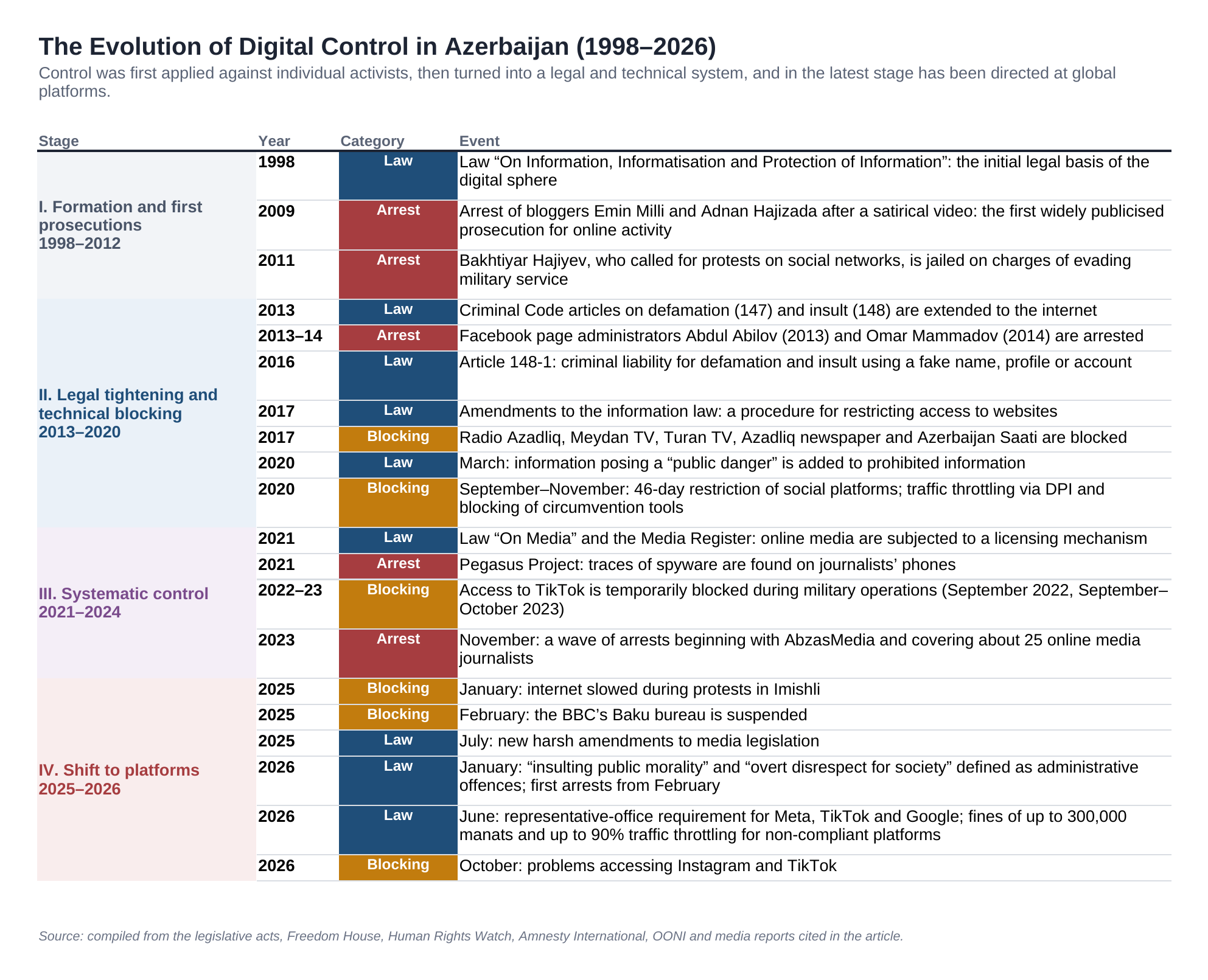
The formation of Azerbaijan’s digital environment dates back to the mid-1990s (RİNN 2021). During this period, internet infrastructure developed and access to international information networks became possible. In the initial stage, owing to technical limitations, high prices and low speeds, the digital environment was accessible only to a narrow group of individuals and institutions. Internet use was considered available mainly to educational establishments, state bodies and organisations (Azərbaycan Respublikası Prezidenti 2005). During this period, the first interactive online communities formed mainly around internet clubs, online forums (Bakililar, etc.) and chat rooms. These platforms functioned less as instruments of political mobilisation than as channels of interpersonal communication that crossed geographical boundaries. From the mid-2000s, blogging platforms also became one of the main refuges for opinion and free speech. From 2010 onwards, Facebook, YouTube and other digital platforms also spread widely in Azerbaijan and served as important channels for political debate, civic activism and critical journalism (Pearce & Ford 2013). In Azerbaijan, the early 2010s – the period of the “Green Movement” and the “Arab Spring” wave – were marked in particular by the mass adoption of the Facebook platform. In this period, Facebook was not only an interpersonal network but was also regarded as the main arena for political mobilisation, replacing traditional media. During the 2010 parliamentary elections, the internet had become one of the important instruments for political communication and election campaigns in Azerbaijan. Independent groups, opposition politicians and political associations used Facebook to disseminate campaign messages, programmes and positions and to inform voters about the electoral process. YouTube and blogs, in turn, gave groups that were insufficiently represented in traditional media the opportunity to express alternative political views (Gojayev 2011).
The protests held in spring 2011 by young people in Azerbaijan with democratic demands, under the influence of the “Arab Spring” wave, and the marches organised in 2013 in protest against soldiers’ deaths in non-combat conditions in the army demonstrated the role of social media in political mobilisation and the organisation of collective protest. In the 2011 protests, young people addressed a wider audience through social media, while in 2013 the protest was called through the “Stop Soldier Deaths” Facebook page (Amnesty International 2011; Sultanova 2013).
In parallel, independent media inside the country moved their news production and communication with audiences to Facebook and YouTube. According to World Bank data, the share of internet users in Azerbaijan’s population rose from approximately 17% in 2008 to 73 percent in 2013 (World Bank 2014).
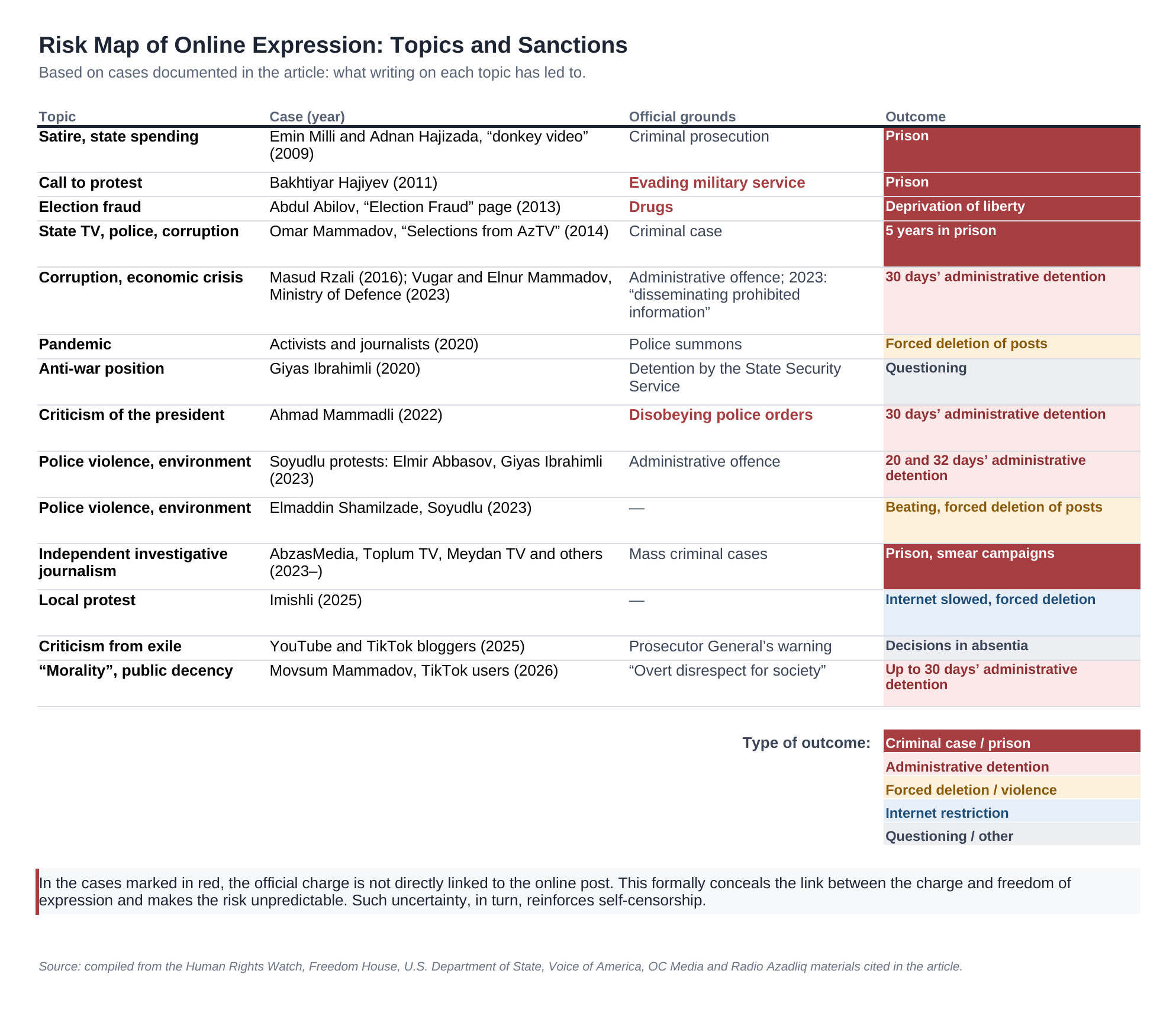
Nevertheless, this development exposed the contradiction between claims about the digital space’s contribution to democratisation and the authorities’ interest in control. The U.S. Department of State’s report for 2009 noted that, although no large-scale general restrictions on the internet had been imposed in Azerbaijan, interference against certain resources with political content had been observed (U.S. Department of State 2010). The article “Networked Authoritarianism and Social Media in Azerbaijan” by Katy Pearce, who studies digital media in the post-Soviet space and authoritarian countries, shows that the spread of social networks did not automatically result in political liberalisation (Pearce 2012). The first sharp practical manifestation of this theoretical framework was the arrest of bloggers Emin Milli and Adnan Hajizada in 2009. Their arrest was one of the first cases of criminal prosecution for online activity to attract widespread attention (Freedom House 2011). Shortly before their arrest, the young bloggers had posted a satirical video titled “The Donkey’s Press Conference”. The video, which quickly went viral, satirised the expensive donkeys imported from Germany at the expense of state budget funds (Pearce & Ford 2013). In 2011, activist Bakhtiyar Hajiyev was detained in connection with protests he had promoted on social networks and was later sentenced to prison on charges of evading military service. Hajiyev’s arrest is considered one of the early examples of social media being linked to the mechanism of persecution for criticism (Human Rights Watch 2012).
In her study covering 2009–2012, Katy Pearce shows that during this period pro-government media conducted propaganda claiming that social networks damaged the institution of the family and caused psychological problems (Pearce & Kendzior 2012).
The initial basis for the legal regulation of the digital space in Azerbaijan is the Law “On Information, Informatisation and Protection of Information”, adopted in 1998 (Azərbaycan Respublikasının Qanunu 1998). In the early period, this law played only a foundational role in regulating the information environment. The mass adoption of technologies and the expansion of internet networks, however, paved the way for the diversification of the legislative base and the formation of new legal categories and control mechanisms. That said, it would be inaccurate to characterise all the steps of this period as direct censorship measures; the regulatory acts on electronic services and telecommunications adopted between 2000 and 2010 served more to regulate the administrative and technical infrastructure of the sector than to control content directly (Freedom House 2011).
In May 2013, amendments to Articles 147 (defamation) and 148 (insult) of the Criminal Code of the Republic of Azerbaijan broadened the scope of criminal liability for these offences. As a result of the amendment, the public dissemination of defamatory and insulting information on internet information resources, in addition to the mass media, became subject to criminal liability. Thus, the acts of defamation and insult provided for by law could lead to criminal prosecution when committed on the internet, including on social networks (Azərbaycan Respublikası 2013; Amnesty International, 2013).
This step is regarded as the state’s official criminalisation of political criticism and activism in the digital space. The legal restrictions established in 2013 did not weaken in subsequent years; on the contrary, they were further institutionalised by the Law “On Amendments to the Criminal Code of the Republic of Azerbaijan” of 29 November 2016. The amendment of 29 November 2016 added Article 148-1 to the Criminal Code. The article established criminal liability for defamation and insult committed using a fake user name, profile or account on an internet information resource. This amendment increased the legal risks associated with disseminating defamatory and insulting information while using anonymity (Azərbaycan Respublikasının Qanunu 2016).
The Deepening of Control in the Digital Space: From Legislative Tightening to Technical Blocking (2014–2020)
From the second half of the 2010s, control mechanisms became more systematic. Beginning in 2014, the large-scale legal restrictions and repression directed at independent media and civil society in Azerbaijan also spilled over into the digital space.
Human Rights Watch (HRW) documents from 2014 describe in detail politically motivated criminal prosecutions against social media activists in Azerbaijan. Abdul Abilov, who ran the Facebook pages “Let’s Say No to Sycophants!” and “Election Fraud” and shared critical content about electoral processes, was detained in 2013 and deprived of his liberty on drug charges. Citing the activist’s lawyer, the organisation stated that the questions asked during the investigation also concerned his posts on social media (Human Rights Watch 2014). In a similar scenario, Omar Mammadov, administrator of the “Selections from AzTV” page on Facebook, was detained in January 2014 and sentenced to five years in prison. Besides criticising AzTV, the page he administered featured satire and critical posts about police conduct and corruption. Tellingly, two days before Mammadov’s arrest, the police had confiscated his computer and demanded that he shut down the Facebook page (Human Rights Watch 2014).
From late 2015 to early 2016, against the backdrop of discontent over the devaluation of the manat, price increases and unemployment, reports emerged of the detention of political and social media activists. Human Rights Watch’s 2016 report documented cases of police questioning people who had criticised Azerbaijan’s economic policy and allegations of corruption on Facebook (Human Rights Watch 2017). For example, in August 2016 Masud Rzali was questioned by police after posting on Facebook about political persecution and corruption, and was subsequently sentenced to 30 days of administrative detention (Amerikanın Səsi 2016).
The amendments made in March 2017 to the Law “On Information, Informatisation and Protection of Information” expanded state intervention concerning information prohibited from dissemination on the internet (Azərtac 2017). Under the amendments, state bodies could, under certain conditions, demand that the owner of a website remove information deemed prohibited and, if the demand was not complied with, initiate a procedure to restrict access to the site (Freedom House 2018). This legal mechanism was put into practice shortly afterwards. In May 2017, access to the websites of independent media outlets such as Radio Azadliq, Azadliq newspaper, Meydan TV, Turan TV and Azerbaijan Saati was restricted (Freedom House 2018). Although the Azerbaijani authorities justified these steps by the requirements of the law, international organisations emphasised that critical sources of information were being targeted (Human Rights Watch 2018). The law itself also drew separate criticism. It established broad restrictions, including on the promotion and financing of terrorism, calls for violence and religious extremism, incitement of national, racial and religious hatred, state secrets, incitement to suicide, defamation, insult and interference in private life (AzərTAc 2017). Some of these categories may be linked to legitimate aims. However, legal certainty and independent judicial oversight are essential in their application. Freedom House wrote in its report that abstract wording in the provision, such as “encroachment on the legally protected interests of the state and society”, made it easy to include any political criticism in the list of prohibited content (Freedom House 2018). Freedom House’s report also states that as the laws were tightened, the number of people arrested, pressured and subjected to cyberattacks for their online opinions increased in parallel (Freedom House 2017).
Blocking of online media resources continued in 2018–2019. According to Freedom House, in 2018 access to the websites Bastainfo.com, Criminal.az, Topxeber.az and Fia.az was restricted (Freedom House 2019). During the same period, the opening of criminal cases over the materials of certain media outlets and the persecution of journalists revealed that digital censorship was operating on a broad political and legal plane. In this sense, the blocking of websites should also be viewed as part of a general system of restrictions that narrowed the space for critical journalism.
After the legal framework was tightened, control mechanisms did not end with the blocking of news websites. The process continued with the targeting of individual freedom of expression and of social media activists. Two main methods in particular came into wide use to silence opposition activists and journalists who criticised the authorities on social networks:
- Mass-reporting mechanism: Organised troll networks and fake profiles engaged in mass reporting of critics’ accounts or posts, claiming that they allegedly violated platform rules. As a result, the platforms’ algorithms blocked these profiles temporarily or permanently (Freedom House 2019).
- Systematic troll attacks: Hundreds of coordinated abusive, misleading or pro-government comments were posted beneath the posts of independent media outlets or political activists. This was aimed at manipulating public opinion (Freedom House 2019).
In addition, when independent media outlets created “mirror sites” to circumvent the blocking, state bodies promptly blocked the new domains as well. People with large audiences on social networks were subjected to cyberattacks and phishing attempts on their profiles; their private correspondence was leaked, and they were punished on fabricated administrative/criminal charges for their online activity (Freedom House 2019).
In Azerbaijan, access to the international internet is concentrated in the hands of just two companies – Delta Telecom and AzerTelecom. For many years, Delta Telecom was the main operator controlling the country’s principal internet backbone and its original internet exchange point (IXP). Moreover, journalistic investigations have proven the links between the country’s major mobile operators and the country’s leadership; for example, the largest operator, Azercell, officially passed into state ownership in 2018 (OCCRP 2018). This centralised system in the internet sector gives the government a convenient means of blocking websites or restricting the internet whenever it wishes.
The U.S. Department of State’s report for 2019 contains information on the blocking of independent websites, punishments for critical posts, coercion to delete posts, threats against journalists and interference with social media accounts (U.S. Department of State 2020). The report notes interference with the Facebook page of Azerbaijan Popular Front Party (APFP) chairman Ali Karimli, as well as journalist Sevinj Osmanqizi’s statement that she had been threatened in order to make her stop her live broadcasts. The cases analysed prove that digital pressure does not consist merely of official blocking; it is part of a systematic control strategy built on direct cyber-interference and mechanisms of psychological pressure (U.S. Department of State 2020). The political impact of such interference is not measured only by the loss of content published on a given day. The takeover of an account can put at risk a journalist’s correspondence with sources and his or her past and future work.
The year 2020 occupies an important place in the history of digital freedom in Azerbaijan. As a result of amendments made to the information legislation in March of that year, information posing a risk of harm to citizens’ life and health or to property, or threatening a mass violation of public security, was added to the category of prohibited information (Azərbaycan Respublikasının Milli Məclisi 2020). This amendment was adopted in the early stage of the COVID-19 pandemic. During the pandemic, false information could pose a real public health risk; nevertheless, how the notion of “false information” is defined and applied is significant from the standpoint of freedom of expression. Yet vague wording open to broad interpretation granted state bodies wide powers to swiftly restrict information flows and alternative narratives on digital platforms under the pretext of “public security”.
A few months later, during the large-scale military operations that began between Armenia and Azerbaijan in September, the state significantly weakened internet access. As a result, during the Second Karabakh War of 2020, state control over the digital environment reached its most acute technological level (Freedom House 2021). In the course of the military operations, citing information security and operational secrecy, access to leading social media platforms such as Facebook, WhatsApp, Instagram, YouTube, TikTok, LinkedIn, Twitter, Zoom and Skype was restricted on a mass scale for 46 days. In the context of military operations, security and the protection of military information may be legitimate state aims. However, this may affect not only the disclosure of military secrets but also the ability of journalists and citizens to obtain information from different sources. Freedom House’s report states that during this period the speed of mobile and fixed internet connections was reduced. This hampered not only journalists’ documentation of events but also citizens’ exchange of information, their ability to stay in touch with family members and the organisation of political forces (Freedom House 2021). The report recorded this as the longest internet restriction in Azerbaijan up to that time.
Against the backdrop of this general blocking, practices of circumventing digital censorship became widespread in Azerbaijani society. VPN technologies, the “Tor” anonymity network and other circumvention tools became an everyday habit for accessing information and communicating securely (OONI 2021; Freedom House 2021). However, the state infrastructure also reacted swiftly to these trends. Through the deployment of Deep Packet Inspection (DPI) systems in the infrastructure of backbone internet operators and providers – including “Sandvine”-type technologies mentioned in international reports – traffic on platforms was throttled, and the connection points of popular circumvention tools such as “Psiphon” and “Tor” were restricted (Qurium 2019; OONI 2021). As a result, an ongoing digital “cat-and-mouse” game emerged between users and the state, and the authorities further consolidated centralised control over the technological infrastructure (Feldstein 2021; Freedom House 2021).
In 2020, during the war and the pandemic, in addition to the restrictions, critics’ digital critical activity was also targeted. The U.S. Department of State’s reports include concerns about activists being questioned by police, being forced under threat of physical violence to delete critical Facebook posts, and about the monitoring of civil society representatives’ digital communications (U.S. Department of State 2021). Activists and journalists were repeatedly summoned to police stations over their posts about the coronavirus and were made to delete critical posts. In particular, during the Second Karabakh War the authorities placed those who wrote against the war under digital surveillance. For example, former prisoner of conscience Giyas Ibrahimli was detained and questioned by the State Security Service (SSS) over critical and anti-war statuses he had written on Facebook (OC Media 2020). This dynamic shows that the strategy of digital authoritarianism in Azerbaijan was aimed at completely neutralising alternative peace discourse under the rhetoric of national security.
In addition, coercion to delete critical posts acts as a specific form of digital repression. Here, the state or the relevant structures are not content merely to eliminate existing content; they also directly influence the user’s future behaviour and decisions about what to post or not post. This is one of the most evident ways in which the mechanism of self-censorship is formed in the digital environment.
In sum, the 2014–2020 period laid the main foundation for bringing Azerbaijan’s digital environment under institutional control. This period both deepened habits of self-censorship in the digital space and placed public criticism of government policy in the category of high-risk topics.
A New Stage of Digital Authoritarianism in the Post-War Period (2021–2024)
In the period after the Second Karabakh War, the political authorities further strengthened their authoritarian levers against the backdrop of the emerging “victory narrative”. The year 2020 also marked the beginning of a new stage aimed at establishing information hegemony. In the post-war reality, with the notions of “national security” and “sovereignty” brought to the fore, the mechanisms of interference in and control of the digital space took on a systematic character.
The most fundamental step in bringing the online space under control was the Law “On Media”, adopted by the Milli Majlis in December 2021 (Azərbaycan Respublikası 2022). Alongside the traditional print press, this law subjected online media resources and journalists to a strict licensing and unified state control mechanism. The Media Register established by the law granted “official media” status only to entities meeting criteria set by the state, which became an important institutional tool for excluding alternative voices in online media from the legal sphere (Freedom House 2023). This regulatory mechanism is consistent with theoretical approaches that explain how the state imposes certain rules on content creators through administrative levers (Van Dijck, Poell & de Waal 2018).
The state’s interference in the internet did not end with blocking entire websites. The rule on “restricting access to the relevant part of a resource”, introduced by amendments to the legislation back in 2017, opened a legal path to filtering specific content (Azərbaycan Respublikasının Qanunu 2017). New rules on critical information infrastructure and cybersecurity approved in 2022 further strengthened, institutionally, the state’s levers of control in the internet space (Azərbaycan Respublikası Prezidenti 2022). The official side justified this step by the need to protect strategic systems. However, the absence of any independent public or judicial oversight over the broad powers granted to the security agencies creates serious risks for citizens’ digital privacy and freedom of expression (Freedom House 2023).
In September 2022, the State Security Service temporarily restricted the TikTok platform on the pretext of preventing the spread of information related to military operations (Freedom House 2023). Against the backdrop of the military operations that began on 19 September 2023, access to the platform was blocked again, and the restriction lasted until the end of October. During the same period, cases of internet speeds being slowed in Fuzuli district were also recorded (Freedom House 2024b). Such bans demonstrate the state’s power to isolate any global platform at any moment of crisis. They also form the foundation of the strategy of controlling information flows in times of crisis.
During the same period, arrests and convictions of activists expressing critical positions on social networks also continued. In September 2022, Ahmad Mammadli, former chairman of the “Democracy 18” youth movement, was jailed for 30 days shortly after criticising President Ilham Aliyev on social media. Although the official charge was disobeying a lawful police demand, international reports documented this as a continuation of digital repression (U.S. Department of State 2023).
The U.S. Department of State’s report for 2023 states that some activists who wrote critical posts on social media were summoned to the police, where they were shown the post in question and warned that similar behaviour could lead to long-term imprisonment in the future (U.S. Department of State 2024). Even those who “liked” critical posts faced direct or indirect threats.
Pressure on freedom of expression in the digital space expanded to cover critical statements on online video platforms and internet television programmes. In August 2023, immediately after voicing allegations of corruption in the Ministry of Defence on a programme broadcast on the “Hurriyyet TV” YouTube channel, Vugar Mammadov, editor-in-chief of the “Hurriyyet” newspaper, and the programme’s guest, retired colonel Elnur Mammadov, were detained. Both were sentenced to 30 days of administrative detention on charges of “disseminating information prohibited from dissemination” on an internet information resource (Human Rights Watch 2024; Institute for Reporters' Freedom and Safety 2024).
In June 2023, protests broke out in the village of Soyudlu in Gadabay against the creation of an artificial lake for mining waste, and the police used physical force and tear gas to disperse the protests. The photos and videos that circulated clearly showed the harsh treatment by the police. According to Human Rights Watch, political activists Elmir Abbasov and Giyas Ibrahimli were sentenced to 20 and 32 days of administrative detention, respectively, after Facebook posts criticising the conduct of the police. Journalist Elmaddin Shamilzade, meanwhile, was reportedly beaten after he exposed photos of the police officers who dispersed the protest, in order to force him to delete them from Facebook (Human Rights Watch 2024).
Regarding those years, Freedom House also emphasises that the authorities attempt to manipulate public opinion in the online space through pro-government individuals and politicians, as well as automated bot and troll accounts (Freedom House 2021, 2022a). In fact, there have also been admissions by former officials on this matter. At the trial of Vugar Safarli, former executive director of the State Fund for Support of Mass Media Development under the President, who was arrested on embezzlement charges, it emerged that troll networks existed at the expense of state resources (AzadlıqRadiosu 2022). From the article published by Radio Azadliq (2022), one may conclude that digital manipulation in Azerbaijan has been a professional digital structure with a centralised budget, a monthly payroll and a focus on specific assignments.
Meta’s quarterly security reports for 2022 revealed that actors linked to the Ministry of Internal Affairs ran Facebook pages targeting opposition figures and attempted to gain unauthorised access to activists’ personal accounts (Meta 2022; Freedom House 2022a). In addition, The Guardian reported that the Meta platform had turned a blind eye to the return to the platform of a massive troll network linked to the ruling New Azerbaijan Party (YAP) that had been taken down in October 2020 (The Guardian 2021; Freedom House 2021).
The Pegasus Project investigation published in 2021 revealed that independent journalists, human rights defenders and activists in Azerbaijan had become targets of surveillance through the Pegasus spyware owned by Israel’s NSO Group. According to the investigation, more than 1,000 phone numbers linked to Azerbaijan had been selected as potential targets, and more than 40 journalists had been placed on a list of candidates for surveillance. Amnesty International’s technical forensic analysis confirmed that Pegasus had been installed on the phones of journalists Sevinj Vagifgizi and Khadija Ismayilova. Traces of infection covering 2019–2021 were found on Vagifgizi’s phone, and covering 2018–2021 on Ismayilova’s (Amnesty International, 2021; OCCRP, 2021; Amnesty International, 2023). Such cases of digital surveillance may heighten concerns among journalists and civil society representatives that even private communication is not beyond control, and may increase the risk of self-censorship.
The psychological chilling effect characteristic of authoritarian governance began to take on a more pronounced character in Azerbaijan, particularly from 2021, when cyber-surveillance scandals such as Pegasus became public. Stoycheff’s (2016) study shows that the likelihood of being watched can deter individuals from openly expressing their positions. In the context of the Pegasus scandal, this suggests that a similar mechanism may be at work in Azerbaijan as well. This, in turn, may create the impression in society that the majority supports the current policy and may gradually constrain the environment for free discussion.
During this period, the violation of Bakhtiyar Hajiyev’s right to privacy was another form of digital repression. A Human Rights Watch report states that intimate photos and messages from Hajiyev’s Telegram and Meta accounts were disseminated, and that some of the materials may have been fake while others may have been stolen from his personal Facebook account (Human Rights Watch 2024). This also shows that digital repression can result in discreditation.
Finally, the harshest indicator of this period is the mass criminal prosecution of online media workers. The wave of arrests that began in November 2023 with “AbzasMedia” extended in the following years to journalists associated with independent online outlets such as “Kanal 11”, “Kanal 13”, “Toplum TV”, “Meclis info” and “Meydan TV”. The mass arrests carried out against nearly 30 journalists directly targeted corruption investigations and critical reporting in the digital space (Amnesty International 2024; Human Rights Watch 2024). The methodology applied in these criminal cases also revealed a new stage of digital repression. First, the electronic devices of the accused were confiscated. Then private messages and photos obtained unlawfully were passed on to pro-government media, and smear campaigns were conducted against the individuals concerned (Freedom House 2024b). At the academic level, this tactic is characterised not only as a violation of individuals’ right to digital privacy but also as a mechanism of “digital smear campaigning” and psychological intimidation. It also directly serves to deepen the atmosphere of self-censorship.
In research on digital authoritarianism, drawing the line between technical malfunctions and deliberate state interference requires particular methodological care. During the 2024 presidential election in Azerbaijan, independent observers were sending the media footage showing electoral violations. Based on my personal observations, serious restrictions were experienced when sending these audio and video files via the WhatsApp platform. Freedom House also wrote that, at the same time, journalists experienced connection problems when sending audio and video materials via WhatsApp, but it also stressed that no signs of the application being blocked were recorded (Freedom House 2024b). Although these were not recorded as mass blocking, they were regarded as a manifestation of digital repression.
According to available statistics, the presence of 7.6 million social network users in Azerbaijan confirms the decisive role of these platforms in the mass flow of information (DataReportal 2024). The loss of public influence by traditional media and the migration of critical voices to digital platforms created a new reality that made control more difficult for the authorities. The need to regulate this huge audience base prompted the state to intensify its efforts to bring global platforms into an official legal framework.
This regulatory process is closely linked not only to domestic political decisions but also to uncertainties at the global level. For example, Telegram founder Pavel Durov’s visit to Baku in August 2024, followed by his arrest in France, was one of the events that clearly illustrated these contradictions (TechPolicy Press 2024; Decrypt 2024). Although there is no credible evidence of the existence of any secret or open agreement with official bodies, the security parameters of this network, regarded as the main alternative news source in the region, sparked serious public debate.
Consequently, the years 2021–2024 can be assessed as a stage of transition in Azerbaijan’s digital authoritarianism from scattered measures to a systematic governance model. In this period, interference in the digital environment was not only a mechanism activated at moments of crisis but also a model of permanent state control exercised through various levers. The global trends of contemporary digital authoritarianism and elements of the control models adopted by regimes such as China, Russia and Iran had also begun to be felt in Azerbaijan. The practice of neutralising independent media was also reminiscent of Russia’s “RuNet” strategy and was considered a hybrid manifestation of this mechanism in Azerbaijan (Feldstein 2021; Freedom House 2022b). As a result, critical discourse in the digital space turned into a high-risk activity, and self-censorship took on a mass character.
The Shift to Platforms: The New Architecture of Digital Control in 2025–2026
According to Freedom House’s “Freedom on the Net 2025” report, in the period from summer 2024 to 31 May 2025, the throttling of internet connections and the blocking of media critical of the government were observed in Azerbaijan (Freedom House 2025). On 18 January 2025, a serious road traffic accident in the town of Imishli caused tension in the district. After a State Road Police (SRP) vehicle collided with another vehicle on Shadlinski Street, it injured young children on the pavement (AzadlıqRadiosu 2025). During the subsequent protests over the incident, the internet in Imishli was slowed down, and residents were forced to delete the materials they had shared about the incident on social networks (Freedom House 2025). This incident was documented as an example illustrating the political significance of digital information flows. According to other information from the organisation, in February 2025 the Ganja Court of Appeal, acting on an application by the Media Development Agency, ruled to block the website Anaxeber.info. The outlet linked this decision to its refusal to delete critical materials. The elimination of alternative and critical sources of information on the pretext of legal frameworks also turns the information ecosystem into a one-sided and controlled environment (Freedom House 2025).
In early 2025, the Prosecutor General’s Office targeted émigré bloggers and activists living abroad who criticise the government on online platforms (mainly YouTube and TikTok) with official warnings and demands to return. By issuing decisions in absentia against them, it criminalised them in an effort to stop their activities (Freedom House 2025). The authorities’ information control has thus been directed not only at the domestic audience but also, crossing state borders, at critical platforms operating in exile. The fact that these resources gain direct access to broad audiences via social networks is regarded as an alternative threat to the official narrative shaped by the state. In parallel, in order to completely shut off alternative information flows inside the country, the policy of restricting the accreditation and suspending the activities of the local bureaus of foreign media outlets – including, in early 2025, international broadcasters such as the BBC – has continued (BBC News 2025). This is part of a strategy to establish a complete monopoly over the information market and to push out the media influence of Western capital (Herman & Chomsky 1988). With new legislative amendments in July 2025, the regulatory framework was tightened further: the activity of print media entities not included in the Register was banned and administrative fines of up to 5,000 manats were introduced, while mechanisms for restricting broadcasting on online platforms on the pretext of prohibited information were strengthened (OC Media 2025; Council of Europe 2025). In addition, licensing and permit requirements for the activities and broadcasts of local representative offices of foreign media outlets were tightened (AzərTac 2025). Through legislative amendments in January 2026, certain acts that insult public morality and express overt disrespect for society – including the use of obscene language on internet information resources and information and telecommunication networks, the display of gestures of this nature, and the exposure of body parts in a manner deemed contrary to national and moral values – were defined as administrative offences. Under the amendments adopted by parliament on 15 January and signed by the President on 26 January, these acts are punishable by a fine of 500 to 1,000 manats and, in certain cases, by up to 30 days of administrative detention. Repeat offences may incur heavier penalties (Azərbaycan Respublikasının Qanunu 2026a; APA, 2026). The fact that expressions used in the law such as “insulting public morality” and “overt disrespect for society” are open to broad interpretation raises concerns from the standpoint of legal certainty and freedom of expression. Human rights defenders and media outlets have drawn attention to the risk that the authorities could apply these provisions against critical posts on social networks (OC Media, 2026a). From February onwards, the first administrative arrests under these amendments were recorded. According to OC Media, activist Movsum Mammadov was placed under administrative arrest for 30 days on 5 February over his posts on social media (OC Media, 2026b). The application of the new provisions has also resulted in the administrative arrest of some TikTok users. It was noticed that social media personalities, mostly those sentenced to administrative detention, later resorted to self-censorship. However, my attempt to verify this directly with the TikTokers within the framework of this study was unsuccessful.
The legislative amendments adopted in June 2026 have further tightened the government’s control mechanisms over digital media and social networks (Meydan TV 2026b). Under the requirements of the legislation, global social network providers such as “Meta”, “TikTok” and “Google” must establish an official representative office in Azerbaijan and undergo state registration in the prescribed manner (Law “On State Registration and the State Register of Legal Entities” 2003 (as amended in June 2026)). Under the new rules, providers must set up a contact centre for state agencies and are obliged to respond to requests within 5 days. The network traffic of platforms that violate the requirements will be restricted. The state, assuming the function of legal guardian under the priority of “protecting children from harmful information”, also restricts the right of persons under the age of 16 to open profiles in the digital space. This regulation plays the role of a dual mechanism: on the one hand, the state’s digital paternalism is legitimised through the tightening of geolocation and privacy regimes for users aged 16–18. On the other hand, however, this age-verification requirement is imposed on foreign platforms (Meta, TikTok, Google) as a direct administrative obligation. To verify age, platforms must have access to user data, and for this they must open a local representative office in Azerbaijan and respond to requests from state bodies within 5 working days. If a platform fails to fulfil these legal obligations, it faces financial sanctions of up to 300,000 manats and the throttling of its internet traffic by up to 90 percent (Azərbaycan Respublikasının Qanunu 2026b).
While this study was being prepared – between 12 and 14 October – there were problems accessing the Instagram and TikTok social networks in Azerbaijan.
The changes in 2025 and 2026 differed from the previous period. Until these changes, control was directed at individual users. In these years, however, control shifted its focus to the platforms themselves (Meydan TV 2026a). Users reported that it was impossible to upload videos to the platforms, accounts would not open and feeds would not refresh. Citizens said they were using VPNs. These restrictions once again act as a tool of digital repression to which the authorities resort in a crisis situation. This is because on the same days, students and teachers wearing the hijab were not being admitted to schools in various parts of the country, and footage of the protests held in this connection was going viral.
Possible Scenarios
The scenarios I outline here show the directions in which the current legal framework may develop. In this article, I have used foreign experience only for comparison. However, there is no official basis for saying that the Azerbaijani authorities will apply one of these models as it is. My scenarios are as follows:
- This is a continuation of the current course. That is, platforms comply with the law by opening representative offices, setting up liaison centres and responding to official requests within 5 working days. In its nature, the model is reminiscent of the law adopted by Turkey in 2020. That law likewise provided for the appointment of a local representative, fines and traffic throttling (Human Rights Watch 2021). For Azerbaijan, this step is the most effective option in the long term. In this scenario, social networks are not officially blocked, but control becomes routine through requirements such as handing over user data. In this scenario, the digital freedom index remains roughly the same or declines slightly. In this scenario, self-censorship is instilled in people without completely cutting off information.
- This scenario is a model of coercive isolation. When platforms refuse to comply with the regulatory requirements put forward, the state may, before resorting to outright bans, turn to pressure tools such as technical throttling (artificially reducing speed), and at the final stage move to full blocking. The initial objective here is not so much to isolate the platform completely from the market as to induce it to accept local jurisdiction. In the regional context, Russia’s experience clearly illustrates the sequence of this mechanism: back in March 2021, Roskomnadzor throttled Twitter, citing its failure to remove prohibited content, and in July of the same year adopted a legislative framework requiring foreign IT companies to open local representative offices (the “landing” law). The full blocking of Facebook and Instagram in 2022, aimed at closing off the information space against the backdrop of the military intervention in Ukraine, was the escalation to its ultimate limit at a point when the technical infrastructure was already in place (Freedom House 2022b). In Azerbaijan, the technical foundation for this was tested in 2020. That is, through the local company Delta Telecom, the speed of live streams on social platforms was reduced, and some VPN tools were blocked. Now the 90 percent restriction in the new law also provides a legal basis for this capability. If this scenario materialises, digital freedoms will weaken further, and digital persecution of individuals will increase.
- This scenario envisages the promotion of local digital services in parallel with the restriction of foreign platforms. This resembles the Chinese model. China has restricted the operation of a number of global platforms. The local digital ecosystem, meanwhile, has granted the state broad powers of control and regulation. However, there is no basis for saying that the Chinese model will be fully replicated in Azerbaijan. This is because Azerbaijan’s economic and geopolitical situation and its dependence on global digital services pose a serious obstacle to such a transition. Moreover, full isolation would be costly for Azerbaijan both economically and diplomatically. Nevertheless, it is also possible to draw on certain elements of this scenario. After all, in moments of crisis – for example, during the 2020 war – Azerbaijan did not hesitate to shut down platforms for weeks.
These three scenarios are not mutually exclusive. On the contrary, a synthesis of these scenarios in Azerbaijan is more plausible. However, the real picture will become clear after June next year, when the dynamics of platforms opening representative offices can be observed.
Conclusion
This study, analysing the past 28 years, shows that the political authorities shaping Azerbaijan’s digital environment have not resorted solely to technical bans. This has been achieved through a multi-layered political and legal system formed over time. The process began with pressure on and manipulation of individuals on social media. Arrests were carried out against pages or activists who were active on social media and featured critical statements. After 2017, control was institutionalised with the help of legal and administrative mechanisms. The authorities have not hesitated to use troll networks in the digital environment to shape public opinion as they wish.
One of the key points revealed by the research is that it would be wrong to measure the scale of digital control solely by blocked websites or shut-down platforms. The main issue here is what risk journalists, activists and ordinary users take when they speak out. The fear of being arrested, persecuted or having personal data leaked inevitably forced people to be cautious and to resort to self-censorship. One of the limitations of the study was the inability to fully measure what percentage of society this affected and to what extent.
In the post-war period, the use of national security narratives became an instrument of digital authoritarianism. The political authorities began to increase their interference in the digital space in order to consolidate their legitimacy.
From November 2023, the levers of pressure hardened with the arrest of journalists working in online media. This year, with the new laws to be applied to platforms, the control mechanism has moved up to a higher level.
The 3 conceptual theses I set out at the beginning of the study were also borne out in the article:
- In the initial stage, control mechanisms were directed at individuals. Over time, however, systematic control took shape.
- It was not only access to information that was obstructed. Self-censorship also took shape through the creation of an atmosphere of fear.
- Legislation changed in order to integrate global platforms into domestic rules. As a result, Azerbaijan began to be compared with the digital authoritarianism of other countries.
Although the Azerbaijani model has adopted some features of Russian and Chinese practice, it has not gone as far as full isolation. The main effect here has been isolation and self-censorship in an environment of uncertainty, and in this respect, in my view, the country can be considered closer to the Turkish model.
One of the main limitations of the research is the lack of transparent information on the decisions of state bodies, technical interventions and user data. This makes it impossible to fully assess the real scale and political consequences of state control. To fill this gap, future research could incorporate sociological interviews and the results of independent monitoring.
The main conclusion of the study is that the authorities’ claims about the large number of internet users are not directly proportional to the existence of digital freedoms in the country. What matters is not simply that people have access to the internet; the main issue is at what risk they express their opinions and what information they have access to.
Note: The article you have read was originally written in the Azerbaijani language. Artificial intelligence tools were used only in the translation.
References
Amnesty International. 2011. The Spring That Never Blossomed: Freedoms Suppressed in Azerbaijan. Index: EUR 55/011/2011. London: Amnesty International. https://www.amnesty.org/en/documents/eur55/011/2011/en/.
Amnesty International. 2013. “Azerbaijan Criminalizes Free Speech Online Ahead of Elections.” Amnesty International News, May 15, 2013. https://www.amnesty.org/en/latest/news/2013/05/azerbaijan-criminalizes-free-speech-online-ahead-of-elections/.
Amnesty International. 2021. “Massive Data Leak Reveals Israeli NSO Group’s Spyware Used to Target Activists, Journalists, and Political Leaders Globally.” July 19, 2021. https://www.amnesty.org/en/latest/news/2021/07/the-pegasus-project-2/.
Amnesty International. 2023. “Armenia/Azerbaijan: Pegasus Spyware Targeted Armenian Public Figures amid Conflict.” May 25, 2023. https://www.amnesty.org/en/latest/news/2023/05/armenia-azerbaijan-pegasus-spyware-targeted-armenian-public-figures-amid-conflict/.
Amnesty International. 2024. The State of the World's Human Rights: Amnesty International Report 2023/24 – Azerbaijan. London: Amnesty International. https://www.amnesty.org/en/documents/pol10/7200/2024/en/.
Amerikanın Səsi. 2016. “AXCP fəalı 30 sutkalığa həbs edilib.” [APFP activist jailed for 30 days] 12 August 2016. https://www.amerikaninsesi.org/a/axcp_feali/3461602.html.
APA. 2026. “Sosial şəbəkələrdə cəmiyyətə açıq hörmətsizliyə görə inzibati həbs və cərimə müəyyənləşib.” [Administrative detention and fines established for overt disrespect for society on social networks] 26 January 2026. https://apa.az/resmi-xeber/sosial-sebekelerde-cemiyyete-aciq-hormetsizliye-gore-inzibati-hebs-ve-cerime-mueyyenlesib-936602.
AzadlıqRadiosu. 2022. “Azərbaycanda trol olmaq: ‘Hər işi görürsənsə, aylıq qazancın 3-4 min manata çatır’.” [Being a troll in Azerbaijan: ‘If you do every job, your monthly earnings reach 3–4 thousand manats’] 1 December 2022. https://www.azadliq.org/a/trol-musahibe/32156945.html.
AzadlıqRadiosu. 2025. “İmişlidə qəzadan sonra etirazlara görə tutulan şəxslərə hökm oxunub.” [Sentences handed down to those detained over protests after the accident in Imishli] 3 July 2025. https://www.azadliq.org/a/imisli-qeza-etiraz-hokm/33463313.html.
Azərbaycan Respublikası. “Azərbaycan Respublikasının Cinayət Məcəlləsində dəyişikliklər edilməsi haqqında” Azərbaycan Respublikasının Qanunu. [Law of the Republic of Azerbaijan “On Amendments to the Criminal Code of the Republic of Azerbaijan”] 14 May 2013. https://president.az/az/articles/view/8356
Azərbaycan Respublikası. 1998. “İnformasiya, informasiyalaşdırma və informasiyanın mühafizəsi haqqında” Azərbaycan Respublikasının Qanunu. [Law of the Republic of Azerbaijan “On Information, Informatisation and Protection of Information”] № 460-IQ, 3 April 1998. https://e-qanun.az/framework/3525.
Azərbaycan Respublikası. 2003. “Hüquqi şəxslərin dövlət qeydiyyatı və dövlət reyestri haqqında” Azərbaycan Respublikasının Qanunu. [Law of the Republic of Azerbaijan “On State Registration and the State Register of Legal Entities”] № 560-IIQ, 12 December 2003. Bakı: e-qanun.az. https://e-qanun.az/framework/5403.
Azərbaycan Respublikası. 2016. “Azərbaycan Respublikasının Cinayət Məcəlləsində dəyişikliklər edilməsi haqqında” Azərbaycan Respublikasının Qanunu. [Law of the Republic of Azerbaijan “On Amendments to the Criminal Code of the Republic of Azerbaijan”] № 431-VQD, 29 November 2016. https://e-qanun.az/framework/61757.
Azərbaycan Respublikası. 2017. “İnformasiya, informasiyalaşdırma və informasiyanın mühafizəsi haqqında” Azərbaycan Respublikasının Qanununda dəyişikliklər edilməsi barədə Azərbaycan Respublikasının Qanunu. [Law of the Republic of Azerbaijan on Amendments to the Law “On Information, Informatisation and Protection of Information”] № 543-VQD, 10 March 2017. https://e-qanun.az/framework/3525.
Azərbaycan Respublikası. 2020. “İnformasiya, informasiyalaşdırma və informasiyanın mühafizəsi haqqında” Azərbaycan Respublikasının Qanununda dəyişiklik edilməsi barədə Azərbaycan Respublikasının Qanunu. [Law of the Republic of Azerbaijan on an Amendment to the Law “On Information, Informatisation and Protection of Information”] № 28-VIQD, 17 March 2020. https://mincom.gov.az/storage/pages/404/d5c2b71ea828dad43a79ddb0a097c998.pdf.
Azərbaycan Respublikası. 2022. “Media haqqında” Azərbaycan Respublikasının Qanunu. [Law of the Republic of Azerbaijan “On Media”] № 487-VIQ, 30 December 2021. https://e-qanun.az/framework/49124.
Azərbaycan Respublikasının Qanunu. 2026a. “Azərbaycan Respublikasının İnzibati Xətalar Məcəlləsində dəyişiklik edilməsi haqqında” Azərbaycan Respublikasının Qanunu. [Law of the Republic of Azerbaijan “On an Amendment to the Code of Administrative Offences of the Republic of Azerbaijan”] № 109-VIIQD, 15 January 2026. Bakı: e-qanun.az.
Azərbaycan Respublikasının Qanunu. 2026b. “İnformasiya, informasiyalaşdırma və informasiyanın mühafizəsi haqqında” və “Hüquqi şəxslərin dövlət qeydiyyatı və dövlət reyestri haqqında” Azərbaycan Respublikasının qanunlarında dəyişiklik edilməsi barədə Azərbaycan Respublikasının Qanunu. [Law of the Republic of Azerbaijan on Amendments to the Laws “On Information, Informatisation and Protection of Information” and “On State Registration and the State Register of Legal Entities”] June 2026. https://e-qanun.az/framework/62416.
Azərbaycan Respublikası Prezidenti. 2005. “Azərbaycan Respublikasında rabitə və informasiya texnologiyalarının inkişafı üzrə 2005–2008-ci illər üçün Dövlət Proqramı (Elektron Azərbaycan).” [State Programme for the Development of Communications and Information Technologies in the Republic of Azerbaijan for 2005–2008 (Electronic Azerbaijan)] № 1055, 21 October 2005. https://e-qanun.az/framework/10778.
Azərbaycan Respublikası Prezidenti. 2022. “Kritik informasiya infrastrukturunun təhlükəsizliyinin təmin edilməsi sahəsində bəzi tədbirlər haqqında” Azərbaycan Respublikası Prezidentinin Fərmanı. [Decree of the President of the Republic of Azerbaijan “On Certain Measures in the Field of Ensuring the Security of Critical Information Infrastructure”] № 1667, 18 April 2022. https://e-qanun.az/framework/49909.
Azərbaycan Respublikası Rəqəmsal İnkişaf və Nəqliyyat Nazirliyi. 2021. Azərbaycanda İnformasiya-Kommunikasiya Texnologiyalarının İnkişaf Tarixi. [History of the Development of Information and Communication Technologies in Azerbaijan] Bakı: RİNN. https://mincom.gov.az/.
AzərTAc. 2017. “‘İnformasiya, informasiyalaşdırma və informasiyanın mühafizəsi haqqında’ Azərbaycan Respublikasının Qanununda dəyişikliklər edilməsi barədə Azərbaycan Respublikasının Qanunu.” [Law of the Republic of Azerbaijan on Amendments to the Law “On Information, Informatisation and Protection of Information”] 10 March 2017. https://azertag.az/xeber/informasiya_informasiyalasdirma_ve_informasiyanin_muhafizəsi_haqqinda_azerbaycan_respublikasinin_qanununda_deyisiklikler_edilmesi_barede__azerbaycan_respublikasinin_qanunu-1044454.
AzərTAc. 2025. “‘Media haqqında’ Qanuna təklif edilən dəyişikliklər təsdiqlənib.” [Proposed amendments to the Law “On Media” approved] 14 July 2025. https://azertag.az/xeber/media_haqqinda_qanuna_teklif_edilen_deyisiklikler_tesdiqlənib-3656239.
Bar-Tal, Daniel. 2017. “Self-Censorship as a Socio-Political-Psychological Phenomenon: Conception and Research.” Advances in Political Psychology 38 (S1): 37–65. https://doi.org/10.1111/pops.12391.
BBC News. 2025. “Azerbaijan Orders Suspension of BBC News Azerbaijani in Baku.” February 20, 2025. https://www.bbc.com/news/articles/c4g7ewd9ne0o.
boyd, danah m., and Nicole B. Ellison. 2007. “Social Network Sites: Definition, History, and Scholarship.” Journal of Computer-Mediated Communication 13 (1): 210–230. https://doi.org/10.1111/j.1083-6101.2007.00393.x.
Bradshaw, Samantha, and Philip N. Howard. 2018. “Challenging Truth and Trust: A Global Inventory of Organized Social Media Manipulation.” Computational Propaganda Research Project, Oxford University. https://demtech.oii.ox.ac.uk/research/posts/challenging-truth-and-trust-a-global-inventory-of-organized-social-media-manipulation/.
Carr, Caleb T., and Rebecca A. Hayes. 2015. “Social Media: Defining, Developing, and Divining.” Social Media + Society 1 (1): 1–11. https://doi.org/10.1177/2056305115584924.
Chadwick, Andrew. 2017. The Hybrid Media System: Politics and Power. 2nd ed. Oxford: Oxford University Press. https://academic.oup.com/book/1922.
Council of Europe. 2025. “Azerbaijan Adopts New Media Restrictions.” Safety of Journalists Platform, Alert Ref. N°43/2022, updated November 2025. https://fom.coe.int/en/alerte/detail/107636954.
DataReportal. 2024. Digital 2024: Azerbaijan. DataReportal. https://datareportal.com/reports/digital-2024-azerbaijan.
Decrypt. 2024. “Telegram Privacy Under Fire as Founder Awaits Trial.” August 30, 2024. https://decrypt.co/247147/telegram-privacy-encryption-security-signal.
Deibert, Ronald J. 2015. “The Cyber-Subversion of International Human Rights.” Journal of Democracy 26 (2): 5–14. https://www.journalofdemocracy.org/articles/authoritarianism-goes-global-cyberspace-under-siege/.
Deibert, Ronald J. 2020. Reset: Reclaiming the Internet for Civil Society. Toronto: House of Anansi Press. https://www.perlego.com/book/2387710/reset-reclaiming-the-internet-for-civil-society-pdf.
Feldstein, Steven. 2021. The Rise of Digital Repression: How Technology Is Reshaping Power, Politics, and Resistance. New York: Oxford University Press. https://academic.oup.com/book/39418.
Freedom House. 2011. Nations in Transit 2011: Azerbaijan Profile. Washington, DC: Freedom House. https://www.freedomhouse.org/sites/default/files/inline_images/NIT-2011-Azerbaijan.pdf.
Freedom House. 2017. Freedom on the Net 2017: Azerbaijan. Washington, DC: Freedom House. https://freedomhouse.org/country/azerbaijan/freedom-net/2017.
Freedom House. 2018. Freedom on the Net 2018: The Rise of Digital Authoritarianism. Washington, DC: Freedom House. https://freedomhouse.org/report/freedom-net/2018/rise-digital-authoritarianism.
Freedom House. 2019. Freedom on the Net 2019: The Crisis of Social Media. Washington, DC: Freedom House. https://freedomhouse.org/sites/default/files/2019-11/11042019_Report_FH_FOTN_2019_final_Public_Download.pdf.
Freedom House. 2021. Freedom on the Net 2021: Azerbaijan. Washington, DC: Freedom House. https://freedomhouse.org/country/azerbaijan/freedom-net/2021.
Freedom House. 2022a. Freedom on the Net 2022: Azerbaijan. Washington, DC: Freedom House. https://freedomhouse.org/country/azerbaijan/freedom-net/2022.
Freedom House. 2022b. Freedom on the Net 2022: Russia. Washington, DC: Freedom House. https://freedomhouse.org/country/russia/freedom-net/2022.
Freedom House. 2023. Freedom on the Net 2023: Azerbaijan. Washington, DC: Freedom House. https://freedomhouse.org/country/azerbaijan/freedom-net/2023.
Freedom House. 2024a. Freedom in the World 2024: Azerbaijan. Washington, DC: Freedom House. https://freedomhouse.org/country/azerbaijan/freedom-world/2024.
Freedom House. 2024b. Freedom on the Net 2024: Azerbaijan. Washington, DC: Freedom House. https://freedomhouse.org/country/azerbaijan/freedom-net/2024.
Freedom House. 2025. Freedom on the Net 2025: Azerbaijan Country Report. Washington, DC: Freedom House. https://freedomhouse.org/country/azerbaijan/freedom-net/2025.
Fuchs, Christian. 2021. Social Media: A Critical Introduction. 3rd edition. London: SAGE Publications. https://sk.sagepub.com/hnbk/edvol/the-sage-handbook-of-global-childhoods/toc#_
Gerschewski, Johannes. 2013. “The Three Pillars of Stability: Legitimation, Repression, and Co-optation in Autocratic Regimes.” Democratization 20 (1): 13–38. https://doi.org/10.1080/13510347.2013.738860.
Gojayev, Vugar. 2011. “The Struggle for Internet Freedom in Azerbaijan.” In Global Information Society Watch 2011: Internet Rights and Democratisation – Focus on Freedom of Expression and Association Online, 88–91. Association for Progressive Communications (APC) and Hivos. https://giswatch.org/en/country-report/internet-rights/struggle-internet-freedom-azerbaijan.
Gramsci, Antonio. 1971. Selections from the Prison Notebooks. Edited and translated by Quintin Hoare and Geoffrey Nowell Smith. London: Lawrence and Wishart. https://ia600506.us.archive.org/19/items/AntonioGramsciSelectionsFromThePrisonNotebooks/Antonio-Gramsci-Selections-from-the-Prison-Notebooks.pdf.
Gunitsky, Seva. 2015. “Corrupting the Cyber-Commons: Social Media as a Tool of Autocratic Stability.” Perspectives on Politics 13 (1): 42–54. https://doi.org/10.1017/S1537592714003120.
Herman, Edward S., and Noam Chomsky. 1988. Manufacturing Consent: The Political Economy of the Mass Media. New York: Pantheon Books. https://files.libcom.org/files/2022-04/manufacturing_consent.pdf.
Howard, Philip N., and Muzammil M. Hussain. 2013. Democracy’s Fourth Wave? Digital Media and the Arab Spring. New York: Oxford University Press. https://doi.org/10.1093/acprof:oso/9780199860098.001.0001.
Human Rights Watch. 2012. World Report 2012: Azerbaijan. New York: Human Rights Watch. https://www.hrw.org/world-report/2012/country-chapters/azerbaijan.
Human Rights Watch. 2014. “Tightening the Screws: Azerbaijan's Crackdown on Civil Society and Dissent.” May 13, 2014. https://www.hrw.org/news/2014/05/13/azerbaijan-new-arrests-convictions-critics.
Human Rights Watch. 2017. World Report 2017: Azerbaijan – Events of 2016. New York: Human Rights Watch. https://www.hrw.org/world-report/2017/country-chapters/azerbaijan.
Human Rights Watch. 2018. World Report 2018: Azerbaijan. New York: Human Rights Watch. https://www.hrw.org/world-report/2018/country-chapters/azerbaijan.
Human Rights Watch. 2021. “Turkey: Law on Social Media Companies Escalates Censorship.” January 14, 2021. https://www.hrw.org/news/2021/01/14/turkey-law-social-media-companies-escalates-censorship.
Human Rights Watch. 2022. “Russia: Online Censorship, Surveillance Escalates.” March 22, 2022. https://www.hrw.org/news/2022/03/22/russia-online-censorship-surveillance-escalates.
Human Rights Watch. 2024. World Report 2024: Azerbaijan – Events of 2023. New York: Human Rights Watch. https://www.hrw.org/world-report/2024/country-chapters/azerbaijan.
Institute for Reporters' Freedom and Safety (IRFS). 2024. Crackdown on Independent Journalism and Online Broadcasters in Azerbaijan. IRFS Monitoring Reports. https://www.irfs.org/.
Kemp, Simon. 2025. “Digital 2026: Azerbaijan.” DataReportal, November 8, 2025. https://datareportal.com/reports/digital-2026-azerbaijan.
King, Gary, Jennifer Pan, and Margaret E. Roberts. 2017. “How the Chinese Government Fabricates Social Media Posts for Strategic Distraction, Not Engaged Argument.” American Political Science Review 111 (3): 484–501. https://doi.org/10.1017/S0003055417000144.
Meta. 2022. “Adversarial Threat Report: Q1 2022.” Meta Security Reports, April 2022. https://about.fb.com/news/2022/04/metas-adversarial-threat-report-q1-2022/.
Meydan TV. 2026a. “Azərbaycanda ‘Instagram’ və ‘TikTok’a girişdə problem yaranıb.” [Problems accessing ‘Instagram’ and ‘TikTok’ in Azerbaijan] 12 October 2026. https://www.meydan.tv/az/article/azerbaycanda-instagram-ve-tiktoka-girisde-problem-yaranib/.
Meydan TV. 2026b. “Tiktokerlərin həbsi və daralan informasiya mühiti.” [The arrest of TikTokers and the shrinking information environment] 1 September 2026. https://www.meydan.tv/az/article/tiktokerl%c9%99rin-h%c9%99bsi-v%c9%99-daralan-informasiya-muhiti/.
Morozov, Evgeny. 2011. The Net Delusion: The Dark Side of Internet Freedom. New York: PublicAffairs.
Mosco, Vincent. 2009. The Political Economy of Communication. 2nd ed. London: SAGE Publications. https://www.globalmediajournal.com/open-access/the-political-economy-of-communication-second-edition.pdf.
Noelle-Neumann, Elisabeth. 1974. “The Spiral of Silence: A Theory of Public Opinion.” Journal of Communication 24 (2): 43–51. https://doi.org/10.1111/j.1460-2466.1974.tb00367.x.
OC Media. 2020. “Anti-war Activist Detained by Azerbaijani Security Service.” September 28, 2020. https://oc-media.org/anti-war-activist-detained-by-azerbaijani-security-service/.
OC Media. 2025. “Azerbaijan Introduces New Restrictions on Media.” July 14, 2025. https://oc-media.org/azerbaijan-introduces-new-restrictions-on-media/.
OC Media. 2026a. “Two Azerbaijani TikTokers Jailed for ‘Immoral Behaviour’ on Social Media.” https://oc-media.org/two-azerbaijani-tiktokers-jailed-for-immoral-behaviour-on-social-media/.
OC Media. 2026b. “Azerbaijan Begins Locking Up Critics Under Social Media ‘Immorality’ Ban.” By Aytan Farhadova. February 11, 2026. https://oc-media.org/azerbaijan-begins-locking-up-critics-under-social-media-immorality-ban/.
OCCRP. 2018. “Telecoms Giant Azercell Brought Back Under State Control.” Organized Crime and Corruption Reporting Project, 2018. https://www.occrp.org/en/news/occrp-and-partners-win-trace-prize-for-azerbaijan-investigation.
OCCRP. 2021. “Sevinj Vaqifqizi, Azerbaijani Reporter.” The Pegasus Project. https://www.occrp.org/en/project/the-pegasus-project/sevinj-vaqifqizi-azerbaijani-reporter.
OONI (Open Observatory of Network Interference). 2021. “Media Censorship in Azerbaijan Through the Lens of Network Measurement.” July 2, 2021. https://ooni.org/post/2021-azerbaijan/.
Pearce, Katy E., and Sarah Ford. 2013. “Networked Altruism: Social Media Use and Activism in Azerbaijan.” Journal of Computer-Mediated Communication 19 (1): 85–100. https://doi.org/10.1111/jcc4.12033.
Pearce, Katy E., and Sarah Kendzior. 2012. “Networked Authoritarianism and Social Media in Azerbaijan.” Journal of Communication 62 (2): 283–298. https://doi.org/10.1111/j.1460-2466.2012.01633.x.
Penney, Jonathon W. 2016. “Chilling Effects: Online Surveillance and Wikipedia Use.” Berkeley Technology Law Journal31 (1): 117–182. https://btlj.org/data/articles2016/vol31/31_1/0117_0182_Penney_ChillingEffects_WEB.pdf.
Qurium Media Foundation. 2019. “SUS-759: Sandvine and Internet Blocking in Azerbaijan.” Qurium Alerts. https://www.qurium.org/alerts/sandvine-and-internet-blocking-in-azerbaijan/.
Rheingold, Howard. 1993. The Virtual Community: Homesteading on the Electronic Frontier. Reading, MA: Addison-Wesley. https://mitpress.mit.edu/9780262681216/the-virtual-community/.
Rød, Espen Geelmuyden, and Nils B. Weidmann. 2015. “Empowering Activists or Autocrats? The Internet in Authoritarian Regimes.” Journal of Peace Research 52 (3): 338–351. https://doi.org/10.1177/0022343314561578.
Shirky, Clay. 2011. “The Political Power of Social Media: Technology, the Public Sphere, and Political Change.” Foreign Affairs 90 (1): 28–41.
Stoycheff, Elizabeth. 2016. “Under Surveillance: Examining Facebook's Spiral of Silence Effects in the Wake of NSA Internet Monitoring.” Journalism & Mass Communication Quarterly 93 (2): 296–311. https://doi.org/10.1177/1077699016630255.
Sultanova, Shahla. 2013. “Azerbaijan Government Worried by Facebook Activism.” Institute for War and Peace Reporting (IWPR), April 2, 2013. https://iwpr.net/global-voices/azerbaijan-government-worried-facebook-activism.
TechPolicy Press. 2024. “The Arrest Of Telegram's Pavel Durov: What's Encryption Got To Do With It?” August 28, 2024. https://www.techpolicy.press/the-arrest-of-telegrams-pavel-durov-whats-encryption-got-to-do-with-it/.
The Guardian. 2021. “Revealed: The Facebook Loophole That Lets World Leaders Deceive and Harass Their Citizens.” April 12, 2021. https://www.theguardian.com/technology/2021/apr/12/facebook-loophole-state-backed-manipulation.
Tufekci, Zeynep. 2017. Twitter and Tear Gas: The Power and Fragility of Networked Protest. New Haven: Yale University Press.
U.S. Department of State. 2010. “2009 Country Reports on Human Rights Practices: Azerbaijan.” Bureau of Democracy, Human Rights, and Labor. March 11, 2010. https://2009-2017.state.gov/j/drl/rls/hrrpt/2009/eur/136020.htm.
U.S. Department of State. 2020. “2019 Country Reports on Human Rights Practices: Azerbaijan.” Bureau of Democracy, Human Rights, and Labor. March 11, 2020. https://www.state.gov/reports/2019-country-reports-on-human-rights-practices/azerbaijan/.
U.S. Department of State. 2021. “2020 Country Reports on Human Rights Practices: Azerbaijan.” Bureau of Democracy, Human Rights, and Labor. March 30, 2021. https://www.state.gov/reports/2020-country-reports-on-human-rights-practices/azerbaijan/.
U.S. Department of State. 2023. “2022 Country Reports on Human Rights Practices: Azerbaijan.” Bureau of Democracy, Human Rights, and Labor. March 2023. https://www.state.gov/reports/2022-country-reports-on-human-rights-practices/azerbaijan/.
U.S. Department of State. 2024. “2023 Country Reports on Human Rights Practices: Azerbaijan.” Bureau of Democracy, Human Rights, and Labor. https://www.state.gov/reports/2024-country-reports-on-human-rights-practices/azerbaijan/.
Van Dijck, José. 2013. The Culture of Connectivity: A Critical History of Social Media. Oxford: Oxford University Press. https://academic.oup.com/book/9914.
Van Dijck, José, Thomas Poell, and Martijn de Waal. 2018. The Platform Society: Public Values in a Connective World. New York: Oxford University Press. https://academic.oup.com/book/12378.
World Bank. 2014. Accelerating Growth of High-Speed Internet Services in Azerbaijan. Washington, DC: World Bank Group. https://www.worldbank.org/en/country/azerbaijan/publication/broadband-in-azerbaijan.
