
(This article was prepared within the framework of the KHAR Center's research on "Russia's Mechanisms of Influence in Post-Soviet Countries")
Abstract
This research paper examines the problems that arose in Armenian-Russian relations after the Second Karabakh War and assesses how Moscow has turned its long-term security partnership with Armenia into a tool of pressure and punishment. Four main directions of the Kremlin's mechanisms of influence against the Nikol Pashinyan government's establishment of closer ties with the West and diversification in the economic and security fields are highlighted. The research shows that although the Pashinyan government is trying to maintain its foreign policy strategy after the 2026 elections, deep dependencies on Moscow continue to significantly limit Armenia's ability to make independent decisions and seek alternative paths.
Introduction
Armenia is a specific example in terms of Russia's mechanisms of influence in the post-Soviet space. Unlike the Baltic states, Ukraine, and partially Moldova, Russia has long been the main security provider, military ally, energy supplier, major trade market, and key supporter in the Karabakh conflict for Armenia. Armenia is a member of political, economic, and military alliances (the Collective Security Treaty Organization, the Eurasian Economic Union) where Russia is the "patron". Unlike other South Caucasus countries, a Russian military base still operates on Armenian territory (in Gyumri) with the consent of the central government. The country's energy dependence on Moscow continues; this dependence is not limited only to Armenia purchasing 70-85 percent of its oil and gas from Russia, but a large part of the country's energy and other strategic infrastructure is also under the control of Russian companies (Nazaretyan, 2023).
Taking all these factors into account, it would not be correct to limit Russia's influence in Armenia only to disinformation, campaigns conducted on social networks, or the activities of pro-Russian political forces. The foundation of this influence in Armenia is made up of military, economic, energy, social, and institutional dependencies formed over decades. These dependencies were long formed at the expense of the country's security guarantees. However, first, Nikol Pashinyan coming to power through democratic elections held in Armenia, and subsequently, Russia's failure to provide the support Yerevan expected in the Second Karabakh War caused serious cracks in the relations. Armenia's initiation of the search for alternative security and economic partnerships after the Second Karabakh War—expanding its relations with the European Union and the US, launching the EU membership process, attempting cooperation with Turkey and Azerbaijan, and participating in regional projects initiated by Trump—has deepened these cracks even further. Russia has turned part of its previously existing cooperation mechanisms into mechanisms of political pressure and punishment. It is true that the quagmire in which Russia is bogged down in the Ukraine war temporarily prevents this punishment from being harsher, but this does not mean Moscow is abandoning its course of pressure on Yerevan.
The KHAR Center's goal in this article is to investigate how an alliance encompassing a security guarantee has turned into a punishment mechanism. The vast majority of studies on Russian-Armenian relations are built on the thesis that "Pashinyan is turning to the West, Russia is losing Armenia." In many analytical writings, Russia's influence is limited to election interference, disinformation by Russian media, and the activities of Moscow's proxy forces in Armenia. However, neither the aforementioned thesis nor merely these issues reflect the complete picture of Russia's influence in Armenia. Russia does not only want to influence society in Armenia, nor does its goal merely consist of changing the government. Russia wants to determine Armenia's strategic choices as a whole and preserve its capabilities to have a say over Yerevan's foreign policy course. This is a much more far-reaching goal than the aim of influencing decisions as in European countries. Undoubtedly, as a result of the foreign policy Armenia has implemented in recent years, the Kremlin's hegemony over this country is decreasing, but this does not mean its influence capabilities have disappeared. It is just that these mechanisms of influence are now changing form.
This research answers questions such as: "What influence mechanisms does Russia use to hinder Armenia's economic and security alternatives? To what extent do these mechanisms limit Armenia's sovereign decision-making capabilities?"
WHAT DOES RUSSIA NOT WANT TO LOSE IN ARMENIA?
For many years, Armenia has played the role of Russia's outpost and main ally in the South Caucasus. This alliance was built on Russia's role as a security patron, and during the post-independence years, Moscow played the role of the main guarantor of Armenia's existence. Although Armenia aimed to conduct a multi-vector and complementary foreign policy with Russia, Iran, and Western countries after gaining its independence in 1991, these relations were not balanced. In practice, friendly relations with Western countries and Iran continued. However, during the period up to the Second Karabakh War, all Armenian governments remained loyal to the line of dependence on Russia to maintain their existence in terms of security, energy, and the economy. Exactly for this reason, Armenia established a military alliance with Russia in 1997, institutionalized this dependence by joining the Collective Security Treaty Organization created in 2002, and increased it further by joining the Eurasian Economic Union in 2015 (de Waal, 2024). During this period, Russia made reverences between the parties, adopting mixed roles such as a mediator, ally, arms supplier, and deterrent. Moscow's main goal was the continuation of the conflict. This controlled instability gave it the opportunity to maintain its influence over both Armenia and Azerbaijan, and to be an indispensable actor. (CSIS, 2026). In 2020, to put it mildly, Russia did not hinder the liberation of a part of the Azerbaijani lands occupied by Armenians. Later, it acted in the role of the one securing the ceasefire and, in exchange, sent its peacekeepers to Azerbaijani territory, simultaneously expressing its claim to have a say over future transit routes in the trilateral agreement. However, Russia and Turkey's "regionalization" attempt—taking the Nagorno-Karabakh war out of a multilateral mediation process and turning it into a process serving their own interests—could not be developed due to the Kremlin falling into the quagmire of war in Ukraine. Russia retreated from the role of regional hegemon and main patron of unresolved conflicts to the position of a stakeholder in the Azerbaijan-Turkey axis (Broers, 2023). Evaluating this opportunity, Armenia is trying to turn Russia from the master of the country into a partner. However, questions remain open such as how long this window will remain open, how much Armenia can benefit from this opportunity, and what mechanisms Russia will resort to in order not to lose its role as the master (Hosaka, 2026). Moscow, on the other hand, does not want to accept that the end of the Nagorno-Karabakh conflict means it has lost its main tool of influence over both Yerevan and Baku. For this reason, it wants to see a pro-Russian government in Yerevan, or at the very least, an administration that wants to restart the conflict with Azerbaijan (Zolyan, 2026a). Another aspect of Armenia's importance to Moscow is the integration model Russia has built in the post-Soviet space. Armenia is still included within these models, and Moscow also finds Yerevan's search for alternatives painful from this perspective. This is because it calls into question the reliability of the economic and security integration models under Russian patronage. On the other hand, Armenia's strategic importance for Russia is also related to its geographic and regional position. Armenia is persistently trying to normalize relations with Azerbaijan and Turkey. From this perspective, Yerevan sees the new framework agreed upon with Azerbaijan in Washington in August 2025, which also includes the TRIPP transportation project, as an opportunity. If this project is implemented, it promises broader economic and political regional cooperation in addition to eliminating the decades-long economic isolation of both Armenia and Nakhchivan. This unites Baku and Yerevan in a common interest—the interest of reducing dependence on Russia through US intervention in the region (Zolyan, 2026b). That is, the main threat to Moscow is not Armenia's rapprochement with the West, but the gradual disappearance of Russia's role as an indispensable security patron, economic partner, and savior.
Russia's influence in Armenia and structural risks for Armenia
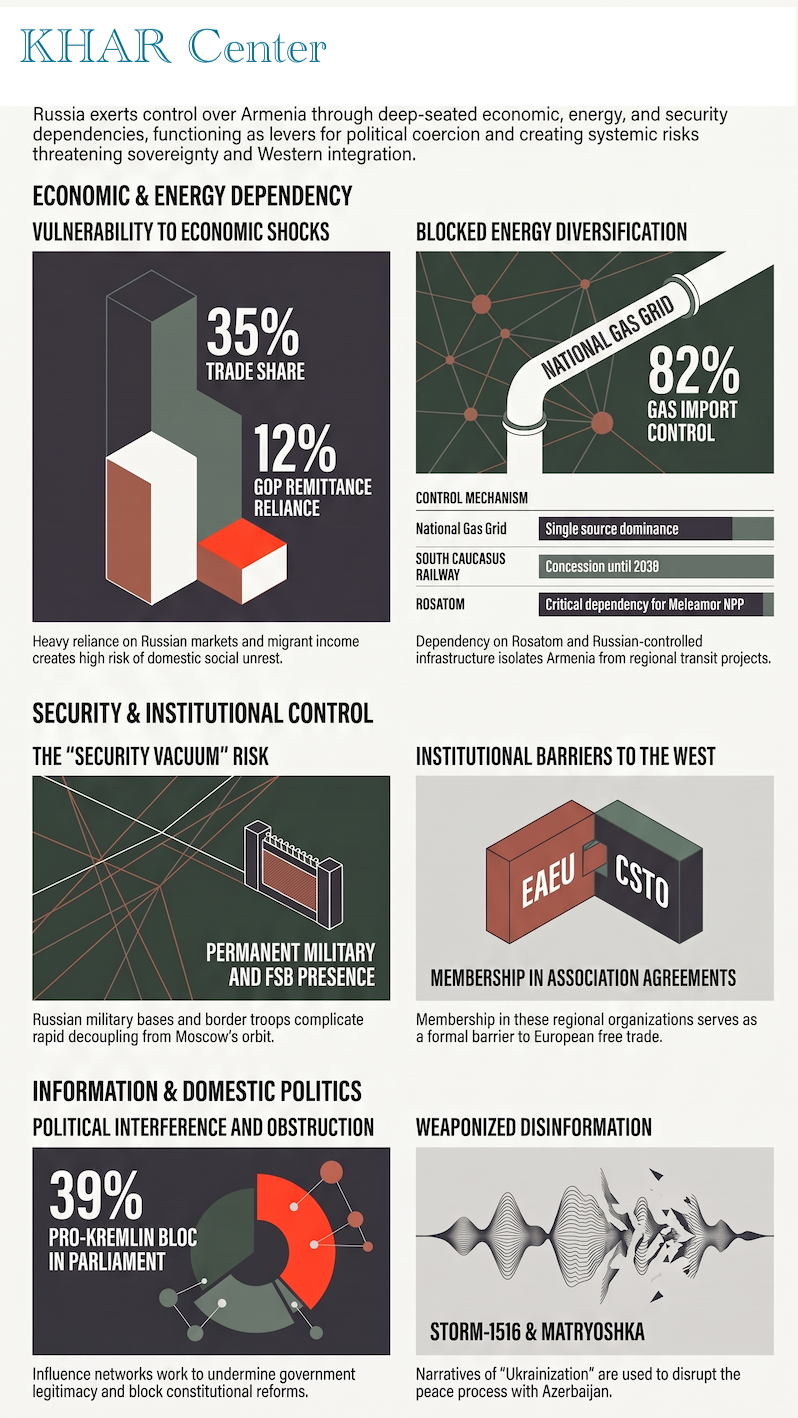
Undoubtedly, the weakening of Russia's dominant position in Armenia does not mean that Moscow has completely lost its mechanisms of influence over this country. As can be seen from the graph above, contrary to popular belief, Russia continues to exert serious influence over Yerevan through trade, energy, military power, intelligence, labor migration, media, and cultural ties. Armenia's dependence on Russia is still greater than that of many post-Soviet countries (Hosaka, 2026).
The head of the Armenian Security Council stated that the biggest risk the country will face in 2026 is the threat coming from third countries. Although he did not name the third country, it is known that he was referring to Russia. This means that the Kremlin no longer sees Armenia as a guaranteed ally, but as a hybrid warfare domain where it fights with the West, and it will not give up its interests here without a fight (Zolyan, 2026b). By all parameters, Russia is determined to use a combination of economic, political, and informational tools to slow down Armenia's foreign policy direction (OSW, 2026). In this combination, the transformation of economic and energy dependence into a means of pressure, military and institutional presence, information operations, local political and business actors, church and diaspora networks are the main mutually complementing channels of influence.
Economic dependence and coercion
The asymmetric economic dependence formed over many years is Russia's most practical tool of influence over Armenia. Especially after 2022, economic relations have become the most important mechanism for Russia to continue its influence in the region. The volume of mutual trade, which rose to 12 billion dollars in 2024 thanks to the re-export of Western products through Armenia, has recently halved. However, despite this, trade with Russia still accounts for 35 percent of Armenia's foreign trade turnover, which is more than the total volume of foreign trade with China and the EU combined (Hosaka, 2026).
In its latest report on the Armenian economy, the World Bank emphasizes that this high degree of dependence is precisely what is risky for Armenia. According to the report, Russia accounts for 33 percent of Armenia's net foreign direct investment inflows and 41 percent of its tourist flow (World Bank, 2026).
Armenian migrants living in Russia are one of the important levers of Moscow's pressure on the Armenian economy. As a member of the Eurasian Economic Union, Armenian citizens can live and work in Russia without a visa. The foreign currency sent to the country in 2025 by Armenians working in Russia reached 3.37 billion dollars, which is 12 percent of the country's gross domestic product (Rogers, 2026).
Russia is still Armenia's main food supplier and, at the same time, the main export market for Armenian agricultural products. According to the report of the Central Bank of Armenia for the second quarter of 2026, more than 90 percent of exports in some product groups go directly to the Russian market. The Central Bank emphasizes that this high concentration makes the Armenian economy vulnerable to the tightening of import rules by individual countries (Central Bank of Armenia, 2026).
Especially since April of this year, the Kremlin has begun consistently restricting the entry of Armenian products into the Russian market. Restrictions were placed on the sale of "Jermuk" mineral water, over 40 percent of which is exported to Russia; flower imports were suspended; and the sale of wine and cognac products of three Armenian producers was banned in Russia. Starting from the end of May, fruits, vegetables, and other agricultural products were also added to the restriction list. In mid-June, Russia restricted the import of all plant-origin products subject to quarantine control coming from Armenia and their transit through Russia to other EEU countries. The exceptional export of fish and fish products, which began in early June, was also completely stopped at the end of June (Rosselkhoznadzor, 2026; Interfax, 2026a; RBC, 2026).
The European Commission called these steps "economic coercion" and promised to prepare a 50 million euro support package to mitigate the effects of this pressure (European Commission, 2026a). In mid-June, the EU announced an initial urgent support package of 34 million euros for Armenia and stated that a portion of the assistance would be directed specifically toward accessing new markets for agriculture, floriculture, and other export-oriented sectors (European Commission, 2026b).
However, on the one hand, finding new markets is not a rapid process, and on the other hand, the problem is not limited merely to these sectors; therefore, the Armenian government is making an effort not to ruin relations with the Russian market—which seems difficult to replace in the short term—and with Russia in general (Hosaka, 2026). Russia, however, expects obedience, not a balanced relationship, from Armenia, which is why it has tightened its economic coercion even further since July—restrictions were imposed on dairy products, and the sale of over 70 thousand bottles of Armenian-produced drinking water and non-alcoholic beverages was suspended (ARKA, 2026).
Energy and infrastructure dependence
When discussing Russia's mechanisms of influence over Armenia, we look at energy and infrastructure dependence as a separate section from economic dependence. Because this is a longer-term, riskier, and deeper dependence than general economic dependence. A large part of Armenia's energy and strategic infrastructure is tied to Russia through long-term contracts and technologies. Russia holds long-term concessions in crucial strategic areas such as railways, nuclear energy, and natural gas distribution. Moreover, this concession is not only linked to Russia's provision of resources but is also strengthened by the fact that transitioning to alternatives requires time and major financing (RUSI, 2024).
The most serious example of Armenia's energy dependence on Russia manifests in natural gas. Out of the 2.7 billion cubic meters of gas entering Armenia in 2025, 2.2 billion cubic meters came from Russia. In other words, Russia accounted for 82 percent of the gas supply. But the dependence is not just this—Armenia's main gas operator is also "Gazprom Armenia," a subsidiary of the Russian company "Gazprom" (Interfax, 2026b). In April, Russian President Vladimir Putin highlighted that Armenia buys gas very cheaply—for $177.5 (Kremlin.ru, 2026). The cheap natural gas reminders by the Russian president and Moscow in general in recent years aim to show Armenia the price of breaking away from the Kremlin vector.
According to a World Bank report that characterizes Armenia's energy reliance on Russia as "deep dependence," Armenia sources two-thirds of its liquid fuel from Russia. Although Azerbaijan starting direct fuel exports to Armenia in 2025 created an alternative for Armenia and this competition positively impacted prices, the dominant position of Russian suppliers in gasoline and diesel still remains (World Bank, 2026).
Up until the last year, Russia also indirectly had a say in Armenia's energy system. Thus, "Electric Networks of Armenia," which manages the country's medium- and low-voltage electrical grid and serves approximately one million subscribers, had been under the control of the "Tashir Group" company, owned by the currently imprisoned Armenian billionaire Samvel Karapetyan operating in Russia, since 2016. However, in 2025, the Armenian government began to intervene in the management of the company and accelerated the nationalization process in 2026. In early August of this year, Pashinyan announced that the company would transition to state ownership and would later be handed over to trust management (Le Monde, 2025; NewsAM, 2026)
Another strategic sector remaining under Russian control is the railways. Armenia's railway system has been managed on a concession basis by "South Caucasus Railway," a subsidiary of "Russian Railways," since 2008, and the term of this contract expires in 2038 (Railway Armenia, 2026). This has become a very serious problem, especially in the context of Armenia's attempts to restore regional communications and connect to new routes within the framework of the TRIPP project. The railways being under Russian control is also one of the obstacles to the efforts to restore the Nakhchivan-Armenia railway line with EU support.
Earlier this year, Armenian Prime Minister Nikol Pashinyan stated that some foreign actors did not want to use the Armenian railway managed by a Russian company, which could cause Armenia to lose its strategic positions in regional transit projects. He pointed to the transfer of the concession to a third country with good relations with Armenia and Russia—for example, Kazakhstan, the UAE, or Qatar—as one of the solution options (Armenpress, 2026). Later, Pashinyan stated that they were conducting discussions with Russia to hand over the concession to a Kazakh company. This was also one of the main issues discussed during Pashinyan's meeting with Putin in April. The Armenian leader subsequently returned to this topic multiple times. However, statements from Moscow revealed that Russia has no intention of giving up this concession in Armenia. The Kremlin threatened Yerevan with punishments, including the restriction of Armenian businesses' access to the Russian market and compensation, should it take this step (CivilNet, 2026).
Armenia has a similar dependence on Russia in the field of nuclear energy as well. The Soviet-made VVER-type reactor operating at Armenia's Metsamor NPP provides 30 percent of the country's electricity generation. "Rosatom" is currently participating in the project to extend the operational life of the second power unit until 2036 (CIVIL Net, 2026 b). Armenia, meanwhile, is considering US, French, Chinese, and South Korean technologies alongside Russia's in order to replace the Metsamor NPP with a smaller station 10 years later (World Nuclear News, 2026). Within this framework, at the beginning of the year, the "123 Agreement" negotiations with the US on the peaceful use of nuclear energy were completed (Office of the Prime Minister of Armenia, February 9, 2026). Russia, on the other hand, approaches these searches by Armenia skeptically, questions the safety and economic efficiency of the small modular reactors proposed by the Americans, and claims that Yerevan has no such alternative. Moscow announced that it is ready to build the new reactor of the Metsamor NPP and has presented a detailed plan for this (TASS, 2026).
In other words, Moscow does not formally dispute Armenia's right to energy diversification, but it tries to maintain its monopoly by claiming that the alternatives are dangerous, expensive, and technologically weak. As in the railway issue, here too, Russia sends the message that reducing existing dependence will create risks and costs for Armenia.
Institutional dependence and the security factor
For many years, Armenia accepted economic dependence and strategic alliance in exchange for Russia's security guarantee. Because since 1988, Armenia's "national interest" has been formed around a policy directly linked to its "vital interest," which symbolized Nagorno-Karabakh. The strategic alliance between Armenia and Russia was formalized by several military treaties, and Yerevan's alignment with Moscow was based on the calculation of a "rational balance" against the Azerbaijan-Turkey tandem. At the same time, until 2013, Armenia was able to maintain balance with all cooperation-oriented partners. However, in 2013, as a result of Russia's efforts, it refused to sign the association agreement negotiated with the European Union, as well as the Deep and Comprehensive Free Trade Agreement, and became a member of the Customs Union created under Russia's leadership. Prior to this, Yerevan was already a member of the Collective Security Treaty Organization, which was again created under Russia's leadership. In other words, after 2013, Armenia was forced to disrupt the balance to the detriment of the West, and unlike Eastern Partnership countries such as Ukraine, Moldova, and Georgia that continued EU integration, it distanced itself from this vector (Vasilyan, 2026).
With Yerevan's defeat in the Nagorno-Karabakh conflict, this paradigm collapsed. Russia, declared as the country's main strategic ally and security provider, demonstrated that it was reluctant or powerless to fulfill the obligations that had long justified Armenia's strategic dependence on Moscow (GMF, 2026). After this, Armenia returned to the course of rapprochement with the EU-US axis, and over the past three years, it has been trying to create a maneuvering space by sharing risks among various power centers. The former monopoly of Russian weapons has been broken, France and India have become the main partners in the defense sector, military exercises with the US have expanded, and the EU's civilian observation mission has been deployed on the Armenia-Azerbaijan border. But despite all this, they do not dare to dismantle the security architecture built with Russia. Because Yerevan believes that if sufficient alternative security guarantees are not created in exchange for a rapid exit from the Russian system, Armenia might face a "security vacuum" (Vasilyan, 2026).
In other words, Moscow's unreliability as a security guarantor has not automatically eliminated Armenia's dependence on Russia. Although the alliance with Russia has fallen into disrepute, institutional dependence continues. This dependence manifests economically in the membership of the Eurasian Economic Union. Armenia still remains a member of the EEU and benefits from its opportunities. These opportunities are the very reason why this institutional mechanism of Russia's influence works. But the main paradox lies here—EEU membership not only creates economic opportunities for Armenia but also limits its alternative integration capabilities. At the most basic level, as long as Armenia remains in the EEU customs system, it cannot transition to an Association Agreement and deep free trade model with the EU. In other words, EEU membership itself draws the boundaries of Armenia's partnership with other economic integration models. Moscow also does not hide the fact that it has turned this institutional dependence into an open tool of pressure. As Armenia's relations with the EU intensify, Russia frequently reminds that the opportunities provided by EEU membership are not permanent, automatic, and unconditional. Russia, Belarus, Kazakhstan, and Kyrgyzstan (the other members of the EEU) openly stated in May of this year that Armenia must make a choice between the two unions (Alander, Hedenskog, Wallberg, 2026).
On the other hand, in Armenia's other line of institutional dependence on Russia—the CSTO—unlike the EEU, there is no benefit that Yerevan continues to obtain. On the contrary, Yerevan's trust in this organization's security guarantee ended after the Second Karabakh War. Frustrated by the CSTO's failure to provide support during the war, Yerevan has frozen its participation in the organization. However, it still remains a formal member. Russia, on the other hand, is trying to turn this formality into practical participation again through threats and punishment. In early August of this year, it was announced that the issue of suspending Armenia's voting rights would be placed on the agenda, since it has not fulfilled its obligations regarding the CSTO budget for more than two years. The Russian representative stated that this issue would be reviewed in November (Caucasus Watch, 2026).
Russia's presence in Armenia's security system is actually not limited to the CSTO either; the 102nd Russian military base in Gyumri continues to operate. Approximately 3,300 military personnel and, additionally, personnel of the Russian Air Force are stationed at this base. The presence of Russian FSB border troops on certain segments of Armenia's borders with Turkey and Iran also remains (Vasilyan, 2026). According to the agreement signed in 2010, this base can remain in Armenia until 2044. This also gives Russia the opportunity to continue its physical presence in the South Caucasus.
To summarize, the narrowness of Armenia's maneuvering space, the limitations of its new collaborations, and the absence of a security guarantee that fully replaces Russia leave it open to Moscow's pressures. Moscow knows this weak point of Armenia and increasingly brings the "price of the choice" to the forefront in their relations (Avdaliani, 2026).
Information influence and main narratives
Russian propaganda has been active in Armenia during all periods. However, the distancing between Moscow and Yerevan in recent years has changed the language and content of the Kremlin's propaganda in Armenia. It has already become very difficult to preserve the positive image created by the "natural alliance and security provider" narrative, which used to be the main line of propaganda. For this reason, Moscow tries to demonstrate its advantages in information influence through the narrative that alternatives are weak, dangerous, and unreliable. This vividly manifested itself especially before and on the eve of the elections held in Armenia in June.
Investigating Armenia's information environment on the eve of the 2026 parliamentary elections, the "Platform for Peace and Humanity" and the "Strategic Security Initiative" concluded that a large portion of Kremlin-sourced messages was aimed at presenting Russia as an indispensable security partner for Armenia against the backdrop of presenting the West as an unreliable and destabilizing actor. Russia-linked information manipulation operated through an ecosystem of coordinated strategic narratives calculated to shape public perceptions about security, sovereignty, political legitimacy, identity, and geopolitical direction (Platform for Peace and Humanity/SSI, 2026).
The report identified five main narratives of Russia in Armenia:
- "Russia is an indispensable security partner"
- "The West cannot protect Armenia"
- Undermining the government's legitimacy
- Identity, religion, and traditional values
- "Ukrainianization", war, and state collapse
The authors compared these narratives in terms of emotional resonance, dissemination capability, persistence, impact on elections, and overall risk, evaluating the last one as the narrative with the highest emotional intensity and greatest strategic risk. Because the "Ukrainianization" narrative combines the fear of war, territorial security, economic anxiety, and the possibility of state destruction within a unified emotional framework. According to the conclusion of the report, such content operates more through emotional escalation than factual persuasion and exploits the trauma of Armenian society left over from 2020–2023 (Platform for Peace and Humanity/SSI, 2026).
The research conducted by "DFRLab" at the end of 2025 confirms this as well. Thus, between January and September 2025, 1,339 posts and approximately 7 million views on these two topics were recorded in the Russian-language "Telegram" space. "DFRLab" traced the origin of one specific campaign back to the Strategic Culture Foundation, which is under US sanctions for its ties to the Russian Foreign Intelligence Service; the material disseminated from there was reshared on at least 36 "Telegram" channels. In those materials, Armenia's integration into the EU was presented as a "one-way ticket", while the strategic partnership with the US was presented as a threat that would "Ukrainianize" the country (DFRLab, 2025). After Putin himself compared Armenia's European direction to Ukraine's rapprochement with the EU in May 2026, this thesis has already become a part of not only peripheral pro-Kremlin channels but also Russia's official political messaging (Platform for Peace and Humanity/SSI, 2026).
Russia's second most functional narrative in Armenia is the thesis that "the West is using Armenia not to protect it, but to push Russia out of the region." According to this narrative, the EU is acting as a geopolitical aggressor trying to change the security balance in the South Caucasus and squeeze both Russia and Iran out of the region. In this thesis line of the Kremlin, the Pashinyan government is presented as a "puppet of the West," and European integration is depicted as an externally managed project rather than a sovereign choice. The EU's civilian observer mission in Armenia has become a specific target of this narrative: the mission is described both as "useless and unable to protect Armenia," and as a structure gathering intelligence on Russia and Iran, creating a platform for NATO to enter the region (Agostini, Ditrych, 2025). During the 2026 elections, the narrative that "the West controls Armenia's domestic policy and elections" was also added to this line. Pro-Russian "Telegram" channels systematically spread and amplified claims that Western organizations would rig the elections in Pashinyan's favor, that the EU's new mission would "manage" the election process, and that cooperation with Europe and Britain was proof of external control (Media.am, 2026).
The systematic undermining of the Pashinyan government's legitimacy holds a special place in Russia's propaganda activities. Pashinyan and the "Civil Contract" government are presented in the pro-Kremlin information environment as an administration that is "weak, strategically incompetent, externally managed, and detached from Armenia's national interests." In this narrative, peace negotiations with Azerbaijan, constitutional changes, rapprochement with the West, and security policy are "packaged" not as normal political choices, but as "treason," "surrender," and the deliberate weakening of Armenian statehood. After 2020, this line strengthened: the government was portrayed as directly responsible for territorial loss, diplomatic failure, and the deterioration of the security situation. In the narrative, the government is presented not merely as incompetent, but as a force actively endangering Armenia's sovereignty and national existence. This narrative serves not only the personal discrediting of Pashinyan, but the main goal is to turn dissatisfaction with specific government policies into a more general distrust of post-2018 political transformation and democratic governance (Platform for Peace and Humanity/SSI, 2026).
One of the active narrative directions of Russia in Armenia recently operates through the issue of identity and morality. Russia-linked and pro-Kremlin actors present Armenia's rapprochement with the West as a threat to the country's traditional social structures, religious identity, and moral foundations. Because this narrative uses the historic and symbolic role of the Armenian Apostolic Church in national identity, it has the capacity for emotional impact (Platform for Peace and Humanity/SSI, 2026).
MAIN PROPAGANDA ACTORS AND AMPLIFICATION MECHANISMS
To implement the numerous narratives mentioned and unmentioned above, Russia utilizes a serious "propaganda army". Moscow's propaganda "machine" in Armenia does not operate as a classic propaganda system broadcasting the same messages from a single center, but as an ecosystem created by interconnected actors of various levels. In its 2026 study on election manipulations in the South Caucasus, "DFRLab" describes this model as the blurring of boundaries between external and internal information influence. In this model, the narrative created abroad is adapted to the Armenian context by local political actors, media, and the influencer network. Thus, the legitimacy of the narrative that has become part of internal political discourse is increased, while simultaneously identifying the actor behind it becomes difficult (DFRLab, 2026a)
Russia's official and state-affiliated media outlets constitute the most overt part of the Kremlin's propaganda actors in Armenia. "Sputnik Armenia", Russian television channels, and other Russian-language platforms are traditional propaganda actors that play a role in presenting the topics of security, Armenia-Azerbaijan relations, and rapprochement with the West in a Kremlin-aligned framework.
However, a noticeable shift occurred in 2025-2026 - the Kremlin expanded the scale of covert and semi-covert digital operations in Armenia rather than official media. These operations reached their peak, particularly on the eve of the June 7 elections. "Storm-1516," considered Russia's most effective propaganda operation worldwide, targeted Armenia the most between April 2025 and April 2026. More than 30 "Storm" campaigns were carried out against the Armenian government in one year. Also known as the "Neva Flood," "Storm-1516" is the name of Russia's state-backed propaganda operation mechanism. This mechanism is linked to the Moscow-based Center for Geopolitical Expertise and the "Double-Headed Eagle Movement" financed by Russian oligarch Konstantin Malofeev. "Storm-1516" uses fake news and activist pages; they mimic authentic media outlets and journalists. The lies are also repeatedly disseminated via the X platform and websites that appear independent at first glance (ISD, 2026).
The DFRLab–CivilNet–Erebus investigation published after the elections in Armenia uncovered the technical infrastructure of the "Storm-1516" operations. According to this, in this operation, Russia used fake and hijacked websites, Armenian-language pages established within the framework of "Storm-1516" operations, various Turkish media organizations ranging from nationalist, leftist, and Islamist to state-backed, and Chinese state media. The contents created within the framework of the operation were multiplied and widespread distribution was ensured via the X platform (DFRLab, 2026b).
In addition, during the pre-election period, disinformation circulated by the "Russian Foundation for Combating Injustice" (R-FBI), created by the former head of the "Wagner" group Yevgeny Prigozhin, was republished on a small group of pro-Russian sites and then multiplied through the exact same X accounts used in the "Storm-1516" operations (ISD, 2026).
Another branch of Russia's propaganda operations, "Operation Overload" (Matryoshka), mimicked more than 50 organizations and individuals in its videos spreading false information about Armenia over the past year. Matryoshka, or otherwise known as "Storm-1679", is an operation that mimics reliable sources to create distrust toward Western institutions. Between January and May of this year, Armenia was the third most targeted country in the "Matryoshka" operations, after Ukraine and France. Media organizations and companies such as "Politico", "Netflix", and "OpenAI" were mimicked in operations targeting Armenia. It was identified that "Matryoshka/Operation Overload" distributed 343 fake videos related to Armenia up until early May 2026; the visual identities of "Euronews", "France 24", "Armenpress", and other well-known media outlets were used in the fake materials (ISD, 2026).
Another significant propaganda channel of Russia in Armenia is its "soft power" structures. The most obvious example of this is the "Evrazia" organization. Evaluated as part of a covert global Russian propaganda network and included in the sanction lists of the US, the EU, and the UK, this organization transferred the election interference model it used in Moldova to Armenia as well. The organization, which opened a representative office in Armenia in 2024, supported 11 Russian-language centers in Yerevan, organized projects and trips in fields such as media, culture, and humanitarian ties, and sent students to the Artek camp located in Russian-occupied Crimea. Since 2025, it also started an aid campaign for Armenians who displaced from Karabakh. The #РоссияСВами ("Russia is with you") campaign was jointly organized by "Evrazia", the Russian Humanitarian Mission, and "Rossotrudnichestvo". At the same time, together with the representative of a pro-Kremlin political party, it held petitions and rallies under the guise of defending the church, incorporating political demands into those campaigns (DFRLab, 2026c).
Mika Badalyan, an Armenian-origin blogger living in Russia, head of the "Azatagrum" movement, and one of the main representatives of the "Evrazia" organization in Armenia, plays a special role in the amplification of the organization's activities within the local information environment. 83 percent of "Evrazia"-related materials about Moldova and Armenia were distributed on "Telegram", and it was identified that Badalyan's channel took first place among the main amplifiers, while his "Azatagrum" channel took second place. Two days before the election, Badalyan and affiliated channels also broadcast an anti-EU campaign in Gyumri, presenting EU integration as a threat to Armenian traditions and values. Tigran Kocharyan, the editor-in-chief of "Alpha News", also supported the campaign (DFRLab, 2026c). In June 2026, the Anti-Corruption Committee of Armenia opened a criminal case regarding Badalyan offering tickets and other privileges to Armenian citizens living in Russia in exchange for participating in the election.
The "Homeland of Armenians" Party of Arthur Vanetsyan, the former head of Armenia's National Security Service, is also among the local branches of the "Evrazia" organization. A portion of the humanitarian aid aimed at displaced Armenians from Karabakh by "Evrazia" was distributed precisely through the offices of this opposition party (DFRLab, 2026c).
One of Russia's soft power channels in Armenia is also the Russian House in Yerevan. In the programs organized for youth by this institution, the thesis that Armenia's future is tied to Russia is systematically propagandized (The Insider, 2026).
Another important channel of Russia's influence opportunities in Armenia is the large Armenian community in Russia and especially the Armenian citizens living there. Over a million ethnic Armenians and hundreds of thousands of Armenian citizens live in Russia. It is estimated that in the first quarter of 2026 alone, more than 100 thousand Armenians went to Russia for work. A large part of the news forming the core of Russia's disinformation and manipulation campaigns during the elections encompassed precisely the Armenian citizens in this country. At the same time, according to national legislation, the requirement for all citizens (excluding diplomatic personnel) to vote on Armenian territory created conditions for Russia to use this factor (Civil Net, 2026 ç).
Moscow also capitalized on the fact that attitudes toward Pashinyan among a part of the Armenian community were shaped based on the Karabakh war. Attempts were made to mobilize the relevant audience with the thesis of "the selling out of Karabakh" by the hands of the pro-Russian opposition. Information about bringing voters from Russia in an organized manner and their potential financial incentivization became a part of the pre-election political environment (ZOiS, 2026)
The Armenian Apostolic Church and the conservative networks around it also serve Russian propaganda directly or indirectly. Church-government confrontation, traditional values, and issues of national identity have become favorable mobilization topics for the pro-Russian information ecosystem. The Apostolic Church and Archbishop Bagrat Galstanyan have directly participated in mass anti-government mobilization in Armenia since 2024, and demonstrated mutual support and cooperation with pro-Russian actors in the 2026 elections. The Church plays a special role in Moscow's narrative that "the West is destroying Armenian identity and religion" (OSCEPA, 2026).
Political actors also occupy a special place within Russia's propaganda mechanism in Armenia. The Strong Armenia bloc led by Samvel Karapetyan, Robert Kocharyan's Armenia Alliance, and the Prosperous Armenia Party led by Gagik Tsarukyan overtly carry out pro-Russian activities, and precisely these three organizations represented Moscow's interests in the recent elections (Zolyan, 2026 b). The results of the parliamentary elections also showed that although Pashinyan managed to stay in power, pro-Russian forces are still strong in Armenia and are not marginal. Thus, these three parties jointly garnered 37.18 percent of the votes in the election. Although Tsarukyan's "Prosperous Armenia" Party failed to pass the electoral threshold, there are currently 41 deputies representing the pro-Kremlin opposition in parliament, which accounts for 39 percent of the total composition (Armenpress, 2026b). Especially considering that the ruling party, which has 64 deputies, does not possess a 70-mandate constitutional majority—that is, the power to independently pass a referendum decision—this creates bargaining opportunities for pro-Kremlin forces on important issues such as Constitutional amendments, peace with Azerbaijan, and normalization with Turkey (Alander, Hedenskog, Wallberg, 2026).
Among the pro-Kremlin political actors, the one receiving the most serious support from Moscow is the currently imprisoned Samvel Karapetyan's Strong Armenia alliance. The "Tashir Group", headed by Karapetyan—leader of the alliance that also includes the New Era and United Armenians parties—possesses vast real estate and industrial assets in Russia. He is also a member of the Russian-Armenian Lazarev Club, led by Russian senator Konstantin Zatulin (CIVIL Net, 2026 b).
Pro-Russian actors in Armenia are not limited to these three parties either. Andranik Tevanyan's Mother Armenia Party, which broke away from Kocharyan's party (CivilNet, 2026 c), the Democracy, Law and Discipline Party led by Vardan Ghukasyan, which despite getting few votes in the election has a political base in the country's second-largest city Gyumri (Zolyan, 2026 b), and Serzh Sargsyan's Republican Party also feature in roles as either openly pro-Kremlin actors or participants in operations localizing the Kremlin's anti-Pashinyan narratives.
In addition to these, serious investigations were also published in 2026 regarding the coordination role played directly by Russian state structures in propaganda activities in Armenia. According to them, the newly created Directorate for Strategic Partnership and Cooperation within the Russian Presidential Administration participated in coordinating anti-Pashinyan information activities, and a number of individuals affiliated with Russian intelligence agencies operated in Armenia. The Gorchakov Fund, the Russian House, and the Russian Institute for Strategic Studies, which are among the core structures of Russia's foreign propaganda operations, featured among the active pro-Kremlin influence structures in Armenia. (The Insider, 2026)
CONCLUSION
The example of Armenia shows how Russia's influence model in the post-Soviet space is changing. Moscow is no longer the undisputed security provider and indispensable political patron for Yerevan as it used to be. But this does not mean that Russia's influence capabilities in Armenia have vanished. It means that they have changed their content, taking on a more dangerous, more threatening form. Moscow uses the instruments of influence formed over many years as weapons to restore the hegemonic position it lost over Armenia. The number and scope of these "weapons" are quite extensive. Economic dependence starting from access to the Russian market, money transfers, labor migration, and agricultural exports, and extending to harder-to-replace strategic sectors such as gas, railways, and nuclear energy; the institutional tie continuing with EEU and CSTO membership; security ties continuing with the military base in Gyumri and the presence of Russian border troops create wide opportunities for Moscow to pressure Yerevan. At every opportunity, Russia warns that the search for alternatives to escape these dependencies will cost Armenia dearly, and in recent months, it has been showing examples of this through various forms of punishment.
Moscow is not alone in this activity. Even though there was a severe collapse in Armenians' trust in their main patrons after the Second Karabakh War, there are still plenty of Kremlin allies within Armenia. In this ranks, alongside the extensions of the Kremlin's official and unofficial propaganda structures in Armenia, some Armenian political forces, social media actors, and the Armenian Apostolic Church play an active role. Armenia is among the main targets of digital operations such as "Storm-1516" and "Matryoshka", which rank among the Kremlin's main global propaganda mechanisms, especially over the last two years.
The 2026 elections demonstrated both the strength and the limits of Russia's influence in Armenia. Pro-Kremlin political parties garnering more than 37 percent of the vote demonstrated that Moscow's political footholds inside Armenia are not marginal. However, the continuation of Pashinyan's political course despite all of Moscow's efforts also showed that Russia's capabilities to convert its influence in this country into results are not as strong as before. In other words, Moscow can still influence political processes in Armenia and obstruct alternatives, but it is no longer the "patron" that single-handedly determines the country's strategic direction.
Undoubtedly, the dependencies with a long history reduce Yerevan's maneuvering capabilities and, for the time being, do not allow it to talk to Moscow in a rhetoric of choices. But at the same time, the Armenian authorities are trying to take maximum advantage of the new opportunities opening up. How sustainable this will be does not depend solely on Armenia itself.
To reduce Russian influence in Armenia, the West should not content itself with mere promises, as it did earlier in the case of Ukraine, but should forge real and long-term alternatives that will replace Yerevan's long-term dependencies on Moscow. The West should invest in projects that reduce Armenia's dependence and increase its resilience, particularly in the fields of energy, transport, security, and the economy, and implement these as soon as possible.
At the same time, Turkey and Azerbaijan, with whom the Pashinyan government is interested in normalizing relations, can also play a role in reducing Yerevan's dependence on Moscow. For this, the signing of a final peace agreement with Armenia and the inclusion of Yerevan in regional communication, trade, and energy projects are very important. This is precisely the most important way to reduce Russia's influence over Armenia - expanding Armenia's range of choices and offering real alternatives.
Note: The article you have read was originally written in the Azerbaijani language. Artificial intelligence tools were used only in the translation.
References:
Nazaretyan, Hovhannes, 2023. Armenia’s Economic Dependence on Russia: How Deep Does It Go? https://evnreport.com/economy/armenias-economic-dependence-on-russia-how-deep-does-it-go/
de Waal, Thomas, 2024. Armenia Navigates a Path Away from Russia. https://carnegieendowment.org/research/2024/07/armenia-navigates-a-path-away-from-russia
CSİS, 2026. Eurasia’s Shifting Balance of Influence: An Opening for the United States. https://www.csis.org/analysis/eurasias-shifting-balance-influence-opening-united-states
Broers Laurence, 2023. Russia Concedes Karabakh Stake for New Regional Order. https://www.chathamhouse.org/2023/09/russia-concedes-karabakh-stake-new-regional-order
Zolyan, Mikayel, 2026a. Between Russia and Europe, Between War and Peace: What Is at Stake in Armenia’s Upcoming Elections? https://www.ifri.org/en/memos/between-russia-and-europe-between-war-and-peace-what-stake-armenias-upcoming-elections
Zolyan, Mikael, 2026 b. Armenia-Russia: Drifting Apart. https://carnegieendowment.org/russia-eurasia/politika/2026/01/armenia-russia-drifting-apart
Hosaka, Sanshiro, 2026. Armenia After the Election: Diversification Without Decoupling from Russia. https://icds.ee/en/armenia-after-the-election-diversification-without-decoupling-from-russia/
OSW, 2026. Armenia Election: Pashinyan Victorious Once Again. https://www.osw.waw.pl/en/publikacje/analyses/2026-06-08/armenia-election-pashinyan-victorious-once-again
World Bank, 2026. Armenia Economic Update. https://documents1.worldbank.org/curated/en/099220307232691033/pdf/IDU-fabe28c5-2e4d-4cac-b76e-fdf32309c601.pdf
Rogers, Luan, 2026. Russian Trade Restrictions Expose Armenia’s Economic Vulnerability. https://evnreport.com/economy/russian-trade-restrictions-expose-armenias-economic-vulnerability/
Central Bank of Armenia, 2026. Package of Documents Related to the Decision on the Policy Rate — 2026 Q2, Monetary Policy Report. https://www.cba.am/en/reports/10145/preview/
Rosselkhoznadzor, 2026. Rosselkhoznadzor Limits Imports of Flowers from Armenia. https://fsvps.gov.ru/news/rosselhoznadzor-ogranichivaet-vvoz-czvetov-iz-armenii/
Interfax, 2026a.Россельхознадзор ограничил ввоз всей подкарантинной продукции из Армении. https://www.interfax.ru/russia/1095414
RBC, 2026. Роспотребнадзор приостановил продажу нескольких коньяков из Армении. https://www.rbc.ru/society/23/05/2026/6a1138659a7947b43f673c1e
European Commission, 2026a. Read-out by President von der Leyen following her phone call with Prime Minister of Armenia Nikol Pashinyan
https://ec.europa.eu/commission/presscorner/detail/en/read_26_1266
European Commission, 2026b. EU Delivers €34 Million Immediate Support to Armenia Announced by President von der Leyen. https://enlargement.ec.europa.eu/news/eu-delivers-eu34-million-immediate-support-armenia-announced-president-von-der-leyen-2026-06-19
ARKA, 2026. Russia Has Suspended the Sale of Another 70,000 Bottles of Water from Armenia. https://arka.am/en/news/economy/russia-has-suspended-the-sale-of-another-70-000-bottles-of-water-from-armenia/
RUSI, 2024. Leaving the Post-Soviet Behind: Redefining Armenia’s Deterrence Strategy. https://www.rusi.org/explore-our-research/publications/commentary/leaving-post-soviet-behind-redefining-armenias-deterrence-strategy
Interfax, 2026b. Russian gas supplies to Armenia decrease 2.6% in 2025.https://interfax.com/newsroom/top-stories/116554/
Kremlin, 2026. Russian-Armenian talks. https://en.kremlin.ru/events/president/news/79454
Le Monde, 2025. En Arménie, épreuve de force entre le premier ministre Pachinian et l’oligarque à la tête de l’unique compagnie d’électricité du pays. https://www.lemonde.fr/international/article/2025/07/03/en-armenie-epreuve-de-force-entre-le-premier-ministre-pachinian-et-l-oligarque-a-la-tete-de-l-unique-compagnie-d-electricite-du-pays_6617739_3210.html
News.am, 2026. We have already decided in the case of Electric Networks of Armenia company, PM Pashinyan says.
https://news.am/en/news/1053866
South Caucasus Railway, 2026. Strategic Importance. https://www.railway.am/en/about
ARMENPRESS, 2026. Third country with warm ties to Armenia and Russia should acquire railway concession rights - Pashinyan https://armenpress.am/en/article/1242159
CivilNet, 2026.The geopolitics of Armenia's nuclear future.
https://civilnet.am/en/news/1013245
World Nuclear News, 2026. US, Armenia Sign Agreement on Nuclear Energy. https://www.world-nuclear-news.org/articles/us-armenia-sign-agreement-on-nuclear-energy
Prime Minister of Armenia, 2026. Nikol Pashinyan and J.D. Vance Make Announcement. https://www.primeminister.am/en/press-release/item/2026/02/09/Nikol-Pashinyan-J-D-Vance-Announcement/
TASS, 2026.Посол РФ: у Армении нет альтернатив предложению "Росатома" по строительству АЭС https://tass.ru/ekonomika/26055245
Vasilyan, Syuzanna, 2026. Armenia’s Policy ‘Twist’ to Cumbersome Tactical ‘Hedging’. https://journals.sagepub.com/doi/10.1177/18793665261442870
GMF, 2026. Armenia Chose Continuity Over Ties to Russia. https://www.gmfus.org/news/armenia-chose-continuity-over-ties-russia
Alander Minna, Hedenskog Jakob, Wallberg Fanny,, 2026. No Going Back Now: Armenia-EU Relations After the 2026 Parliamentary Elections.
Caucasus Watch, 2026. Russia Outlines Procedure for Suspending Armenia’s CSTO Voting Rights. https://caucasuswatch.de/en/news/russia-outlines-procedure-for-suspending-armenias-csto-voting-rights.html
Avdaliani, Emil, 2026. Russia to Armenia: Do as We Say. https://cepa.org/article/russia-to-armenia-do-as-we-say/
Platform for Peace and Humanity; Strategic Security Initiative (SSI), 2026. Foreign Influence and Information Manipulation in Armenia’s Electoral Context: Assessing Russian Narratives, Networks, and Pre-Election Risks Ahead of the June 7 Vote. https://peacehumanity.org/wp-content/uploads/2026/06/Foreign-Influence-and-Information-Manipulation-in-Armenias-Electoral-Context.pdf
DFRLab, 2025. Kremlin-Originated Campaigns Target Armenia with “Ukrainization” Narrative. https://dfrlab.org/2025/12/23/kremlin-originated-campaigns-target-armenia-with-ukrainization-narrative/
De Agostini, Leonardo; Ditrych, Ondrej, 2025. Digital Echoes: Countering Adversarial Narratives in Georgia and Armenia. https://www.iss.europa.eu/publications/briefs/digital-echoes-countering-adversarial-narratives-georgia-and-armenia
Media.am, 2026. Foreign Interference Or Closer Ties? Pro-Russian Channels Aim To Delegitimise Armenia’s Elections
https://media.am/en/verified/2026/05/08/45975/
DFRLab, 2026a. Foreign and Domestic Information Manipulation Report. https://dfrlab.org/wp-content/uploads/sites/3/2026/04/03.2026-ERP-Report-FINAL.pdf
ISD, 2026. All Operations on Armenia: Russia’s Influence Machine Targets the Vote. https://www.isdglobal.org/digital-dispatch/all-operations-on-armenia-russias-influence-machine-targets-the-vote/
DFRLab, 2026b. Uncovering the Digital Infrastructure Behind Russian Interference in Armenian Elections. https://dfrlab.org/2026/07/29/uncovering-the-digital-infrastructure-behind-russian-interference-in-armenian-elections/
DFRLab, 2026c. From Chisinau to Yerevan: How Russia’s Evrazia Brought Its Moldova Playbook to Armenia. https://dfrlab.org/2026/06/05/from-chisinau-to-yerevan-how-russias-evrazia-brought-its-moldova-playbook-to-armenia/
The Insider, 2026. Grabbing him by the “Beard”: The Insider identifies the FSB, GRU, and SVR agents Russia sent to Armenia to take on PM Nikol Pashinyan https://theins.press/en/inv/292740
ZOIS, 2026. Russia and Armenia’s 2026 Parliamentary Elections. https://www.zois-berlin.de/en/publications/zois-spotlight/russia-and-armenias-2026-parliamentary-elections
OSCE Parliamentary Assembly, 2026. 2026 Parliamentary Elections — Election Observation Statement: Armenia. https://www.oscepa.org/en/documents/election-observation/election-observation-statements/armenia/statements-2/5525-2026-parliamentary-1/file
ARMENPRESS, 2026b.CEC announces final results of Armenia’s parliamentary elections https://armenpress.am/en/article/1252978
CivilNet, 2026b. Where do Armenian parties stand on Russia and the West? https://civilnet.am/en/news/1012220
CivilNet, 2026c.Armenia’s election line‑up so far. https://civilnet.am/en/news/1001534
