
Samira Huseynli is a freelance journalist and documentary filmmaker. She has an M.A degree in Future Media and Journalism from Vytautas Magnus University and B.A degree in Journalism from Baku State University. Her research interests include digital storytelling and subcultures in Azerbaijan.
(This article was prepared within the framework of the Khar Center's research on Azerbaijani authoritarianism)
Note: The original version of this article was written in English.
Introduction
This article explores the function of the rock music as an alternative subculture in post-Soviet Azerbaijan, with a particular focus on the factors that have contributed to its decline in the context of the country's authoritarian landscape. Since the dissolution of the Soviet Union, the cultural and intellectual developments in every post-Soviet “republic” have been studied by the new generation of scholar. Nonetheless, some thematic areas in the scholarship have remained underexplored. Subculture in Azerbaijan is one such area. Although there is valuable scholarship on Soviet and Soviet-influenced ways of life among larger nations (see: Fierman, 1988), in the Azerbaijani case the literature remains extremely limited, extending little beyond local scholars’ personal observations and studies. Driven by this academic lacuna along with my emerging interest to the urban subcultures, I decided to focus on this topic.
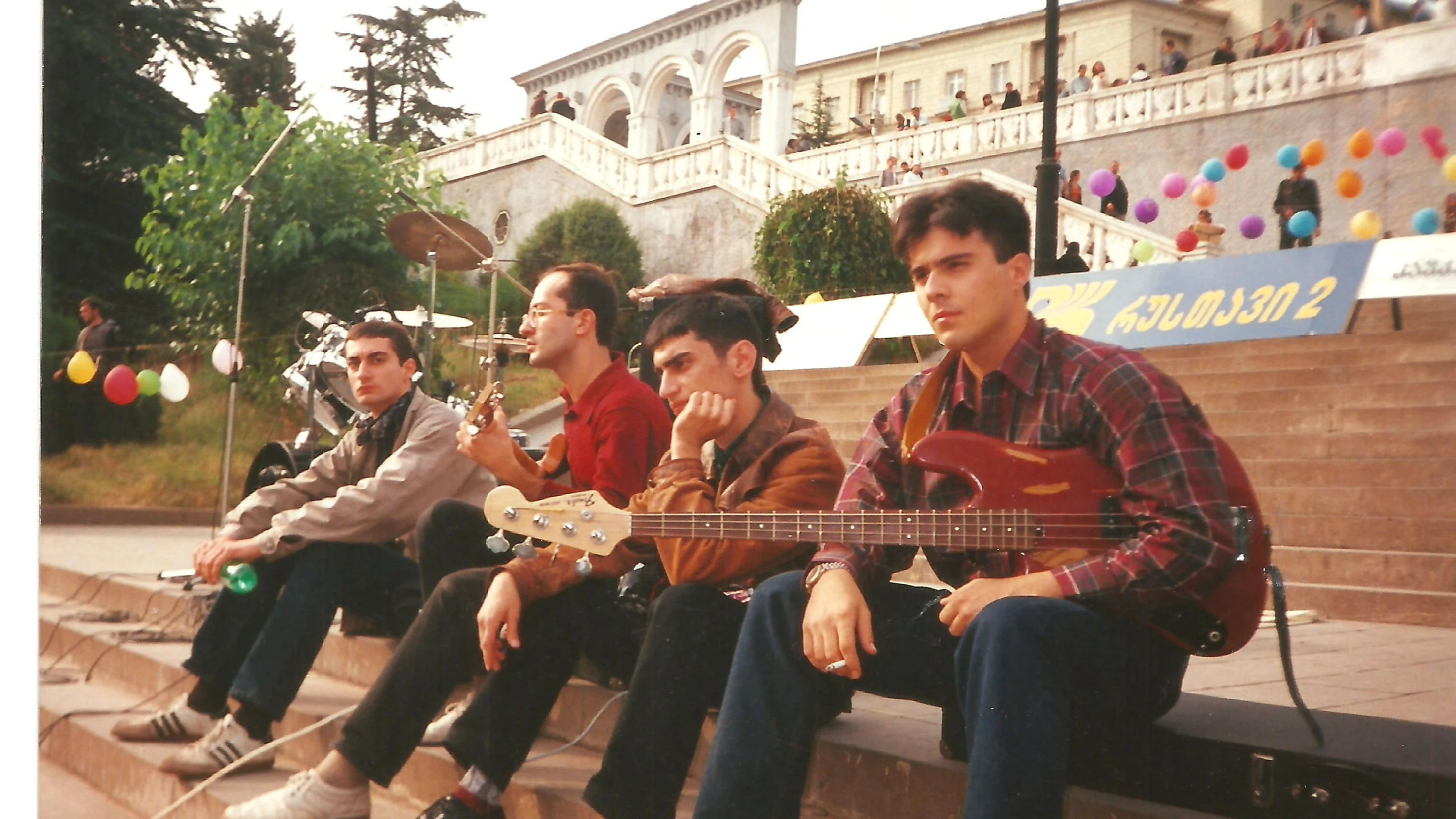
The direct subject of this article is a rock band from Azerbaijan, with the aim of examining how this once-active artists has been influenced by political and societal changes. While this article may only represent the tip of the iceberg, I believe that through interviews and analysis, the paper will help illuminate the broader rock scene within the context of the political landscape. The interviews were conducted with the vocalist of Coldünya- Teymur Nadir, as well as two other members of the band. Other members of the band are Rovshan Kerimov who played guitar and sang back vocals, and Samir Jafarov who performed on drums, vocals, and keyboard. Drawing on semi-structered interviews with the band’s three members, and cross-referencing their accounts with the experience of other bands, I trace the band’s trajectory from 1990s to 2020s. I examine how this band, among others, has been influenced by political and societal changes and what this suggests about the fate of the rock scene in post-Soviet Azerbaijan.
Why I chose the band Coldünya. This decision is mainly based on the fact that the band was an active and popular rock band in Azerbaijan during 1990s which gradually withdrew from the country’s rock scene in 2010s. Coldünya was regarded as the pioneer of Azerbaijani rock, together with bands such as Experiment OK and Yuxu of late Soviet era. The band was founded in the year 1990, followed by the release of two albums Nota Bene in 1996 and Demo in 1999. The band also stood out for gaining international visibility, for example, their song Sehrbaz (Magician) was featured on London’s BBC Radio in 1996. They were even invited to London by producer Daggi Douglas after their song reached 7th place on the BBC’s foreign hit list, along with German metal band Rammstein. However, it was financial constraints that thwarted their future collaboration with British producer of the time. In the meantime, the band released three more albums such as Mektub (Letter) in 2002, Oyanısh (Awakening) in 2003 and Ehate Dairesi Xaricinde (Outside the Scope) in 2009. The band had constant visibility and broadcast in ANS TV, ANS Radio and Space TV in those years. As of 2010s, the vocalist Teymur Nadir emigrated to Lithuania and continued his artistic endeavors abroad. The band also distanced itself from public and cultural life in Azerbaijan since that period. Considering that 2010s is the period, many rock and metal bands in Azerbaijan such as Unformal, Sadnos, 3.14 (П), Sirat, Bende, Ferrum and others waned their activities, it raises an important question. Whether it may be that “shrinking” space (Balfour, et. al., 2020) and “deepening” authoritarianism (Delcour & Wolczuk, 2021, 12) in Azerbaijan which has shaped rock enthusiasts’ cultural and professional trajectories. Accordingly, this paper asks the extent to which progressive subcultures, here rock were perceived by the state as politically undesirable or it may be perceived as stimulating dissenting voices through the energy of music and lyrics. To analyse attitudes toward rock music during the Soviet period and the years following independence, my aim is to provide a broader perspective on the similarities between the two periods in terms of how rock music has been perceived. The paper begins with the explanation of the transformations of the rock scene in Azerbaijan within political and cultural contexts in the 1990s-2020s and continue with the influence of rock as a cultural expression. I claim that it was the political context of the country which resulted in rock enthusiasts’ either emigrating or gradually withdrawing from the rock scene. It was both direct restrictions in public broadcasting and neglectful approach which have narrowed cultural space in Azerbaijan. And those rock artists who remained in genre, resorted to politically insensitive lyrics.
The objectives of this paper are to discover:
- What did change in the rock arena in Azerbaijan after independence?
- Why did the decline of Azerbaijan’s rock scene happen after its late 1990s peak?;
- What is the significance of rock music as a tool for protest and social expression?;
- How have political and societal changes been reflected in the lives of rock artists?;
Transformation of rock scene in Azerbaijan
Changes in Azerbaijan’s political landscape have been a decisive factor in rock’s backsliding from the rebellious edge of popular culture. With the country’s authoritarian character in mind, one wonders what has become of those involved in rock music. While some argue that music can play a powerful role in transforming politics and culture (Wicke, 1992, p.196), others maintain that its influence is limited: For example, songwriter Rosselson argues that political songs should be read in their historical context and understood as responses to moments when public pressures shape private life. In this sense, political songwriting is not about propaganda or slogans, but about linking personal experience with political realities (1981). By contrast, the former argument aligns more closely with the Soviet ideal of being “all united in one family”, which framed rock as a potentially dangerous cultural force capable of shaping political attitudes and undermining ideological unity (Soi︠u︡za, 1961). I would even say that Soviet authorities considered rock as dangerous as ‘loaded gun’. It is not a coincidence that Soviet officialdom described rock music in pathological metaphors as a “tumour on the social organism,” “musical drug,” or as a “virus”, at times even compared to AIDS (Szemere, 1989, 203-205). Of course, the extent of this danger, whether due to its Western orientation, its role as a medium of protest, or a combination of both, remains uncertain. In the 1960s, one of the notable strategies was sugarcoating rock music with state-approved vocal/instrumental ensembles (VIA) which echoed a softened, harmless version of popular music (Troitsky, 1987, p.154).
Rock bands in Azerbaijan which were founded as of late 1960s were strongly influenced by prominent western rock bands such as The Beatles, The Rolling Stones, Deep Purple, Led Zeppelin and others. Forming in the school and university’s buildings, first VIAs of Azerbaijan reflected unquenchable passion of amateur young and enthusiastic bands. They were several- Experiment OK, Eskulap , Üç alov and Xürrəmilər. That was the time allowed to music enthusiasts to buy and listen to Beatles records from Melodiya’music stores in Baku alongside other capital of Soviet countries (Riad, 2020). Even from 1987, Baku began strengthening its role in the rock scene with the establishment of the City Youth Modern Music Center under the Baku Komsomol Committee, which later led to the foundation of a Rock Club within it (Riad, 2021). However, with the enjoyment of independence years, people began to question and experience plethora of new things in their lives more intensely, paving the way for new concerts, new ways of self-expression and self-realization.
Possible reasons for decline in post-Soviet Azerbaijan’s rock scene
Reasonably, discontent was the expected theme in rock culture after the country’s first democratic elections in June 1992, as every part of culture began experiencing more independence. In the first years of independence, there were strong hopes for democratic development across all spheres of life within the society. Nevertheless, these expectations did not come true. Beginning in the early 2000s, large-scale rock concerts gradually atrophied. Still along with the newly emerging hopes of independence in 1991, ANS (Azerbaijan News Service) became a unique platform for broadcasting different musical styles. All of this was during the rule of Heydar Aliyev, father of the current president, Ilham Aliyev. As Audrey L. Altstadt (2017, pp. 10-11) has noted, this was a “rocky path” for the country, as the early presidents were primarily occupied with building international connections and managing the Armenian-Azerbaijani conflict. Even local experts have pointed out that during those years, rock music could be heard on local radio very often (Riad, 2020). However, Ilham Aliyev’s rule (2003-present) came with increasing restrictions on freedom of speech among other things. The more measures the president Aliyev introduced against criticism and the free exchange of ideas, the fewer open-minded people and unconventional programs rose to prominence. The clearest example was the closure of ANS under the guise of alleged insufficiency of the license as determined by the National Television and Radio Council (BBC, 2017). ANS was not only a news television channel that shed light on social problems in the country, but also a platform that gave visibility to emerging rap and rock bands (Riad, 2019). The most prominent program in that channel was called Dissident where various rock bands such as Bende, Ferrum, Ozan and others received public space and visibility in late 2000s. From that time onwards, as most local experts have concurred, the conditions for music, especially genres like rock, rap which were not widely accepted as national or familiar to the broader public, deteriorated significantly.
It is not surprising that American researcher Altstadt (2017, p.23) draws an analogy between the language of the Azerbaijani officials and that of Stalin when describing the vilification of political opponents. The similarities with Soviet times are not limited to restricting non-governmental organizations (NGOs). They also include the control or, at times, the deliberate neglect of cultural expressions. This is especially true for those forms that might encourage people to think critically and awaken a spirit of protest. According to the Article 94 of the Constitution of the Republic of Azerbaijan (2012), Chapter II, Article 3, Clause 3.1 “The state policy on culture is an inseparable part of the domestic and foreign policy of the Republic of Azerbaijan”. In practice, almost all television channels and radio stations, in one form or another, remain under government control. According to media expert Ahad Ahadli, the government increased programming formats like matchmaking shows or missing persons programs on TV which is another way to keep “national, moral values” and discussion on how western values can destroy them (Radio Free Europe, 2025, 2:54). To illustrate, official statistics from the Azerbaijan Audiovisual Council on the genres of nationwide terrestrial television programming in the second quarter of 2025 show that respective entertainment programs are the second most dominant category (Audiovisual Council of the Republic of Azerbaijan, 2025). These programs include mainly ashiq music or pop singers which present no harm to “national values”. If they do, they are punished accordingly, as in the recent case of a rapper Akbar Novruzlu Epi sentenced to 30 days for criticizing the ruling family’s Kapital and Pasha banks in a rap battle (Meydan TV, 2025). Another case occurred recently, when rapper Elshad Xose was detained after speaking out against the demolition of the historic ‘Bayır Şəhər’ district (Radio Liberty, 2026). Amongst the environment in which every diversity, alternative perspective is perceived as a threat, how can the rock scene move forward?
Having long been associated with protest, self-expression, rock struggles to find its stable place in Azerbaijan. Unlike the early independence years, there are no special concerts taking place in the country presently. As lead vocalist Teymur Nadir expresses with hesitation that after their generation, the progress declined, “probably because of political situation”. It is ironic that he himself acknowledged the impact of politics on the decline of Azerbaijani rock, while simultaneously hesitating to directly associate rock music with protest and free expression. Teymur Nadir’s hesitation also correlates with the fact that there is little to no rock bands that have turned to politically salient lyrics over the past decade. The latter suggests that, despite the relative relaxation that prevailed among rock artists in the 1990s and 2000s, Soviet-era fears of criticism have returned. A telling example from this earlier period is Ferrum’s song “Polis”, which included explicit social criticism and was even performed and broadcast on mainstream media such as ANS TV. The lyrics compare the police to prostitutes and depict policing as shaped by bribery (YouTube; Mahammadli, 2009). This performance reflects a period when openly critical rock could still reach mainstream television and this openness that appears strictly restricted today. Another example could be brought from Bulistan’s video clip “Vermişel” which openly criticized the government’s policy of demolition of historical quarters, mass corruption and political surveillance against the backdrop of rising poverty (YouTube; Suleymanov, 2013). Although that band never received public airtime on state television, the members of the band were residents in Azerbaijan at the time. With rising political restrictions in 2012, they too were forced into a permanent exile from the country (Qafqazinfo, 2012). These instances stand testament to the fact that the government’s authoritarian trajectory is in inverse proportion to the development of the rock genre. For instance, in Coldünya’s most prominent song from 1990s, “Sehrbaz”, one can identify rebellious and Sufi-inflected motifs in the lyrics. Lines such as “even a mountain made of iron cannot stop a human” and “God is within me” challenge dominant beliefs and hierarchies of the period (1996). Although the song does not address politics directly or explicitly call for protest, it elevates human agency in a way that can be read as implicitly subversive suggesting a form of empowerment that approaches the divine. These lyrical choices were likely shaped by the euphoria of the early independence years, when civil society and individual self-expression appeared to be emerging more visibly.
As Teymur Nadir stated, “the 1990s were the freest period in Azerbaijan,” comparing that decade to the UK in the 1960s. He gave an example related to their song “Sehrbaz”: “Even though we performed with long hair and eyeliner, it was broadcast on public television, not just once, but several times.” These choices challenged conventional expectations of Azerbaijani masculinity and defied dominant norms of appearance at the time. On the other hand, Samir Cafarli - a drummer of the Coldünya band - argued (2025), “today’s music enthusiasts have everything in terms of access to musical instruments and albums”, then what thwarts the potential development of rock music in Azerbaijan? While this observation may suggest a degree of declining interest in rock even by rock lovers themselves, it should not obscure the fact that many highly committed rock enthusiasts have ultimately stopped being active in Azerbaijan or have left the country.
Influence of rock music and concerts as a tool for social expression and freedom
In the post- II World War period, genres like jazz, folk, and rock gained prominence in Europe partly by rejecting pop music as ideologically empty or excessively sentimental. Among these, according to Hesmondhalgh (2013, p.45), the rock subculture became especially influential, promoting values of rebellious creativity, social struggle, and a closer identification with ordinary people. This expressive freedom was not merely symbolic, at times it produced volatile situations. Like Kureishi and Savage (1995, p. xix) described pop, it creates desire to feel rather than to think. Rock history contains numerous cases in which concerts that began as routine performances descended into forms of collective disorder or even riot (Irwin, 2022). One well-known example is Jim Morrison’s arrest in 1967: after being maced by a police officer before the concert, Morrison denounced him onstage as “the little blue man in a little blue hat” and later as “a little blue pig,” leading to police intervention and the arrest of thirteen audience members. In a different context, rock concerts and festivals, which were widespread in Azerbaijan in the early 2000s before fading with the country’s authoritarian turn, can be understood as generating temporary publics. When Jean-Louis Fabiani (2011, pp.104-119) compares festivals to other forms of cultural consumption, he highlights their role as public spaces: “unlike the ordinary consumption of cultural goods, festivals allow more time to gather [and] discuss before and after the show. They produce a fair number of ‘regulars’ or ‘devotees’ who collectively build a critical space of their own”. More broadly, the sense of collective unity that rock performances can generate, through energetic rhythms and emotionally charged lyrics, reinforces the genre’s significance as a vehicle of critical self-expression among young people. As the member of the Coldünya band Rovshan Karimov expresses: “It is not only music -it is a way of thinking differently, of daring to tell the truth”. In authoritarian contexts especially, rock music can function as a medium through which young people articulate anger, express dissent, and form affective bonds with others who share similar emotions. As the band’s guitar player noted, rock held deep personal significance for him:
It is not only music. When you engage with it, you start reading the thoughts and lives of the artists you admire, and you realise they are not like the people around you. They have a unique point of view, they are not afraid to tell the truth unlike our Soviet-era upbringing, when we were always told, “Don’t speak loudly, be silent, and live as part of the mass”. And when you wanted to express your own opinion, the elders would say, “Do you think you are smarter than everyone else?”(personal interview, 2025).
Rock music has long been associated with a rebellious spirit, whether explicit or implied. In post-Soviet contexts marked by a legacy of cultural control, this symbolism remains politically sensitive, particularly when rock is framed as a Western cultural form. During the anti-Lukashenko protests in Belarus, for example, two DJs were arrested after playing Viktor Tsoi’s “Khochu Peremen” (Want Changes!), a song often interpreted as a call for political change (Koval, 2020). Subsequent reporting suggested that Belarusian state radio discouraged or restricted the song’s broadcast, echoing earlier patterns of censorship associated with its political connotations (RFL, 2011). This continuity of attitudes, inherited from the Soviet era, persists in some post-Soviet countries and Azerbaijan is no exception. Documented cases suggest that Azerbaijani authorities have subjected musicians to pressure and intimidation. One such case involved Jamal Ali, the lead vocalist of the band Bulistan, known for blending rap and rock and for contributing as a freelance reporter to Meydan TV. Although his detention was presented as a consequence of a confrontation with another man during the 17 March 2012 protest in Baku, observers are convinced that the underlying reason was the band’s critical lyrics and its role in challenging political oppression (Human Rights Watch, 2012). While he was arrested along with his guitar player Natig Kamilov during the protest, they were performing their song which were replete with stylistic and critical jargons (YouTube; Suleymanov, 2013). The last speculation intensified after the release of the song “Heykəl Baba” (“Monument Grandpa”), which referred to the 10-year prison sentences of young activists Giyas Ibrahimov and Bayram Mammadov for writing an anti-system slogan on a monument to Heydar Aliyev, the father of Azerbaijan’s current president. Following the song’s circulation, not only Jamal Ali but also his close relatives, including his mother, were detained and arrested, which brought more popularity to the song (Adilgizi, 2017). Its views on YouTube exceeded 150,000.
Based on my participant observation throughout our conversation with members of the Coldünya rock band, I would suggest that they too accepted the existence of restrictions to the freedom of speech and free thought in general, but they did it implicitly. A telling example is provided by Rovshan Karimov, who recalled restrictions on free thought, acknowledged that they persist in the country, but quickly added that the same may be true in the United States and other countries. Another interesting fact is that after 2010, Teymur Nadir organized music projects and performed in different countries such as Lithuania and Georgia, but not in Azerbaijan. This fact itself justifies Said Riad, a researcher on subcultures in Azerbaijan, who lamented that Azerbaijan’s rock musicians with good performance in foreign countries are bewitched when they come back to the country (2021). Interviews conducted with members of the Coldünya rock band makes it self-evident that rock musicians are no less affected by changing political landscape that has developed since 2010s. One possible explanation for the shrinking space for the rock enthusiasts lies in the potential of rock subculture to reignite the energy of young people. Especially 2010s was the tipping point for color revolutions in in Arabic countries and later in post-Soviet space. These political movements were the early signals which rendered the untamed energy of youth dangerous in the eyes of Azerbaijani government (Altstadt, 2017, p.23). Accordingly, it gave rise to the 2013 repression targeting NGOs, independent journalists, and human rights defenders. It was not happenstance that most of those belonged to the younger generation (Human Rights Watch, 2013). This generation, more dauntless and courageous in their aspirations for a better life. Apparent example of it is the ongoing Gen-Z protests erupting in Morocco (Chothia,2025). There is little doubt that young people with free thought and open minds represent a tangible risk to those in power. With its strong beats and rebellious energy, rock has historically amplified such sentiments. As my interviewee Rovshan K. observed: “there are lots of police in every rock concert, unlike jazz or pop concerts, due to fear of the increasing energy of the young”.
In today’s Azerbaijan, rock lovers can only enjoy the subculture in underground venues such as pubs and clubs unlike it was during the early years of country’s independence. Understandably, this situation offers little perspective for musicians to remain in the field. The increasing emigration of rock artists has therefore become normalized. Despite the abundance of accessible sources for the musician thanks to the technological advancement, those who remain must make significant sacrifices that are unlikely to be rewarded in the long run. Under an authoritarian political space, independent artists can be under the pressure of political repercussions, while also facing financial instability and the difficulty of maintaining motivation amid these hardships. All these political and societal changes did not leave the musicians of Coldünya unaffected. The band’s vocalist, for instance, turned to business, while his brother became the director of a food company in Baku. Only the drummer, Samir Cafarli, has continued in music performing in underground pubs as a source of income, much like during the Soviet period. It stands to reason that, after a certain stage, many young enthusiasts in this field abandon their artistic aspirations due to man-made barriers that hinder creative freedom and gradually erode motivation. The transformation of initial passion into disillusionment serves as a vivid example of authoritarian dynamics in Azerbaijan.
Conclusions
It is reasonable to infer that the rock scene’s contraction appears, in certain respects, analogous to failures in Azerbaijan’s self-proclaimed democratic development. Just after the brief opening in the early independence years, the space for youth self-expression has narrowed, especially after 2010, amid heightened sensitivity to youth mobilization following the “color revolutions.” The late-1990s peak of rock owed partly to novelty and curiosity among Azerbaijani youth. Even if that intensity could not have been sustained at the same scale, the subsequent outcome emigration or exit from music was not inevitable. This limbo, on the other hand, instigated policies that privilege “national, moral values” and framing Western culture as corrosive on pro-government media that as a result have pushed rock to the margins. Its evocative power as a vehicle for protest persists in post-Soviet countries seen, for example, when Belarusian protesters rallied to Viktor Tsoi’s “Peremen”, reminding both publics and decision-makers that music can energize critique and prompt questioning of the political status quo. Considering financial hurdles and the lack of widespread interest in rock music in Azerbaijan, it would be a mistake to assume that the country’s authoritarian character alone is responsible for this backsliding.
Unsurprisingly, the authoritarian control in Azerbaijan extends far beyond rock music, and simply liberating the genre will not by itself democratize the country. As a post-Soviet state, the Azerbaijani government still carries some of the same fears that Soviet officials had, which we see echoed in their rhetoric targeting dissidents. In a similar vein, authorities cast rock (or any alternative subculture) as a threat to national values. It is also likely that in post-Soviet contexts where authoritarian figures remain in power, many still believe in rock’s disruptive potential.
The possible recommendations for expanding the project could be this way:
- Future research could broaden the scope by including a wider range of contemporary rock bands, particularly younger musicians and female band members, in order to reduce the risk of overgeneralising from a small and relatively homogeneous sample.
- It would also be valuable to situate Azerbaijani rock within a comparative framework, examining similar developments in other post-Soviet contexts to gain a wider perspective on how rock music relates to social and political change.
- In addition, incorporating the standpoint of rock listeners, for example through audience surveys, focus groups or in-depth interviews could significantly reshape or enrich the findings. Such a bottom-up approach would offer a fresh and more comprehensive view of the current and future prospects of the rock scene. Last but not least, addressing questions such as the extent to which Islam has influenced this waning interest could further broaden the horizon of possible conclusions.
References
- Altstadt, A. L. (2017). Frustrated democracy in post-Soviet Azerbaijan. Columbia University Press.
- Adilgizi, L (2017, Jan 9). Azerbaijan: Rapper’s Family Punished over Song Critical of Government. Eurasianet. https://eurasianet.org/azerbaijan-rappers-family-punished-over-song-critical-of-government
- Amnesty International 2024\25.
- Audiovisual Council of the Republic of Azerbaijan. (2025, July 11). The Audiovisual Council has released genre statistics of the programs broadcast by nationwide terrestrial television channels in the second quarter of 2025. https://acra.gov.az/en/news/1396
- Balfour, R. & Gelhaus, L. and Matrakova, M. (2020). “The changing landscape of civil society in the Eastern Partnership”. German Marshall Fund, October 12. https://www.gmfus.org/news/changing-landscape- civil-society-eastern-partnership.
- Azərbaycan Respublikasının Qanunu. (2012, December 21). ‘Mədəniyyət haqqında Qanun’ (25303). e-qanun.az. https://e-qanun.az/framework/25303
- BBC (2017, Aug 31). ‘Azərbaycanda bağlanmış media təşkilatlarının qısa tarixçəsi’.
https://www.bbc.com/azeri/azerbaijan-41107828
- Chothia, F. (2025, 03 Oct). First killings in Morocco since Gen Z protests erupted. BBC international. https://www.bbc.com/news/articles/cgrqpekyxpvo
- Delcour, L. & Wolczuk, K. (2021). “Mind the gap: Role expectations and perceived performance of the EU in the South Caucasus”.Eurasian Geography and Economics 62 (2): 156–77.
- Fierman, W. (1988) Western popular culture and Soviet youth: A case study of the “Muslim” regions, Central Asian Survey. Routledge. http://dx.doi.org/10.1080/02634938808400612
- Giorgi, L, M. Sassatelli, & G. Delanty (Eds.) (2011). Festivals, local and global: Critical interventions and the cultural public sphere. In Fabiani, J(Ed.), ‘Critical interventions and the cultural public spaces’. Routledge.
- Hesmondhalgh, D (2013). Why Music Matters. Blackwell Publishing.
- Human Rights Watch. (2013, March 21). Azerbaijan: Investigate Alleged Ill-Treatment by Police. https://www.hrw.org/news/2012/03/21/azerbaijan-investigate-alleged-ill-treatment-police
- Human Rights Watch. (2013, Sep 2). Azerbaijan: Crackdown on Civil Society. https://www.hrw.org/news/2013/09/02/azerbaijan-crackdown-civil-society
- Irwin, C. (2022, Aug 4). 18 Rock Concerts That Turned Into Riots. Classic Rock& Culture. https://ultimateclassicrock.com/rock-concerts-riots/
- Jamal Ali. (2014). Vermişel. Youtube. https://www.youtube.com/watch?v=QTBa4HS8-sg
- Koval, I. (2020, May 9). Under threat from authorities, Belarusians go into exile. Deutsche Welle. https://www.dw.com/en/under-threat-from-authorities-belarusians-go-into-exile/a-54817861
- Mahammadli, I. (2009). Ilkin Mahammadli (ex Ferrum) - Polis (ANS - Dissident - 2009). Youtube. https://www.youtube.com/watch?v=EcyT1jVSNkM&list=RDEcyT1jVSNkM&start_radio=1
- Meydan TV (2025, July 16). “Paşa Bank” və “Kapital Bank”ın adını çəkən repçiyə 30 sutka həbs verilib.https://www.meydan.tv/az/article/pasa-bank-v%C9%99-kapital-bankin-adini-c%C9%99k%C9%99n-repciy%C9%99-30-sutka-h%C9%99bs-verilib/
- Meydan TV (2026, Jan 8). Bayırşəhərdəki söküntüləri tənqid edən repçi Elşad Xose həbs edildi. https://www.meydan.tv/az/article/bayirs%c9%99h%c9%99rd%c9%99ki-sokuntul%c9%99ri-t%c9%99nqid-ed%c9%99n-reper-elsad-xose-h%c9%99bs-edildi/
- Qafqainfo.az (2012). Camal Əli Azərbaycanı tərk etdi. https://qafqazinfo.az/news/detail/bcamal-eli-azerbaycani-terk-etdib-17870
- Radio Free Europe (2011, July 19). Belarusian State Radio Reportedly Bans Politically Sensitive Song https://www.rferl.org/a/belarus_bans_revolutionary_rock_songs/24270086.html
- Radio Free Europe (2025, July)- Banal programs, entertainment shows: Why are these types of programs still dominant in Azerbaijan. (Video). Youtube. https://www.youtube.com/watch?v=Rhyh6Vw-TmA
- Riad, S. (2019). Azərbaycanda rok var!. Literal.az https://literaz.com/news/go/649/seid-riyad-azerbaycanda-rok-var
- Riad, S. (2020, Dec 21). Biker and Rock Subcultures in Azerbaijan. BakuResearchInstiute.https://bakuresearchinstitute.org/en/biker-and-rock-subcultures-in-azerbaijan/
- Riad, S. (2021). Rok kim üçündür?. Literal.az https://literaz.com/news/go/663/seid-riyad-rok-kim-ucundur
- Rosselson, L. (1979). Pop music: Mobiliser or opiate? In C. Gardner (Ed.), ‘Media, politics and culture’ (p. 46). London: Macmillan.
- Rosselson, L. (1981, Jan 23). Songs in the dark ages. Folk Roots.
- Savage, J& Kureishi, H. (1995). The Faber Book of Pop.
- Suleymanov, N. (2014). Vermişel. Youtube. https://www.youtube.com/watch?v=f49doIkTSuE
- Szemere, A. (1989). Review of the book Back in the USSR: The true story of rock in Russia, by A. Troitsky. Popular Music, 8(2).
- Soi︠u︡za, S. (1961). Communist Party of the Soviet Union. Programme of the Communist Party of the Soviet Union, adopted by the 22nd Congress of the C.P.S.U., October 31, 1961. Foreign Languages Publishing House.
- Troitsky, A. (1987). Back in the USSR: The true story of rock in Russia, Omnibus Press.
Wicke, P. (1992). The role of rock music in the political disintegration of East Germany. In J. Lull (Ed.), Popular music and communication. Sage.
