

(This article was prepared as part of the Khar Center's research on Azerbaijani authoritarianism)
Introduction
Natural resources, a gift of nature, have turned into a curse for some societies while becoming a blessing for the political elites who manage them. In geographies where unearned rent income has become a means for personal enrichment and maintaining power, long-lasting and bloody resource dictatorships have formed. Unfortunately, Azerbaijan, which gained independence with the collapse of the USSR, could not escape the fate of the resource-based authoritarian regimes of Latin America and Africa. Thanks to Production Sharing Agreements signed with the world's leading transnational oil and gas companies, Azerbaijan increased its oil production more than threefold in just six years (2004–2010), rising from 15.5 million tons to 51 million tons (State Statistics Committee, statistics on oil and gas production). With the same momentum, commercial gas production more than doubled between 2015 and 2024, rising from 15 billion cubic meters to 35 billion cubic meters. Over the past period, geopolitical crises, wars, and conflicts in various geographies prevented the price of oil and gas from falling on world markets. As a result, over 20 years, the Azerbaijani government managed to obtain $272 billion in revenue from oil and gas sales, of which $52 billion accounts for taxes paid to the state budget by oil and gas companies, and $220 billion represents profits obtained by the government through the State Oil Fund (Reports of the Chamber of Accounts and the State Oil Fund).
The influx of massive resource wealth into the country eliminated the possibility of political regime change in Azerbaijan. For the last 32 years, the country has been governed by the same political force. However, after 2003, oil money was used not only to eternalize power but also to completely dismantle the fragile democratic institutions—independent media, civil society, and opposition political forces—that had begun to emerge in the early 1990s.
But the threat posed to the country by an authoritarian regime fed by oil is not limited to eliminating the possibility of democratic change. For these types of regimes, preparing the country for a post-resource era becomes a priority only on paper. The real daily agenda consists of maximizing enrichment through unearned rent income and destroying all political institutions and social groups perceived as potential threats. However, resource revenues are not eternal—either the natural resources are exhausted after a certain period, or periodic price collapses plunge the country into the embrace of social and economic cataclysms. There is only one way to insure against such shocks—the economy must not remain dependent on resources; budget revenues and the export basket must be diversified to the maximum extent.
Economic diversification is always on the agenda of resource dictatorships, but merely as a tool of propaganda. In the language of such regimes, economic diversification—which gives the effect of a fairytale—requires a strategic vision, professional, corruption-free and transparent management, and a competitive and free business environment.
The presented analysis is dedicated to assessing the current level of diversification of the Azerbaijani economy and evaluating the results of the steps taken by the government in this field.
1. Economic Diversification: Global Ranking
The International Monetary Fund considers economic diversification a means of expanding economic activities for developing countries. According to this approach, diversification is one of the main mechanisms for promoting sustainable economic growth and improving living standards. Through it, developing countries increase their ability to withstand economic shocks while gaining new opportunities for innovation, investment, and employment. Governments either aim to develop all sectors with potential through horizontal strategies or target specific fields (industry, technology and innovation-related activities, various services, etc.) through vertical strategies (Corinne C. Delechat, Giovanni Melina 2024).
For economies with natural resource dependency, diversification is a tool to eliminate the dependence of national income, exports, and budget revenues on the raw material sector. This is generally possible through the development of non-resource sectors and the strengthening of innovation and human capital.
An institute established by the Dubai government prepares the economic diversification ranking. The latest report is titled “Global Economic Diversification Index 2026.” From the disclosed information, it is clear that Azerbaijan ranks 112th among the 117 countries involved in the study (Global Economic Diversification Index 2026). This means that Azerbaijan is one of the 10 countries in the world with the least diversified economies. These 10 countries, which are the global outsiders of economic diversification, include Azerbaijan along with Ghana, Congo, Mozambique, Ethiopia, Tanzania, Niger, Algeria, Mongolia, and Angola. In turn, the report separately compiled the ranking of 42 countries dependent on raw materials and resources, and Azerbaijan ranks 38th in that list as one of the 5 natural resource countries with the lowest level of diversification.
In the ranking, the other two countries of the South Caucasus appear to be in more favorable positions. Georgia is in 65th place, and Armenia is in 69th place.
The report notes that for the last 20 years, Azerbaijan has consistently remained the country with the lowest level of economic diversification in the world.
In the Global Diversification Index, the ranking of countries is evaluated based on three components:
- Diversification of production. This indicator measures to what extent the GDP is formed based on different sectors (industry, especially non-resource fields, agriculture, tourism, and services such as finance and information). Derived indicators such as the ratio of investment to GDP and the share of sectors creating medium and high-tech products (as well as services) in GDP are also used in the evaluation;
- Diversification of exports. This is used specifically to evaluate the weight of non-resource exports in total exports. Derived indicators such as the share of goods and services in exports separately, and the weight of medium and high-tech products in exports are also used in the calculation;
- Diversification of revenues. This measures the extent to which the public funds at the government's disposal depend on natural resources. Derived indicators such as revenues obtained from taxes and duties applied to foreign trade operations and the ratio of tax revenues to GDP are also included in the calculation.
Each of the three indicators has an equal weight in determining the country's ranking. For example, if 50 points are collected for production, 60 for exports, and 49 for revenues in terms of diversification, the country's average score in the ranking will be 53.
In the Global Diversification Index for 2026, the USA holds the leading position with 169.6 points. China follows in second with 148 points, and Germany closes the top three with 138.6 points. Additionally, the United Kingdom, Ireland, Singapore, France, the Netherlands, Switzerland, and Japan are also in the top ten.
According to the report, Azerbaijan's lowest indicator is related to export diversification, for which it scored 77.3 points. Based on the level of export diversification, Azerbaijan lags behind Nigeria, Ghana, Tanzania, and Mozambique, leading only four countries among 117: Algeria, Angola, Mongolia, and Congo. According to the report of the State Customs Committee, in 2024—the reference year for the report—Azerbaijan's natural resource exports (oil, gas, and gold combined) accounted for 90 percent of total exports (State Customs Committee statistical reports on foreign trade 2024). A relatively higher indicator was recorded in government finance. Thus, according to the Ministry of Finance report, approximately half of the state budget revenues in 2024 were formed from resource revenues (Ministry of Finance reports on budget execution 2024). However, it is evident from the global report that, compared to the export indicator, the performance of resource countries regarding the level of financial dependency is very similar to one another.
2. Country Experiences in Turning Resources into a Blessing, Not a Curse
For many years, in various studies and academic discussions, the concept of the "resource curse" has generally been applied to countries like Nigeria, Angola, and Venezuela. For instance, Nigeria, which possesses the largest oil reserves in Africa, ranks 6th in the world in terms of oil export volume. Despite its rich natural resources, Nigeria also has the highest rate of extreme poverty in Africa: nearly 30 percent of the entire population, or 70 million people, live on an income of less than $1.90 a day. Economic diversification is very low, and 90 percent of export revenues are derived from natural resources. In the World Bank's 2020 Human Capital Index, Nigeria ranks 150th out of 157 countries. Nigeria's tax revenue-to-GDP ratio is only 6 percent, which is far below the African average of 17 percent. Although 36 percent of the country's workforce is employed in agriculture, this sector accounts for less than 2 percent of exports. Nigeria meets a significant portion of its food needs through imports. Approximately one-quarter of Nigerians face food insecurity, and 45 percent lack access to electricity. Its GDP per capita is around $1,000 (The Borgen Project 2023). For comparison, this is nearly 85 times less than the indicator for Norway, another resource country. In the global corruption ranking, Nigeria ranks 140th out of 180 countries. The primary reason for this situation is the absence of democratic institutions that would ensure transparent and efficient spending of resource revenues and prevent corruption. Although the military junta regimes that lasted for more than 30 years ended in 1999, serious problems still remain in the democratization of the political system. According to data from the international human rights organization Freedom House (Freedom House 2025), in the 25 years since Nigeria's transition to civilian rule, although there have been significant improvements in the quality of elections, voting is still accompanied by irregularities, corruption is widespread in the oil industry, and security problems (insurgencies, kidnappings, religious and ethnic violence) keep the fundamental rights of the population under serious threat. During this period, the main achievement the country reached was moving from "not free" status to "partly free."
Norway, the total opposite of Nigeria, is considered a country that has succeeded in turning natural resources into a blessing. According to the aforementioned World Bank database, Norway's GDP per capita in 2024 was $86.8 thousand (World Bank 2024). Out of the country's $168 billion in commodity exports, $57 billion (35%) is provided by non-resource goods. However, in addition to commodities, Norway is a major exporter of services, and in 2024, the volume of the country's total service exports was close to $57 billion (Trademap 2024). When service exports are taken into account, the non-resource sector provides more than half of Norway's total exports. The share of the oil and gas sector in the country's GDP is quite low—approximately 17%.
Through resource revenues, Norway has formed massive assets for future generations and the country's prospective economic security. According to data as of mid-2025, the total volume of assets in the Global Pension Fund, where resource revenues are accumulated, has exceeded $1.8 trillion (OECD 2017). Such a massive amount of savings was made possible by a strict fiscal rule. According to that rule, the government can spend a maximum of 3 percent of the real value (calculated by subtracting inflation) of the Global Pension Fund's assets by transferring them to the state budget. There is no doubt that Norway achieved the consistent application of such strict financial discipline through parliamentary oversight by a democratically elected parliament, an effective and accountable government, and public oversight by a free media and civil society. However, to preserve resources, a diversified economy must also be created. Otherwise, the government would not be able to find the necessary financial resources to fulfill its most fundamental obligations to its citizens. This refers to budget funds for ensuring education, healthcare, social protection, public order, and security. In this regard, Norway's experience in diversifying the economy alongside its preservation of resource revenues is extremely significant. Norway's economic diversification strategy includes several target sectors. These include renewable energy, the service sector (financial and insurance services, services related to the energy sector, transport services, etc.), fishing and the agricultural sector, and high-tech industrial fields. The Norwegian experience shows that having resources for investment is not yet sufficient for successful diversification. In parallel, any production not supported by education and science cannot develop sustainably, let alone be competitive in foreign or even domestic markets. Looking at some segments considered the engines of economic diversification as examples, the truth of this argument can be clearly seen.
A massive network of industrial-type breeding farms has been formed for the production of red fish (salmon), which has become one of the most developed sectors in the country. According to recent statistics, there are 420 farms in the country engaged in fishing and the breeding of other marine animals for food purposes. Their total annual production is close to 1.7 million tons, of which approximately 1.4 million tons are processed and exported. Total exports of seafood are nearly $16 billion, which is equivalent to about 10 percent of the country's total exports. The export volume of Norway's aquaculture products alone is approximately 5.5 times larger than Azerbaijan's entire non-oil exports (NBIM 2025). Norway's seafood export geography is extremely wide: the USA, Japan, China, France, Germany, and Spain are among the main buyers. Norway alone meets 70 percent of the global market's total demand for salmon (2 million tons).
The question arises: while there are dozens of countries in the world surrounded by oceans and seas, why did Norway specifically manage to become a world leader in the field of industrial salmon production? Taking this field as an example, what are the main factors that make diversification successful? In response, one must first mention the creation of an entire ecosystem involving science and technology that supports production-related initiatives and ensures their successful outcome. First of all, we are talking about strong academic centers specialized in fishing and aquaculture. For example, the "Institute of Marine Research," one of the world's largest engaged in marine studies, deals with monitoring fish stocks, aquaculture biology, marine food safety, preparing scientific recommendations on fish quotas for the government, and assessing Arctic fish stocks. To perform these activities, the Institute possesses dozens of research vessels and long-term ocean observation programs. The Norwegian University of Science and Technology, which specializes in ocean engineering, has top-level ocean laboratories and cooperates closely with industry. The "Nofima" Institute of Applied Research develops feed and food technologies for fish and fish breeding, supports the processing and export of fish products, works directly with the aquaculture industry, prepares joint projects with startups and companies, and conducts research on productivity and disease management in the salmon industry. Alongside these, UiT The Arctic University of Norway and the University of Bergen, while specializing in scientific research in marine biology, oceanography, Arctic fishery resources, and North Sea ecosystems, also prepare the scientific basis for Norway's northern fishing policy.
Such high scientific potential in the aquaculture sector provides the industry with genetic research, supports the prevention of diseases, creates artificial feed and production systems, realizes the initiatives of startups and their application in practice, and achieves the production of necessary technology and aquaculture equipment for automated fish breeding. Secondly, scientific centers work in coordination with the ministries that form fishing and ocean policy. In this cooperation, the main role of the state consists of financing research and development (R&D) expenditures, supporting pilot projects and innovation clusters, and creating regulations in the field of fishing. Finally, industrial enterprises apply the competitive ideas and initiatives and farming methods produced by scientific centers and supported by the state, turn them into products, and bring them to market. Scientific centers specialized in the aquaculture field do not only support the local industrial fishing industry but also export services to various countries around the world, earning money for the country. For example, the "Nofima" Institute of Applied Research, with its scientific staff of nearly 200 PhD holders, implemented its services in 2024 within the framework of more than 500 projects in 34 countries around the world. Those projects were mainly related to fish breeding technologies, processing of seafood, fish feeds, and their health (Nofima 2022).
The Research Council carries out the support of activities with resources on behalf of the Norwegian government. In accordance with priorities and activities reflected in strategic documents, sectoral ministries send a formal letter to the Council with an added justification to receive financial support. Based on discussions in which businesses also participate, the Research Council allocates finance to projects it deems necessary to support. In recent years, the volume of finance allocated by the Council has been nearly 11 billion Norwegian kroner (Research Council of Norway 2024). Although Norway's ratio of research and development expenditures to GDP still lags behind the indicators of leading European countries (averaging 3%), it is quite high compared to developing countries (close to 2 percent). Approximately 55 percent of research and development spending consists of business funds (OECD 2018).
It is precisely thanks to the strengthening of scientific potential that high-tech segments play an important role in the diversification of the Norwegian economy. Serious steps have been taken in the field of creating and exporting robotics related to shipbuilding, oil and gas processing, and aquaculture (Norway's "JM Robotics" specialized technology company). Robots specialized in ocean exploration (autonomous underwater vehicles) are used for conducting underwater inspections and monitoring. Robotized fish breeding systems automatically monitor aquaculture and optimize processes in autonomous mode. Drone logistics systems ensure the transport of goods between remote regions and islands. The expansion of the production of industrial robots is rapidly expanding its use within the country, and currently, the market volume reaches $500 million, while it is predicted to reach $1.2 billion by 2030 (Norway Industrial Robotics Market Source). Currently, 171 robotics companies operate in Norway. Their number has increased sharply and suddenly in recent years, and the reason is the rapid transition to renewable energy. Because the transition to green energy is impossible without robots and automation (Norway's "HowToRobot" Platform).
Norway has already risen to such a stage of industrial development that it has begun the production of products with complex and high added value, such as energy storage battery systems (Reuters Agency). Considering that currently approximately 90 percent of all passenger cars in Norway are pure electric engine cars, the existence of a large domestic market for battery production is clearly visible (Norwegian EV Association). However, those batteries with larger capacities are intended for use in energy grids to prevent renewable energy from going to waste. The Norwegian government states that 3 new plants with a production capacity of 14 GWh will also be commissioned by 2029. Norway has an enormous wind energy production potential and carries out exports worth approximately $2 billion a year, and the volume of electricity sold abroad reaches 25 billion kilowatt-hours. The total export volume of vehicles, ships, electrical equipment, and complex devices is close to $15 billion, and the export of pharmacological products is close to $1.5 billion (UN "Comtrade" global foreign trade database).
3. Unseen Aspects of Economic Diversification in Azerbaijan in the Mirror of "Manipulative Statistics"
The current results of the Azerbaijani government's propaganda of "economic diversification" and "rapid development of the non-oil sector," which has been ongoing for more than 20 years, are clearly shown by the official figures themselves. The following diagram, prepared precisely based on government-owned statistical sources, allows Azerbaijan to be characterized as a country with extreme dependency on natural resources, and the "Global Economic Diversification Index" presented above confirms this very fact. The information provided has been prepared based on the Ministry of Finance's budget statistics, the State Customs Service's foreign trade statistics, and the State Statistics Committee's national accounts statistics.
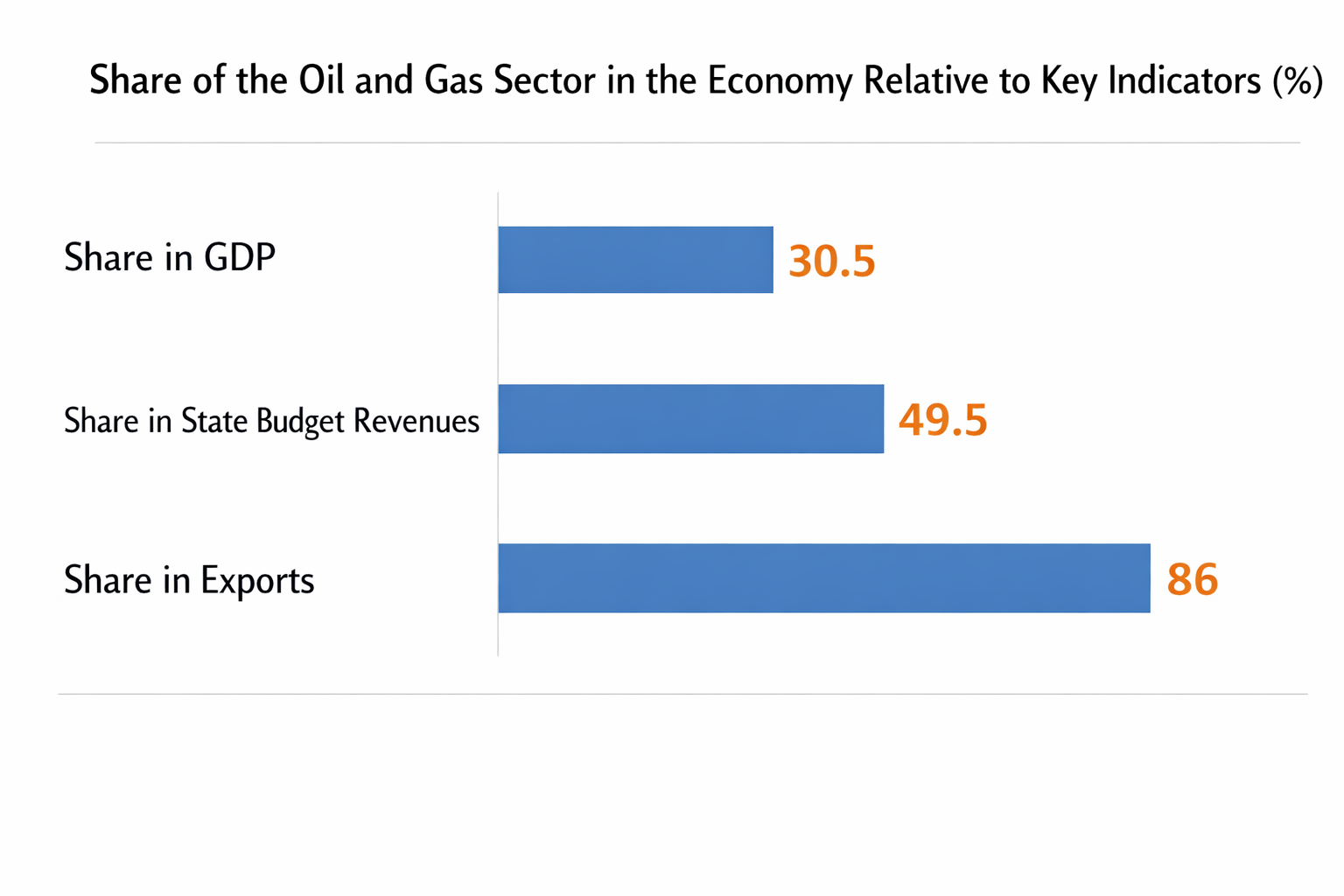
As the figures show, by the end of 2025, half of the state budget and 86 percent of exports were formed specifically through natural resource revenues. However, in official propaganda, to brighten this "black-and-negative" picture and steer public opinion toward positive political messaging, the following thesis is constantly utilized: dependency is high, but the trend of its decrease has continued in recent years.
Again, looking at official figures, one can find data that justifies the government's propaganda. Specifically, taking 2018 as the base year, the government emphasizes that from that period until now, the state budget's dependency on the oil and gas sector has dropped from 59 percent to 50 percent, and the share of natural resource products in the structure of exports has fallen from 91 percent to 86 percent. Likewise, it is particularly highlighted that non-oil exports increased 2.2 times in absolute terms, reaching $3.6 billion.
In reality, the decrease in the resource dependency of exports is not significant, and in years when the price of oil on world markets is low, the decline in natural resource revenues raises the share of the non-oil sector in exports. For example, in 2025, the average annual selling price of Azerbaijani oil on world markets fell by $10 compared to the previous year, amounting to approximately $71 (fed.az economic portal). As a result, the total amount of oil and gas exports decreased by $1.8 billion, falling to $21.4 billion.
It is factually true that between 2018 and 2025, non-oil exports rose to $3.6 billion, with an increase of 2.2 times or $1.9 billion in absolute (value) terms. However, behind this fact lie statistical manipulations directly serving political propaganda that provide no actual contribution to real economic diversification. First, the global pandemic in 2020, followed by the Russia-Ukraine war starting in 2022, caused a disruption of global supply chains and a significant increase in the prices of most products on world commodity markets. In this regard, countries are able to increase their export revenues without increasing the mass (real volume) of production and exports. This fact is clearly visible in Azerbaijan's official statistics as well. Thus, official reports provide both the nominal value of non-oil exports at current year prices and the real growth dynamics at base year prices. Below, the nominal and real growth dynamics for the years 2018–2025 are reflected based specifically on that data from the State Statistics agency:
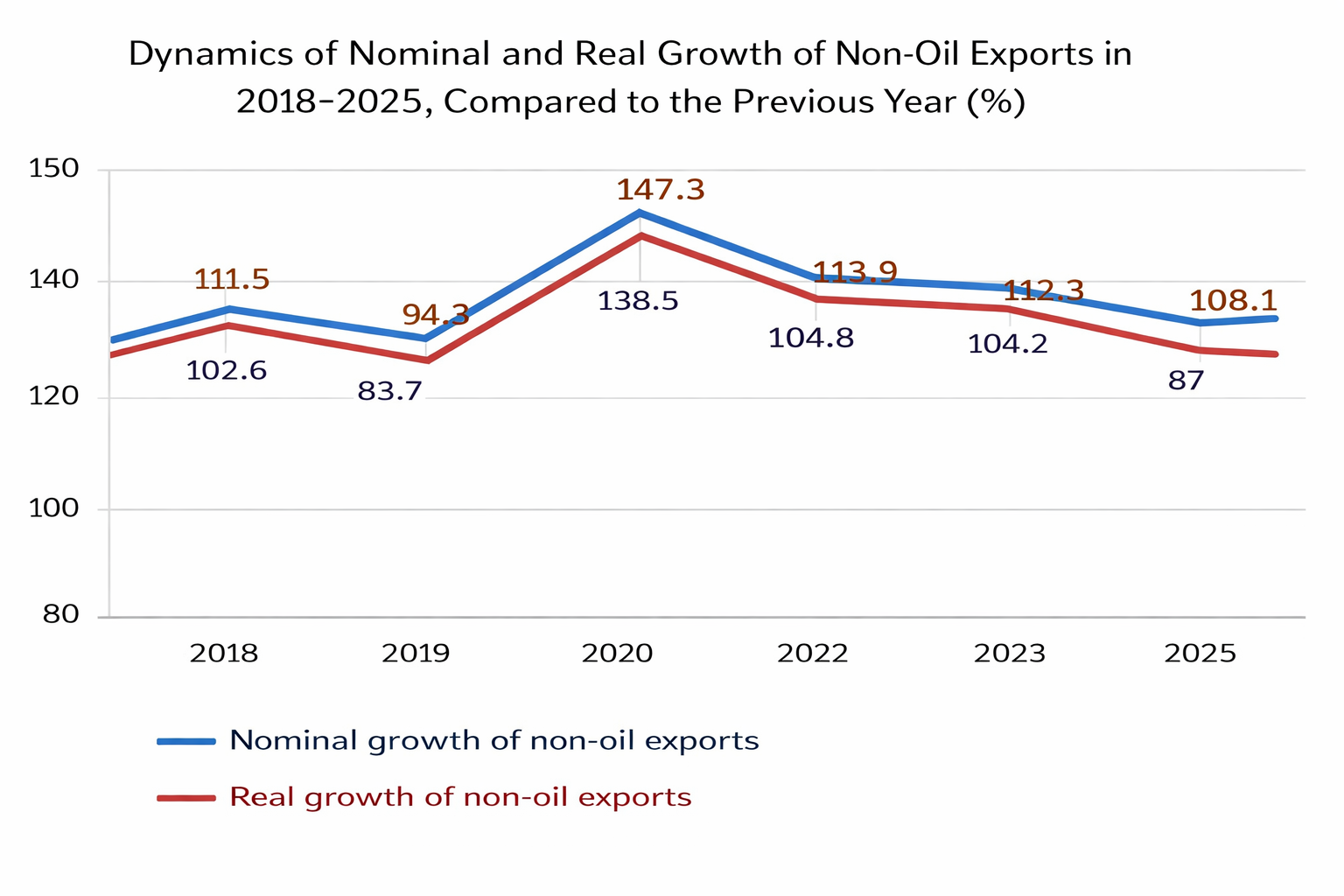
Mathematically, when calculating cumulative growth, it appears that in 7 years, non-oil exports increased 2 times in nominal value (at current prices), but the real volume of exports decreased by 0.5%. Growth in export revenues driven by high prices—caused by geopolitical and global economic tensions rather than supported by an increase in production volume—is not sustainable; it is temporary in nature. Such foundationless growth cannot make economic diversification lasting or effective and, at best, can only serve short-term political propaganda. To see how realistic this argument is, it is sufficient to pay attention to the facts in the case of several products. For example, the average export price for one ton of apples, considered one of the main products of non-oil exports, was $423 in 2018 and $705 in 2025. Or, while the average export price per ton of gold was $30 million seven years ago, it rose to $72.5 million in 2025. Due to this sharp rise in the price of gold and the price difference, non-oil exports increased by nearly $200 million. It is another matter entirely that presenting gold—which is sold abroad in raw form and is a pure mining product—as non-resource export is itself a form of statistical manipulation.
Naturally, compared to growing exports through price increases, the inflation of non-oil export indicators through the re-export of foreign-origin products is a more serious manipulation. For example, while very small amounts ($1-2 million) appeared in the "export of passenger cars" column from Azerbaijan until 2022, in 2022 this amount suddenly rose to $40 million, and in 2025 to $216 million (SSC 2026). Excluding assembly production lines where all spare parts are brought from abroad to be turned into a final product and where numbers do not exceed 500-1000 units per year, how does a country like Azerbaijan, which has no automobile industry, become an exporter of passenger cars? It is well known that Azerbaijan's assembly-based automobile production is mainly directed toward the domestic market based on government budget orders.
However, the officials who prepare these statistics register passenger cars imported from Georgia under the name of the country of origin of those car brands. As a result, official reports reflect imports from Georgia to Azerbaijan as many times lower than they are in reality. For example, according to information from "Comtrade," a global database on international trade, while the Georgian side showed that it exported $723 million worth of goods to Azerbaijan in 2024, the Azerbaijani side recorded this amount as $128 million. By the same logic, Azerbaijan should not have shown the sale abroad of $216 million worth of passenger cars—which it did not produce and which were objects of re-export operations—as non-oil exports.
The same situation is seen in the export of butter. Azerbaijan meets approximately half of its domestic demand for butter through imports. For this very reason, in the years 2018-2025, the import of butter into the country increased 2.1 times, rising from 9.5 thousand tons to 20.1 thousand tons. But in such a situation, it appears that the export of butter from the country to abroad increased from $1 million to $27 million.
The petrochemical sector, built upon oil raw materials, plays a significant role in the growth of non-oil exports. In the last 7 years, the export volume of this industry expanded from $80 million to $320 million. As strange as it may sound, the State Oil Company of Azerbaijan (SOCAR) also holds the status of the largest exporter of the country's non-oil sector. Thus, in 2025, the value of non-oil products exported on behalf of SOCAR was nearly $700 million, which is equal to approximately 20 percent of the sector's total exports (Export Review bulletins of the Center for Analysis of Economic Reforms and Communication of Azerbaijan). However, in 2018, this figure was around $200 million. That is, $500 million of the $1.9 billion total increase recorded in non-oil exports over 7 years was formed in fields directly linked to the oil sector.
As for the decrease in the share of the natural resource sector in state budget revenues, there has been rapid price inflation in Azerbaijan over the last 7 years, and the level of the GDP deflator clearly shows this. Thus, according to official statistical reports related to the national accounting system, while the nominal amount of GDP increased by 61% from 80 billion manats to 129 billion manats in 2018-2025, real growth amounted to only 17% (National Accounts statistical indicators of the State Statistics Committee of Azerbaijan). The difference between them is purely related to inflation, and the tens of billions of manats in excess turnover created by price increases return to the state budget in the form of taxes. These taxes grow more rapidly, especially in the case of indirect taxes—VAT, excises, and customs duties. For example, in 2018-2025, the amount of budget receipts from this source increased 2.1 times to 12.5 billion manats, and their share in the state budget rose from 26 percent to 32 percent. According to an OECD report, while the share of customs collections in the form of duties alone in the budgets of developed countries varies in the interval of 0.1-0.2%, in Azerbaijan that indicator is higher than 1 percent (OECD, Revenue Statistics 2025). These two mentioned facts show that the decisive factor in the growth of tax collections from the non-oil sector is more the inflation of prices and high payments rather than the expansion of production potential.
To evaluate the real state of economic diversification through the strengthening of production potential, it is sufficient to look at the results of the activities of enterprises created over the last 20 years that could not grow and sometimes disappeared in a short period. Let's look at several examples from the list of new enterprises created in 2004-2024 by the State Statistics Committee: In 2004, a plant with the production capacity to raise 15 million juvenile sturgeon a year and release them into water basins was commissioned in Neftchala (Construction statistical indicators of the State Statistics Committee of Azerbaijan). When tracking information in official statistics regarding the number of juvenile fish released into natural water basins each year, it becomes clear that the expected result was not obtained from this enterprise. According to those statistics, while 350-450 thousand juvenile fish were released into water basins each year in 2004-2017, in the last 6-7 years this indicator has been in the maximum interval of 5-10 thousand units (Agriculture and Fishing statistical indicators of the State Statistics Committee of Azerbaijan). Or, in 2005, a factory with an annual production capacity of 1.2 million televisions was commissioned in Shamakhi. A short time later, the enterprise's activity was halted and it has not existed for many years; there is no television production in Azerbaijan at all. In 2006, an enterprise carrying out the assembly of passenger cars was established in Shamakhi, but that enterprise also completely disappeared after 3-4 years. Since 2011, another plant assembling passenger cars began operating in Nakhchivan; in the initial periods there were 500-600 units produced, and in recent years there are sometimes even only 25-30 units produced a year. Another passenger car enterprise began operating in 2018, and although the annual output was up to 200-2500 units in 2018-2022, it has not exceeded 500-600 units in the last 3 years. Most importantly, the buyer of all these products is the state. Such assembly products are not attractive to the market or the broad mass of buyers.
The most serious problem is that enterprises created under the propaganda of economic diversification with investments of hundreds of millions of manats over the last 20 years did not lead to the strengthening of the country's export potential through the non-oil sector. These investments did not even save the country—which remains unable to industrialize and maintains its agrarian dominance—from food dependency. In 2025, a $2 billion deficit was recorded in the food section of Azerbaijan's foreign trade. That is, the country imports $2 billion more than the value of the food products it exports. Thus, the value of food imports was $3.4 billion, while the volume of food exports was $1.4 billion. However, just 7 years ago (2018), the food balance deficit was only $1 billion (Foreign Trade statistical indicators of the State Statistics Committee of Azerbaijan).
Main Conclusions of the Research
According to the "Global Economic Diversification Index 2026" report, Azerbaijan is one of the 10 countries in the world with the least diversified economies among the 117 countries selected as research subjects. In turn, among the 42 countries dependent on raw materials and resources, Azerbaijan is one of the 5 natural resource countries with the lowest level of diversification. Due to such a low result, it is in the same row as countries like Ghana, Congo, Mozambique, Ethiopia, Tanzania, Niger, Algeria, Mongolia, and Angola. According to the latest statistical reports, approximately half of Azerbaijan's state budget and up to 90 percent of its exports are formed by natural resources.
A comparative analysis of the experiences of Norway, which succeeded in escaping the negative impacts of natural resource dependency, and countries like Nigeria, which were subjected to the "resource curse," shows that the recipes for a successful result are not very complex: the fundamental conditions are the ensuring of economic freedoms, the existence of effectively working state institutions, a parliament that achieves continuous oversight over the government, and a fair judicial system. At the same time, it is extremely necessary to support economic reforms with the development of science and innovation.
Precisely because these conditions were not present, even though the Azerbaijani government spent billions of manats on infrastructure projects and the creation of new enterprises over the last 20 years, it has not been able to escape its status as one of the "10 countries in the world with the least diversified economies."
To achieve not only successful economic diversification but also to escape the "middle-income trap," it could be useful to look at the "Asian Miracle" as well. In one of the studies prepared by International Monetary Fund experts, there are interesting findings on why these experiences can be an effective vaccine for the "resource curse" (IMF, Reda Cherif, Fuad Hasanov). The authors claim that effective state intervention at the stage of early industrialization, the selection of an export-oriented economic model, and fierce competition are 3 important principles that must be chosen. If these principles ensure a focus on innovation and technology, it means the process is moving in the right direction. The authors believe that one of the most important results of the application of high technologies specifically will be economic diversification.
Another interesting conclusion reached by the authors is that cheap labor and the imitation of foreign technology can provide benefit for a period and can even create the opportunity to turn from a low-income country into a middle-income country. However, sustainable development is not possible without abandoning the imitation of innovation and new ideas and moving to their real application. South Korea, precisely thanks to high industrialization, an export-oriented model, and the application of high innovations, brought its GDP per capita indicator to 40 percent of the US indicator in the shortest possible time (approximately 20 years). However, it took Malaysia 2.5 times more time (nearly 50 years) to achieve this result.
The main conclusion coming from the points noted is that Azerbaijan has not even been able to step into the elementary stage of industrialization based on high innovation and technology. Some industrial initiatives based more on imitation than real application (for example, the automobile industry, agro-industry) are not supported by high scientific and technological potential. Moreover, none of the initiatives put forward in the direction of creating an export-oriented economic model over 20 years have resulted in success.
References:
Azərbaycanda xam neft və təbii qaz hasilatına dair statistika https://www.stat.gov.az/source/balance_fuel/
Hesablama Palatasının rəyləri (https://sai.gov.az/filter?type=rey )
Dövlət Neft Fondunun hesabatları (https://oilfund.az/report-and-statistics/recent-figures)
Corinne C Delechat, Giovanni Melina, Monique Newiak, Chris Papageorgiou, Nikola Spatafora. 2024. “Economic Diversification in Developing Countries: Lessons from Country Experiences with Broad-Based and Industrial Policies”.
Global Economic Diversification İndex 2026.
ADGX xarici ticarətə dair statistik hesabatları 2024 https://customs.gov.az/uploads/foreign/2024/2024_12.pdf?v=1737520142
AMN büdcə icrasına dair hesabatları 2024
https://maliyye.gov.az/static/15/budcenin-gelir-ve-xerc-hissesinin-yerine-yetirilmesinin-tehlili
“The Borgen Project” Qrupu 2023
https://borgenproject.org/resource-curse-extreme-poverty-in-nigeria/
Freedom House 2025.
https://freedomhouse.org/country/nigeria
Dünya Bankı 2024.
https://data.worldbank.org/indicator/NY.GDP.PCAP.CD
“Trademap” 2024.
OECD 2017.
NBİM 2025.
https://www.nbim.no/en/news-and-insights/reports/2025/half-year-report-2025/
The Norwegian Fiscal Policy Framework 2022
https://www.regjeringen.no/en/topics/the-economy/economic-policy/economic-policy/id418083/
Comprehensive Statistics on Norwegian Aquaculture.2024
DSX, 2026. https://www.stat.gov.az/source/trade/
Norveçin “Nofima” Tətbiqi Tədqiqatlar İnstitutu https://nofima.com/
Norveç Tədqiqat Şurası https://www.forskningsradet.no/en/
Norveçin “JM Robotics” ixtisalaşmış texmologiya şirkəti
https://jmrobotics.no/en/about-us/
Norveçdə sənaye robortlarının tətbiqinə dair statistik göstəricilər, https://www.nextmsc.com/report/norway-industrial-robotics-market-se3734
Norway energy transition opens new doors for autamation
https://howtorobot.com/expert-insight/report-norways-energy-transition-opens-new-doors-automation
Norway's Morrow Batteries opens factory, plans first deliveries by year-end
Norwegian EV Association, https://elbil.no/english/norwegian-ev-market/
BMT-nin qlobal xarici ticarətə dair məlumat bazası, https://comtradeplus.un.org/
Azərbaycan Dövlət Statistika Komitəsinin “Mlli Hesablar” göstəricilər sistemi https://www.stat.gov.az/source/system_nat_accounts/
“2025-ci ildə Azərbaycan neftinin orta ixrac qiyməti”
İqtisadi İslahatların Təhlili və Kommunikasiya Mərkəzi
https://ereforms.gov.az/az/ixrac-icmali
Revenue Statistics 2025, OECD
Azərbaycan Dövlət Statistika Komitəsinin “Kənd təsərrüfatı və balıqçılıq” göstəricilər sistemi
https://www.stat.gov.az/source/agriculture/
Azərbaycan Dövlət Statistika Komitəsinin “Tikinti” statistik göstəricilər sistemi
https://www.stat.gov.az/source/trade/
Reda Cherif, Fuad Hasanov. “The Return of the Policy That Shall Not Be Named: Principles of Industrial Policy”
