(This article was prepared as part of the KHAR Center's "Post-Soviet Authoritarianism Studies" series.)
✍️ Author:
Tinatin Inauri is a Georgian political scientist and PhD researcher in Comparative Politics at Central European University. She holds master's degrees from Central European University and Leiden University. Her research interests include autocratization, illiberal politics, and political institutions.
Introduction
As the world witnesses a global wave of democratic subversion - also referred to as the third wave of autocratization (Lührmann and Lindberg 2019) - political scientists seek to capture this phenomenon by developing new conceptual frameworks and analyzing dysfunctional institutional performance that undermines liberal democratic norms and rules. However, scholarly interest remains largely focused on institutions, rarely placing discourse at the center of regime change analysis. Furthermore, existing democracy metrics exacerbate this gap by emphasizing formal institutions while overlooking the role of political rhetoric in regime transition (Dawson 2018; Omelicheva 2016; Schmidt 2008).
Against this backdrop, growing scholarly interest in the role of discourse in the study of autocratization has prompted closer examination of how political actors communicate and what they communicate. Research suggests that public discourse works differently in established democracies and autocracies. In democracies, political communication is generally more pluralistic and allows for greater debate, while in autocracies it tends to be more controlled and used for specific political purposes. Moreover, authoritarian leaders use discourse to redefine what constitutes legitimate governance and gradually erode democratic norms. Therefore, discursive practices do not merely reflect political reality but actively produce it (Finlayson and Martin 2008; Martin 2014; Schedler 2023; Van Dijk 2006; Wodak 2015).
The increasing volume of research argues that substantial shifts toward illiberal rhetoric can be early indicators of gradual regime transformations (Drinóczi 2022; Maerz and Schneider 2021; Omelicheva 2016). Drawing on political leaders’ speeches from several countries and positioning them along a [il]liberalness scale, Maerz and Schneider demonstrate that two discursive dimensions - infringing on autonomy and sabotaging accountability - are consistently present in cases of democratic decline. Public rhetoric, they argue, serves as a “harbinger of change (soon) to come” (Maerz and Schneider 2020, 537). Accordingly, they argue that it is important to examine the nature of political rhetoric, including whether it is [il]liberal or authoritarian, and to give greater attention to discourse analysis in the study of political regimes.
Scholarly efforts have already produced a lot of meaningful theoretical output, but most studies remain quantitative. Studies that only draw on numbers and data can raise context-specific questions, especially when applied to emerging autocracies. To fill this theoretical and empirical gap, bringing in qualitative analysis is essential, first to uncover the meanings and intentions embedded in political rhetoric, but also to trace the evolution of ideational shifts that may precede institutional change.
This research presents a single case study of Georgia and its authoritarian trajectory under the current ruling party, Georgian Dream - Democratic Georgia (GD). With its fourth consecutive victory in the parliamentary elections in October 2024, Georgian Dream became the longest-ruling party in the history of independent Georgia since 1991. The uninterrupted periods of being in power have allowed GD to gradually consolidate power, limit democratic oversight, and shift its rhetoric from defending liberal democracy and Western values to embracing increasingly illiberal narratives. Unlike fast and unexpected regime shifts, GD’s rule illustrates what can be described as slow autocratization. We use this term to describe situations where democratic backsliding occurs through incremental changes in laws, media control, and institutional capture, most importantly, all under the guise of electoral legitimacy. Notably, in the 2025 report by the Varieties of Democracy (V-Dem), Georgia was classified as an electoral autocracy, having previously been categorized as an electoral democracy (Nord et al. 2025).
This study therefore asks: Does illiberal political discourse precede measurable institutional decline, or merely track it? In particular, the paper explores whether changes in the political discourse of the Georgian Dream party preceded a measurable decline in Georgia’s democratic institutions. The research does not test a formal causal hypothesis. Instead, it argues that the incorporation of discourse analysis in the study of regime types and their transition can provide a complementary and more refined analytical toolkit.
The argument is based on an initial observation that gave rise to the research – namely, that the political rhetoric of GD’s leading figures started to change noticeably prior to the party’s attack on liberal democratic practices and norms. This research traces the evolution of these changing narratives in relation to regime changes through a systematic analysis of political discourse throughout the different phases of GD’s rule. It also analyzes the speeches and statements of the party’s founder Bidzina Ivanishvili, former Prime Minister Irakli Gharibashvili and current Prime Minister Irakli Kobakhidze, from the founding of GD in 2012 to 2024, to determine whether the illiberal rhetorical practices stayed the same or increased in intensity over time.
The importance of this method is that political discourse may provide previous signals of democratic decline than the institutional indicators. The change in rhetoric before institutions can be measured as deteriorating can serve as an early warning mechanism for authoritarian consolidation.
Autocratization, Illiberalism and Political Discourse
Over the past two decades, a growing body of research has documented the erosion of democratic norms and institutions across diverse political contexts. Rather than collapsing abruptly through coups or revolutions, many democracies have experienced a slower and more incremental process of decline (Schedler 2024; Levitsky and Ziblatt 2018; Diamond 2021; Guriev and Treisman 2022; Lührmann and Lindberg 2019). Moreover, authoritarianism can intensify even in countries that are already non-democratic - “the worst gets worse” (Walker 2016, 52) - emphasizing that democratic deterioration in such regimes warrants just as much attention as in established democracies (Cassani and Tomini 2020; Walker 2016).
The greatest scholarly and political uncertainty lies in the fact that today’s agents of democratic subversion often gain power through legal means and then gradually - yet profoundly - erode democratic norms while preserving the formal architecture of democratic institutions. Rather than dismantling democracy outright, they hollow it out from within. Moreover, to justify these changes, incumbents frequently claim they are acting with the people’s permission (Diamond 2021; Haggard and Kaufman 2021; Kneuer 2021; Schedler 2013).
This process raises an important conceptual question in the Georgian case. Georgia has never achieved the status of a liberal democracy. It was long categorized as an electoral democracy, but in V-Dem’s most recent report, Georgia was reclassified as an electoral autocracy (Nord et al. 2025). Therefore, terms that imply a regression from a consolidated liberal democracy are not always sufficient to capture the country’s trajectory.
For such cases, scholars consider autocratization the most appropriate term (Cassani and Tomini 2020; Tomini 2024; Wilson et al. 2024). These authors argue that any movement toward liberal democracy constitutes democratization, while any movement toward closed autocracy represents autocratization (Wilson et al. 2024, 544). Moreover, autocratization - like democratization - is a process, not a discrete event (Sato et al. 2022; Wunsch and Blanchard 2023). In light of the tactics employed by today’s democracy eroders, focusing on the processual nature of democratic decline rather than its endpoint proves more analytically useful.
Autocratization usually unfolds through a series of recognizable and often incremental mechanisms. These include electoral law manipulation, judicial independence curtailment, executive power concentration, media and civil society control, and political opponent delegitimization or cooptation (Bermeo 2016; Gerschewski 2013; Haggard and Kaufman 2021; Sato et al. 2022; Scheppele 2022). These strategies are frequently pursued under the guise of legality or reform, allowing incumbents to erode democracy without outright rupture.
This stealth character of modern autocratization complicates detection and underscores the need to analyze not only institutional manipulations and breakdowns but also the ideational dimension of regime change (Enyedi 2024) - most evidently expressed through political rhetoric (Martin 2014).
The present research therefore treats illiberalism as the ideational dimension of autocratization, while authoritarianism is treated as a regime type. Enyedi defines illiberalism through its opposition to three core liberal principles: limited power, a neutral state, and an open society. Reversely, “illiberalism is centered on power concentration, a partisan state, and a closed society” (Enyedi 2024, 1–2). Due to its wide scope across different countries and regime types, illiberalism can be understood as a context-dependent thin ideology. Despite this variability, different trajectories toward illiberalism share a common feature: they question some essential aspect of liberal democracy.
This distinction is important for the Georgian case since the research is not simply asking whether GD has become authoritarian. Rather, it asks about the way in which political language articulates and legitimates an alternative normative vision of political order.
Ideologies are largely produced and reproduced through discourse; what discursively reveals ideologies are texts and spoken words, generated through the use of language (Van Dijk 2006).
As being performative, alongside being descriptive, language is synchronous with the praxis and aims to alter the status quo (Austin 1975). Therefore, one can distinguish the political discourse sphere as pivotal, considering its reliability in researching the theoretical foundations of autocratization.
It is of utmost importance to differentiate between discourse and rhetoric for the sake of conceptual clarity. When one mentions discourse, they mean that phenomenon encompasses wide ideational concepts such as sovereignty, illiberalism, and national identity that, within the given context, form political communication. Whilst rhetoric is the performance of strategicity that orchestrates the discourse in the specific texts and speeches to the ends of persuading, justifying, or legitimating (Martin 2022, 170–71). In this paper, the discourse is used as an analytical orientation, and rhetoric is viewed as an element of it.
It is important to use a longitudinal approach to scrutinize the evolution of Georgian Dream’s political discourse. From 2012 to 2024, the rhetoric has become a discursive action integrating into a wider area of concept-making. Finlayson and Martin (2008) argue that, as being projective, rhetoric can prepare the masses for future possible changes, “dangers”, and developments. Also, we may find in Maerz and Schneider’s works (2021) that political regime transformations can be signalled by public discourse.
This research produces a straightforward logic. Changes in political discourse may offer an early warning towards authoritarianism, as visible in Georgian Dream’s example.
Methodology and Research Design
The research employs a qualitative single-case study design, is exploratory, and targets to scrutinize how and to what extent the ruling party’s discourse correlates with the dynamics of authoritarianism.
Georgia is selected as a single instrumental case study. The country provides a fitting case for examining the discursive dimension of autocratization for several reasons. First, Georgian Dream has remained the dominant political force since 2012, which provides a long period through which changes in political discourse can be traced. The continued dominance of one political force also makes it possible to observe how political narratives develop and change over time. Another advantage for this research is the availability of a large amount of publicly accessible material. This provides a rich source for tracing the ideational shifts that may underlie the process of regime transformation.
The study uses Political Discourse Analysis (PDA) as its main analytical approach. Rather than simply counting or quantifying textual data, the analysis focuses on exploring and interpreting its meaning. It looks for recurring patterns and themes in order to understand the worldview of Georgian Dream’s main political elites and how their rhetoric has changed over time.
PDA specifically addresses political communication, focusing on how political actors, institutions, and processes are constructed, maintained, and contested through language. It examines political speeches, interviews, debates, laws, campaigns, and other forms of political text and talk, emphasizing discourse’s role in shaping political realities such as legitimacy, sovereignty, and opposition (Dunmire 2012; Van Dijk 2006).
The research focuses on three central political figures within Georgian Dream: Bidzina Ivanishvili, Irakli Gharibashvili, and Irakli Kobakhidze. These politicians were key figures in determining the party's policy direction, ideological stance, and trajectory of the regime. They have generated the most relevant material; therefore, they are especially well-suited for capturing a longitudinal and comprehensive view of the political discourse of Georgian Dream.
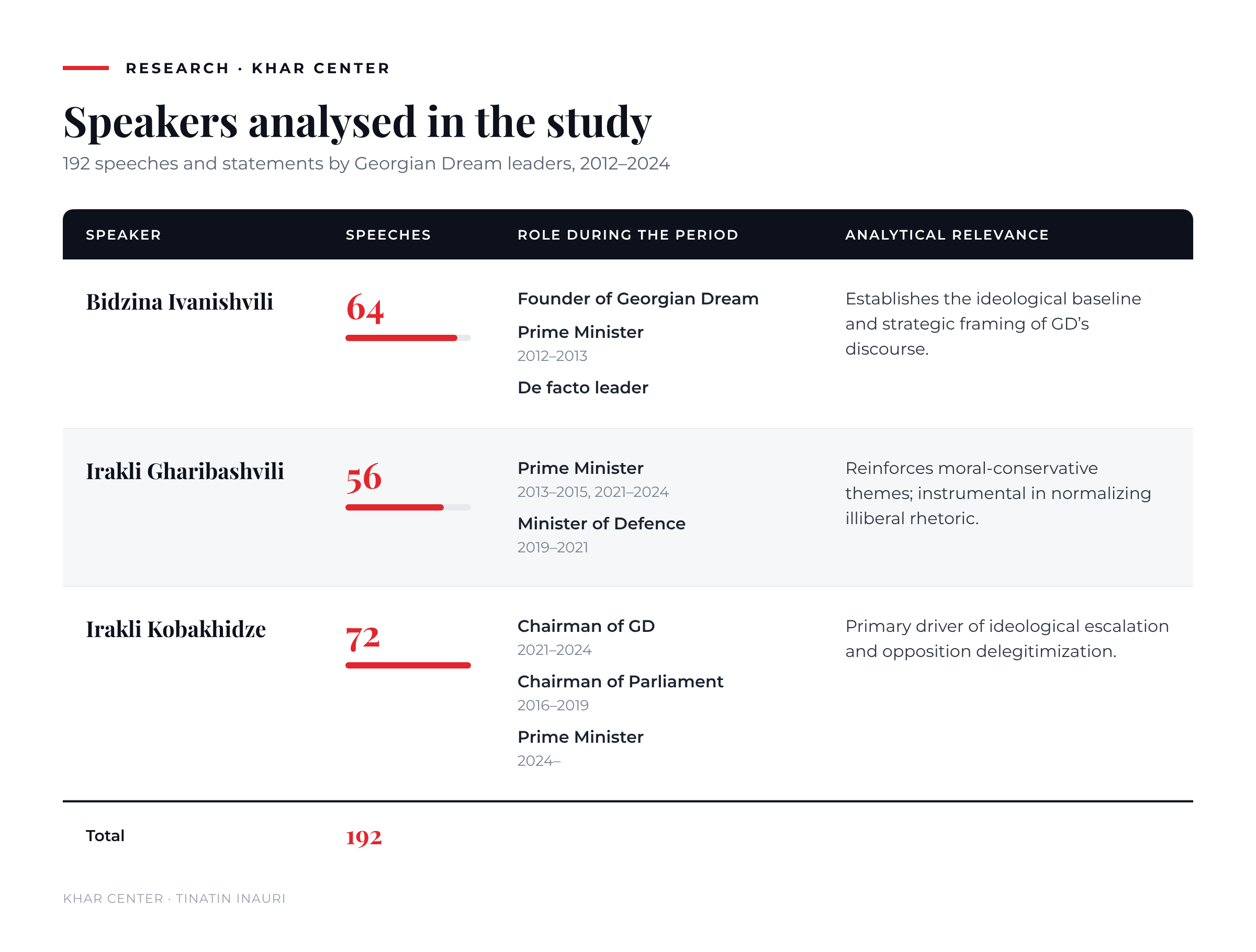
The timeframe covers the entire period of Georgian Dream’s rule, from 2012 through 2024. The final dataset consists of 192 speeches and statements: 64 by Ivanishvili, 56 by Gharibashvili, and 72 by Kobakhidze. The corpus includes public speeches, interviews, press conferences, official statements, public comments, and other public remarks.
A purposeful sampling strategy was employed. The strength of this approach lies in selecting information-rich cases that offer deep insights into issues central to the research purpose (Patton 2002). The corpus was collected from various media websites as well as official government websites and social media channels. The original materials were retrieved in Georgian and translated into English using AI tools such as DeepL and ChatGPT. All translated texts were manually reviewed and edited, with particular attention paid to context-specific terms and phrases.
The material was selected systematically. After an initial close reading of the entire corpus, only texts that directly dealt with the ideological and political foundations of Georgian Dream’s rule were retained.
The collected and filtered materials were uploaded and manually coded using NVivo 15. The primary parent codes were Liberal Rhetoric and Illiberal Rhetoric. In addition, other parent codes - those not explicitly fitting into either category - were created, including Views on Russia-Georgia Relations and Views on Georgian Society.
Codes were constructed using both inductive and deductive approaches. Some emerged organically from recurring themes in the textual materials, while others were informed by existing theories of authoritarianism and illiberalism. The manual coding approach allows for more nuanced interpretation than dictionary-based computational techniques because it takes context and meaning into account.
The research therefore combines a longitudinal perspective with thematic and actor-centric analysis. The primary purpose is not to establish a causal relationship between individual statements and institutional outcomes, but to identify whether a systematic transformation in political discourse can be observed before measurable democratic decline.
Findings: The Shift from Liberal to Illiberal Discourse
The manual thematic coding reveals a clear shift in Georgian Dream’s discourse from a pluralist, pro-Western orientation to an increasingly illiberal narrative structure. The analysis focuses on two overarching discursive clusters - liberal and illiberal narratives - which are also the two largest parent codes in the codebook.
In the early years of GD’s rule, specifically 2012 and 2013, the number of liberal (N=36) and illiberal (N=38) references was nearly identical. However, starting in 2014, liberal themes declined sharply, while illiberal discourse began to rise. This shift became especially pronounced in 2016 and intensified further during the third period (2021–2024), culminating in a dramatic peak of illiberal rhetoric in 2024.
As opposed to previous years, when liberal and illiberal ideas existed side-by-side, the recent discourse is characterised by a more coherent and aggressive deployment of illiberal narratives, often portraying political opponents, civil society and the West as threats to national sovereignty, values and stability.
The shift is not simply a change in the frequency of particular words. It reflects a broader transformation in how GD leaders construct political legitimacy, define the boundaries of the political community, and identify threats to the state and society.
The thematic coding reveals four dominant and interconnected discursive frames: fear-based mobilization and saviour-leader logic; anti-Western narratives and the delegitimization of civil society and media; opposition delegitimization; and the fusion of religious and national identity, with an emphasis on family values and majoritarian will.
These themes correspond closely with Enyedi’s three dimensions of illiberalism: power concentration, a partisan state, and a closed society. Fear-based mobilization and saviour-leader logic justify executive dominance; anti-Western, NGO, and civil society narratives construct a closed society; opposition delegitimization reinforces the partisan state and concentration of power; while church-state fusion and national identity position traditional values and majoritarian will as foundations of legitimate statehood.
Fear-Based Rhetoric and Saviour-Leader Logic
The first major thematic cluster emerging from the illiberal narrative umbrella draws upon fear-based appeals and saviour-leader rhetoric. It functions by constructing an atmosphere of existential threat - framing the ruling party as the sole guarantor of national stability, while portraying the opposition, civil society actors, and international partners as sources of political chaos and moral decay.
Within this cluster, several interrelated rhetorical strategies are observable: the instrumentalization of fear through the “spin over war” logic, the depiction of political opponents as anti-Georgian or foreign-backed actors, the elevation of Georgian Dream as the only force capable of preserving peace and sovereignty, the use of paternalist rhetoric, and the deployment of a “national interests first” narrative.
Fear-based discourse is particularly visible in relation to major geopolitical events, such as the Russian invasion of Ukraine in 2022. After this point, the number of references to the deductive code “spin over fear” notably increased. Georgian Dream presents itself as the sole barrier between peace and war, while casting the biggest opposition party, United National Movement (UNM), other opposition parties, NGOs, and even Western actors as existential threats seeking to “Ukrainize” Georgia.
As Kobakhidze stated in 2023:
“Their only goal is to turn Georgia into another Ukraine. I call on everyone to distance themselves from these dangerous agendas. The ‘Ukrainization’ of Georgia is something we must not allow under any circumstances” (Tabula 2023).
This rhetoric reflects a strategy of conflating domestic dissent with foreign influence, reinforcing a narrative in which Georgian Dream is positioned as both protector and redeemer.
This logic connects directly to paternalist rhetoric. Unlike the classical populist “people vs. corrupt elites” dichotomy, which is not predominant among Georgian Dream leaders, paternalist inclinations are evident. The combination of fear-based rhetoric and saviour-leader logic emphasizes a discourse in which the public is portrayed as politically immature and in need of guidance.
As Ivanishvili stated in 2016: “Our population struggles with evaluation, and that is precisely why I want to visit every region - to help those who believe in me analyze and understand things better” (Tabula 2016).
The rhetorical construction of leadership within this framework depicts political figures as rational, unifying actors who guide society toward the “right” decisions, preserve national stability, and protect against collapse.
The Enemy Within and Without: Civil Society, Media, and the West
The ruling party “Georgian Dream” frequently portrays itself as a saviour of national interests, casting Western institutions, civil society, and independent media as forces that undermine sovereignty and social cohesion over time, turning into a sustained effort to discredit critics by labeling them as foreign agents and provocateurs.
The anti-Western narrative experienced the most drastic increase among the relevant thematic clusters, being used 15 times more frequently compared to the initial period. The dominant anti-Western subthemes are the portrayal of foreign organizations as interventionist and the depiction of the EU as biased or hostile, together accounting for over 65% of references.
Among the conspiratorial narratives, the concepts of the “Global War Party” and the “Deep State” are particularly important, suggesting that Western institutions are tools of hidden agendas aiming to destabilize the country, while Georgian Dream is defending national integrity.
At the same time, Georgian Dream’s rhetoric retains elements of pro-European language. This is important because the transformation was not an immediate or complete rejection of the West. Rather, pro-Western language increasingly coexists with anti-Western rhetoric, creating a space for strategic ambiguity.
The overall number of references to pro-Western narratives declined by over 40% in Period 3 compared to Period 1. Nevertheless, the framing of the West as a strategic partner and Europe as Georgia’s natural destination rooted in shared values still persists. Kobakhidze stated in 2024:
“Europe represents transparency, traditional values, and Christian principles” (Tabula 2024b).
This illustrates that Georgian Dream did not simply abandon the idea of Europe. Instead, “Europeanness” increasingly became filtered through its own illiberal lens, particularly through themes of church-state fusion, traditional values, and national identity.
These themes were also amplified, setting the tone for real policy measures to suppress dissent. One example is the “foreign agent” law, which was withdrawn in March 2023, in the wake of mass public protests, but was reintroduced and passed in May 2024. GD leaders repeatedly said the so-called “transparency law” was needed to defend national sovereignty.
The connection between rhetoric and policy is therefore especially significant. Political discourse was not just a description of an existing conflict between the government and civil society, but also a way of creating the conceptual framework through which restrictions on civil society could be framed as necessary measures to protect sovereignty, transparency and national interests.
Opposition Delegitimization as a Core Pillar
Despite the presence of new political competitors, the United National Movement continues to be the centre of the illiberal discursive strategy of the Georgian Dream. The largest subcode under the illiberal narrative parent code is “opposition delegitimization” with 151 coded references, far exceeding other illiberal subthemes.
UNM has been cast since the early years of GD’s rule, not simply as a political opponent, but as an existential threat to Georgia’s sovereignty, morality and future. This story has become a central plank of GD’s broader illiberal logic, underwriting the idea of a partisan state and justifying the concentration of power. Increasingly, GD leaders have adopted the phrase “collective United National Movement” to collapse the entire opposition spectrum into a single, dangerous entity, regardless of ideological or organizational differences.
As Gharibashvili stated in 2024:
“Instead of European integration, you will once again get a bloody dictatorship” (Tabula 2024a).
The subcode “UNM/Saakashvili = to be marginalized” appears consistently across all three periods, indicating a stable rhetorical strategy aimed at excluding UNM from legitimate political competition. Another recurring theme is the narrative that Saakashvili is responsible for the 2008 war with Russia, with this frame intensifying particularly in the second and third periods.
At the same time, some subcodes show sharp increases in the third parliamentary term. These include “call to ban opposition,” “opposition = anti-Georgian,” and “opposition = foreign-backed.” During the 2024 election pre-campaign, Ivanishvili promised to punish the “collective UNM,” declaring that after the elections, the party would prosecute it for its “treasonous actions.”
This framing positions the UNM as a threat that cannot be engaged with through normal democratic competition, but must be neutralized - a logic that severely undermines pluralism. This subtheme of opposition delegitimization ultimately undermines the norms of fair competition, while at the same time allowing the ruling party to dismiss criticism by labelling all dissent as UNM-affiliated.
As such, opposition delegitimization aligns with both the partisan state and power concentration elements of illiberalism and forms a key mechanism through which GD justifies authoritarian tendencies within a formally electoral framework.
Church-State Fusion and National Identity
Another consistent pillar of Georgian Dream’s illiberal rhetoric is the symbolic and political fusion of the Georgian Orthodox Church with national identity. In this discourse, the Church is cast not merely as a religious institution but as the foundational source of the country’s morality, unity, and legitimacy.
Gharibashvili stated in 2021:
“There is a very strong unity between the Church and the government... The government and the Church share a firm and unbreakable bond” (Tabula 2021).
Within this narrative, Georgian nationhood is inseparable from Christian identity, and deviation from religious tradition is framed as a threat to both cultural integrity and political stability. Orthodoxy is positioned not as a private belief system but as a foundational pillar of the state, essential to preserving national cohesion.
The discursive continuation of this logic is reflected in GD’s broader vision of societal ordering - one rooted in the majoritarian will, anchored in traditional family structures, and oriented toward the preservation of moral values. The praise of family values, in itself, is not necessarily illiberal. However, when such values are prioritized at the expense of minority rights and used to justify discriminatory policies under the banner of majoritarianism, they align closely with the illiberal feature of a closed society.
In GD’s rhetoric, liberal pluralism and secularism are portrayed as corrosive forces - imported ideologies that seek to undermine the historical and spiritual essence of Georgian identity. The rejection of secular norms and defense of the Georgian Orthodox Church are thus not merely cultural stances, but political acts that legitimize the ruling party’s authority as the true guardian of national authenticity.
In Georgia, perceived “outsiders” in this discourse are more often civil actors such as NGOs, independent media, liberal activists, LGBTQ+ groups, and the so-called “collective UNM.” In this sense, adherence to a Christian way of life becomes less a matter of personal belief and more a marker of group identity.
Contradictions and the Gradual Nature of the Shift
Most illiberal democratic leaders today preserve a façade of democracy, not only institutionally but rhetorically. The exploratory nature of this research led to the inclusion of both illiberal features and liberal language in the codebook. It was through this dual lens that the analysis was able to chart the ways in which narratives changed over time and to reveal the strategic and often contradictory use of political language.
One of the most important rhetorical contradictions is the use of both pro- and anti-Western language by Georgian Dream. References to pro-Westernism were significantly reduced but not excluded. Instead, pro-European language was increasingly intertwined with frank criticism of Western institutions.
A similar contradiction appears in relation to minority rights. In its early years, GD adopted a liberal framing aligned with constitutional guarantees of equality. For instance, in 2013 Ivanishvili condemned violence against LGBT demonstrators and emphasized that “the Constitution of Georgia guarantees the right to assembly and expression to all citizens - without exception” (Tabula 2013).
But since 2020, this discourse has shifted towards moral panic. GD leaders increasingly framed LGBTQ+ expression as an external imposition that endangered Georgia’s traditional values and Christian identity. In such narratives, LGBTQ+ people are not simply outsiders but agents of pseudo-liberalism and moral decay.
Another contradiction lies in the representation of Georgian society. The judgement of citizens is praised, especially at the time of elections. At other times, these same citizens are depicted as politically naive, unable to understand complex issues without the guidance of the leadership.
This contradiction is at the core of a paternalist logic that acknowledges the moral authority of the people but denies them autonomy. These narratives collectively constitute a discourse model where legitimacy is not constructed through pluralist deliberation but through the assumed moral unity between the people and their leader.
The contradictions are thus significant because they show the transformation as a process of gradual change and not a simple substitution of illiberal rhetoric for liberal rhetoric. The language of liberalism persisted, but increasingly alongside, and eventually under, a more consistent illiberal narrative structure.
Actor-Centric Evolution
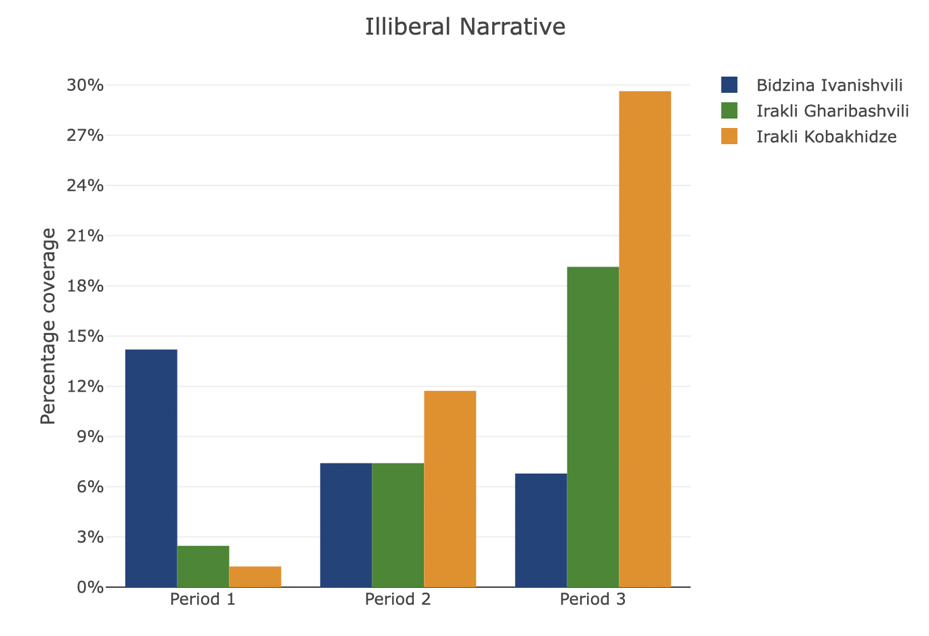
The aggregate number of coding references under the parent code “illiberal narrative” reveals notable shifts in the roles of key actors over time.
At the outset of Georgian Dream’s rule, Ivanishvili was not only the primary driver of the illiberal narrative but also recorded the highest number of coding references under the liberal narrative parent code (N=32), even slightly surpassing his illiberal references during Period 1 (N=31). As the founder of Georgian Dream and its initial Prime Minister, Ivanishvili occupied a central role in shaping the party’s ideological direction.
The near-equal distribution of liberal and illiberal rhetoric in Ivanishvili’s early discourse suggests a strategic attempt to balance Georgia’s Euro-Atlantic aspirations with conservative values that resonated with the domestic audience. This dual messaging likely reflected an effort to maintain broad-based support during Georgian Dream’s formative years by appealing simultaneously to pro-Western constituencies and more traditional segments of society.
However, this equilibrium proved unsustainable. In Period 2, as Ivanishvili retreated from formal political roles and Kobakhidze gained increasing prominence, a clear discursive shift became evident. Kobakhidze’s rhetoric adopted a more explicitly ideological tone, with illiberal themes gaining prominence.
Irakli Gharibashvili performed a mediating role across periods. His re-emergence in high office was marked by a blend of conservative social values, overt support for the Church, and securitized narratives. His discourse often amplified the cultural dimension of illiberalism - particularly on family, tradition, and anti-LGBTQ+ rhetoric - while also reinforcing anti-UNM narratives.
Kobakhidze’s rhetoric in Period 3 shows the highest concentration of illiberal content, accounting for nearly 30% of his overall discourse.
This leadership transition also signals an institutionalization of illiberal discourse within the party. Whereas early illiberal narratives were reactive and sporadic, later periods saw their standardization across multiple actors. Therefore, the actor-centric view strengthens the idea that Georgian Dream’s ideological trajectory is not merely a product of individual leadership styles, but rather a broader structural realignment increasingly oriented toward illiberal governance.
Political Discourse and Democratic Decline: The Temporal Gap
The central finding of this research emerges when the trajectory of Georgian Dream’s discourse is compared with Georgia’s Electoral Democracy Index (EDI).
The yearly trajectory of liberal and illiberal narratives in Georgian Dream’s discourse from 2012 to 2024 shows that 2013 was the last year in which liberal narrative predominated. Since then - particularly from 2015 onward - illiberal discourse gradually emerged, reaching its first significant peak in 2018, followed by another in 2022, and rising notably by 2024.
Meanwhile, V-Dem’s Electoral Democracy Index for Georgia shows that the country reached its highest score in 2016, at 0.68. The index remained relatively stable in the following two years, at 0.67 in 2017 and 0.66 in 2018. The first significant decline occurred in 2019, when Georgia’s EDI dropped to 0.62.
The alignment between these two trajectories is noteworthy.
The transformation in political language began before the measurable institutional decline captured by the EDI. Illiberal narratives began to emerge and increasingly dominate Georgian Dream’s discourse around 2015, while the significant decline in the EDI became visible in 2019.
This creates a temporal gap of approximately four years between the emergence of a dominant illiberal discourse and the measurable institutional decline.
The significance of this sequence lies not in claiming that discourse alone caused institutional decline. The research does not establish such a causal relationship. Rather, it demonstrates that the transformation in political discourse was not simply a reaction to already visible institutional deterioration.
Instead, the discursive shift preceded the significant decline measured by the institutional indicator.
This sequence reinforces the theoretical proposition that discourse can function both as a precursor and an enabler of regime change. The strategic use of illiberal rhetoric - portraying dissent as foreign, amplifying perceived threats to sovereignty, and fusing national identity with moral order - gradually redefined the boundaries of legitimate political participation.
In this sense, political discourse can provide information that conventional democracy indices cannot capture at the same moment. Institutional indicators measure the condition of democratic institutions. Discourse can reveal how political elites are beginning to conceptualize those institutions, their limits, their opponents, and the legitimate boundaries of political participation.
The Georgian case therefore suggests that rhetoric may be useful as a leading indicator, rather than merely as a lagging reflection of institutional decline.
Conclusion
This paper reached several crucial conclusions, conducting dynamic scrutiny of the discourse used by the high representatives of the governing “Georgian Dream” party throughout 2012-2024. The research studied 192 samples of speech and statements by Bidzina Ivanishvili, Irakli Kobakhidze, and Irakli Garibashvili. As a result, the gradual transformation of dominant discourse from being liberal to illiberal is evident. The analysis found that discourse changes occurred earlier than democracy indices documented deterioration in the conditions for the democratic environment.
In fact, liberal and illiberal elements coexisted in the GD Party’s discourse during the early years of its rule. However, approximately from 2014 to 2015, illiberal narratives started to dominate the agenda of the political elites. Finally, by 2021-2024, the discourse employed by the government became utterly aggressive, attacking civil society, foreign partners, political opponents, and independent media, portraying them as threats to the stability, sovereignty, and national values.
The change has surfaced in several interconnected patterns, such as attitudes towards Western institutions, civil society and political opposition, as well as national identity and moral values, designating four frames. Transforming the national identity by navigating it through the “narrow filter” of the one-party order, the aforementioned four frames justify the power concentration in Georgia. :
- Anti-Western narratives directed at civil society and the media: Internal political disagreement was narrated as being intentionally designed by outside forces to destabilize the country, instrumentalizing Georgian independent civil society and media.
- Fear-based mobilization: The sense has been established that the GD Party is the only “saviour” of peace and security, and it bravely keeps the forces of the “Global War Party” out.
- Delegitimization of the opposition: As the normal, constitutional-political competition turned into the fight against an existential enemy, polarizing discourse started to be used against alternative political powers.
- Fusion of national and religious identity: Traditionalist narratives construct a moral boundary between the “true” nation and those portrayed as threats to its identity and values, while positioning the Georgian Orthodox Church and the state as guardians of a shared national and moral order.
These frames rest well on Enyedi’s account of illiberalism, consisting of three elements: power concentration, a closed society, and a partisan state (Enyedi 2024).
The gradual manifestation of illiberal characteristics in the discourse of the Georgian political elites signaled the deteriorating conditions for democratic standards earlier than V-Dem’s Democracy Index, and this is the pivotal finding of the piece. Thus, the liberal discourse was last dominant in 2013, and starting from 2015, illiberalism has started to show itself. Nevertheless, the V-Dem democracy Index peaked in 2016 and significantly dropped only in 2019. This 4-year difference signifies discourse changes as early warning signs.
Moving on to the limitations of the research, one can spot two major ones. The research is based on a single-case study, which makes it hard to generalize particular findings. There is a need for similarly designed research in differing environments to reach the point of theorization. At the same time, it is necessary to point out that the piece has exclusively studied the discourse of elites, while leaving out how the general public conceived, perceived, accepted, or resisted the political changes for further research on a similar topic.
Note: The text you are reading was originally written in English. AI tools were used only for translation into other languages.
References
Austin, J. L. 1975. How To Do Things With Words. Oxford University Press. https://doi.org/10.1093/acprof:oso/9780198245537.001.0001.
Bermeo, Nancy. 2016. “On Democratic Backsliding.” Journal of Democracy 27 (1): 5–19. https://doi.org/10.1353/jod.2016.0012.
Cassani, Andrea, and Luca Tomini. 2020. “Reversing Regimes and Concepts: From Democratization to Autocratization.” European Political Science 19 (2): 272–87. https://doi.org/10.1057/s41304-018-0168-5.
Dawson, James. 2018. “‘Everyday Democracy’: An Ethnographic Methodology for the Evaluation of (de-) Democratisation.” East European Politics 34 (3): 297–316. https://doi.org/10.1080/21599165.2018.1482213.
Diamond, Larry. 2021. “Democratic Regression in Comparative Perspective: Scope, Methods, and Causes.” Democratization 28 (1): 22–42. https://doi.org/10.1080/13510347.2020.1807517.
Drinóczi, Tímea. 2022. “The Unfolding Illiberalism in Hungary.” Review of Central and East European Law 47 (3–4): 352–80. https://doi.org/10.1163/15730352-bja10071.
Dunmire, Patricia L. 2012. “Political Discourse Analysis: Exploring the Language of Politics and the Politics of Language.” Language and Linguistics Compass 6 (11): 735–51. https://doi.org/10.1002/lnc3.365.
Enyedi, Zsolt. 2024. “Concept and Varieties of Illiberalism.” Politics and Governance 12 (September): 8521. https://doi.org/10.17645/pag.8521.
Finlayson, Alan, and James Martin. 2008. “‘It Ain’t What You Say…’: British Political Studies and the Analysis of Speech and Rhetoric.” British Politics 3 (4): 445–64. https://doi.org/10.1057/bp.2008.21.
Gerschewski, Johannes. 2013. “The Three Pillars of Stability: Legitimation, Repression, and Co-Optation in Autocratic Regimes.” Democratization 20 (1): 13–38. https://doi.org/10.1080/13510347.2013.738860.
Guriev, Sergei, and Daniel Treisman. 2022. Spin Dictators: The Changing Face of Tyranny in the 21st Century. Princeton University Press. https://doi.org/10.2307/j.ctv1xp9p7d.
Haggard, Stephan, and Robert Kaufman. 2021. “The Anatomy of Democratic Backsliding.” Journal of Democracy 32 (4): 27–41. https://doi.org/10.1353/jod.2021.0050.
Kneuer, Marianne. 2021. “Unravelling Democratic Erosion: Who Drives the Slow Death of Democracy, and How?” Democratization 28 (8): 1442–62. https://doi.org/10.1080/13510347.2021.1925650.
Levitsky, Steven, and Daniel Ziblatt. 2018. How Democracies Die. Viking an imprint of Penguin Books.
Lührmann, Anna, and Staffan I. Lindberg. 2019. “A Third Wave of Autocratization Is Here: What Is New about It?” Democratization 26 (7): 1095–113. https://doi.org/10.1080/13510347.2019.1582029.
Maerz, Seraphine F., and Carsten Schneider. 2021. “Public Discourse and Autocratization: Infringing on Autonomy, Sabotaging Accountability.” SSRN Electronic Journal, ahead of print. https://doi.org/10.2139/ssrn.3779244.
Maerz, Seraphine F., and Carsten Q. Schneider. 2020. “Comparing Public Communication in Democracies and Autocracies: Automated Text Analyses of Speeches by Heads of Government.” Quality & Quantity 54 (2): 517–45. https://doi.org/10.1007/s11135-019-00885-7.
Martin, James. 2014. Politics and Rhetoric: A Critical Introduction. Routledge. https://doi.org/10.4324/9781315886893.
Martin, James. 2022. “Rhetoric, Discourse and the Hermeneutics of Public Speech.” Politics 42 (2): 170–84. https://doi.org/10.1177/0263395720933779.
Nord, Marina, David Altman, Fabio Angiolillo, Tiago Fernandes, Ana Good God, and Staffan I. Lindberg. 2025. Democracy Report 2025: 25 Years of Autocratization – Democracy Trumped? University of Gothenburg: V-Dem Institute.
Omelicheva, Mariya Y. 2016. “Authoritarian Legitimation: Assessing Discourses of Legitimacy in Kazakhstan and Uzbekistan.” Central Asian Survey 35 (4): 481–500. https://doi.org/10.1080/02634937.2016.1245181.
Patton, Michael Quinn. 2002. “Two Decades of Developments in Qualitative Inquiry: A Personal, Experiential Perspective.” Qualitative Social Work 1 (3): 261–83. https://doi.org/10.1177/1473325002001003636.
Sato, Yuko, Martin Lundstedt, Kelly Morrison, Vanessa A. Boese, and Staffan I. Lindberg. 2022. “Institutional Order in Episodes of Autocratization.” SSRN Electronic Journal, ahead of print. https://doi.org/10.2139/ssrn.4239798.
Schedler, Andreas. 2013. The Politics of Uncertainty: Sustaining and Subverting Electoral Authoritarianism. Oxford University Press. https://doi.org/10.1093/acprof:oso/9780199680320.001.0001.
Schedler, Andreas. 2023. “Rethinking Political Polarization.” Political Science Quarterly 138 (3): 335–59. https://doi.org/10.1093/psquar/qqad038.
Schedler, Andreas. 2024. “Rethinking Democratic Subversion.” In The Routledge Handbook of Autocratization. Routledge.
Scheppele, Kim Lane. 2022. “How Viktor Orbán Wins.” Journal of Democracy 33 (3): 45–61. https://doi.org/10.1353/jod.2022.0039.
Schmidt, Vivien A. 2008. “Discursive Institutionalism: The Explanatory Power of Ideas and Discourse.” Annual Review of Political Science 11 (1): 303–26. https://doi.org/10.1146/annurev.polisci.11.060606.135342.
Tabula. 2013. “Ivanishvili: We Will Not Allow Restrictions on the Right to Expression on the Grounds of Sexual Orientation.” May 27. https://tabula.ge/ge/news/553432-ivanishvili-seksualuri-orientatsiis-nishnit.
Tabula. 2016. “Ivanishvili: The Population Has Problems with Assessment, and I Want to Help.” September 1. https://tabula.ge/ge/news/589229-ivanishvili-mosakhleobas-akvs-problemebi.
Tabula. 2021. “Gharibashvili: We Are United; the Government and the Church Share a Very Strong Unity.” September 16. https://tabula.ge/ge/news/673096-gharibashvili-chven-vart-ertiani-mtavrobas.
Tabula. 2023. “Kobakhidze: It Is Our Collective Responsibility to Keep the Country from Being Ukrainianized; This Is Our Task.” September 20. https://tabula.ge/ge/news/706999-kobakhidze-saerto-pasukhismgeblobaa-rom-kveqanas.
Tabula. 2024a. “Gharibashvili: In the Unthinking Search for Something Better, We Are Guaranteed to End Up with Something Worse.” September 14. https://tabula.ge/ge/news/722971-gharibashvili-gauazreblad-uketesis-dziebashi.
Tabula. 2024b. “Kobakhidze: A Man Should Be Called a Man, and a Woman a Woman — They Declare This to Be a ‘Russian Law.’” September 18. https://tabula.ge/ge/news/723180-kobakhidze-katss-unda-erkvas-katsi-kals-kali-amas.
Tomini, Luca. 2024. “Conceptualizing Autocratization.” In The Routledge Handbook of Autocratization. Routledge.
Van Dijk, T. A. 2006. “Politics, Ideology, and Discourse.” In Encyclopedia of Language & Linguistics. Elsevier. https://doi.org/10.1016/B0-08-044854-2/00722-7.
Walker, Christopher. 2016. “The Authoritarian Threat: The Hijacking of ‘Soft Power.’” Journal of Democracy 27 (1): 49–63. https://doi.org/10.1353/jod.2016.0007.
Wilson, Matthew C., Amanda B. Edgell, Yuko Sato, Vanessa Boese-Schlosser, and Staffan I. Lindberg. 2024. “Autocratization - Not an ‘Illiberal Turn.’” In The Oxford Handbook of Illiberalism, edited by Marlene Laruelle. Oxford Handbooks.
Wodak, Ruth. 2015. The Politics of Fear: What Right-Wing Populist Discourses Mean. SAGE Publications Ltd. https://doi.org/10.4135/9781446270073.
Wunsch, Natasha, and Philippe Blanchard. 2023. “Patterns of Democratic Backsliding in Third-Wave Democracies: A Sequence Analysis Perspective.” Democratization 30 (2): 278–301. https://doi.org/10.1080/13510347.2022.2130260.
