
Author:
✍️ Elman Fattah – Director of the KHAR Center
(The article was prepared by the “Khar Center” within the framework of research on Azerbaijani authoritarianism)
The "banality of evil" and "bureaucratic thoughtlessness," which Hannah Arendt discussed within the framework of her analysis of totalitarianism, demonstrate their modern form today in Azerbaijan, where a strict autocratic system has been established. The system suffocates justice through submissive judges who execute political orders and keeps the society under the constant fear of external/internal enemies. However, this seemingly strong monolith will eventually lose its legitimacy and, as expressed in Arendt's thesis of "natality," will absolutely be shattered one day before the unpredictable human will for freedom.
The most devastating conclusion H. Arendt came to while observing the trial of Adolf Eichmann in Jerusalem was that the heaviest oppressions in history are not always carried out by bloodthirsty pathological sadists, but by the hands of ordinary officials who have surrendered their ability to think to the bureaucracy, hiding behind obedience to the leader and the chain of instructions coming from above. The "thoughtlessness" conceptualized by Arendt expresses the rise of evil simply through officials subject to an administrative calendar and subservient to the ambition of career advancement. Authoritarian mechanisms are established precisely upon such mechanical obedience, upon a bureaucracy that has surrendered its conscience as a hostage to the ruling regime (H. Arendt, 1963).
However, no matter how solid, perfect, and monolithic this totalitarian mechanism may appear, it is subject to its own ontological boundaries. Authoritarian systems are like bicycles; they cannot remain in static equilibrium. In order to preserve their existence, they constantly need new threats and new enemies; at the same time, they are forced to continuously conduct and increase repressive measures.
The greatest laboratory of this process in history was the Soviet Union. The totalitarian Soviet state apparatus protected its existence for decades through a constant mobilization built on the foundation of class antagonism, the search for and punishment of "enemies of the people," as well as the struggle against foreign imperialism and capitalism. However, after the internal opposition was completely destroyed, society was subjugated, and the establishment of an "advanced socialist society" was declared, the system faced an "enemy deficit."
When no real enemy was left to destroy, the apparatus of repression and control lost its functional purpose; and the ideology turned into a pile of lifeless slogans that no one believed in, but everyone ritually repeated. When the "external/internal threat" engine keeping the system in motion broke down, the stagnation (zastoy) of the Brezhnev era began. The massive Soviet bureaucracy, losing its habit of fear and mobilization, rotted from within due to inertia, corruption, and ideological dullness.
Bureaucratic complicity in crime, thoughtlessness, and bureaucracy
The main starting point in Hannah Arendt's analysis of totalitarianism and bureaucracy is the potential of the modern state apparatus to strip the human being of being a moral subject and simply turn them into a working cog in the mechanism. A judge throwing independent investigative journalists into prison with a fabricated indictment, a police officer engaging in behavior that degrades the dignity of a detainee, or a tax inspector paralyzing civil society organizations with baseless tax penalties is, in the eyes of the executor, more of a process of "winning the leadership's favor" than ideological hatred.
Thinking is a silent dialogue that the individual conducts within themselves; moral judgment is born precisely from this internal reckoning. Authoritarian bureaucracies silence this dialogue of the individual, replacing it with ready-made templates, official language, and procedural requirements. Because the executor is merely the one executing and not the one making the decision, they are confident that they have evaded responsibility. "Eichmann too was motivated by nothing other than the desire to advance in his position; and this desire for advancement in itself was by no means criminal in nature” (H. Arendt, 1971).
The Azerbaijani autocracy reflects exactly this reality. Over the course of a generation, the regime formed under the leadership of Heydar Aliyev and Ilham Aliyev has remolded the nomenklatura habits left over from the Soviet era with the exorbitant rent revenues of petro-capitalism. For any official working in the court buildings, tax offices, and police stations in Baku, arresting and convicting a human rights defender, opposition representative, or journalist on charges such as "treason," "smuggling," or "drug use" has become a routine clerical task. The official does not suffer pangs of conscience when lying in bed at night; because they are in the comfort of having completely surrendered themselves to "serving the leader and the state."
The working principle of this mechanism can be compared to the metaphor of the greengrocer (zelinář) in Vaclav Havel's essay "The Power of the Powerless". In his shop window, among the vegetables, there would always be the sign "Workers of the World, Unite!" (Vaclav Havel, 1978a). The portraits and dynastic praises we encounter in every state building and school corridor in Azerbaijan are also a manifestation of the bureaucratic system's and society's agreement to “live only with a lie”. Evil strengthens its power not only through harsh actions, but also through making the lie a norm.
Azerbaijan's example is one of the interesting ways to understand this dynamic. For a long time, the regime's main point of reference was the occupation of Karabakh and the narrative of war with Armenia. Although the de facto restoration of territorial integrity with the Second Karabakh War in 2020 and the Khankendi operation in 2023 provided the regime with moral legitimacy on one hand, this situation damaged the main pillar of legitimacy within the regime on the other hand. As the euphoria of victory faded, the government immediately had to create new enemies so that society would not voice questions like, “what about bread, jobs, and justice?”
In the first stage, the foreign threat narrative was revived. Western institutions were declared as enemy centers unable to digest the sovereignty Azerbaijan had achieved. With this, the regime attempted to instill a psychology of being “under siege” in society following the victory.
In the second stage, it was the turn of the independent organizations that had still not reconciled with the regime. The silencing of “Abzas Media,” “Toplum TV,” “Meydan TV,” the Institute for Democratic Initiatives, the III Republic Platform political initiative, and other media, civil society, and political initiatives through mass arrests was initiated. The fact that the courts began issuing long-term sentences for those arrested on political motives is calculated to strengthen terror and an environment of fear in society, and to serve as an intimidating warning to all opponents and potential protesters.
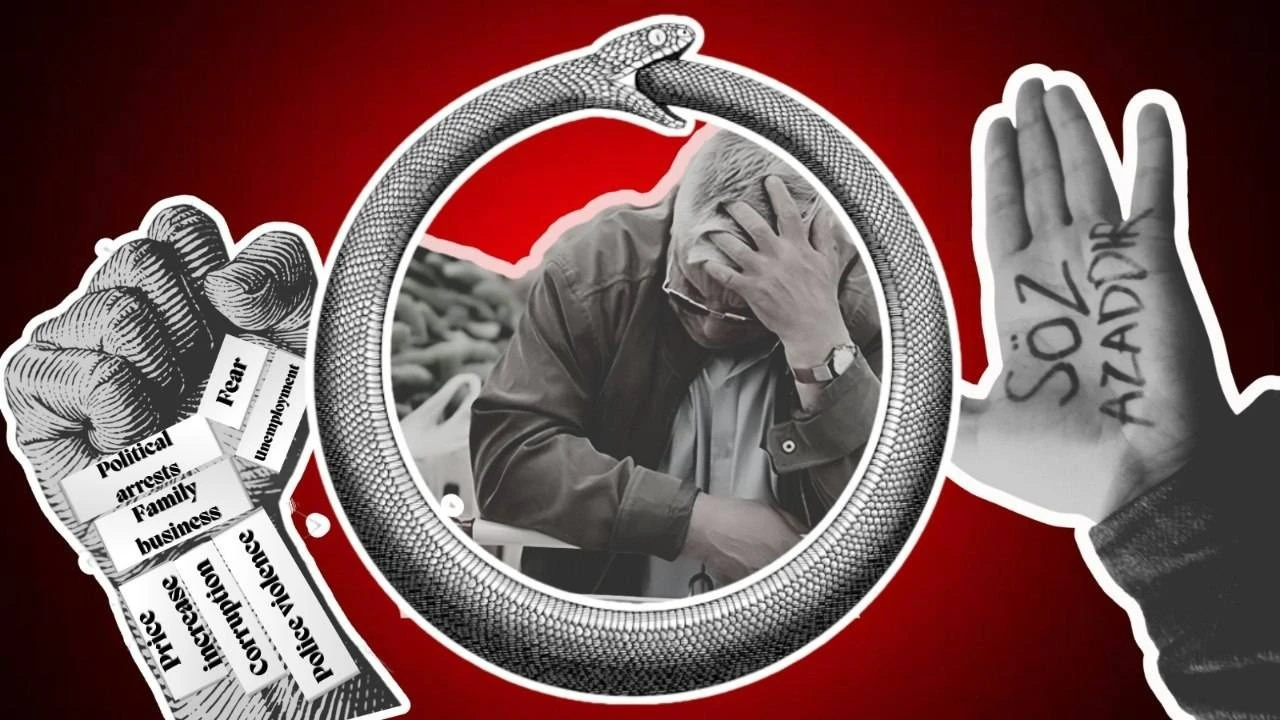
However, this vortex may ultimately turn the system into a “snake eating its own tail” (Ouroboros). When no one is left in society to protest, when the opposition is suffocated and free media is destroyed, the regime does not relax at all. On the contrary, this time the “iron fist” is directed against officials loyal to the regime. Even high-ranking officials who were considered untouchable until yesterday become the target of the "traitor" stigma overnight. That is, the regime, desiring to keep everything and everyone under absolute control, eventually begins to suffocate within the walls of fear it has created itself.
The reign of the lie and the destruction of the public sphere
In her work “Truth and Politics,” H. Arendt emphasizes that what makes humans truly human is the "public sphere." The public sphere is a shared world where citizens can speak with one another, act, and discuss the truth. Authoritarianism, first and foremost, destroys this sphere. It turns individuals into beings who do not trust each other, where everyone suspects everyone else.
"If you are constantly being lied to, the result of this is not that you believe the lies, but in fact that no one believes in anything. Such a society is already incapable of making a decision on any issue; in this case, they not only lose the capacity to act, but also destroy their abilities to think and make judgments. With such a people, it is possible to carry out whatever you desire.” (H. Arendt, 1967).
Azerbaijani authoritarianism has currently established this configuration in the country. Hiding the truth and remaining silent are presently considered the most correct ways to evade danger in Azerbaijani society. However, the difference between the illusion of "prosperity" presented by the Aliyev regime through subservient media and the bitter reality the people experience in the streets, markets, and hospitals is gradually deepening even further. As Michel Foucault said, this situation causes the concept of "disciplinary power" to give way to naked violence.
A system built on lies is inherently unstable by nature. Because it is impossible to destroy the truth by denying it. On the contrary, suppressed truth creates an invisible fault line that will shake the foundation of the regime in the future.
Unpredictable resistance
The greatest illusion of totalitarian and harsh authoritarian regimes is their certainty that they can completely rule human nature and turn society entirely into submissive subjects. The Aliyev regime also thinks it has mastered everything by arresting all journalists, suffocating the voice of the opposition, and bringing the entire country under digital surveillance. H. Arendt's concept of “Natality” justifies that this achieved success is hollow.
According to Arendt, every human being born brings the potential for a new beginning. The occurrence of great events during intergenerational transitions also feeds on this regularity. The factor of the unpredictability of these people's will can nullify all the system's algorithms and all its intelligence reports in an instant. This unpredictability is a phenomenon capable of initiating the unexpected. It is precisely this phenomenon that makes it impossible to calculate where the first spark, which will instantly shatter the seemingly flawless repression mechanism, will flare up (H. Arendt, 1951).
It is also possible to observe the clear manifestations of this in the Azerbaijani context. At a time when the government was applying the strictest control regime, elderly women in the village of Söyüdlü in Gadabay standing before the police with walking sticks in their hands against the waste lake of a cyanide gold mine managed to paralyze the regime's entire power projection for several days. The regime might have neutralized the political parties, but it could not hide its bewilderment in the face of the natural reaction of the villager wanting to protect their land and water.
Independent media and its young journalists: Following the regime being swept away by the illusion of "we solved the problem" when the older generation of opposition leaders were arrested or bought off and put out of action, the initiation of a new wave of journalism by young investigative journalists in their 20s and 30s exposing the ruling family's secret properties abroad is a true example of "natality".
The moral superiority overcoming dungeon walls: The intellectual and moral resistance demonstrated in the dungeons by Akif Gurbanov, Sevinj Vagifgizi, Shamshad Agha, Ruslan Izzatli, Aynur Elgunash, Ramil Babayev, Ilkin Amrahov, and other activists demonstrates the power of the individual described in Camus's “The Rebel” as one who "says no, but at the same time says yes for the sake of human dignity" (Albert Camus, 1951). Every unbending body shatters the illusion of legitimacy of the court and the ordinary officials judging them.
Overcoming the threshold of fear
When analyzing Eastern Bloc totalitarianism by developing Aleksandr Solzhenitsyn's thesis of "Live Not by Lies," Vaclav Havel emphasized that the system stayed on its feet more due to the masses accepting the lie than through physical weapons. For this reason, for Havel, resistance is a moral decision prior to a revolutionary uprising that would directly overthrow the state (Vaclav Havel, 1978b).
Living with the truth is not repeating the lies spread by the system, choosing not to be a partner in crime, and being able to keep one's hands in one's pockets when applause is demanded. In Azerbaijan, a lawyer not giving up on defending a political prisoner, or a youth not pledging allegiance to the regime's official rhetoric on social media, opens irreparable cracks in the fabric of the system. Following this, the moment comes when the masses overcome the threshold of fear, when they accept the punishments applied by the system not as a shame but as an honor, and this will be the harbinger of the beginning of the end of the regime.
The bureaucratic cogs who surrender their consciences to the regime for the sake of position, career advancement, and fear can be the executors of oppression. However, this mechanism is powerless to destroy the human desire for freedom, moral judgment, and the capacity to bring a new breath to the world.
The petro-autocracy in Azerbaijan may look like a seemingly unshakable fortress with its repressive security apparatus, gleaming skyscrapers, and hosting of international events. However, internally, there exists a regime circling in a closed loop, unable to stand without manufacturing crises, suffocating in its own bureaucratic numbness, and doomed to lose its legitimacy more with every passing day. Such a mechanism, which attacks internal enemies when external enemies run out, and attacks factions within itself when internal enemies run out, has never been able to escape this labyrinth it entered at any stage of history.
History has repeatedly proven that the final word is spoken by that "unpredictable human" whom no repression apparatus can completely subjugate. Even in the place where the darkness is thickest, a single moral protest rising from a cell, a village square, or a courtroom can be the herald of a new beginning that will ensure the collapse of paper castles and the attainment of human freedom.
As long as "natality" exists, humanity's yearning for freedom is not merely a desire, but an ontological necessity.
Note: The article you have read was originally written in the Azerbaijani language. Artificial intelligence tools were used only in the translation.
References:
H. Arendt, 1963. "Eichmann in Jerusalem: A Report on the Banality of Evil". Chapter VIII. https://platypus1917.org/wp-content/uploads/2014/01/arendt_eichmanninjerusalem.pdf
H. Arendt, 1971. "Thinking and Moral Considerations", 1971, "The Life of the Mind", Vol. 1, Chapter: "The Two-in-One"). https://gabriellebw12.wordpress.com/wp-content/uploads/2016/08/arendt_thinking_and_moral_considerations.pdf
Vaclav Havel, 1978a. The Power of the Powerless. Chapter IV. https://www.nonviolent-conflict.org/wp-content/uploads/1979/01/the-power-of-the-powerless.pdf
H. Arendt, 1967. Truth and Politics. Section IV. https://german.yale.edu/sites/default/files/arendt.truth_and_politicslying_in_politics.pdf
H. Arendt, 1951. The Origins of Totalitarianism. paraqraf (§ 33). https://social-ecology.org/wp/wp-content/uploads/2024/03/Hannah-Arendt-The-Origins-of-Totalitarianism-Harcourt-Brace-Jovanovich-1973.pdf
Albert Camus, 1951. "L'Homme révolté". Chapter I. https://www.anthropomada.com/bibliotheque/CAMUS-Lhomme-revolte.pdf
Vaclav Havel, 1978. The Power of the Powerless. Chapter VII. https://www.nonviolent-conflict.org/wp-content/uploads/1979/01/the-power-of-the-powerless.pdf
