✍️ Ahad Ahadli – Master of Political Science, Central European University.
Introduction
Azerbaijan-Armenia relations, which will shape the future foundation of the South Caucasus region, have been in the attention of the world public for many years. After the military operations in 2020 and 2023, Azerbaijan has restored full control over its territories, and the parties have now turned to the discussion of relations from now on. At the foundation of these discussions stands the peace agreement that is envisaged to be signed in the future. However, although progress has been achieved on a number of issues, the problem of amending the Armenian constitution, which is the main disputed issue, still remains. Baku puts the change of the Armenian constitution as the first condition of peace. Yerevan, in turn, states that this condition is groundless. Although the demands of the Azerbaijani side are voiced in the local media, the counter-arguments of the Armenian side are not discussed.
In this article, against the background of the Armenia-Azerbaijan peace talks, I have examined the latest discussions related to the change of the Armenian constitution and the claims and responses that the parties have put forward against each other. The question of the research will be “Why does Azerbaijan demand the change of the Armenian constitution, and on what grounds does Armenia not change the constitution?”.
The peace agenda in Armenia-Azerbaijan relations after 2023
After the 44-day war that took place between Armenia and Azerbaijan in 2020, with the participation of Russia as well, a trilateral statement on the cessation of the war was signed. Although in August 2025 in Washington the agreed text of the peace agreement between Azerbaijan and Armenia was initialed, the final legal-political procedures required for the signing and entry into force of the document have not yet been completed. Especially after 2024, headed by President Ilham Aliyev (Report, 2024a), Azerbaijani officials (Trend, 2024) continuously put forward the condition of changing the Armenian constitution for the signing of the peace agreement.
Even in September of this year, Minister of Foreign Affairs Jeyhun Bayramov, speaking at a press conference, voiced the same opinion: “As also noted in the joint declaration signed in Washington, after the initialing of the peace agreement, the steps necessary for the completion of the process must be taken. One of these is the holding of a referendum in Armenia and amendments to the constitution... Our position on this topic is unchanged. For the signing of the peace agreement, these listed things are important” (Report, 2026a).
Over the past years, both sides have given quite a lot of positive messages in the direction of peace. Especially after the peace document initialed in the USA, while Ilham Aliyev called this document “the end of the war, of the conflict” (Prezident.az, 2025), Armenian Prime Minister Nikol Pashinyan also made the statement “Peace has been established between Armenia and Azerbaijan” (Primeminister.am, 2025a). Even, according to official sources, by the end of 2025 Azerbaijan sent Armenia 22 wagons of AI-95 brand gasoline (BBC, 2025). According to information given in May 2026, up to that date Azerbaijan had exported to Armenia 9 thousand tons of diesel, 979 tons of "AI-92" gasoline and 2955 tons of "AI-95" gasoline (Report, 2026b).
Despite all these positive statements and changes, messages of peace, Armenia has not made the constitutional change that Azerbaijan demands for the signing of the peace agreement. Although in the media under the control of the Azerbaijani government the claims of official Baku regarding the change of the Armenian constitution are continuously voiced, on what grounds Yerevan refuses this demand is not shown.
Why does the Azerbaijani side want the change of the Armenian constitution?
As the reason for demanding a constitutional change in Armenia, Azerbaijan cites the reference made in the introductory part of the Armenian constitution to Armenia's Declaration of Independence (President.am, 2015). That is, the Armenian constitution takes as its basis the principles declared in the act of independence. In that act, in turn, (Concourt.am, 1990) reference is made to the decision concluded in 1989 between the Armenian Soviet Socialist Republic and the National Council of the Nagorno-Karabakh Autonomous Oblast, which envisages the unification of the Nagorno-Karabakh Autonomous Oblast with Armenia (Legal-tools.org, 1989). Baku states that this reference is a territorial claim against Azerbaijan and that the Armenian constitution must be changed, this reference must be removed.
The decision of the Constitutional Court of Armenia
Armenia is of the opinion that these claims are groundless. That is, in September 2024, the Constitutional Court of Armenia, while interpreting the Regulation on the joint activity of the commissions on the delimitation of the state border between Azerbaijan and Armenia (Amerikaninsesi, 2024), noted that not every provision mentioned in the declaration of independence creates a constitutional obligation (Concourt.am, 2024). Prime Minister Nikol Pashinyan, who voiced this during a parliamentary speech, also, comparing the subjects that adopted the declaration of independence and the constitution, stated that the declaration was adopted by the Supreme Council of the Armenian Soviet Socialist Republic, one of the 15 members of the Soviet Union, while the constitution was adopted by referendum by the internationally recognized Republic of Armenia (emphasizing the superiority of the Constitution over the declaration) (Primeminister.am, 2024a).
The importance of the decision of the Constitutional Court of Armenia is in that the court gave an interpretation regarding the joint activity of the delimitation commissions. As was announced from the beginning, the joint activity (Report, 2024b) is based on the Alma-Ata declaration signed in 1991. Agreement on this had been reached in 2022 at the Prague meeting (Consilium.europa.eu, 2022). The Alma-Ata declaration, in turn, contains the provision of the former Soviet republics recognizing each other's territories. That is, the court confirmed that the border delimitation process based on the 1991 Alma-Ata Declaration is in accordance with the Armenian constitution. This approach, in turn, strengthens the legal framework formed between Baku and Yerevan regarding the recognition of Azerbaijan's territorial integrity on the basis of the 1991 borders. This has been confirmed both by Armenia's ministry of foreign affairs (MFA.am, 2025), and by Nikol Pashinyan (Pace.coe.int, 2025).
The objection of the Azerbaijani side
Azerbaijan, however, does not consider the decision of the Constitutional Court of Armenia sufficient and continues to put forward the constitutional change as the first condition of the signing of the peace agreement (MFA.gov.az, 2024). As the reason for this, it points to the precedent related to the Zurich protocols of 2009, which contained the normalization process between Turkey and Armenia. That is, although the Constitutional Court of Armenia considered those protocols in accordance with the constitution, it had set as a condition that their interpretation and application be done within the framework of the preamble of the constitution and Article 11 of the Declaration of Independence (Concourt.am, 2010). Since that Article 11, in turn, contains the concepts of the “Armenian Genocide” and “Western Armenia”, there was no progress regarding these protocols; later both governments cancelled the protocols.
Also, researchers (Huseynov, 2024), giving a specific example from the history of Armenia, show that the 1989 resolution could be considered superior to the Constitution (Sargsyan, 2021). That is, according to the constitution adopted in 1995, the president of the country had to be a citizen of Armenia for the last 10 years and had to live these 10 years in Armenia. Robert Kocharyan, who was a candidate in the presidential elections held three years later, however, had moved to Armenia from Azerbaijan - from Nagorno-Karabakh - only one year before. The local court that examined the complaint of the opposition regarding this (OSCE, 2003) made a decision in favor of Robert Kocharyan and, as the basis for this decision, had pointed to the decision concluded in 1989 between the Armenian SSR and the Nagorno-Karabakh Autonomous Oblast (Azatutyun.am, 2003). That is, although the Constitution did not permit Kocharyan's participation in the elections, the court, citing the 1989 act, had considered this candidacy legal.
The Washington declaration
Nikol Pashinyan also, referring to Article 12 of the peace document, stated that Armenia cannot cite local legislation in order not to implement this agreement: “In our constitution it is stated that ratified international treaties are superior to local legislation. That is, when we sign the peace treaty, we must send it to the Constitutional Court to check its conformity with the constitution. If the court decides that the treaty is contrary to the constitution, as I have declared from the beginning, we will take the initiative for a change to the constitution. If the court states that the treaty is in conformity with the constitution, then no obstacle remains for the ratification of the treaty in parliament” (Pace.coe.int, 2025).
Also, Armenia's Minister of Foreign Affairs Ararat Mirzoyan, while commenting on the Washington declaration, stated that in Washington the Constitution of Armenia was not discussed at all and that Armenia has no obligation before any country to change its constitution (News.am, 2025).
As is also seen from Nikol Pashinyan's statement, the Armenian side plans, after the new peace treaty is signed, to send it to the Constitutional Court. If the court confirms that the peace treaty is in conformity with the constitution, then Yerevan will state that no reason remains to change the constitution. In other words, whether the constitution changes or not will depend on the opinion the Constitutional Court gives on the peace treaty. That is, in Yerevan's opinion, the necessity of a change to the constitution will be determined after the peace treaty.
From the Constitutional Court's approval of the Regulation on the joint activity of the commissions on delimitation, it can be estimated that if the peace treaty is concluded, the Constitutional Court will approve this decision. Because the court substantiates in that decision that not all provisions of the Declaration of Independence create a constitutional obligation. However, if the Constitutional Court claims that the treaty is not in conformity with the constitution, then two possibilities arise. The first possibility is that, in order to bring the treaty and the constitution into conformity with each other, it will be necessary to amend the constitution. In this case, since it is not possible to change the preamble part, this procedure has no significance left. The second possibility, in turn, is to adopt a completely new constitution, which the current Armenian government is trying to do (about the new constitution below). The concern of the Azerbaijani side is not the Constitutional Court of Armenia not accepting the treaty. Because, if the court does not accept it, a new constitution must be prepared, which is also in accordance with the wish of the Azerbaijani side. The issue that worries Baku is the Constitutional Court accepting the treaty. Because, in this case, there will be no need left to adopt a new constitution, and then no power of influence remains on Armenia for the change of the constitution anymore. For this reason, Azerbaijan wants first the constitutional change to be made, then the signing of the peace treaty, so that it does not lose the means of influence for the change of the constitution afterwards.
The claims of the Armenian side about the Azerbaijani constitution
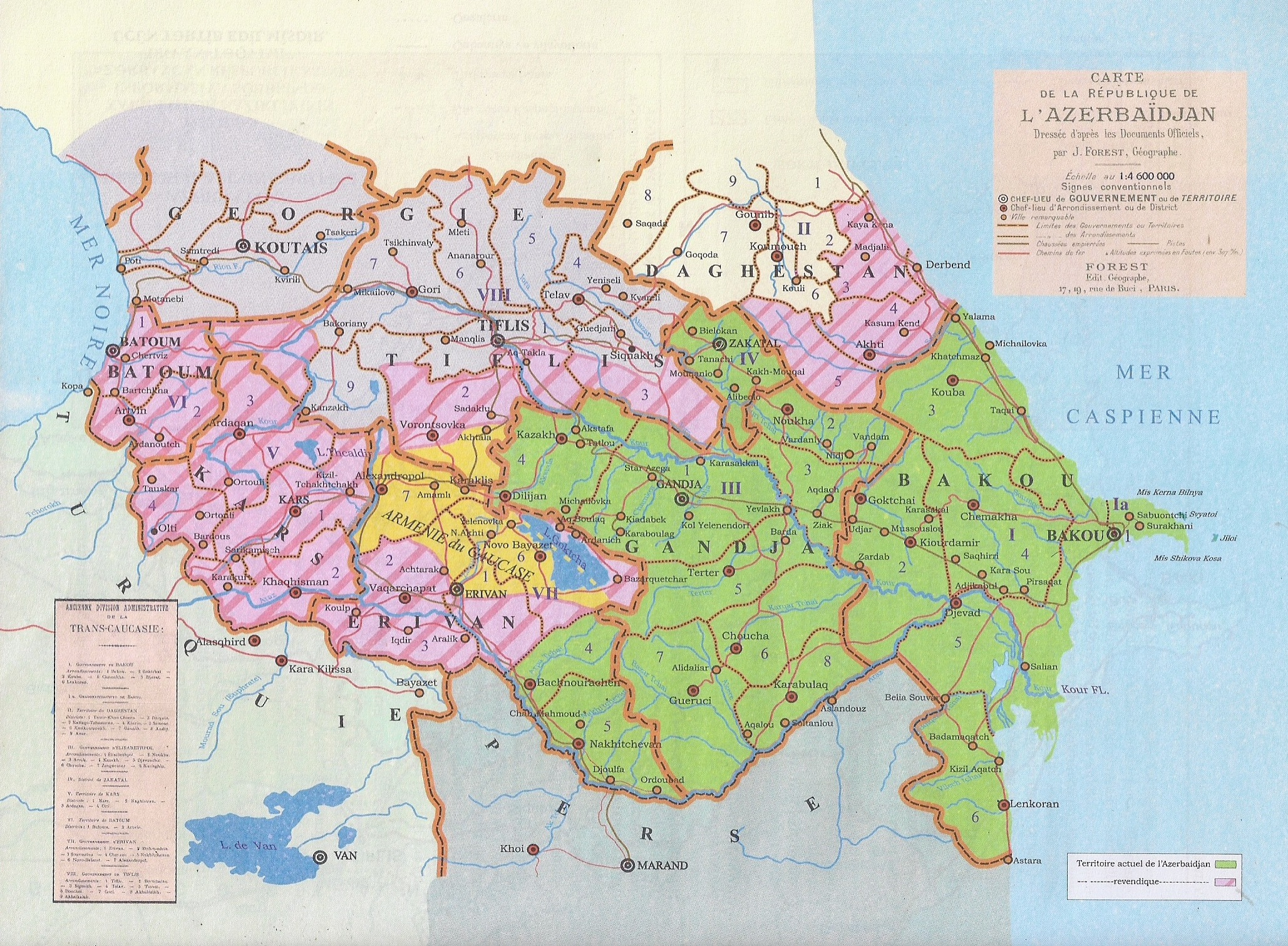
Armenia also puts forward similar claims against Azerbaijan. Nikol Pashinyan stated that, by the same logic, the Azerbaijani Constitution also puts forward a territorial claim against Armenia (Primeminister.am, 2024b). Because the Azerbaijani Constitution, in its introductory part, refers to the Constitutional Act “On the state independence of the Republic of Azerbaijan”. The Constitutional Act, in turn, states that the Republic of Azerbaijan is the successor of the Republic of Azerbaijan that existed from 28 May 1918 until 28 April 1920. The Republic of Azerbaijan that existed in the years 1918-1920 (the Azerbaijan Democratic Republic), in the map it sent to the Paris Peace Conference, had shown a part of today's territory of Armenia as the territory of the Republic of Azerbaijan (Lib.az, Date not indicated). The Azerbaijani side does not accept this claim and states that in the 1918 declaration of independence there is no territorial claim against Armenia: “Which territories were part of Azerbaijan during the period of the First Azerbaijan Republic, and when they were added to the composition of Armenia, are historical facts, and it is not possible to deny these facts. This does not in any case mean that there are now territorial claims against Armenia in Azerbaijani legislation”, - the Ministry of Foreign Affairs stated. Nikol Pashinyan also expressed concern about the Azerbaijani government's Western Azerbaijan narrative, saying that this is a territorial claim against Armenia (Primeminister.am, 2025b).
The obstacles in front of the change of the Armenian constitution
Another obstacle in the issue of changing the Armenian Constitution is the decision the Constitutional Court gave in 2021 regarding the fact that the preamble of the basic law cannot be changed (Concourt.am, 2021). That is, although the constitution itself envisages that only Articles 1, 2, 3 and 203 cannot be changed, the court also added the preamble part to this list. That is, even if there are amendments to the constitution, the preamble part that the Azerbaijani side wants changed cannot change.
Another obstacle standing in front of amendments to the constitution, in turn, is that Nikol Pashinyan's Civil Contract Party could not win as many seats as necessary for a referendum in the 2026 elections. That is, the party won 64 of the 105 seats in parliament (OC-media, 2026a). However, for constitutional changes to be put to a referendum, 2/3 of parliament, that is, 70 deputies, must vote in favor (Horizonweekly.ca, 2026). Currently Nikol Pashinyan's party does not have such a majority in parliament. And in Armenia there is no legal way to replace this procedure with any other procedure. The consent of 2/3 of parliament to the referendum is mandatory (OC-media, 2026b).
The preparation of a new constitution
Against the background of the difficulty of changes to the Constitution currently existing in Armenia, another topic on the agenda is the adoption of a completely new constitution. Nikol Pashinyan has voiced this even since 2020, before the 44-day war began (Primeminister.am, 2020). Nikol Pashinyan, who also made statements regarding the new constitution in the following years, for the first time in April 2025 stated that the new constitution will not refer to the declaration of independence (Azatutyun.am, 2025). The Prime Minister repeated this opinion of his in later periods (Armenpress.am, 2026) as well (Primeminister.am, 2026). Arusyak Julhakyan, a deputy of the ruling Civil Contract Party, also voiced the same opinion (Caucasuswatch.de, 2026). It has been stated that the draft of the new constitution will be ready by the end of 2026 (OC-media, 2026c). The referendum, in turn, is expected to take place in 2027 (OC-media, 2024).
It can be assumed that, since the adoption of a new constitution and the abolition of the reference to the declaration of independence in it looks like a more possible procedure, official Yerevan chooses this path. According to Article 7 of the current Constitution, sending the draft of a new constitution to the Constitutional Court is not mandatory (Translation-centre.am, Date not indicated). The Venice Commission also confirms this (Odihr.osce.org, 2017). In the case where changes are to be made to the existing constitution, however, according to Article 8 of the basic law, the Constitutional Court must give an opinion on the draft of changes. In this case, the Constitutional Court, referring to the decision it gave in 2021 regarding the unchangeability of the preamble, can object to the change of that part. In the procedure of adopting a new constitution, however, since the intervention of the Constitutional Court is not envisaged, this path looks easier.
Conclusion
As can be seen, Azerbaijan demands the change of Armenia's constitution as a precondition of the signing of the peace treaty. Armenia, in turn, citing the decision of the Constitutional Court, insists that the currently existing basic law does not put forward any territorial claim against Azerbaijan. Official Yerevan states that after the peace treaty is signed, it will be sent to the Constitutional Court, and if the court gives a negative opinion, then the initiative for a new constitution will be taken. In other words, Azerbaijan demands the change of the Armenian constitution before the peace treaty is signed. Armenia, in turn, states that after the peace treaty is signed it will act on the basis of the opinion of the Constitutional Court: if the court approves the treaty, then there will be no need for a new constitution either. The Azerbaijani side, in turn, citing the decision that same court gave in 2010 regarding the Zurich protocols, claims that however much the Armenian side states that not every provision of the Declaration of Independence creates a constitutional obligation, in practice there exists a precedent of giving preference to the Declaration of Independence in comparison with the constitution.
In addition to this, the change of the Armenian constitution also looks difficult practically. Both the Constitutional Court does not allow the change of the preamble of the basic law, and the ruling Civil Contract Party does not have a constitutional majority in parliament. Although recently it has been stated that the ruling party is working on a new constitution and that in this document the act of independence will not be referred to, the text of the draft has not yet been made public.
Note: The article you have read was originally written in the Azerbaijani language. Artificial intelligence tools were used only in the translation.
Sources:
Amerikaninsesi, 2024. Azerbaijan and Armenia have agreed on the joint activity of the state border commissions
https://www.amerikaninsesi.org/a/7765054.html
Armenpress.am, 2026. Pashinyan: New Armenian Constitution should not reference 'conflict-logic' Declaration of Independence
https://armenpress.am/en/article/1244511
Azatutyun.am, 2003. Court Rejects Opposition Demand To Disqualify Kocharian
https://www.azatutyun.am/amp/1570858.html
Azatutyun.am, 2025. Pashinian Wants Constitutional Change Demanded By Azerbaijan
https://www.azatutyun.am/a/33387437.html
BBC, 2025. Azerbaijan has sent Armenia 22 wagons of gasoline
https://www.bbc.com/azeri/articles/c3e0kvj1p01o
Caucasuswatch.de, 2026. Armenia's New Constitution to Omit Reference to Declaration of Independence
Concourt.am, 1990, Armenian Declaration of Independence
https://concourt.am/en/normative-legal-bases/declaration
Concourt.am, 2010. Decision of The Constitutional Court of The Republic of Armenia
https://www.concourt.am/decision/full_text/850.pdf
Concourt.am, 2021. Decision of The Constitutional Court of The Republic of Armenia
https://www.concourt.am/decision/full_text/646219fdf31ed_1590.pdf
Concourt.am, 2024. Decision of The Constitutional Court of The Republic of Armenia
https://www.concourt.am/decision/full_text/6737379018be8_SDV-1749_EN.pdf
Consilium.europa.eu, 2022. Statement following quadrilateral meeting between President Aliyev, Prime Minister Pashinyan, President Macron and President Michel, 6 October 2022
Gov.am, date not indicated. Declaration of Independence
https://gov.am/en/independence/
Horizonweekly.ca, 2026. Can Armenia’s ruling party change the Constitution without a two-thirds majority? (EXPLAINER)
Huseynov, 2024. Armenia’s Constitutional Catch-22
https://verfassungsblog.de/armenias-catch-22/
Lib.az, Date not indicated. Map of Azerbaijan submitted by the Azerbaijan Democratic Republic to the Paris Peace Conference
https://lib.az/users/1/upload/files/1918_cumhuriyyet.jpg
Legal-tools.org, date not indicated. Joint resolution of Armenia SSR and Nagorny Karabakh Oblast on reunification
https://www.legal-tools.org/doc/67c50c/pdf/
Mfa.am, 2025. Deputy Foreign Minister of Armenia Robert Abisoghomonyan addressed the Special Meeting of the OSCE Permanent Council
https://www.mfa.am/en/speeches/2025/03/26/Abisoghomonyan_OSCE/13144
MFA.gov.az, 2024. No:402/24, Comment of the spokesperson of the Ministry of Foreign Affairs Aykhan Hajizada on the views voiced by the spokesperson of the Ministry of Foreign Affairs of Armenia on justifying the militarization of Armenia and the alleged threats from Azerbaijan
https://mfa.gov.az/az/news/no40224
News.am, 2025. FM: Armenia constitution not discussed in Washington
https://news.am/en/news/901252
OC-media, 2024. Armenia to hold constitutional referendum in 2027
https://oc-media.org/armenia-to-hold-constitutional-referendum-in-2027/
OC-media, 2026a. European observers criticise Armenia’s decision to annul results in three polling stations
OC-media, 2026b. Armenian government faces uphill battle over new constitution following election results
OC-media, 2026c. Armenian opposition accuses government of adjusting new constitution to Azerbaijan’s demands
Odihr.osce.org, 2017. Joint Opinion on The Draft Law on Referendum
https://odihr.osce.org/sites/default/files/f/documents/a/f/362061.pdf
OSCE, 2003. Republic of Armenia Presidential Election 19 February And 5 March 2003 Final Report
https://cdn.osce.org/sites/default/files/f/documents/8/7/14054.pdf
Pace.coe.int, 2025. Séance des questions : M. Alain BERSET, Secrétaire Général du Conseil de l'Europe
https://pace.coe.int/fr/verbatim/2025-09-30/am/en
Primeminister.am, 2020. “RA citizens must consider the Constitution as theirs” – PM addresses the Professional Committee on Constitutional Reform
https://www.primeminister.am/en/statements-and-messages/item/2020/06/15/Nikol-Pashinyan-meeting/
Primeminister.am, 2024a. No article of the Constitution of Armenia contains any direct or indirect reference to Nagorno-Karabakh. Prime Minister
https://www.primeminister.am/en/statements-and-messages/item/2024/11/13/Nikol-Pashinyan-Speech/
Primeminister.am, 2024b. "Durable peace in the South Caucasus is not only possible but also realistic” - Prime Minister’s speech at the "Yerevan Dialogue" international conference
Primeminister.am, 2025a. Prime Minister Nikol Pashinyan's speech at the plenary session of the autumn session of the Parliamentary Assembly of the Council of Europe
https://www.primeminister.am/en/statements-and-messages/item/2025/09/30/Nikol-Pashinyan-Speech/
Primeminister.am, 2025b. The Prime Minister gives interview to Turkish media representatives
Primeminister.am, 2026. Prime Minister Nikol Pashinyan’s speech at the discussion of the Government's 2026-2031 Program at the National Assembly
https://www.primeminister.am/en/statements-and-messages/item/2026/08/24/Nikol-Pashinyan-Speech/
President.am, 2015. Constitution of the Republic of Armenia
https://www.president.am/en/constitution-2015/
Prezident.az, 2025. Ilham Aliyev gave an interview to the “Al-Arabiya” TV channel
https://president.az/az/articles/view/69968
Report, 2024a. Ilham Aliyev: The main condition of the peace agreement is the change of Armenia's constitution
Report, 2024b. Azerbaijan and Armenia will be based on the 1991 Alma-Ata Declaration in the delimitation process
Report, 2026a. Jeyhun Bayramov: Our position on the topic of the change of Armenia's constitution is unchanged
Report, 2026b. The next batch of petroleum products has been dispatched from Azerbaijan to Armenia - UPDATED
Sargsyan, 2021. The Robert Kocharyan Administration: 1998-2008
Translation-centre.am, Date not indicated. Constitutional Law of The Republic Of Armenia
https://www.translation-centre.am/pdf/Translat/HH_orenk/2018/2018_HO-155-N_CL_en.pdf
Trend, 2024. Jeyhun Bayramov told Biden's special assistant that the most serious obstacle to the peace agreement is the Constitution of Armenia