(This article was prepared within the framework of the Khar Center's research on Azerbaijani authoritarianism)
Introduction
The impact of the fundamental changes observed in Azerbaijan–West relations in recent years on the country's internal political dynamics is increasing day by day. Especially since 2022, following Russia's invasion of Ukraine, the sharp prominence of Europe's energy and security priorities has shifted the balance of values and interests in the West's Azerbaijan policy in favor of the latter. Although principles such as democracy, human rights, and the rule of law previously occupied an important place in the discourse of Western political centers, the energy and security agenda has now pushed this normative framework off the agenda. This change acts as an important structural factor influencing the behavior of the political regime in Azerbaijan. For this reason, analyzing how the transfer of the West's geopolitical approach from values to interests affects the consolidation of Azerbaijan's family authoritarianism is of particular importance.
Purpose of the Analysis
In this article, the "Khar Center" examines the impact of the radical change in the West's view of values, and the further disruption of the long-standing selective value-interest map by post-2022 energy ties, on the rise of authoritarianism in Azerbaijan.
The Main Question of the Analysis
How does the transition from values to interests in the West's Azerbaijan policy after 2022 affect the hardening of the political regime in the country?
The West's Test of Values and Interests
For years following independence, relations with the West and Russia were evaluated for Azerbaijan as a direct political choice—a model of democracy versus authoritarianism. Rapprochement with the West was mostly associated with democracy and reform, while closeness with Russia was predominantly associated with authoritarian stability, geopolitical dependence, and the weakening of democratic institutions. This thinking became particularly popular in the early 2000s and was largely justified by the priorities—such as democracy, human rights, and the rule of law—during the period when the European Union included post-Soviet countries in its neighborhood policy framework (European Commission, 2009).
According to Manners' classical theory, it is precisely these priorities that turned the European Union into a normative power. This theory argues that values such as peace, freedom, the rule of law, democracy, human rights, social solidarity, anti-discrimination, and sustainable development lie at the foundation of the European Union's constitution, identity, and behavior. The Manners framework implies that the EU's power stems not only from material resources but from its ability to define the boundaries of "normal" in international relations (Manners, 2002).
This approach of Manners was reflected in the statements of EU leaders for a long time (EEAS, 2016). Some critics, however, emphasize that an actor can only truly possess normative power when it can ensure that Country A or B does something they otherwise would not do. Diez, a proponent of this view, states that the EU's concrete ability to influence in this way is limited, and a large part of these limitations stems from the contradiction between the EU's ethical norms and the material interests of member states. According to Diez, member states have prioritized economic interests in their foreign policies at the expense of the EU's ethical norms, and this contradiction, among other damages, has undermined the union's credibility as a values-based actor (Diez, 2005). The victim of the clash between member states' economic interests and values has been human rights—because from a rational perspective, when the material-political cost of the value-interest contradiction is low and the application of international norms is uncertain, the likelihood of states violating human rights is higher (Cardenas, 2004).
Authors like Diez and Cardenas drew attention to the contradictions in applying normative power theory to EU policy. Adrian Hyde-Price, unlike the overt normative approach of liberal-idealism that views the EU as an international actor, argued that realism is the defining factor of EU foreign and security policy (Hyde-Price, 2006).
Hans Morgenthau, who turned classical realism into a comprehensive international relations theory in the 20th century, argued that politics is governed by clear and immutable laws of nature, and that states can take rationally and objectively correct steps by understanding these laws. According to Morgenthau, the timeless and universal insatiable human lust for power and desire to dominate is the main cause of conflicts. In his work "Politics Among Nations: The Struggle for Power and Peace," published in 1948, Morgenthau states that international politics, like all politics, is a struggle for power. According to the author, human nature and power-interest lie at the core of realism, and although ethical values play a role in politics, politics is not a field absolutely bound to ethical values (Stanford, 2023).
According to Kenneth Waltz, one of the main theoreticians of neorealism, international politics is primarily determined not by the character of state leaders or human nature, but by the anarchic structure of the international system. What determines the behavior of states the most is the structure of the system and how power is distributed within that system. According to Waltz's theory, the organizing principle of the international system is anarchy; states are functionally similar to one another, but what distinguishes them is their relative capabilities, that is, their share of power. According to defensive realists, including Waltz, states primarily seek security and try to maintain a balance of power. Offensive realists, on the other hand, believe that states try to maximize their power whenever the opportunity arises and seek to achieve a dominant, even hegemonic position in the system (Stanford, 2023). Both classical and neorealism view states as the primary actors in international relations, emphasize the anarchic nature of the international system, and explain state behavior mainly through the prism of power, security, and national interests.
In the 2000s, criticisms directed at the EU's normative power status were explained by the mismatch between value and interest and the selectivity in applying priorities within this framework. These theoretical criticisms seemed very justified in the case of Azerbaijan. The main reason for this selectivity in Azerbaijan was undoubtedly energy resources. However, again in the 2000s, building relations with the West along the lines of democracy, human rights, and the rule of law could create a certain normative control effect. In critical issues such as human rights, political prisoners, pressure on the media, and freedom of assembly, the position of Western states and institutions, and the weight of statements coming from Western capitals, mattered and created a reputational cost for the government. The government viewed pressures and criticisms from the West as a risk, factored them in, took steps backward at certain points, and at points where it did not, built influence mechanisms like "caviar diplomacy" to soften the pressure. This "policy," which began shortly after Azerbaijan joined the Council of Europe in 2001, accelerated after Ilham Aliyev—who had been the head of the Azerbaijani delegation to the PACE (Parliamentary Assembly of the Council of Europe)—became president in 2003, and gained wider momentum after the Baku–Tbilisi–Ceyhan oil pipeline was commissioned in 2005 and the state budget was filled with oil revenues, was the name of the mechanism to bribe PACE members (ESI, 2012). The Azerbaijani government spent massive amounts of money on this "caviar diplomacy" policy implemented to protect the seal of legitimacy provided by Council of Europe membership, and in return, it was largely able to ensure that the deepening of Azerbaijani authoritarianism was ignored within the CE (ESI, 2012).
Unlike the Council of Europe, European Union institutions, especially the European Parliament, had a harsher reaction to the Azerbaijani government's violations, particularly regarding human rights, and this line still continues. However, the principled stance of parliamentarians is not synchronized with the loyalty of governments to the Azerbaijani regime. The energy factor plays a main role in this, and it is not a trend limited to just the last few years.
The EU's dilemma between these two concepts coincided with the "stability instead of democracy" narrative that the Azerbaijani government started with the "Contract of the Century," continued with oil and gas money, and found many partners for. In many instances, the EU acted more cautiously in its demands for democratic reform, went against its own principles, and decided to prioritize stability over change at the expense of strengthening the authoritarian regime. Ultimately, no matter how paradoxical and ironic it may be, this very stability-versus-democracy dilemma of the EU manifested as support for the Azerbaijani government (Tartes, 2015). Research results also show that the EU, as a normative power, did not follow a unified, common approach in promoting freedom, democracy, the rule of law, and respect for human rights in Azerbaijan—although the European Parliament pursued a more confrontational strategy, the EU External Action Service and Commission preferred a dialogue-based, consensus-oriented approach (Guillot, 2016).
A similar values and interests dilemma existed in US policy toward Azerbaijan in the 2000s. On one hand, Washington demonstrated a harsh rhetoric of criticism regarding democracy and human rights violations, election fraud, the suppression of media freedoms, and the issue of political prisoners (State Gov, 2004); on the other hand, especially after 2001, it placed the security and energy agenda at the top of its "national interest" list:
"US national interests in Azerbaijan focus on strong bilateral security and counterterrorism cooperation, advancing US energy security, progress in free market and democratic reforms, as well as the resolution of the Nagorno-Karabakh conflict through mediation" (State gov, 2004).
The formality of democratic reforms in this ranking of interests manifested itself particularly in the controversial presidential election of 2003. Before the official results of the presidential elections in Azerbaijan were announced and while back-to-back reports of election fraud were coming in from international observers, US Deputy Secretary of State Richard Armitage called to congratulate Ilham Aliyev (CRS, 2003). This was one of the critical moments that caused deep disappointment regarding the US, the "herald of democracy," among the segments of Azerbaijan seeking change.
Energy Diplomacy and the Erosion of the Normative Agenda
However, despite all this, the fact that democracy and human rights topics formally remained in the ranking of priorities still formed the normative framework of the pressures from both the US and the EU toward Azerbaijan and had certain visible results. Within West-Azerbaijan relations based on concrete interests like energy security and regional stability, discussions on human rights topics also occupied a certain space and appeared as a guarantee that the government "would not go much further" in its repressions.
After 2022, however, the West's normative map underwent a serious transformation—energy, transit routes, and security issues gained dominance in a way that severely pushed human rights to the background. This transformation turned Azerbaijan, previously a small supplier, into a regional actor using the energy card as a shield for authoritarian rule (KharCenter, 2025a).
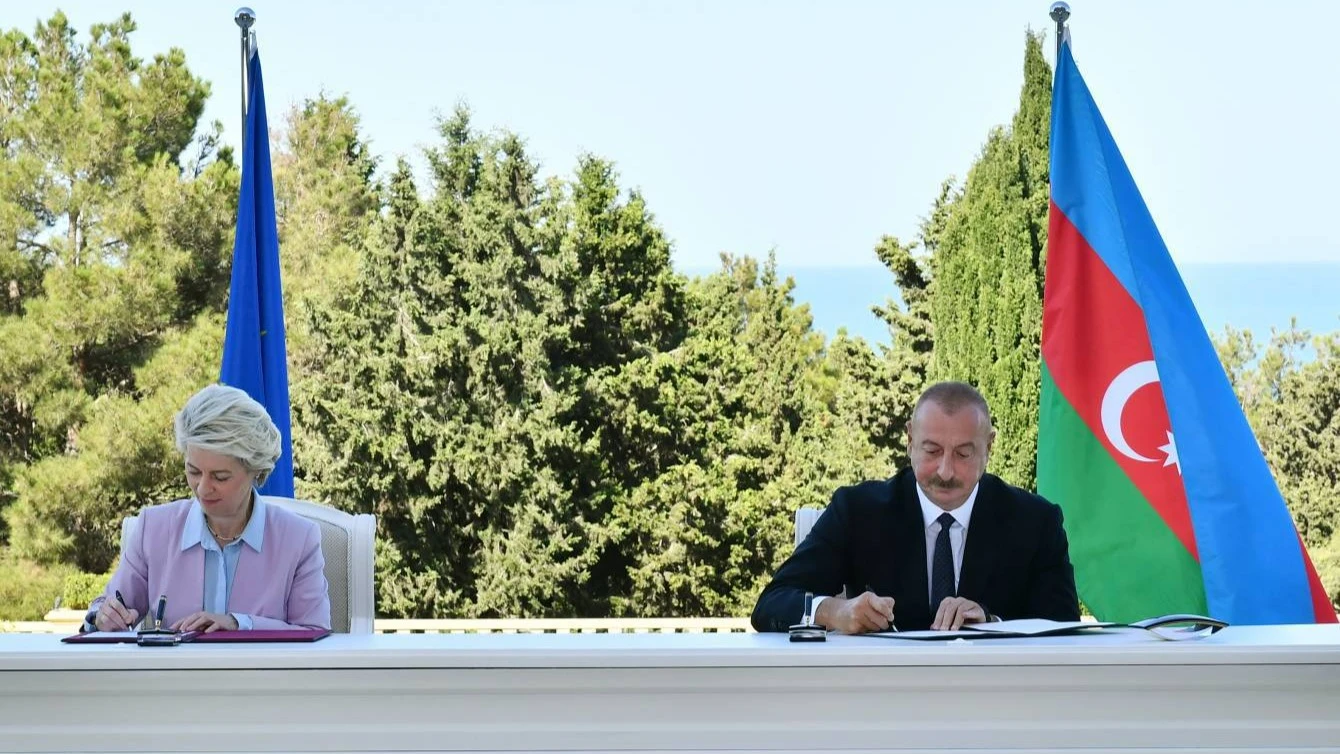
On July 18, 2022, a memorandum of strategic partnership in the field of energy was signed between Azerbaijan and the EU. The statement by European Commission President Ursula von der Leyen regarding the memorandum contained no expressions related to human rights, democracy, or the rule of law (European Commission, 2022a). A subsequent statement by the European Commission reported that discussions were underway on a new agreement aiming to increase cooperation with Azerbaijan across a broad spectrum such as economic diversification, investment, trade, and utilizing the potential of civil society, and that this agreement emphasized the importance of human rights and the rule of law (European Commission, 2022b). There is still no news of this agreement. During her visit to Azerbaijan in April 2025, Kaja Kallas, the European Union's High Representative for Foreign Affairs and Security Policy, stated that they had agreed with Ilham Aliyev to restart discussions on a new partnership and cooperation agreement (EEAS, 2025a). However, there is no information on whether discussions have actually started.
Following the agreement signed in 2022, Azerbaijan became the European Union's fourth-largest supplier providing gas via pipelines, and cooperation in this direction expands every month (KharCenter, 2025a). The negative impact of this cooperation on democracy in Azerbaijan has also been reflected in European Parliament resolutions—demanding an end to dependence on gas exports from Azerbaijan, the cancellation of the strategic partnership memorandum signed in 2022, and that any future document to be signed be indexed to issues of political prisoners, legal reform, and human rights (European Parliament, 2024, 2025).
But instead, Brussels rewarded official Baku by deciding that the 2028 European Political Community summit would be held in Azerbaijan (KharCenter, 2025). The harsh warnings previously expressed were replaced by symbolic statements of "concern," declarations about the determination to continue dialogue with Azerbaijan (EEAS, 2025b), and EU officials thanking Ilham Aliyev for energy (President.az, 2022).
Normative Disconnect in US Foreign Policy and the New Context of Washington–Baku Relations
The month of February was remembered by two episodes in terms of US-Azerbaijan relations. The first of these was the visit of US Vice President J.D. Vance to Azerbaijan—this was the first visit at this level from Washington to Baku since former Vice President Dick Cheney's arrival in 2008. The other episode was recorded a few days after Vance's visit—bodyguards of Azerbaijani President Ilham Aliyev, who was attending the opening of US President Donald Trump's Peace Council meeting, beat Azerbaijani political emigrants demanding freedom for political prisoners (The Guardian, February 2026).
These two episodes, seemingly unrelated at first glance, actually shared a common point: Washington-Baku rapprochement no longer raises expectations of softening or reform in Azerbaijan; on the contrary, it turns into a resource for more international legitimacy, more maneuverability, and in parallel, more hegemony and domestic hardening for Ilham Aliyev.
The harshest form of the transition from a system of values to a system of interests, which became more evident after 2022, began with Donald Trump coming to power again in the US. Analysts evaluate the National Security Strategy (NSS) of Trump's second administration (White House, 2025) in exactly this way—"ruthless and short".... (Carnegie Foundation, 2026).
According to the assessment of Carnegie Foundation analysts, the emphasis on democracy and human rights in the national security strategy has always been problematic due to recurring compromises between the US's value commitments and geopolitical-economic interests. However, Trump's strategy completely tears down this balance and reflects a more fundamental disconnect. According to analysts, all references to universal human rights have disappeared with this strategy. Instead, the Trump administration points to a search for religious rights, disconnected from international human rights treaties, by appropriating the "God-given natural rights of American citizens": "In this reframing, the main enemies of freedom, democracy, and rights are not autocratic and corrupted regimes, but international alliances like the EU that take measures to regulate information ecosystems, protect minority rights, and limit the power of governance, and even traditional US allies in Europe" (Carnegie Foundation, 2026).
Steven Feldstein, an analyst at the foundation, states that Trump's 2025 National Security Strategy is direct proof of a radical change in the previous approach to democracy, including the 2017 document from the president's prior term in office, and is "America's first post-democracy" document. Democracy is touched upon in only three contexts in the document, and all of these differ radically from the traditional description of the term; combating elements that are the main threats to democracy in both domestic and foreign policy is evaluated as "violating the fundamental principles of democracy" (Carnegie Foundation, 2026).
Trump's decision to remove all references to democracy and values from the new document is explained by the intention to fundamentally change the post-1945 international liberal order and is evaluated as a serious challenge to EU leaders. In this context, it is particularly underlined that the US administration has started to view radical right parties in Europe as its main allies, and has built more vibrant relations with the governments of Hungary, Slovakia, and the Czech Republic, which are the staunchest opponents of support for Ukraine. It is emphasized that the increase in the "courage" of these countries to oppose EU decisions also stems precisely from the stance against democracy declared in the US National Security Strategy (Carnegie Foundation, 2026).
Human rights organizations also point out that the regressive trend in democratic values started before Trump, but with Trump's arrival, the global human rights system is in danger. According to Human Rights Watch's latest World Report, within 12 months, the Trump administration launched a large-scale attack on US democracy and the foundations of the global rules-based order, which the US had helped build alongside other states, despite its general contradictions (HRW, 2026a).
In Trump's strategy, issues such as energy dominance, economic security, and the defense industry base are presented as the foundation of national security (Atlantic Council, 2026). The US president wants to establish global hegemony in the field of energy, and these goals are not limited only to control over hydrocarbon resources (Chatham House, 2026). Many processes around the world—from the Venezuela "operation" to threats against Canada, from demands on India and Turkey to reduce dependence on Russian natural gas to tensions with Iran—are evaluated precisely within the framework of Trump's desire for energy hegemony.
Trump's Interest Acting as a Shield for the Aliyev Regime
Washington's growing interest in Azerbaijan (and Armenia) must also be evaluated within the framework of the White House's post-democracy strategy—energy dominance, transit corridors, new investment deals—and Trump-style security discourse. During his visit to the region in February, US Vice President J.D. Vance signed a cooperation agreement with Armenia in the fields of nuclear energy and the military, and a strategic cooperation charter with Azerbaijan envisioning the creation of working groups to implement joint projects. This visit demonstrated Washington's aim to increase its presence in the region, particularly in the transport and energy sectors, and simultaneously the US's desire to be the "patron" of the peace process between Azerbaijan and Armenia (OSW, 2026).
Vance's visit was a continuation of the meeting in August of last year in Washington where Trump came together with Azerbaijani President Ilham Aliyev and Armenian Prime Minister Nikol Pashinyan, presenting himself as the main foreign actor of the new order in the region. Since that date, Trump has repeatedly emphasized that the Armenia-Azerbaijan conflict is one of the problems being resolved through his mediation. This narrative is also reflected in the US National Security Strategy published in December. Although a peace agreement between Azerbaijan and Armenia has not yet been signed, the line of communication started under the auspices of the US is moving from political declaration to the practical application phase. Vance's visit also aimed to reconfirm the central role of the US (Tatikyan, 2026).
On the other hand, Vance's visit was carried out as a continuation of the TRIPP (Trump Route for International Peace and Prosperity) project presented at the August 2025 meeting and within the framework of expanding the Middle Corridor trade and logistics network, which is the next target of the Trump administration. Moreover, this time the agenda also included topics like nuclear energy, arms sales, and artificial intelligence (OSW, 2026).
The TRIPP project, which completely overshadows the relevance and political weight of the November 10, 2020 statement signed between Azerbaijan and Armenia with Russia's participation (which formed the new basis of Moscow's regional cooperation and security architecture), is the most obvious demonstration of Washington's claim to have a say over the region (Khar Center, 2025b). Some analysts evaluate this not only as part of a larger trend where the US, but the West and Turkey in general, are limiting Moscow's show of force. According to this framework, directing all its power to the Ukraine war has caused the collapse of the Kremlin's allies in Syria and Venezuela, and Washington is demonstrating that it will now press the Kremlin's vulnerable spots in other regions it considers its outposts. The fact that the Russian Foreign Ministry spokesperson reacted to the civil nuclear energy agreement signed by the US with Armenia—where Russia has a nuclear power plant (Metsamor NPP)—by saying "such things are not a joking matter" is an indicator of this (Azatutyun, 2026). Turkey, meanwhile, is trying to strengthen its positions in the South Caucasus by utilizing Moscow's dependence on bypassing sanctions, oil and gas trade, and imports of key technologies (CEPA, 2026).
Azerbaijan seems satisfied with this situation. First of all, the Aliyev-Putin meeting that took place in Dushanbe last September did not bring the expected warming to Azerbaijan-Russia relations, which had been cold for over a year. At that meeting, after Putin accepted responsibility for the downing of an Azerbaijani plane and signaled interest in normalizing relations, there was an appearance that relations were getting back on track. However, in December of last year, although Putin's spokesperson Dmitry Peskov said the Russian president would meet with Ilham Aliyev and Nikol Pashinyan on the sidelines of the informal summit of CIS leaders in St. Petersburg, it was announced that the Azerbaijani president would not attend this event. Aliyev's tight work schedule was cited as the reason (AA, 2025). The real reason (or one of the reasons) emerged a few days later. Azerbaijani Foreign Minister Jeyhun Bayramov said that Russia had informed Baku about concluding the investigation into the downing of the AZAL plane and that this information raised very serious questions in Baku (Report, 2025). When information about the results of the investigation leaked to the media in January, the picture became clearer—the Russian side had cleared itself by blaming the crash on bad weather conditions, the pilot's unsuccessful landing attempts, and the plane crashing into the ground while approaching Aktau (CEPA, 2026).
Secondly, rapprochement with the US promises Ilham Aliyev two things he wants. First, the strategic partnership charter signed with Azerbaijan and Trump's overall interest in the region mean opportunities for new economic deals. The words Aliyev said at a meeting with representatives of the US Chamber of Commerce the day before Vance's visit, "we are entering a very promising and highly active new era" (President.az, February 2026), are an expression of this expectation.
Biden Line in Armenia, Trump Line in Azerbaijan?
The second nuance Aliyev wants is that this charter is completely free of classical value calls such as democracy, human rights, and the rule of law. This is also visibly demonstrated by the differences between the contents of the strategic partnership charters the US signed with Azerbaijan and Armenia—specifically, the language of the documents. While the emphasis on values is at the forefront with Armenia, the "strategic partnership" with Azerbaijan is envisioned at the level of sector cooperation.
The strategic partnership charter with Armenia was signed before Trump took the oath for his second term—at the beginning of 2025, in the last week of former US Secretary of State Antony Blinken's term in office (Armenia, MFA, 2025). The document encompasses main headings such as economic cooperation, security and defense, strengthening democracy, law, and inclusivity, and increasing people-to-people ties. The common values and shared interests defining the framework of cooperation between the two countries are listed in the document as follows: the development of democracy and economic freedom, fighting corruption, strengthening the rule of law and respect for human rights and fundamental freedoms, increasing judicial independence, strengthening civil society, promoting the strengthening of political parties and think tanks, freedom of expression for the media, increasing transparency, defense of sovereignty and territorial integrity, supporting innovations and technological advancements, as well as strengthening energy security... Even when presenting this document, the US Embassy in Yerevan included the emphasis: "Our partnership is based on the democratic values we share" (US Embassy in Armenia, 2025). Although this strategic partnership document reflects the foreign policy trend of the Biden administration, the Trump administration has not changed it.
A large part of the charter signed with Azerbaijan in February, however, is devoted to maximizing the economic potential of the TRIPP project, which also involves the personal PR of the US president (Eurasianet, 2026). The charter covers three main items: regional connectivity including energy, trade, and transit (TRIPP); economic projects including artificial intelligence and digital infrastructure; and security (US Embassy in Azerbaijan, 2026). Unlike the strategic partnership framework with Armenia, the Azerbaijan-US charter does not involve reform and structural change, is not based on political values, and is focused on sector cooperation rather than systemic reforms (Tatikyan, 2026).
If it were previous years, the absence of any mention of normative values like democracy, human rights, and the rule of law in the Azerbaijan-US charter, as well as the complete lack of reference to these values during the US Vice President's visit, would undoubtedly raise questions. However, the policy of ignoring values and turning vague "American interests" into a priority, clearly demonstrated by the US administration through its national security strategy document, as well as its rhetoric and behavior over the past year, leaves no room for these questions or for surprise. On the other hand, the continuation of the strategy with Armenia, which was a core value of the Biden era, raises additional questions.
Azerbaijan, of course, has never been a "value partner" of the US, but "additional problems" like the "normative value agenda" have acted as a barrier to its relations with Washington and as one of the excuses for its closeness with Russia. Now this "problem" has been eliminated—Trump's new strategy has created a godsend opportunity for official Baku. In all cases, the priority for Ilham Aliyev is to stay in power; ensuring the continuity of this goal under the wings of a superpower like the US, and moreover without any normative value demands, now looks more attractive to him than an uncertain future with a weakened Russia in the region and the world. For the Azerbaijani government, the US-Russia choice is no longer a matter of determining a position between two contradictory values—democracy and authoritarianism—but a matter of getting closer to the "stronger" of the two powers with similar strategies. On the other hand, by dragging his feet on signing the peace agreement, Aliyev is trying to keep the doors open for future bargaining with both the US and Russia.
Values to Yerevan, Deals to Baku – Rapprochement with the West is No Longer a Democratic Choice
One of the most important factors facilitating the work of the Azerbaijani government is the overt shift towards emphasizing realism and interests not only by the US, but also by the European Union. The gap between the European Parliament's concerns regarding the strengthening of energy ties with Azerbaijan, alongside its warnings about the dangers this creates, and the European Commission's realism is steadily deepening. European Commission President Ursula von der Leyen's statement that "Europe can no longer be the defender of the old order, there is a need for a more realistic and interest-centric foreign policy. The Union will always defend and support the rules-based system, but it can no longer rely on this system to defend Europe's interests and protect the continent from threats" (The Guardian, March 9, 2026) indicates that Brussels no longer feels the need to mask its interest-centric policy.
The statements made by European Council President António Costa after his meeting with Ilham Aliyev in Baku are also a manifestation of this line: "At a time of rising global tension and instability, strengthening ties between Azerbaijan and the European Union is more important than ever... The European Union is committed to working with Azerbaijan to turn today's challenges into tomorrow's opportunities. Your leadership is essential, and our partnership is strong. We can further expand it together for the well-being of our peoples" (APA, March 11, 2026). An example of this "expanded" partnership emerged the day before Costa's visit to Baku—it became known that the Kulevi Oil Terminal in Georgia, owned by Azerbaijan's state oil company SOCAR, narrowly avoided being included in the 20th EU sanctions package prepared against Russia, despite being among the ports used by Russia's shadow fleet (Abzas, March 10, 2026). Although it was stated that the terminal evaded sanctions because the Georgian authorities, the port operator, and SOCAR committed to complying with EU sanctions, the likelihood of this gesture being a "partner's gift" to Ilham Aliyev seems more convincing against the backdrop of the unfolding events.
Another symbolic example of the Aliyev-EU partnership is that on the very day Costa showered the Azerbaijani regime with praise in Baku, Azer Qasimli, the imprisoned director of the Institute of Political Management, was sentenced to 12 years in prison (Toplum TV, March 11, 2026).
This position of the West gives Ilham Aliyev a guarantee to continue the new wave of repression he started domestically since 2022 on a rising trajectory, or rather, it frees him from the interrogations that would "cause him headaches" while continuing this line. This "guarantee" is undoubtedly stronger than the "gain" of a traditional authoritarian alliance with Russia—because the continuation of repressions and the regime of total suppression is now legitimized within the support package of the US, the "traditional protector of democracy and human rights," for the Azerbaijani government, and the EU's "energy marriage" package with Azerbaijan.
The indicator of the deepening of authoritarianism in Azerbaijan after 2022 is not only new arrests; this period is characterized as a time when repressions against the media, civil society, and political opposition were carried out with a broader, consistent, and planned mechanism. In late 2022, a coordinated and total wave of repressions began against NGOs, civil society representatives, public activists, journalists, and independent media outlets. Journalists and media organizations investigating state capture and corruption, NGOs operating in the fields of human rights, media, and law, and especially activists active on the internet became the targets of this wave. Many methods of repression were used, such as arrests, raids, freezing of bank accounts, sealing of offices, travel bans, and smuggling charges. Unlike previous periods, this pressure also severely impacted internet activism (Baku Research Institute, 2025).
Reports by international human rights organizations show that the situation in Azerbaijan has further worsened, with the government increasing its pressure on the independent press, political opponents, and NGOs, silencing the opposition, and strengthening the atmosphere of fear. In its latest report, the Justice for Journalists organization stated that 2025 was the year in which independent media and freedom of expression were completely destroyed in Azerbaijan. In 2025, 211 attacks against journalists were recorded in Azerbaijan. The main source of pressure is state institutions. Physical attacks aimed at the life, freedom, and health of journalists increased by 67 percent and were mostly directed against journalists who were already imprisoned. At least 39 media workers are still in prison. The total number of political prisoners has reached 340 (JFJ, February 2026).
The government targets not only those inside the country but also bloggers, journalists, and activists in exile. Especially over the past year, the Azerbaijani government has issued convictions against journalists, bloggers, and other critics living abroad and initiated extradition channels to create international pressure on them (HRW, 2026b), increasing instances of threats, kidnappings, and orchestrating assassination attempts (RSF, 2025). At least 14 exiled journalists were sentenced in absentia to terms ranging from 6 to 16 years in prison (JFJ, February 2026). Facts such as the incident involving Azerbaijani President Ilham Aliyev's bodyguards with protesters in Washington, Vice President Mehriban Aliyeva insulting an Azerbaijani emigrant in Germany who asked her a question about the state of democracy in the country by saying "he dresses in women's clothes and runs away," and the government increasing pressures on political emigrants in Europe can be evaluated as the fruits of the US-Azerbaijan strategic partnership package and EU-Azerbaijan energy cooperation in this regard.
CONCLUSION
Overall, the post-2022 trend, and specifically the February episodes, show that the weight of countries with authoritarian regimes is increasing precisely in the new political and security architecture of the world. The world is moving rapidly from democratization toward a large club of authoritarians, and this atmosphere creates comfort especially for countries that use energy resources to deepen authoritarianism. Azerbaijan is among these countries.
The fact that the strategic partnership charter signed between Azerbaijan and the US in February is devoid of normative demands such as democracy, human rights, and the rule of law can be explained by the Trump administration's new worldview—the US National Security Strategy. And the attack by Aliyev's bodyguards on Azerbaijani emigrants in Washington is a symbolic picture of this.
However, the problem is that these values are no longer visible not only in the behavior of the US, but also of the European Union, which claims to be the world's normative center of power, towards Azerbaijan. It is of course impossible to say what happens in closed-door negotiations or what demands are brought to the agenda, but the obvious result—the ever-expanding boundaries of Azerbaijani authoritarianism—shows a visible regression even in the selective application of the West's traditional norms. While executing a strategy to reduce energy dependence on Russia, which has one of the world's most authoritarian regimes, the energy ties that turn small actors no less authoritarian than Azerbaijan into regional players have once again confronted the EU with a very serious clash of values and interests. Unfortunately, the winner of this clash is interests and the Ilham Aliyev regime.
Rapprochement with the West has ceased to be a factor restricting the government's authoritarian behavior on issues such as human rights, pressure on the media, and the crushing of civil society. On the contrary, the "fruits" of this rapprochement—energy, security, investment, and transit projects—create opportunities for Aliyev to have more international legitimacy, more bargaining power, and tighter control domestically.
The complete removal of normative values from the US agenda and the EU's limiting of them to the level of parliamentary criticism and "forgetting" them in practice have created a situation where, for Azerbaijan, the West–Russia choice no longer looks like a democracy–authoritarianism choice; instead, it has turned into a question of "who is stronger," "who brings more profit," and "who can help more in prolonging authoritarian rule." This not only deepens the darkness for the opposition, civil society, and the media within the country but also promises harder days for the struggle in exile.
References:
Avropa Komissiyası, 2009. European Neighbourhood Policy – AZERBAIJAN https://ec.europa.eu/commission/presscorner/detail/en/memo_09_183
Manners, Ian, 2002. Normative Power Europe: A Contradiction in Terms? JCMS: Journal of Common Market Studies, 40, 235-258.
EEAS, 2016.Critically assess and analyse the notion that the EU is a Normative Power. https://www.eeas.europa.eu/node/15687_en
Diez, Thomas, 2005. Constructing the Self and Changing Others: Reconsidering `Normative Power Europe'. Millennium - Journal of International Studies, 33, 613-636.
Cardenas, Sonia. 2004. Norm Collision: Explaining the Effects of International Human Rights Pressure on State Behavior. International Studies Review, 6, 213-232.
Hyde-Price, Adrian, 2006. ‘Normative’ power Europe: a realist critique https://www.tandfonline.com/doi/pdf/10.1080/13501760500451634
Stanford Encyclopedia of Philosophy, 2023. Political Realism in International Relations. https://plato.stanford.edu/entries/realism-intl-relations
ESI, 2012. Caviar Diplomacy.
https://www.esiweb.org/sites/default/files/reports/pdf/ESI%20-%20Caviar%20Diplomacy%20-%20May%202012.pdf
Tartes, Alexandra, 2015. The EU and Azerbaijan: Prospects for a Partnership Beyond Energy?
https://www.coleurope.eu/sites/default/files/research-paper/edp-9-2015_tartes_0_0.pdf
Gulliot, Elise, 2016. QUESTIONING THE EU'S NORMATIVE POWER IN AZERBAIJAN https://repository.gchumanrights.org/server/api/core/bitstreams/8a598cb9-e75f-42d0-9e3d-6b393e4656d4/content
U.S. Department of State, 2004. (PDF-s.368).
https://2009-2017.state.gov/documents/organization/42251.pdf
CRS(Congressional Research Service ), 2003. Azerbaijan’s 2003 Presidential Election and Succession: Implications for U.S. Interests.
https://www.everycrsreport.com/files/20031105_RS21661_570c3c421017c3fde4f458768ca76cb9c9478806.pdf
Khar Center,2025a. Kiçik tədarükçüdən geosiyasi aktora: Azərbaycanın enerji kartı avtoritar idarəetmənin qalxanı kimi.
https://kharcenter.com/nesrler/kicik-tedarukcuden-geosiyasi-aktora-azerbaycanin-enerji-karti-avtoritar-idareetmenin-qalxani-kimi
Avropa Komissiyası, 2022a.Statement by President von der Leyen with Azerbaijani President Aliyev. https://ec.europa.eu/commission/presscorner/detail/en/statement_22_4583
Avropa Komissiyası, 2022b. EU and Azerbaijan Enhance Bilateral Relations Including Energy Cooperation.
https://enlargement.ec.europa.eu/news/eu-and-azerbaijan-enhance-bilateral-relations-including-energy-cooperation-2022-07-18_en
EEAS(European External Action Service ), 2025a. Azerbaijan: Remarks by High Representative/Vice-President Kaja Kallas at the joint press conference with Minister for Foreign Affairs Bayramov https://www.eeas.europa.eu/eeas/azerbaijan-remarks-high-representativevice-president-kaja-kallas-joint-press-conference-minister_en
Avropa Parlamenti, 2024. Siuation in Azerbaijan, violation of human rights and international law and relations with Armenia. Resolution TA-10-2024-0029. https://www.europarl.europa.eu/doceo/document/TA-10-2024-0029_EN.html
Avropa Parlamenti, 2025. Human Rights Violations in Azerbaijan, Nigeria and Guinea-Bissau.
https://www.europarl.europa.eu/news/en/press-room/20251211IPR32170/human-rights-violations-in-azerbaijan-nigeria-and-guinea-bissau
EEAS(European External Action Service ), 2025b, Statement on Sentencing Journalists and Political Activists.
https://www.eeas.europa.eu/eeas/azerbaijan-statement-spokesperson-sentencing-journalists-and-political-activists_en
President.az, 2022.Press statements by Ilham Aliyev and President of the European Commission Ursula von der Leyen. https://president.az/en/articles/view/56810
The Guardian, 2026.Bodyguards for Azerbaijani president, in town for Trump’s Board of Peace, attack protesters in DC https://www.theguardian.com/us-news/2026/feb/20/azerbaijan-trump-board-peace-protestors
The White House, 2025. 2025 National Security Strategy.
https://www.whitehouse.gov/wp-content/uploads/2025/12/2025-National-Security-Strategy.pdf
Carnegie Endowment for International Peace, 2026. Trump National Security Strategy.
https://carnegieendowment.org/emissary/2026/01/trump-national-security-strategy
Human Rights Watch, 2026a. World Report 2026.
https://www.hrw.org/world-report/2026
Atlantic Council, 2026. Trump’s National Security Strategy Doesn’t Downgrade the Middle East—It Redefines It.
https://www.atlanticcouncil.org/blogs/menasource/trumps-national-security-strategy-doesnt-downgrade-the-middle-east-it-redefines-it/
Chatam House, 2026. Trump wants US energy dominance. Global markets may not agree. https://www.chathamhouse.org/2026/02/trump-wants-us-energy-dominance-global-markets-may-not-agree
OSW (Centre for Eastern Studies), 2026. A Greater US Presence in the Caucasus: Vice President Vance in Armenia and Azerbaijan.
https://www.osw.waw.pl/en/publikacje/analyses/2026-02-12/a-greater-us-presence-caucasus-vice-president-vance-armenia-and
Tatikyan, Sossi, 2026. Strategic Partnerships in Motion: J.D. Vance in Armenia and Azerbaijan.
https://evnreport.com/politics/strategic-partnerships-in-motion-j-d-vance-in-armenia-and-azerbaijan/
The Guardian, 9 mart 2026. Von der Leyen calls for EU foreign policy to be ‘more realistic and interest-driven https://www.theguardian.com/world/2026/mar/09/ursula-von-der-leyen-eu-foreign-policy-more-realistic-interest-driven
APA, 11 mart 2026. Prezident İlham Əliyev və Antonio Koşta mətbuata bəyanatla çıxış ediblər. https://apa.az/resmi-xeber/prezident-ilham-eliyev-ve-antonio-kosta-metbuata-beyanatla-cixis-edibler-yenilenib-946731
Abzas, 10 mart 2026. SOCAR-ın Gürcüstandakı Kulevi terminalı son anda Aİ-nin Rusiyaya qarşı sanksiyalar siyahısına salınmayıb. https://abzas.org/az/2026/3/socar-n-gurcustandak-kulevi357d3c2f-f/
Khar Center,2025b. Tripp yolu: maneəsiz keçiddən suveren nəzarətə.
https://kharcenter.com/ekspert-serhleri/tripp-yolu-maneesiz-kecidden-suveren-nezarete
Azatutyun, 2026. Հայաստանի կողմից ԱՄՆ միջուկային տեխնոլոգիաների ընտրությունը հարցեր է առաջացնում ՌԴ-ում. Զախարովա. https://www.azatutyun.am/a/33675960.html
CEPA (Center for European Policy Analysis), 2026.Russia-Azerbaijan Relations Back on the Rocks?
https://cepa.org/article/russia-azerbaijan-relations-back-on-the-rocks/
Anadolu Agency, 2025. Azerbaijan’s President Unable to Attend Informal CIS Summit in Russia.
https://www.aa.com.tr/en/world/azerbaijan-s-president-unable-to-attend-informal-cis-summit-in-russia/3777522
Report.az, 2025.Ceyhun Bayramov: AZAL təyyarəsi ilə bağlı cinayət işinə xitam verilməsi bizdə çox ciddi suallar doğurur.https://report.az/xarici-siyaset/nazir-azal-teyyaresi-ile-bagli-cinayet-isine-xitam-verilmesi-bizde-cox-ciddi-suallar-dogurur
President.az, fevral 2026. Ilham Aliyev received delegation of the U.S. Chamber of Commerce. https://president.az/en/articles/view/71523
Ermənistan XİN, 2025. Press Release (14 January 2025).
https://www.mfa.am/en/press-releases/2025/01/14/the/13032
ABŞ-ın Ermənistandakı səfirliyi, 2025.Charter on Strategic Partnership between the United States of America and the Republic of Armenia.
https://am.usembassy.gov/charter-on-strategic-partnership-between-the-united-states-of-america-and-the-republic-of-armenia/
Eurasianet, 2026. US-Azerbaijan Sign Charter on Strategic Partnership.
https://eurasianet.org/us-azerbaijan-sign-charter-on-strategic-partnership
ABŞ-ın Azərbaycandakı səfirliyi, 2026. Charter on Strategic Partnership between the Government of the United States of America and the Government of the Republic of Azerbaijan. https://az.usembassy.gov/us-azerbaijan-charter/
Toplum TV, 12 mart 2026. Azər Qasımlı 12 il azadlıqdan məhrum edilib. https://toplummedia.tv/mehkeme/pazer-qasimli-12-il-azadliqdan-mehrum-edilibnbspp
Baku Research Institute,2025. From Reactive Oppression to Codified Authoritarianism.
https://bakuresearchinstitute.org/en/from-reactive-oppression-to-codified-authoritarianism/
Human Rights Watch, 2026 b. Azerbaijan – Country Chapter.
https://www.hrw.org/world-report/2026/country-chapters/azerbaijan
Justice for Journalists, fevral 2026. Attacks on Media Workers in Azerbaijan in 2025.https://jfj.fund/attacks-on-media-workers-in-azerbaijan-in-2025/
RSF, 2025. Attempted Assassination of Blogger Mahammad Mirzali.
https://rsf.org/en/attempted-assassination-blogger-mahammad-mirzali-french-courts-recognise-azerbaijan-s-involvement
