(This paper was prepared within the framework of Khar Center’s research on Azerbaijani authoritarianism)
Introduction
The political regime in Azerbaijan is assessed in international indices as a fully consolidated authoritarianism. In Freedom House’s 2026 report, the country scored only 6 out of 100 points, and its score for political rights is 0. According to the report, power is concentrated in the hands of Ilham Aliyev, who has been president since 2003, and his extended family (Freedom House 2026).
In the research paper “The Stability and Legitimacy Mechanism of Azerbaijani Authoritarianism” previously published by Khar Center, Azerbaijani authoritarianism was also classified as a tandem of fear and security, and it was noted that a unique “authoritarian hybrid model” has emerged in the case of Azerbaijan (Elman Fattah, 2025).
One of the distinctive features of Azerbaijani authoritarianism is the attempt to dress repression in legal garb. In other words, in Azerbaijan the law does not constrain power; on the contrary, it becomes its instrument. Put differently, “the rule of law” gives way to “rule by law.” According to an analysis published by the Baku Research Institute, the state has moved from reactive and inconsistent persecution to systematic, legally grounded political repression (Nijat Mammadbayli, 2025). Opposition parties, the independent media and the NGO sector have each been disabled in stages.
The aim of this analysis is to examine NGO legislation precisely in this context, as one of the mechanisms through which the regime reproduces itself.
On 16 November 2026, reports emerged that new amendments to the NGO law had been placed on the agenda of the plenary session of the Milli Majlis. Before that, through the July–August 2025 amendments, the provision of services and performance of work by NGOs in Azerbaijan with foreign funding had also been made subject to prior state registration (HRW, World Report 2026). With this, the permit regime established for grants in 2014 comes to cover all forms of an NGO’s financial turnover.
The main thesis of this article, prepared by Khar Center’s analytical team, is as follows: the norms adopted over the last 15 years are officially justified by “transparency,” “accountability” and “combating money laundering.” With the latest amendments to the law, however, authority over all stages, from an NGO’s creation to its liquidation, passes to the executive branch.
The difference between regulation and control lies not in the purpose of a norm but in the mechanism of its application. When a rule is clear, proportionate and open to judicial review, it is regulation. When a decision is left to the unfounded, unexplained and unchallengeable discretion of an administrative body, it is control.
Let us note at the outset that registration of foreign funding is not an issue unique to Azerbaijan. Transparency requirements also exist in many democratic states. Therefore, our argument rests not merely on the “registration requirement” but on the joint presence of three main features:
1. Activity being conditional solely on legal permission, with unregistered activity prohibited;
2. Vagueness of the grounds for refusal and broad discretion of the executive body;
3. Even where a violation exists, its transfer from the administrative sphere to criminal prosecution.
The article shows how these three features were completed in 2023–2026, and also devotes space to analysing the changes in the periods preceding the broad wave of repression that gained momentum in 2023–2024.
The Layer-by-Layer Construction of the Prohibition Regime
The current mechanism did not appear all at once. What has happened is the logical continuation of the grant-control architecture of 2013–2014. At each stage, the alternative funding channel used by NGOs was closed by the next amendment. First grants, then service contracts.
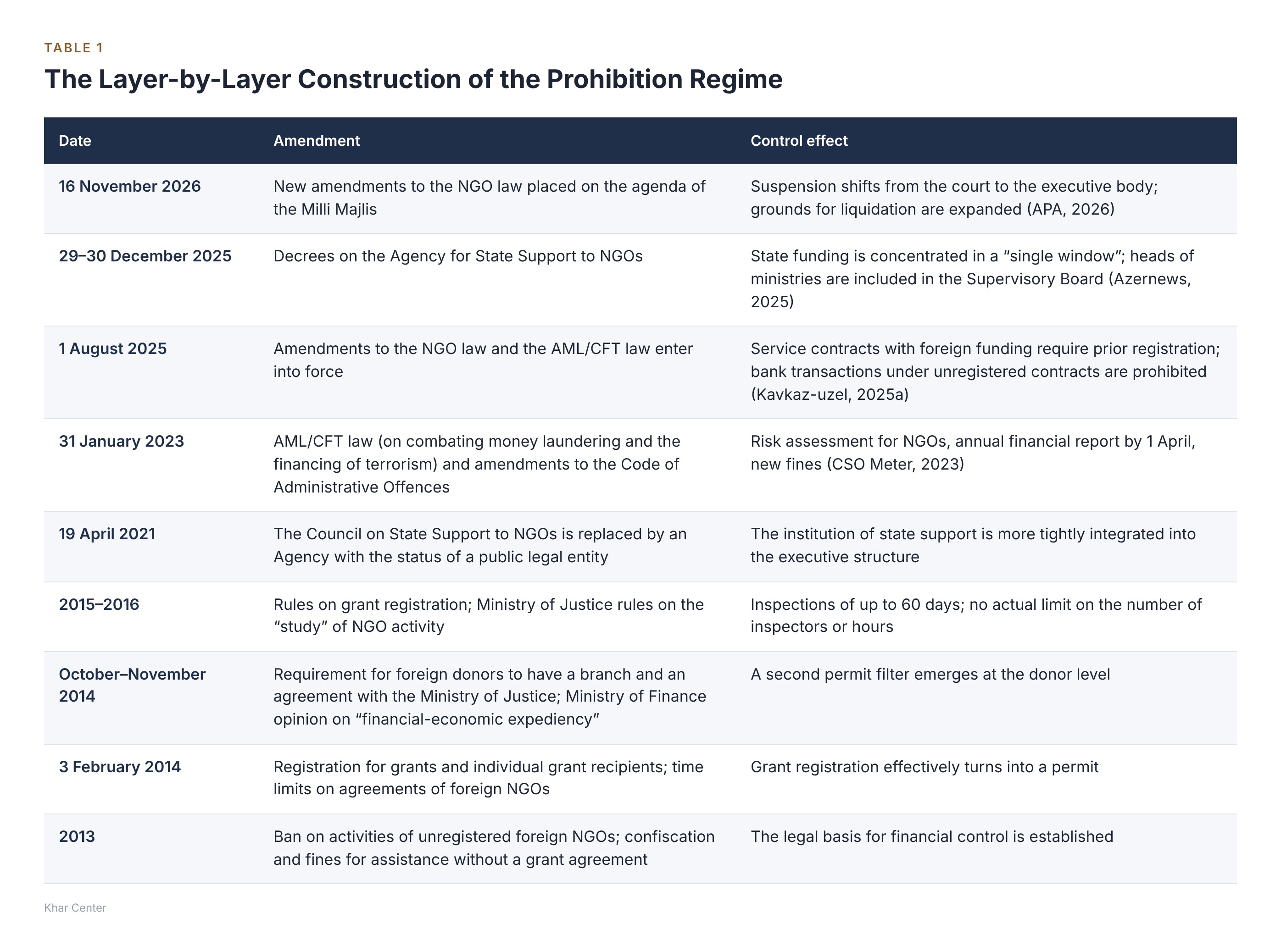
This sequence is the central evidence for the thesis. After the 2014 amendments, many organisations continued their activities until 2023 by receiving foreign funds not as grants but in the form of service contracts. The 2025 amendment closed precisely this channel by law. The aim of this law was, in effect, to close the last legal funding route for pro-democracy groups that had already been de facto silenced (OC Media, 2026).
The Shift from Normative Control to Criminal Prosecution
The tightening of legislation in earlier periods was carried over to the plane of mass criminal cases from 2023 onwards. Even so, the charges were brought without reference to the NGO law (it was still not possible to qualify the activities of independent NGOs as a crime under the NGO law), directly under Articles 206 (smuggling) and 192 (illegal entrepreneurship) of the Criminal Code.
The series began in November 2023 with “Abzas Media.” After that, on 6 March 2024, the Ministry of Internal Affairs raided the offices of “Toplum TV” and the Institute for Democratic Initiatives (IDI). Staff members were first charged under Article 206.3.2, after which the charges were further expanded. The charges were cast in the form of “Toplum TV,” IDI, “Fakt Yoxla” and the Third Republic Platform operating as an “organised criminal group” with donor funds. On 27 July 2026, the Baku Grave Crimes Court sentenced nine people in the “Toplum TV” case to between 12 and 15 years of imprisonment. Human Rights Watch called this the harshest sentence since the start of the campaign against independent journalism (HRW, 2026).
The “Meydan TV” case began in December 2024 with the arrest of six journalists on charges of currency smuggling. By August 2025, the number of those arrested had reached 11, and later rose to 12. In parallel, the NGO sector was also targeted. Over 2023–2026, the number of those arrested grew steadily. These prosecutions are directly linked to the logic in the table. The targeted organisations operated mainly through “service contracts.” The subject of the court proceedings was likewise the conclusion of “illegal contracts” and the receipt of funds not as grants but as personal income. Thus, the channel closed administratively by the 2025 amendment was in effect turned into retroactive criminal prosecution (IRFS, 2025). This directly contradicts Article 7 of the European Convention on Human Rights. Under that article, no one may be held liable for an act that did not constitute a criminal offence under national or international law at the time it was committed. In addition, Article 7 also prohibits the extensive interpretation of criminal law norms to the detriment of the individual.
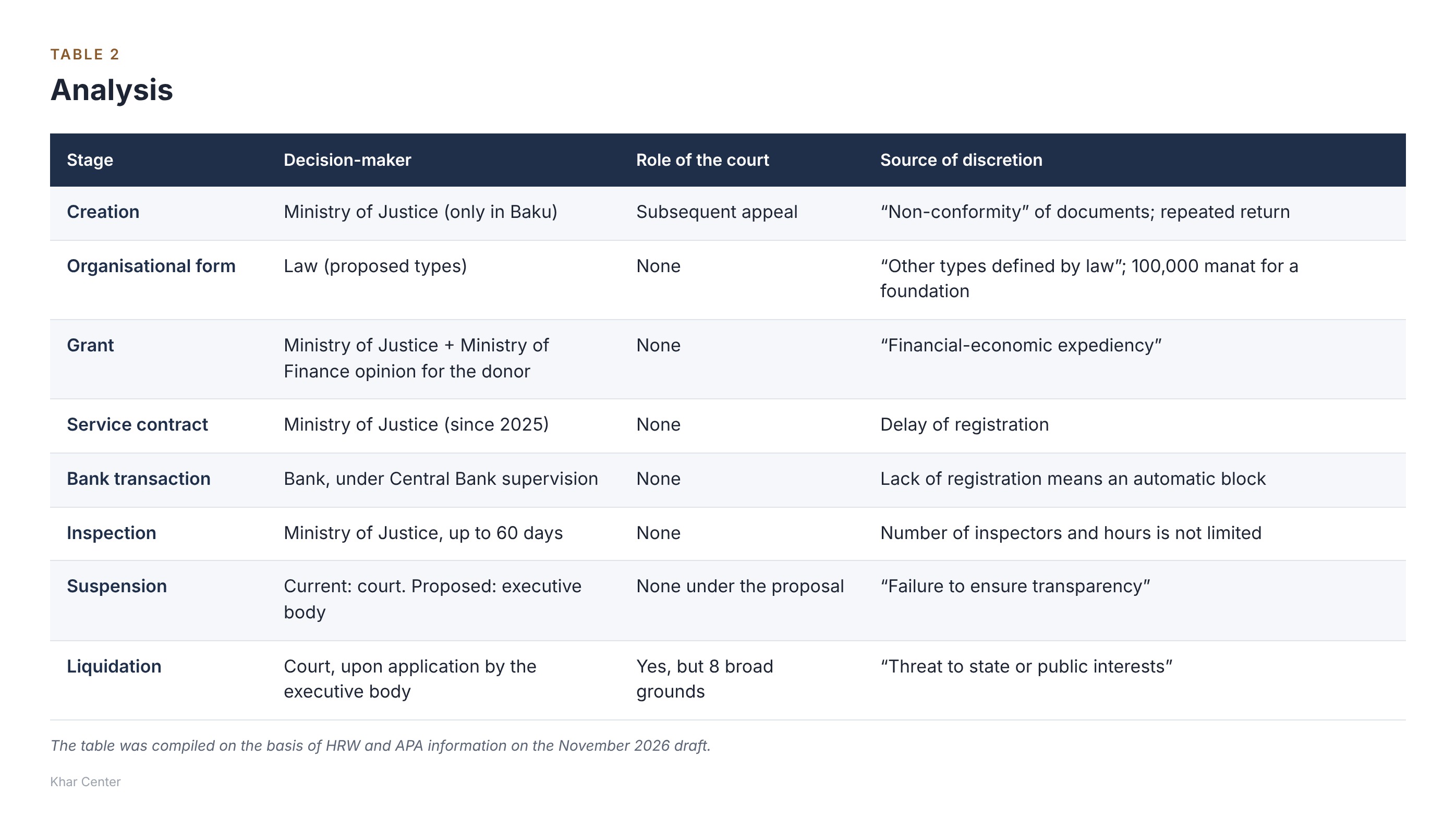
Thus, the 2025–2026 amendments complete control in four directions: the source of funding, the bank transaction, the suspension of activity and the organisational form itself.
Placing Service Contracts under a Permit Regime (July 2025)
On 8 July 2025, the Milli Majlis adopted the amendments in the third reading, and the law entered into force on 1 August. It is now prohibited to provide services or perform work funded from a foreign source without state registration, and to carry out bank transactions under such a contract (Kavkaz-uzel, 2025b).
The key novelty here is automatic blocking through the banking system: if a contract has not been registered, the money physically does not move. The authorities do not even need to reject the contract; simply delaying the registration is enough.
Centralisation of State Support (December 2025)
Under the decree of 29 December 2025, the Agency for State Support to NGOs, together with other bodies that award grants from the state budget (the Youth Foundation, KIBIA, the Social Services Agency), will carry out funding on the “single window” principle. The Agency becomes the owner and operator of a new information system. The heads of the registration department of the Ministry of Justice and of the relevant department of the Ministry of Finance were included in the Supervisory Board approved the following day (Azernews, 2025).
Thus, after foreign funding channels have been completely closed, the state budget remains the only legal source of funding for NGOs. If an employee of the ministry that registers NGOs simultaneously sits on the supervisory body of the funding institution, the legal existence of an organisation and its financial capacity become bound into a single administrative circuit.
Suspension and Liquidation: From the Court to the Executive Body
Open sources do not indicate at which reading the draft of new amendments to the NGO law, placed on the agenda of the plenary session of the Milli Majlis on 16 November 2026, currently stands (Trend, 2026). Under the current law, an NGO’s activity may be suspended for up to one year only by a court decision. The new draft transfers this power to the relevant executive authority, together with the right of liquidation, and adds four new grounds:
• failure to ensure transparency of activity;
• failure to take measures against corruption, money laundering and the financing of terrorism;
• expiry of the agreement with a branch of a foreign NGO;
• failure to make changes in the state register within 3 months after the expiry of the term of office of the governing body.
Early restoration also passes to the executive body: the provision on the participation of the court and on an application by the organisation’s members is abolished.
The same draft lists the types of public associations (professional, social-humanitarian, cultural, education and science, environmental, legal, economic and other types defined by law). Each organisation may be established in only one type. In practice, this means that each organisation is tied to one thematic field, and any activity that goes beyond that field, for example, court monitoring or the preparation of a human rights report by an association registered in the field of education, can be cited as activity outside its charter and as grounds for a warning, suspension or liquidation. Organisations working in several areas will be forced either to choose one or to register a separate entity for each area. The minimum charter capital of foundations, meanwhile, is raised from 10,000 manat to 100,000 manat (Meydan TV, 2026).
Analysis
If the November 2026 draft is adopted, the power to make the initial decision at all stages of an NGO’s life cycle will be given to the executive branch. The powers are so broad that, in the liquidation process, the role of the court is reduced to the level of formal approval.
Structural Problems
Vague concepts. “Transparency of activity” is defined neither by a reporting form nor by a measurable criterion. This creates a universal ground for suspending any organisation. As early as 2014, in the “Islam-Ittihad” case, the ECtHR found that the absence of a clear definition of the prohibited activity in warnings constituted a violation of freedom of association (HUDOC, 2014).
Cascading trap. During the period of suspension, “any activity” is a ground for liquidation. Yet eliminating a violation often requires activity such as reporting, holding a meeting or making changes to the register. Although the draft provides for a number of exceptions (actions related to “mandatory state payments, fines, payments under existing civil-law and employment contracts,” “compensation for damage caused as a result of its activity,” and “elimination of the violations indicated in the warning and instruction of the relevant executive authority”), continuation of programme work by a suspended organisation leads directly to liquidation.
Turning financial requirements into criminal prosecution. The “NGO and Media cases” of 2023–2026 show that issues of grant registration, taxation and documentation are turned into charges of money laundering and fraud. According to the US State Department’s report for 2024, by the end of 2024 at least 40 people had already been jailed on precisely these charges (State.gov, 2025).
As a result, NGO activity has been de facto criminalised. The consequence of any independent activity is now actual imprisonment.
Assessment in Light of International Standards
Azerbaijan’s international obligations (Article 11 of the European Convention on Human Rights (Convention for the Protection of Human Rights and Fundamental Freedoms), Article 22 of the International Covenant on Civil and Political Rights (the UN Covenant of 1966)) permit interference with freedom of association under three conditions: being prescribed by law, pursuing a legitimate aim and being necessary in a democratic society.
The Venice Commission adopted two opinions on Azerbaijan’s NGO law, in 2011 and 2014. The 2014 opinion (CDL-AD(2014)043) was adopted on 12–13 December 2014, precisely after the amendments on grant registration and foreign NGOs. In its conclusion, the Commission noted that the cumulative effect of these stringent requirements further restricts the activities of NGOs in Azerbaijan and may have a “chilling effect” on civil society (Venice Commission, 2014). No new opinion of the Commission on the 2025–2026 amendments is available in open sources.
European Court of Human Rights. The government lost the applications to the ECtHR concerning refusals of registration of a total of 25 organisations: 12 in the case of “Mehman Aliyev and Others v. Azerbaijan” and 13 in the case of “Abdullayev and Others v. Azerbaijan” (CSO Meter, 2021).
FATF (Financial Action Task Force) Recommendation 8. The AML/CFT standards, which are the government’s main justification, were amended in 2023. The FATF states openly that Recommendation 8 has been misused against NGOs in many countries (FATF, 2023).
BTI – Bertelsmann Stiftung’s Transformation Index 2026 report emphasises that these restrictions have led many international donors to leave the country (BTI, 2026).
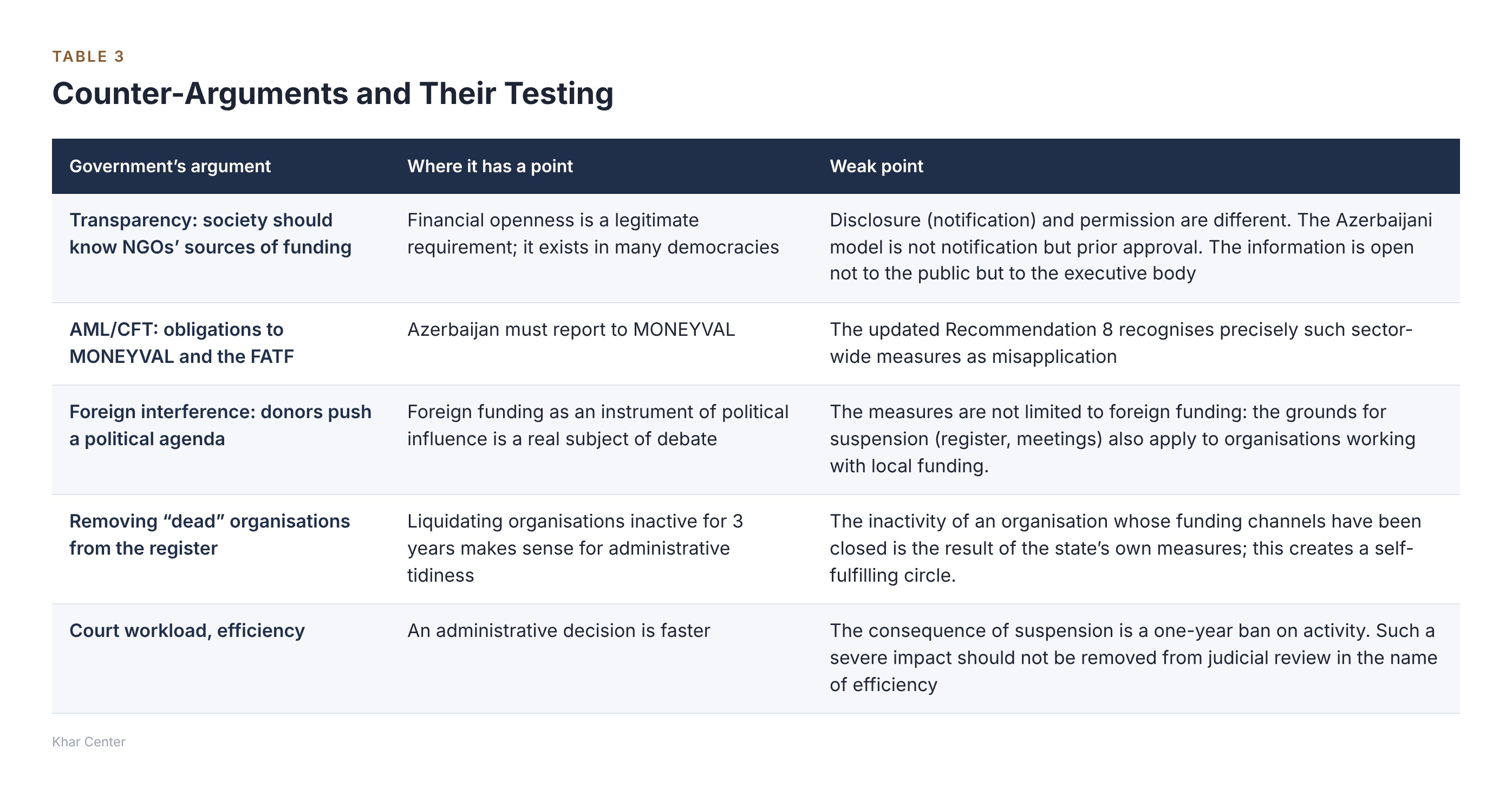
Counter-Arguments and Their Testing
For the thesis to be convincing, let us test the government’s strongest arguments:
Conclusion
The regulation of NGOs in Azerbaijan is now a closed administrative circle. Creation, funding, bank transactions and inspections depend on the approval of the executive body. If the November 2026 draft is adopted, suspension and restoration will also join this circle. In short, in an environment where the creation and activity of NGOs are prohibited altogether, an NGO still carries the status of an “independent organisation” that depends on permission at every stage.
Thus, the evolution of NGO legislation reflects, on a small scale, the general logic of Azerbaijani authoritarianism. Instead of clear and categorical prohibitions, the regime governs society through prohibitions presented as permission. Formally, it is as if nothing is prohibited, but every step depends on the consent of the executive body. This model performs two functions at the same time. Domestically, it completely zeroes out the financial and legal basis of independent initiative. Internationally, it uses “transparency” and “FATF obligations” as a legal shield against criticism.
This means that, without political change, legal reform in Azerbaijan does not appear possible.
Because the problem lies not only in the reactionary laws but in the nature of the government that applies them. Therefore, rather than correcting the text of the law, the goal of international actors should be to deprive the regime of international legitimacy and to defend the political prisoners harmed by such laws. In this context, three key steps are important:
First step: The Council of Europe should request an urgent opinion from the Venice Commission on the November 2026 draft and integrate the Commission’s view into the execution process. During the adoption of the 2014 opinion, the Commission’s visit to Baku was cancelled. For this reason, it is more appropriate to determine the value of the new opinion through a formal legal assessment rather than through dialogue with the government. The Committee of Ministers should link that assessment to the execution of the Mammadli group of cases. These actions are based on the European Court of Human Rights’ finding of “the arrest of civil society activists through the misuse of criminal law.” The prosecutions of 2023–2026 follow exactly the same model. As in the case of Ilgar Mammadov, reopening infringement proceedings under Article 46 § 4 is also an option that should be put up for discussion.
Second step: In its next follow-up report, MONEYVAL should re-evaluate the R.8 rating in the context of the 2025–2026 amendments. The FATF’s Recommendation 8, as updated in 2023, requires measures applied to NGOs to be risk-based and proportionate and, at the same time, not to disrupt their legitimate activity. An approach that brings foreign funding into a permit system and attaches criminal liability to unregistered transactions does not meet these requirements. If the AML/CFT framework is being used for the purpose of shutting down non-governmental organisations, MONEYVAL should explain this issue openly in its report. Otherwise, the application of international standards will have contributed to the legitimisation of repression.
Third step: The EU and donors should not require their partners to comply with Azerbaijan’s reactionary legislation, and should take on the related legal risks themselves. The main instruments here are the following: legal defence funds for detained NGO representatives; sustained institutional support for organisations operating abroad; and the presence of the NGO law and political prisoners, and human rights in general, as a specific condition on the agenda of cooperation between the EU and Azerbaijan (including in the energy sector). Donors should also note that previous grant and service contracts are currently being used as evidence in criminal cases, and pass this information on to the Council of Europe and UN mechanisms.
Note: The article you have read was originally written in the Azerbaijani language. Artificial intelligence tools were used only in the translation.
References:
Freedom House. 2026. “Azerbaijan: Freedom in the World 2026 Country Report.” Accessed November 18, 2026. https://freedomhouse.org/country/azerbaijan/freedom-world/2026.
Elman Fattah, 2025. The Stability and Legitimacy Mechanism of Azerbaijani Authoritarianism. https://kharcenter.com/en/publications/the-stability-and-legitimacy-mechanism-of-azerbaijani-authoritarianism
Nijat Mammadbayli, 2025. From Reactive Oppression To Codified Authoritarianism. https://bakuresearchinstitute.org/en/from-reactive-oppression-to-codified-authoritarianism/
HRW, World Report, 2026. Azerbaijan
Events of 2025. https://www.hrw.org/world-report/2026/country-chapters/azerbaijan
APA, 2026. QHT-lərin ləğvinə dair yeni şərtlər müəyyənləşir. https://apa.az/social/qht-lerin-legvine-dair-yeni-sertler-mueyyenlesir-1014258
Azernews, 2025. Azerbaijan improving activities of Agency for State Support to NGOs - decree.https://www.azernews.az/nation/252327.html
Kavkaz-uzel, 2025a. Azerbaijan tightens conditions for foreign funding of NGOs. https://amp.eng.kavkaz-uzel.eu/articles/66938
CSO Meter, 2023. Brief analysis of the law “On the fight against the legalization of property obtained through crime and the financing of terrorism” and amendment law to the article 598 of the Code of Administrative Offenses entered into force on January 31, 2023. https://csometer.info/sites/default/files/2023-02/Brief%20analysis%20AZ%20CT%20AML%20law%20Jan%202023.pdf
OC Media, 2026. Azerbaijan introduces fines for receiving unregistered grants. https://oc-media.org/aliyev-names-state-bodies-in-charge-of-investigating-unregistered-grants/
İRFS, 2025. AZERBAIJAN HUMAN RIGHTS REPORT The Institutionalization of Totalized Control. https://www.irfs.org/wp-content/uploads/2026/04/Az-2025-report.pdf
HRW, 2026. Azerbaijan Jails Prominent TV Journalists, Media Workers. https://www.hrw.org/news/2026/07/29/azerbaijan-jails-prominent-tv-journalists-media-workers
Kavkaz-uzel, 2025b. Azerbaijan tightens conditions for foreign funding of NGOs. https://amp.eng.kavkaz-uzel.eu/articles/66938
Azernews, 2025. Azerbaijan approves new composition of Supervisory Board of Agency for State Support to NGOs - decree. https://www.azernews.az/nation/252390.html
Trend, 2026. QHT-lərin fəaliyyətinin vaxtından əvvəl bərpası qaydası dəyişdirilir. https://az.trend.az/azerbaijan/gundem/4246866.html
Meydan TV, 2026. Azərbaycanda QHT-lərin fəaliyyətinin dayandırılması və ləğvi üçün yeni əsaslar təklif olunur. https://www.meydan.tv/az/article/az%C9%99rbaycanda-qht-l%C9%99rin-f%C9%99aliyy%C9%99tinin-dayandirilmasi-v%C9%99-l%C9%99gvi-ucun-yeni-%C9%99saslar-t%C9%99klif-olunur/
HUDOC, 2014. CASE OF ISLAM-ITTIHAD ASSOCIATION AND OTHERS
v. AZERBAIJAN. https://hudoc.echr.coe.int/eng#{%22itemid%22:[%22001-147866%22
State.gov, 2025. 2024 Country Reports on Human Rights Practices: Azerbaijan. https://www.state.gov/reports/2024-country-reports-on-human-rights-practices/azerbaijan/
Venesiya Komissiyası, 2014. Opinion on the Law on non-governmental Organisations (Public Associations and Funds) as amended of the Republic of Azerbaijan, adopted by the Venice Commission at its 101st Plenary Session (Venice, 12-13 December 2014).https://www.coe.int/en/web/venice-commission/-/cdl-ad-2014-043-e
CSO Meter, 2021. Azerbaijan: European Court of Human Rights declares the refusal to register 25 NGOs illegal. https://csometer.info/updates/azerbaijan-european-court-human-rights-declares-refusal-register-25-ngos-illegal
FATF, 2023. Mitigating the Unintended Consequences of the FATF Standards. https://www.fatf-gafi.org/en/publications/Financialinclusionandnpoissues/Unintended-consequences-project.html
BTİ, 2026. Azerbaijan Country Report 2026. https://bti-project.org/en/reports/country-report/AZE
