(The article was prepared by the analytical group of the "Khar Center" within the framework of research on Azerbaijani authoritarianism)
Introduction
In recent years, the Azerbaijani government has been trying to present itself not only as a fossil fuel-rich state enriched by oil and gas exports, but also as a responsible and modern actor participating in discussions on the global climate crisis and supporting the transition to green energy. Ilham Aliyev expressed this approach in his speech at the opening of the Baku Energy Week in early June with these words: "With our natural gas reserves, which will be sufficient not only for us but also for our customers for at least 100 years, we actually do not need another source of electricity generation. But our responsibility compels us to invest in renewable energy" (President.az, 2026).
The Azerbaijani government highlights this image of a responsible and modern actor while striving for and succeeding in hosting the UN Climate Summit (COP-29) held for the first time in a post-Soviet country, declaring Karabakh and Eastern Zangezur a "green energy zone," creating the "Green" structure of the fossil fuel company SOCAR, and finally, while talking about ambitious projects like the transmission of green energy from the Caspian to Europe.
However, the reality behind this image is very different - the Azerbaijani political-economic model is completely based on oil and gas hegemony. This hegemony exists not just in domestic policy but also forms the basis of Azerbaijan's foreign policy. Especially in recent years, against the backdrop of global energy turmoil, the boundaries of Azerbaijan's oil and gas bargaining have expanded further, and its value has increased. Hydrocarbon resources are an economic revenue source, a shield for internal security, and an instrument for international legitimacy and maneuvering for the Azerbaijani government. In this regard, the intention of the Azerbaijani government is not so much to meet the demands and responsibilities of the modern era, such as green energy, green zones, and a clean climate, but rather to create this image to provide an additional layer of support to the fossil fuel hegemony. Ilham Aliyev does not hide this either - according to his "realist" approach, green energy is not an alternative, but a complement to oil and gas exports (President.az, 2026).
That is, the Azerbaijani government does not keep the "green" topic on its agenda as a means to reduce dependence on oil and gas; on the contrary, it sees it as a defense mechanism for its oil and gas-based authoritarian model.
In this article, the "Khar Center" takes a look at the illusions of the green autocracy of the Azerbaijani government. The main question of the analysis also stems from here - how does the Azerbaijani government protect and re-legitimize its oil-gas hegemony through "green" projects, major ecological events, climate diplomacy, and renewable energy investments? Or we can phrase the question differently - how does the "green transition" rhetoric of the Ilham Aliyev government serve the continuation of authoritarian rule, resource distribution, and hydrocarbon dependence?
What does green autocracy entail?
In this article, "green autocracy" is used as an analytical framework in the Azerbaijani context for concepts such as authoritarian environmental governance, eco-authoritarianism, the sustainability spectacle, greenwashing, and green grabbing. At the same time, this concept does not solely encompass lies, manipulation, or control over the field of ecology. It refers to a broader mechanism where an authoritarian government utilizes trending topics like ecology, green energy, and the global climate crisis to strengthen its governance model, increasing resource exploitation and hydrocarbon dependence behind a green showcase, and gaining an additional shield of international legitimacy for its power. Thus, in this sense, "green autocracy" is the appropriation and exploitation of ecology, green energy, and climate topics by the authoritarian government. This concept combines several directions.
One of the elements of green autocracy is authoritarian environmentalism. According to Bruce Gilley, who analyzed the concept of authoritarian environmental governance in the case of China's climate change policy, this model encompasses a non-participatory approach to the formulation and implementation of public policy regarding serious environmental problems. In this model, the state announces major environmental goals, programs, and projects, but severely limits the role of public discussion, local communities, independent media, courts, and civil society in the process. It is exactly the factor of public participation that is the key point distinguishing democratic environmental governance from authoritarian environmental governance - the presence of this participation is the main indicator of the former, and its absence of the latter. The citizen's participation in this process is limited to complying with state policy; that is, the citizen is not in the decision-making process; they are merely the submissive executor of the policy announced by the authoritarian regime (Gilley, 2012).
According to the author, authoritarian environmental governance is more effective in producing policy outputs rather than policy outcomes. That is, authoritarian regimes aim to create the image of an "effective state" on the international platform by making quick decisions and implementing large projects in a short time, while real outcomes do not interest them much (Gilley, 2012).
Supporters of eco-authoritarianism argue that climate change, ecological disasters, and global environmental problems cannot be solved with slow and highly debatable democratic mechanisms; strong (read - authoritarian) state mechanisms are more effective for this. The eco-authoritarian approach points to the slow, contentious, and rights-restricted decision-making mechanism of liberal-democratic regimes as one of the main obstacles to solving the ecological crisis. Defenders of this idea reject central planning, but still advocate giving governments powers that are not restricted by civil rights and democratic procedures. In this model, green autocracy does not bear elements of overt dictatorship in its appearance; it entails a control mechanism adorned with concepts such as effectiveness, state capability, and technocratic management. Dan Coby Shahar, who critiques eco-authoritarianism, points out that freeing governments from democratic procedures and civil rights on the grounds of the ecological crisis is a dangerous path. According to the author, the weakening of public control breeds eco-authoritarianism, meaning environmental policy can easily turn into a new mechanism of coercion, new resource distribution, and new silencing (Shahar, 2015).
Another element of green autocracy is the display of ecological sustainability. Today, ecological sustainability is directly associated with modernism; to claim modernity, a state or institutions must have "green identity" data. That is, actors and institutions wishing to demonstrate their modern status in the global order feel compelled to demonstrate their commitment to ecological sustainability to achieve their material, political, and moral goals (Koch, 2022). This is not always a sincere display of commitment, especially for oil and gas states with authoritarian regimes. According to Natalie Koch, who observes ecological sustainability projects in the Arabian Peninsula, post-oil greening initiatives use the very sustainability spectacle to create a positive narrative about a 'modern' national identity. In these states, the green energy discourse often entails not moving away from the fossil fuel model, but rather adapting that model to new conditions under a "green" curtain. Regimes enriched by oil revenues present themselves as actors ready for a post-oil future, modern and responsible, with green projects, showy events, and visually impactful sustainability initiatives. These sustainability spectacles undoubtedly encompass greenwashing, which expresses the mismatch between real ecological performance and ecological communication—or to simplify it further, a manipulation where the state tries to show itself as "greener." However, according to the author, it is not correct to evaluate this issue merely as government PR and "greenwashing." Because ecological sustainability scenes are a matter of internal national pride, international reputation, investment attraction, and political legitimacy for authoritarian regimes possessing oil and gas resources (Koch, 2022). That is, evaluating these projects only as lies and manipulation of the authoritarian regime does not lead to the right conclusion; it must be noted that the green agenda is also a legitimization tool for the oil and gas state in the new era. Because the sustainability spectacle distracts attention from the country still remaining dependent on oil and gas and actively promoting a resource-based future. In these types of examples, what the word 'sustainability' actually entails is kept ambiguous. When saying "green energy," "green zone," "sustainable development," "smart village," "green corridor," it is often unclear exactly what ecological standards, what public participation mechanism, what emission reductions, and what social justice dimensions are being talked about. That is, spectacular green branding is essentially often elitist and anti-democratic (Koch, 2022).
One of the deep layers of green autocracy—a model where ecological discourse is entirely in the hands of the government—is green grabbing or green appropriation. Explaining this concept, James Fairhead, Melissa Leach, and Ian Scoones emphasize that "green" goals are sometimes used to justify the appropriation of land, water, forests, energy, and other resources in new forms (Fairhead, Leach, and Scoones, 2012). That is, a project being "green" does not automatically make it just; on the contrary, in regimes where the participation of local communities is absent, and public and media scrutiny are restricted, it turns into a social injustice factor where resources pass under the control of business circles close to the state or foreign investors. This is of great importance, especially when implementing large infrastructure and energy projects. Because at first glance, solar and wind panels, hydropower projects, and green zones may seem like modern, climate-friendly projects that benefit society. However, a critical approach does not view natural resources merely as economic wealth; it also asks who controls access to these resources, how they are extracted or used, who benefits from the process, who suffers, and how revenues and ecological damages are distributed among different political actors (Koch, 2024). In an atmosphere where there are no answers to these questions and even raising the questions entails danger, green projects create a new rent mechanism.
Authoritarian regimes' enthusiasm for looking "green"
The theoretical framework above also gives us reason to say that the interest of authoritarian regimes in the green agenda cannot be explained solely through a flat framework - the perspective of responding to ecological problems. For them, it is more about an international image, a desire to look modern, attracting investments, controlling resources, and the opportunity to neutralize potential social explosions. Because the topic of ecology represents both an opportunity and a risk for authoritarian regimes. The regime uses ecology as a show of legitimacy and modernization, but environmental problems also carry the danger of becoming a cause for public explosion. For this reason, authoritarian regimes do not completely reject ecology; they accept it in a managed, nationalized, and depoliticized form. The interest of authoritarian leaders in the environment and natural resources stems from the concern to ensure the legitimacy of the regime. Ecological issues create an opportunity for regimes seeking international legitimacy; by promoting climate policies and hosting major environmental summits, they can demonstrate their environmental credibility (Koch, 2024).
One of the most obvious examples of this approach is the United Arab Emirates. In the UAE, which has long been a rentier state model formed on oil and gas revenues, hydrocarbon revenues have been distributed to citizens in the form of various social privileges, subsidies, and welfare mechanisms, but political participation has been limited. In the Gulf monarchies, this "ruling bargain" (i.e., a governance agreement where political rights are replaced by welfare goods) is built on fossil fuel revenues. However, along with the increase in global climate discourse, the UAE, considering the reputational risk of being a fossil fuel country, has begun to present itself as one of the pioneers of "clean energy," "green innovation," and "post-oil modernity" (Koch, 2022). The Abu Dhabi Future Energy Company (Masdar), established in 2006, is one of the most important examples of the UAE's claim to appear as a global green actor and is presented as the UAE's global renewable energy company (Masdar, official page). Initiatives such as solar parks, eco-city projects, EXPO-2020, and COP-28 are ecological sustainability spectacles that serve the oil-gas country UAE exactly to portray itself as a modern, responsible, future-ready actor (Koch, 2022).
It is possible to form similar sentences regarding Kazakhstan. In this country, revenues from natural resources like oil, copper, uranium, etc., are the main pillar of both economic development and authoritarian legitimization. The image of modernity created at the expense of these resources for many years is already losing its relevance on the international platform dictated by the global climate crisis. For this reason, the Kazakh government has also switched to the rhetoric of ecological sustainability and a green economy. The "Concept of Transition to Green Economy until 2050" adopted in 2013, the hosting of the "Future Energy" EXPO in Astana in 2017, and the announcement of ambitious targets such as increasing the share of renewable energy to 3 percent by 2020, 30 percent by 2030, and 50 percent by 2050 (APEF, 2013) demonstrate the fossil fuel country Kazakhstan's enthusiasm to look modern and "clean". On the other hand, facts such as the revelation of the long-standing secret of nuclear tests conducted in Semipalatinsk (CTBTO, 2011), the Aral Sea disaster (UNDP, 2025), and serious pollution caused by the oil and mining industry (World Bank, 2023) show that it is impossible to hide real environmental problems behind the green showcase the government tries to create.
Another example of green autocracy is Turkey. Turkey is not a classic oil-gas rentier state, but during the 24 years of AKP rule, ecology has turned into one of the branches of populist-authoritarian governance and one of the main elements of sharp political polarization. While in previous periods in Turkey, greening was mostly related to modern national state-building, during the AKP period, the government's claim that "we are the real supporters of ecology" was formed as a response to ecological protests. The AKP showing itself as "green" is not just "greenwashing," but a more political mechanism - the government takes the language of ecology under its control and presents independent ecological movements as fake, politically motivated, open to foreign influence, or dangerous groups. Thus, state tree planting is coded as "true ecology," while citizens' protests are coded as "disrupting public order," the state as "the true friend of ecology," and ecologists, citizens, and media as the "enemy." Erdogan's expression "I am the real environmentalist" against the HES (hydroelectric power plant) protests in 2008 is the key sentence of this line (Kurtich, 2022).
Ecological challenges such as protests against the opening of gold mines in the Aegean, Marmara, and Black Sea regions and against the construction of hydroelectric power plants in many parts of the country also existed in Turkey in the period before the AKP rule. However, the increase in ecological problems and injustices in resource exploitation have also increased ecological activism and mobilization during the AKP period. Starting with the Gezi Park events in 2013, the Turkish government has chosen a very radical line regarding ecology within the framework of its increasingly authoritarian populism. In order to ensure the continuity of its power, it has taken ecological policy under its hegemony and turned it into an important front. In this context, it has especially created a narrative that secularists, leftists, pro-Westerners, and Western circles use ecological mobilizations to overthrow the AKP government, and it has antagonized ecological activists (Özen, 2022).
That is, the AKP has turned an area where it is weak into an area where it is strong through authoritarian methods. While presenting ecological activism as criminal activity, enmity towards the state, and even international treason, it has presented itself as the greatest friend of ecology and the greatest defender of the environment, and began implementing large image projects in this direction. The biggest of these is the "Zero Waste" project initiated in 2017 under the patronage of Erdogan's wife, Emine Erdogan. UNDP Turkey awarded this project the "Sustainable Development Goals Action Award" in 2021 (UNDP, 2021). Hosting COP-31, to be held in November this year, will also give Ankara the opportunity to appear as an important actor in global climate diplomacy (UN, 2026). Other "green" steps, such as declaring November 11 as National Afforestation Day with the "Breath to the Future" campaign in 2019, the "nation's gardens" presented as one of the AKP's most symbolic projects, the Karapınar YEKA-1 project presented as Turkey's and Europe's largest solar power plant, and the announcement of the net-zero carbon emission target for 2053, are also among the modern and ecological sustainability spectacle events of the Erdogan regime. This seemingly apolitical "greenness" of Erdogan constitutes the basis of a highly political goal (the criminalization of grassroots environmental activism) (Kurtich, 2022).
The examples above show that the "green" enthusiasm of authoritarian regimes is not accidental; it is an area of activity with concrete political goals for them. In the UAE, it works as a post-oil reputation; in Kazakhstan, a modern showcase based on resources; and in Turkey, a mechanism for covering up ecological problems through authoritarian methods.
The hydrocarbon hegemony behind the green showcase
In the example of Azerbaijan, the elements we emphasized in the theoretical section appear simultaneously - authoritarian environmental governance, eco-authoritarianism, greenwashing, the ecological sustainability spectacle for international image, green grabbing, rent, and the silencing of internal ecological dissatisfactions through harsh methods.
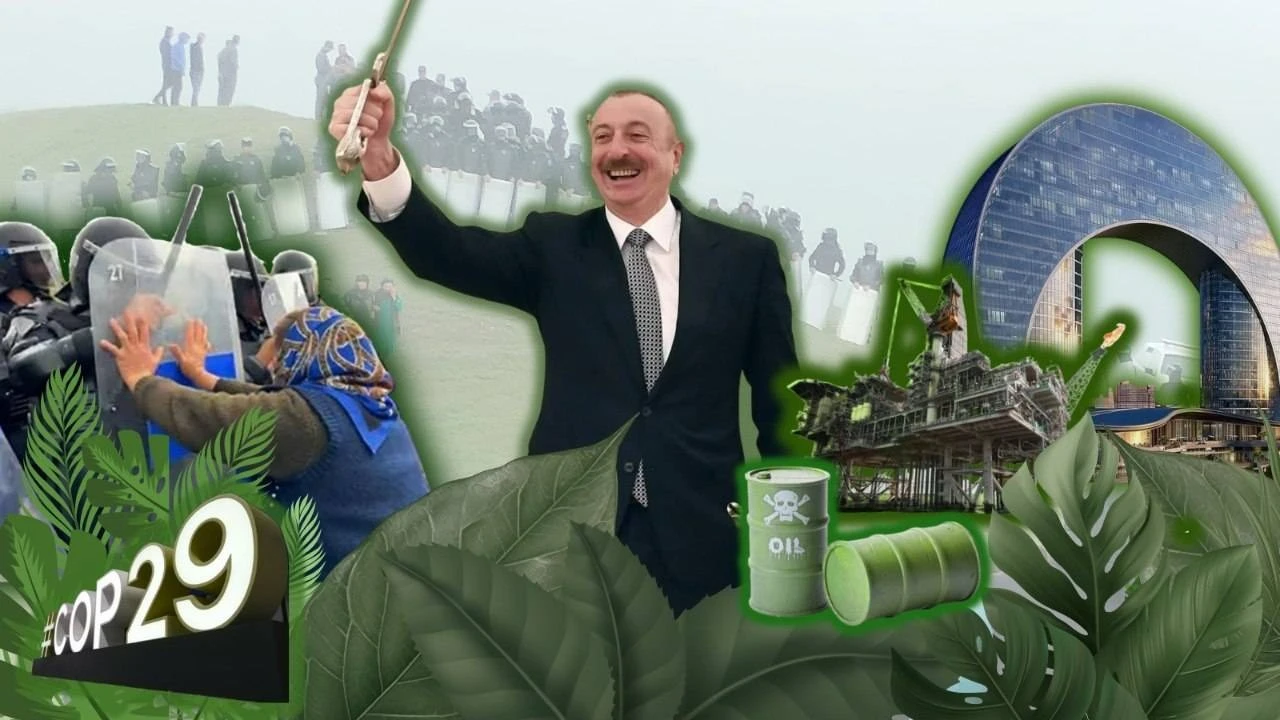
First of all, it should not be forgotten that the oil-gas hegemony forms the basis of the Azerbaijani political-economic model. Fossil fuel is the source of both internal "stability," security, and international legitimacy for Azerbaijan's authoritarian regime. The "green" agenda also serves the needs of the authoritarian governance model based precisely on hydrocarbon resources. The Azerbaijani government is trying to form an image of a modern and ecological state that not only exports oil and gas but also participates in discussions on the global climate crisis, supports the transition to green energy, and creates renewable energy corridors. But even while doing this, it does not hide its dominant style relying on fossil fuel resources. The place where this paradox is most evident was the UN Climate Change Conference (COP-29) held in Baku in 2024. Hosting COP-29 in Baku was exactly the sustainability spectacle and greenwashing act we emphasized in the theoretical part, and it served to advertise official Baku as the initiator of the transition to green energy (Urgewald, 2026).
While the desire of an oil-gas rentier state to appear as the initiator of the transition to green energy is itself a huge contradiction, Azerbaijani President Ilham Aliyev's presentation of fossil fuel resources as a "gift from God" and simultaneously accusing critics of the harms of oil and gas of slander and blackmail (Reuters, 2024) further strengthened this contradiction.
That speech by Ilham Aliyev was not a momentary emotional reaction; on the contrary, it was an expression of the Azerbaijani government's view on oil and gas. Aliyev's message that "the world cannot live without fossil fuels," given at the Baku Energy Week held recently (June 1-3, 2026), confirmed this once again (Azertag, 2026). And again, the paradox was not limited to Aliyev's rhetoric; the event itself contained a contradictory synthesis of deepening hydrocarbon cooperation while transitioning to green energy. During the Energy Week, where the Caspian Oil and Gas Exhibition, the Caspian International Clean Energy Exhibition, and the Baku Energy Forum were held, the Azerbaijani government spoke about the "green energy" future while also emphasizing that fossil fuel hegemony is indispensable. This shows Baku's approach to the green transition very clearly. For it, green energy and a clean environment are not alternatives to the fossil fuel model; on the contrary, oil means national wealth, gas means energy security, and green energy is the cover of modernity and a responsible actor. At the same time, this cover has another function. The Azerbaijani government increases the export of hydrocarbon resources through renewable energy projects implemented together with international partners. That is, it plans to direct the domestic gas resources saved through renewable energy sources to export and gain additional income from this (Genin, 2023). In other words, the function of the green cover is actually to add power to the hegemony of "national wealth." Patrick Galey, a researcher from the international environmental organization Global Witness, points out that this data raises serious doubts about Azerbaijan's environmental credibility: "We know that a portion of the electricity generated from the planned solar and wind energy projects will be used to feed Azerbaijan's oil and gas infrastructure. It is absurd to use renewable energy to feed what it is supposed to constitute an alternative to" (Wall Street Journal, 2024).
Even BP's start of commercial non-associated gas production at the Azeri-Chirag-Gunashli field at the Baku Energy Week (Reuters, 2026 a) shows that for the Azerbaijani government, the green agenda is merely a showcase topic, while oil and gas remain the priority. Information about BP taking over the operatorship of the Babek gas field (Reuters 2026b), TotalEnergies' plans to move to the second phase of the Absheron gas-condensate field and start production in 2029 (Reuters, 2026 c), and important events such as Europe's gas demand and SOCAR's growing role in energy diplomacy in this context also show the invariance of the importance of fossil fuels for the Azerbaijani government.
The shift in Europe's gas focus after the Russia-Ukraine war has increased Azerbaijan's geopolitical importance. Azerbaijan has turned from a small oil-gas exporter into a serious regional energy ally, and this increasingly strengthening line is not only an economic but also a serious political-diplomatic channel. By using precisely this ally status, the Azerbaijani government has gained new maneuvering opportunities in its relations with the West (Khar Center, 2026). In recent times, a green label has also been added to this. Azerbaijan is no longer presented only as a Southern Gas Corridor country, but also as a "green energy corridor" country capable of transmitting green electricity from the Caspian to Europe in the future (Report.az, 2026).
Thus, in the example of Azerbaijan, the topic of green energy acts not as the end or alternative to oil-gas hegemony, but as its support.
Green zone or a new area of rent?
One of the main topics of the Azerbaijani government's green agenda is the presentation of the liberated territories - Karabakh and Eastern Zangezur - as a "green energy zone" (GEZ). This concept, put forward in 2021, envisions measures in the liberated territories such as electricity production from renewable energy sources, energy efficiency measures, the use of electric vehicles, the installation of renewable energy devices (especially solar panels) on the roofs of buildings, as well as the use of solar-based LED lamps for street and road lighting, the use of renewable energy technologies in heating, cooling, and hot water supply, the application of smart energy management technologies, and energy-oriented waste management (AREA, official page). In 2022, Nakhchivan was also included in the Green Energy Zone. In this context, the construction of Azerbaijan's largest solar power plant has begun in Jabrayil, a hydroelectric power plant has been opened in Lachin (Gulebird), the Matagis-1 and Sugovushan stations have been renovated, and two hydroelectric power plants have been built on the Araz River (PISM, 2025).
This concept and the advertised works undoubtedly give the impression, at first glance, of a highly symbolic step and the modernization of the liberated lands. However, at the same time, the government's choice of precisely the liberated lands for this concept, presented with phrases like "green energy zone," "smart village," "smart city," "zero emission," and "green technology," aims to "neutralize" public scrutiny, potential criticisms, and questions with the label of "national pride." With a narrative of victory and national pride, the government preemptively blocks questions about who is given the large projects under the name of the green zone, how they are managed, how resource distribution is carried out, and how profits and losses are shared. These narratives allow any criticism, doubt, or question regarding the green zone to be easily framed as "opposing a national issue."
A green zone does not just mean setting up an energy system somewhere; it involves the redistribution of land, water, electricity, agricultural, transport structures, residential areas, and future areas of economic activity. How this distribution is carried out, by whom it is carried out, to whose benefit and to whose detriment, how the arising problems are solved - the government is not interested in answering these questions, nor even in the sounding of these questions.
For example, in 2023, "Abzas Media" revealed the connection between agricultural areas in the liberated territories and high-ranking officials and their family members, including Ilham Aliyev's daughters. The investigation showed that agricultural lands in Karabakh were distributed among companies owned by the president's daughters Leyla and Arzu Aliyeva, as well as "Pasha Holding" belonging to the family of Vice-President Mehriban Aliyeva, the food monopolist "Azersun" close to the ruling family, and family members of the head of the State Security Service Ali Naghiyev and the head of the Presidential Security Service Beyler Eyyubov. According to the same investigation, although the Turkish partner of the agricultural park created in the "smart village" established within the framework of the Green Energy Zone in the Birinci Agali village of Zangilan is known, the name of its Azerbaijani partner is kept secret (Abzas Media, 2023). It should be noted that another investigation revealed that the owner of the mentioned agricultural park, "Dost Tarım Parkı" (Dost Agriculture Park), is also the son-in-law of the Turkish president's brother (Abzas Media, 2024a).
A previous investigation by the Turan Information Agency had revealed the connection of most of the new agricultural parks established in Karabakh with individuals close to the government. According to that investigation cited by "Eurasianet," in general, the owners of at least 38 of the 49 agricultural parks established in Azerbaijan since 2012 are people close to the government, and the sole operator of the agricultural parks is "Pasha Holding," which owns 9 agricultural parks, of which Aliyev's two daughters are also shareholders (Eurasianet, 2021).
In addition, "Abzas Media" determined in 2024 that large tenders related to water and land reclamation in Karabakh were also given to foreign and local companies close to the Aliyev government, and at the same time, these proximities played a role in the implementation of those projects. Among these, the names of "Cengiz Inşaat," known for its closeness to Turkish President Recep Tayyip Erdogan, as well as companies belonging to Abdulkadir Karagoz, the son-in-law of Erdogan's brother, are mentioned (Abzas Media, 2024 a).
Aqroman LLC, which illegally cut down trees in Shusha, also won the 2 million manat tenders announced for the demolition of old buildings and the transportation of waste precisely thanks to its closeness to the government. Moreover, it was not satisfied with this and won other tenders in Karabakh as well. This company, belonging to the brother of Deputy Foreign Minister Yalchin Rafiyev, works together with "PMD Group," which belongs to Ilham Aliyev's family (Abzas Media, 2024 b).
There are other serious facts regarding the family connections standing behind the "green" advertisement of the Azerbaijani government. In 2024, it was revealed that in the former son-in-law of the president Emin Agalarov's "Sea Breeze" project, he received a job worth 9 million manats to temporarily accommodate participants coming to COP-29 through a procurement method, without any tender (Abzas Media, 2024c). Among the "green zone" partners of COP, very familiar names took place again - "Pasha Holding," where the president's daughters Leyla and Arzu Aliyeva are major shareholders, and "Azersun" and SOCAR, which have offshore connections with the Aliyeva sisters (OCCRP, 2024). Drawing attention to these facts, "Transparency International" emphasized that COP-29 provided marketing opportunities and a platform to present "green credibility" on the world stage for those companies (Transparency International, 2024).
"Abzas Media" also discovered that a state conference related to COP-29 in Nakhchivan was given not by tender, but by procurement method to a furniture company registered a few months earlier, and the owner of this company is a department head in the Ministry of Digital Development and Transport of Nakhchivan (Abzas Media, 2024 ç).
These facts show that the green agenda is nothing more than an activity of economic interest and reputation for the ruling family and its close associates.
Repressive attack on grassroots ecological demands
The Azerbaijani government and the relevant authorities did not answer any of these investigations and emerging questions. More precisely, they did answer - due to these and similar investigations, repressions began against "Abzas Media" (as well as other independent media organizations like Toplum TV and Meydan TV) starting from 2023 and continue today.
These attacks were not limited only to the media. The Azerbaijani government, exactly as in the Turkish example, criminalized all grassroots protests related to ecology. The government, which hosts the world's largest climate-related conferences, talks about topics such as green energy and renewable energy corridors on international platforms, and demonstrates modernity, puts a criminal spin on grassroots protests and demands regarding water, land, mining waste, and pollution.
One of the most obvious examples of this is the Soyudlu incident. In June 2023, the protest of the residents of the Soyudlu village in Gadabay against the creation of a second artificial lake for the storage of gold mine waste was evaluated by the state almost as an act of terrorism. The villagers, who held a peaceful protest, stating that even the existing lake was polluting water sources and soil and creating health problems, faced serious police brutality. When facts of tear gas, rubber bullets being fired, and physical violence being applied to protesters, mostly elderly women, spread on the internet, the whole country and the world became aware of the Soyudlu events. However, this was accompanied by the government behaving even more cruelly - entry and exit to the village was restricted, dozens of people were arrested, more than 30 people were injured, journalists who filmed and disseminated the events were beaten, expelled from the village, had their phones confiscated, were threatened, and thrown into prison (IPHR, 2023). A criminal case on drug charges was opened against three people detained at the rally. Joshgun Musayev, a villager who prepared the placards for the protest rallies in Soyudlu, was sentenced to 3 years of imprisonment (Toplum TV, 2026). There are still people in prison on false charges over the Soyudlu events - like journalist Nargiz Absalamova, sentenced to 8 years in prison (Amnesty International, 2024a), former deputy Nazim Beydemirli, who was arrested and given an 8-year prison sentence for supporting the protests (Eurasianet, 2024), Sevinj Vaqifgizi and other employees of "Abzas Media" who exposed the government's green lies including the Soyudlu incident and are therefore still in prison... (Forbidden Stories, 2024).
Reacting to the protests in Soyudlu 20 days later, President Ilham Aliyev stated that the behavior of the police, who applied violence to peaceful people, was "dignified" and justified this violence by saying, "Go and see how many people the American police kill a year" (Toplum TV, 2026). Although the gold mine temporarily suspended its operations after the Soyudlu events, it was restored in 2024, and in August of that year, the expansion of the artificial waste lake was also permitted (OC Media, 2024). Even though three years have passed since the protest action, police posts still remain at all entrances to the village, and those coming to the village are questioned and their identity cards photographed (Toplum TV, 2026).
The Soyudlu incident gained a symbolic meaning because it attracted more attention from the media and international organizations. There are other similar facts as well. For example, a few months before Soyudlu, in March 2023, villagers protesting water shortages in the Saatli district also faced police brutality. In Saatli, about 200 villagers had tried to block the highway in protest against the water shortage in the Kura and Araz rivers, and the police had used tear gas and rubber bullets against the protesters, and at least 3 people were injured in those events. Four rubber bullets hit the chest of a 15-year-old child (Meydan TV, 2023).
The Soyudlu and Saatli events are facts that show the working mechanism of green autocracy very openly. The state does not recognize the right of the citizen, communities, and the media to speak about ecology, and evaluates any protest in this direction within the context of a security problem. The approach of the Azerbaijani government is as follows: the "green" projects announced by the state are legitimate, whereas the ecological demands of society are not legitimate; moreover, they are a threat. Both those arrested and subjected to repression in both incidents, and later on the eve of COP-29 the activists who were punished with long-term imprisonments for initiating climate justice initiatives (like human rights defender Anar Mammadli and economist-journalist Farid Mehralizada) (Amnesty International, 2024b, Climate Home News, 2024) are victims of the Azerbaijani government's "green autocracy."
CONCLUSION
The facts and data in this article show that the green agenda of the Azerbaijani government does not entail a real ecological transition initiative, but the strengthening of oil-and-gas-based authoritarian governance adapted to new global trends.
For the Aliyev government, green energy, green zones, renewable energy, climate problems, events of international importance like COP-29, and events like the inclusion of "green topics" in the Baku Energy Week are necessary for presenting a modern, responsible actor. On the one hand, the government uses green energy projects for international reputation; on the other hand, it expresses that these projects will actually play an investment role for additional gas exports. It feels no need to explain this paradox - because Europe's growing energy needs have turned an authoritarian regime state like Azerbaijan into one of the main players, and this insures the Aliyev regime against many criticisms.
On the other hand, the green energy agenda is an additional form of corruption, embezzlement, and appropriation for the ruling family and its entourage, one whose showcase looks modern and clean. The implementation of green zones, renewable energy projects, or international events like COP-29 far away from any public discussion, strictly under the participation and control of the ruling family and its close associates, the distribution of almost all tenders among the family and its circle, the punishment of demands for transparency and accountability with arrests and repressions, and the criminalization of any grassroots ecological demands and protests clearly show the ugly picture behind that modern and beautiful showcase. The government tries to hide this picture with solar panels, smart villages, green parks, wind stations, and international-level events, but what is visible needs no guide - for Azerbaijan, green politics is one of the mechanisms that further deepens oil-and-gas-based authoritarianism.
Note: The article you have read was originally written in the Azerbaijani language. Artificial intelligence tools were used only in the translation.
References:
President.az, 2026. “President Ilham Aliyev attended the opening ceremony of Baku Energy Week”. https://president.az/en/articles/view/72649
Gilley, Bruce, 2012. “Authoritarian Environmentalism and China’s Response to Climate Change”. https://www.researchgate.net/publication/254232695_Authoritarian_environmentalism_and_China
Shahar, Dan Coby, 2015. “Rejecting Eco-Authoritarianism, Again”. https://journals.sagepub.com/doi/abs/10.3197/096327114X13947900181996?download=true
Koch, Natalie, 2022. “Sustainability Spectacle and ‘Post-Oil’ Greening Initiatives”. https://www.tandfonline.com/doi/full/10.1080/09644016.2022.2127481
Fairhead, James; Leach, Melissa; Scoones, Ian, 2012. “Green Grabbing: A New Appropriation of Nature?”. https://www.tandfonline.com/doi/full/10.1080/03066150.2012.671770
Koch, Natalie, 2024. “Authoritarian Regimes and the Environment”. https://nataliekoch.com/wp-content/uploads/2024/06/KochAuthEnv_Web.pdf
Masdar, rəsmi səhifə. “About Masdar”. https://masdar.ae/en/our-company/about-masdar
APEF (Asia Pacific Energy Portal) 2013. “Concept for Transition of the Republic of Kazakhstan to Green Economy”. https://policy.asiapacificenergy.org/node/133
CTBTO, 2011, “20th Anniversary of the Closure of Semipalatinsk Test Site”, https://www.ctbto.org/news-and-events/news/20th-anniversary-closure-semipalatinsk-test-site
UNDP Kazakhstan, 2025. “The Woman and the Sea: A Journey Toward Revival and a Sustainable Future”. https://www.undp.org/kazakhstan/stories/woman-and-sea-journey-toward-revival-and-sustainable-future
World Bank, 2023. “Kazakhstan Mining Sector Diagnostic”. https://documents1.worldbank.org/curated/en/099081823001539573/pdf/P17674501063760b08b290a4ae6547845d.pdf
Kurtich, Ekin, 2022. “Criminalizing Environmental Activism in Turkey”. https://www.brandeis.edu/crown/publications/middle-east-briefs/pdfs/101-200/meb147.pdf
Özen, Hayriye, 2022. “Interpellating ‘the People’ Against Environmentalists: The Authoritarian Populist Response to Environmental Mobilizations in Turkey”. https://www.sciencedirect.com/science/article/abs/pii/S0962629822001093
UNDP Türkiye, 2021. “Zero Waste Project Receives UNDP Turkey’s First Global Goals Action Award”. https://www.undp.org/turkiye/press-releases/zero-waste-project-receives-undp-turkeys-first-global-goals-action-award
UN, 2026. “COP31”. https://unfccc.int/cop31
Urgewald, 2024. “COP29: New Report on SOCAR Highlights Azerbaijan’s Damning Fossil Fuel and Human Rights Record”. https://www.urgewald.org/en/medien/cop29-new-report-socar-highlights-azerbaijans-damning-fosil-fuel-and-human-rights-record
Reuters, 2024. “COP29: Pay Up or Face Climate-Led Disaster, Humanity Warns UN Chief”. https://www.reuters.com/business/environment/cop29-pay-up-or-face-climate-led-disaster-humanity-warns-un-chief-2024-11-12/
AZERTAC, 2026. “President: World Cannot Live Without Fossil Fuel”. https://azertag.az/en/xeber/president_world_cannot_live_without_fosil_fuel-4232275
Genin, Yulia, 2023. “Azerbaijan’s Green Energy Development Serves the Hydrocarbon Industry”. https://crudeaccountability.org/azerbaijans-green-energy-development-serves-the-hydrocarbon-industry/
Wall Street Journal, 2024, “At COP29, the Host Boasted About Its Renewable Energy Plans. They Just Happen to Be on Disputed Territory”, https://www.wsj.com/articles/at-cop29-the-host-boasted-about-its-renewable-energy-plans-they-just-happen-to-be-on-disputed-territory-62928d38
Reuters, 2026 a. “BP Starts Commercial Non-Associated Gas Production at Azerbaijan’s ACG Field”. https://www.reuters.com/business/energy/bp-starts-commercial-non-associated-gas-production-azerbaijans-acg-field-2026-06-01/
Reuters, 2026 b. “BP Set to Take Over Offshore Natural Gas Project in Azerbaijan, Sources Say”. https://www.reuters.com/business/energy/bp-set-take-over-offshore-natural-gas-project-azerbaijan-sources-say-2026-05-28/
Reuters, 2026 c. “TotalEnergies Plans to Start Phase Two Output at Azerbaijan’s Absheron Gas Field in 2029”, https://www.reuters.com/business/energy/totalenergies-plans-start-phase-two-output-azerbaijans-absheron-gas-field-2029-2026-03-16/
KHAR Center, 2026. “Dəyərlərin eroziyası, maraqların hegemoniyası: Qərbin yeni siyasəti və Azərbaycan avtoritarizmi”, https://kharcenter.com/arasdirmalar/deyerlerin-eroziyasi-maraqlarin-hegemoniyasi-qerbin-yeni-siyaseti-ve-azerbaycan-avtoritarizmi
Report.az, 2026. “Alparslan Bayraktar: Great Opportunities Exist for Implementing Green Energy Projects”. https://report.az/en/energy/alparslan-bayraktar-great-opportunities-exist-for-implementing-green-energy-projects
AREA, rəsmi səhifə. “Yaşıl enerji zonası”. https://area.gov.az/az/page/layiheler/yasil-enerji-zonasi/yasil
PISM, 2025. “Azerbaijan’s Challenges in the Reconstruction of Karabakh”. https://www.pism.pl/publications/azerbaijans-challenges-in-the-reconstruction-of-karabakh
Abzas Media, 2023. “President’s Family Members, Companies Close to Officials Sow Fields in Karabakh”. https://abzas.org/en/2023/12/presidents-family-members-co2446f7ba-c
Abzas Media, 2024a. “Investigation: ‘Re-occupiers’ of liberated water resources”. https://abzas.org/en/2024/1/investigation-re-occupiers95802605-f/
Eurasianet, 2021, “Azerbaijan Prepares for Karabakh Resettlement in ‘Smart Villages’”, https://eurasianet.org/azerbaijan-prepares-for-karabakh-resettlement-in-smart-villages
Abzas Media, 2024b. “Anti-korrupsiya təhsili alan nazir müavininin qardaşının şirkəti Qarabağda tenderlər qazanır”. https://abzas.org/az/2024/5/anti-korrupsiya-thsili-alan-ndb93468d-3
Abzas Media, 2024 c. “COP29 üçün prezidentin keçmiş kürəkəninə 9 milyon manatlıq iş verilib”. https://abzas.org/az/2024/7/cop29-ucun-prezidentin-kecmisbf344d89-5
OCCRP, 2024. “Official Partners of Azerbaijan’s COP29 Climate Summit Linked to Ruling Aliyev Family and Their Inner Circle”. https://www.occrp.org/en/project/know-your-host/official-partners-of-azerbaijans-cop29-climate-summit-linked-to-ruling-aliyev-family-and-their-inner-circle
Transparency International, 2024. “COP Co-Opted: How Corruption and Undue Influence Threaten Multilateral Climate Action”. https://files.transparencycdn.org/images/COP-CO-OPTED-How-Corruption-and-Undue-Influence-Threaten-Multilateral-Climate-Action_FINAL.pdf
Abzas Media, 2024 ç. “Naxçıvanda COP29-la bağlı dövlət konfransı tenderlə deyil, bir mənbədən satınalma ilə verilib”. https://abzas.org/az/2024/10/naxcvanda-cop29-la-bagl-dovl0b8cef46-4
IPHR, 2023. “Environmental Protest in Soyudlu, Azerbaijan”. https://iphronline.org/articles/environmental-protest-in-soyudlu-azerbaijan/
Amnesty International, 2024a. “Meet Nargiz Absalamova, a Journalist Arrested for Reporting on Protests in Azerbaijan”. https://www.amnesty.org/en/latest/campaigns/2024/11/meet-nargiz-absalamova-a-journalist-arrested-for-reporting-on-protests-in-azerbaijan/
Eurasianet, 2024. “Azerbaijan: Ex-MP Gets an Eight-Year Sentence for Voicing Support for Former Constituents”. https://eurasianet.org/azerbaijan-ex-mp-gets-an-eight-year-sentence-for-voicing-support-for-former-constituents
Toplum TV, 2026. Söyüdlü hadisələrindən 3 il keçir. Kənddə hələ də polis postları var, zavod isə işinə davam edir. https://www.facebook.com/share/v/1G6kHH5LHp/?mibextid=wwXIfr
Forbidden Stories, 2024. “From Azerbaijan to Smartphones: How Tainted Gold Ends Up in High-Tech Products”. https://forbiddenstories.org/from-azerbaijan-to-smartphones-how-tainted-gold-ends-up-in-high-tech-products/
OC Media, 2024. “Azerbaijani Government Greenlights Expansion of Soyudlu Acid Mine Drainage Lake”. https://oc-media.org/azerbaijani-government-greenlights-expansion-of-soyudlu-acid-mine-drainage-lake/
Meydan TV, 2023. “Police Violently Repress Saatli Residents Who Were Protesting Water Supply Cuts”. https://www.meydan.tv/en/article/police-violently-repress-saatli-residents-who-were-protesting-water-supply-cuts/
Amnesty International, 2024b. “Azerbaijan: Human Rights and Climate Justice Advocate Arrested Ahead of COP29”. https://www.amnesty.org/en/latest/news/2024/04/azerbaijan-human-rights-and-climate-justice-advocate-arrested-ahead-of-cop29/
Climate Home News, 2024. “How Azerbaijan Locked Up Climate and Social Justice Advocate Ahead of COP29”. https://www.climatechangenews.com/2024/11/04/how-azerbaijan-locked-up-climate-and-social-justice-advocate-ahead-of-cop29-prison
