
(The article was prepared by the "Khar Center" within the framework of research on Azerbaijani authoritarianism)
Introduction
In authoritarian regimes, presenting socio-political stagnation as stability is a fairly widespread tradition. The silence achieved through the “neutralisation” of opposition forces, the elimination of political competition, the dismantling of civil society and the de facto ban on protests is presented as society’s satisfaction with the government.
In Azerbaijan, the roots of this tradition go back to the 1990s – the period of Heydar Aliyev’s rule. It was from that period that serious restrictions began to be imposed on the activities of the opposition and on press freedom ("Human Rights Watch", 1999). Against the backdrop of critical voices being silenced through various bans and punishments, an image of the broad masses “rallying closely around the government” was created, and this was presented as an indicator of stability. Caucasus researcher Thomas de Waal also noted that opportunities for political competition in Azerbaijan narrowed after 1993 (Thomas de Waal, 2016).
During Ilham Aliyev’s rule, opportunities for political competition and free assembly have been almost completely eliminated. OSCE observers gave a negative assessment of the most recent elections held in the country – the 2024 parliamentary elections (OSCE/ODIHR, 2025a). In its 2026 report, "Freedom House" gave Azerbaijan 0 out of a possible 4 points for freedom of assembly ("Freedom House", 2026). The Committee of Ministers of the Council of Europe recalled the violations of rights related to the dispersal of peaceful demonstrations that posed no threat to public order and the detention of their participants. The Committee called on the Azerbaijani authorities to create legal safeguards preventing local executive bodies from excessively restricting freedom of assembly (Committee of Ministers of the Council of Europe, 2025).
The ruling party’s victory in that same non-competitive election cannot be considered society’s support for the current government, because in a country where voters have no ability to influence the outcome, political passivity signals distrust in the institution of elections.
According to CEC data, voter turnout in parliamentary elections fell from 49.56 percent in 2010 to 37.24 percent in 2024 (Azerbaijan CEC, 2024). Although the number of voters increased by about 1.5 million people over this period, the number of those who voted fell from 2.44 million to 2.40 million (OSCE/ODIHR, 2011, 2025).
OSCE observers noted that the 2010 campaign generated little public interest. In 2024, an analysis of data collected at the polling stations they observed showed that the number of voters was lower even than the official figures for those polling stations (OSCE/ODIHR, 2011, 2025).
In Armenia’s parliamentary elections of 7 June 2026, by contrast, 58.91 percent of voters cast their ballots (Inter-Parliamentary Union, 2026). Compared to Azerbaijan, voter turnout in Armenia was 21.67 percentage points higher. OSCE observers stated that voters in Azerbaijan were not offered genuine political alternatives and that public interest in the campaign was weak (OSCE/ODIHR, 2024). In their assessment of Armenia, although they noted that campaign opportunities were unequal, they concluded that voters were able to make a genuine choice between political alternatives (OSCE/ODIHR, 2026).
This study by “Khar Center” questions the government’s thesis that “silence means stability and consent”. The main question of the study is as follows: what risks does it pose for the government that protests in Azerbaijan remain within a non-political framework?
Theoretical Framework
This article is based on three theoretical approaches. Together they explain two things: why visible silence in an authoritarian regime is not a reliable indicator of stability, and why this situation creates a risk for the government itself.
Public opinion and private opinion. Economist Timur Kuran calls this difference “preference falsification”. In an environment where there is a risk of pressure or social isolation, people publicly display positions different from what they actually think (Timur Kuran 1991). Kuran’s main conclusion is this: in such societies, neither citizens nor the government know the true scale of discontent. That is why regimes that appear unshakeable for a long time can collapse unexpectedly, as happened in Eastern Europe in 1989.
The dictator’s dilemma. Economist Ronald Wintrobe explains this concept as follows: as repression increases, citizens refrain from speaking openly, and the government cannot learn the real level of support for it. In other words, the tool that protects the leader’s security deprives him of information (Ronald Wintrobe, 1998).
Albert Hirschman’s “exit, voice and loyalty” model shows the same mechanism in a broader framework. Any organisation, including the state, learns about its shortcomings through the “voice” of its members/citizens, that is, their complaints and criticism. When voice is suppressed, the dissatisfied party either falls silent or chooses the path of “exit”. The organisation, meanwhile, does not receive a timely signal about the deterioration of the situation (Albert O. Hirschman, 1998). In Azerbaijan, such “voice” channels are the independent media, lawyers, the opposition, competitive elections and municipalities. The subsequent sections of the article show how each of these channels has narrowed, and this article does not claim that discontent will necessarily turn into instability. Its claim is narrower and can be tested:
- Silence is not proof of consent;
- The closure of voice channels weakens the government’s ability to assess risks correctly;
- The transition from rent to taxation changes the terms of the bargain against the citizen and raises the “price” of silence.
Methodology
This study uses only existing sources: official statistics, legal acts, reports of international organisations and academic literature. The aim is not to prove a cause-and-effect relationship statistically, but to show to what extent the mechanisms described in the theoretical framework are observed in Azerbaijan.
The analysis mainly covers Azerbaijan’s 2025–2026. Budget comparisons are based on the initial state budgets for 2025 and 2026, and the figures for 2027 on the draft budget. Most of the statistics for 2026 refer to the first nine or ten months of the year. The elections section starts from 1993 to provide historical context. The data reflect the situation as of mid-November 2026.
The indicators are grouped into four dimensions:
- Signals of public mood. Opinion polls of the Media Development Agency and the “EU Neighbours East” programme. This dimension is tested through the concept of preference falsification: both surveys were conducted face-to-face, so the answers to political questions are read in comparison with the answers to socio-economic questions;
- Socio-economic pressure. The abolition of tax exemptions, the ratio of wages to inflation, the ratio of the minimum wage to the subsistence minimum, the share of food expenditure, the coverage of targeted social assistance and the state of the agricultural sector;
- Terms of the authoritarian bargain. The transition from oil revenues to tax revenues, the structure of budget expenditures, the financial capacity of municipalities and the state of the financial disclosure system for public officials;
- “Voice” channels. The number of political prisoners, international assessments of elections, the independence of lawyers and court statistics.
Official sources include the State Statistical Committee, the laws on the state budget and its execution, the Tax Code and amendments to it, the State Tax Service, the State Oil Fund, the Ministry of Energy, the Chamber of Accounts and the Supreme Court. The government’s position is presented on the basis of the president’s speeches and official statements.
International sources include the IMF, the OECD, the World Bank, the OSCE/ODIHR, PACE, the European Parliament, the Congress of the Council of Europe and the Bertelsmann Foundation. Among human rights organisations, materials from “Human Rights Watch”, “Amnesty International”, CPJ, RSF and the International Commission of Jurists were used. The expert assessment of the agricultural sector is based on the public posts of economist Rovshan Agayev.
Several indicators not given directly in the sources were calculated by the author:
- Net wage. The net salary for the minimum wage of 400 manat was calculated with the State Tax Service calculator. It was assumed that the employee works in the private non-oil-and-gas sector and has no additional personal tax relief;
- Model family. The comparison of family income with the subsistence minimum was carried out using a model scenario: two parents earn the minimum wage, and there are two children in the family. The subsistence minimum was calculated as 2 × 317 + 2 × 260 = 1,154 manat. The average consumption expenditure was taken from the SSC’s per capita figure for a four-person household (433.1 × 4);
- Coverage of social assistance. Calculated as an upper bound. It was assumed that all 349.3 thousand recipients of assistance belong to the lowest-income 20 percent group. Actual coverage may be lower than this, but cannot be higher;
- Budget dynamics. Growth was calculated on the basis of the initial budgets; changes made in the middle of the year were not taken into account. The difference between the plan and actual execution is shown only for education expenditure;
- All monetary figures are given in nominal manat, not adjusted for inflation.
Limitations
Since the opinion polls were conducted face-to-face, it is not possible to determine how many of the answers to political questions reflect genuine opinion. There is no independent survey conducted using indirect survey methods.
The reliability of official statistics has not been verified separately. Independent inflation estimates are not systematic and do not give a specific figure.
The model family scenario does not represent the average family. The SSC does not show the number of minimum wage earners separately. The available table only contains the share of those earning between 400 and 500 manat: 23.4%.
The expert opinion on the agricultural sector is based on a single source.
The study does not test a causal relationship between socio-economic discontent and political instability. It shows the existence of factors of discontent and the narrowing of the channels that measure them.
How does the “good mood” look in the polls?
On 8 November, President Ilham Aliyev once again spoke about stability in the country, saying that “The socio-political stability, good mood, constructive tendencies and the unity of our society around a single goal that prevail in Azerbaijan today are a picture rarely found in today’s world” (Ilham Aliyev, 2026).
The results of two opinion polls conducted this year can also be considered an indirect confirmation of Aliyev’s claim of socio-political stability. In a face-to-face survey conducted among 1,210 people in May this year by the Media Development Agency (a state body\public legal entity), 93.6 percent of respondents rated Aliyev’s performance positively (Media Development Agency, 2026). It should be noted that in an authoritarian regime, face-to-face answers to politically sensitive questions may not reflect people’s real thoughts.
The survey conducted among 1,000 people at the beginning of 2026 within the framework of the European Union’s (EU) “EU Neighbours East” programme was also face-to-face. In this survey, 94 percent of respondents said they trust the president. But their answers to other questions were different: 62 percent of respondents said they consider unemployment a serious problem, 48 percent poverty, 47 percent low wages and pensions, and 29 percent the cost of living or inflation ("EU Neighbours East", 2026).
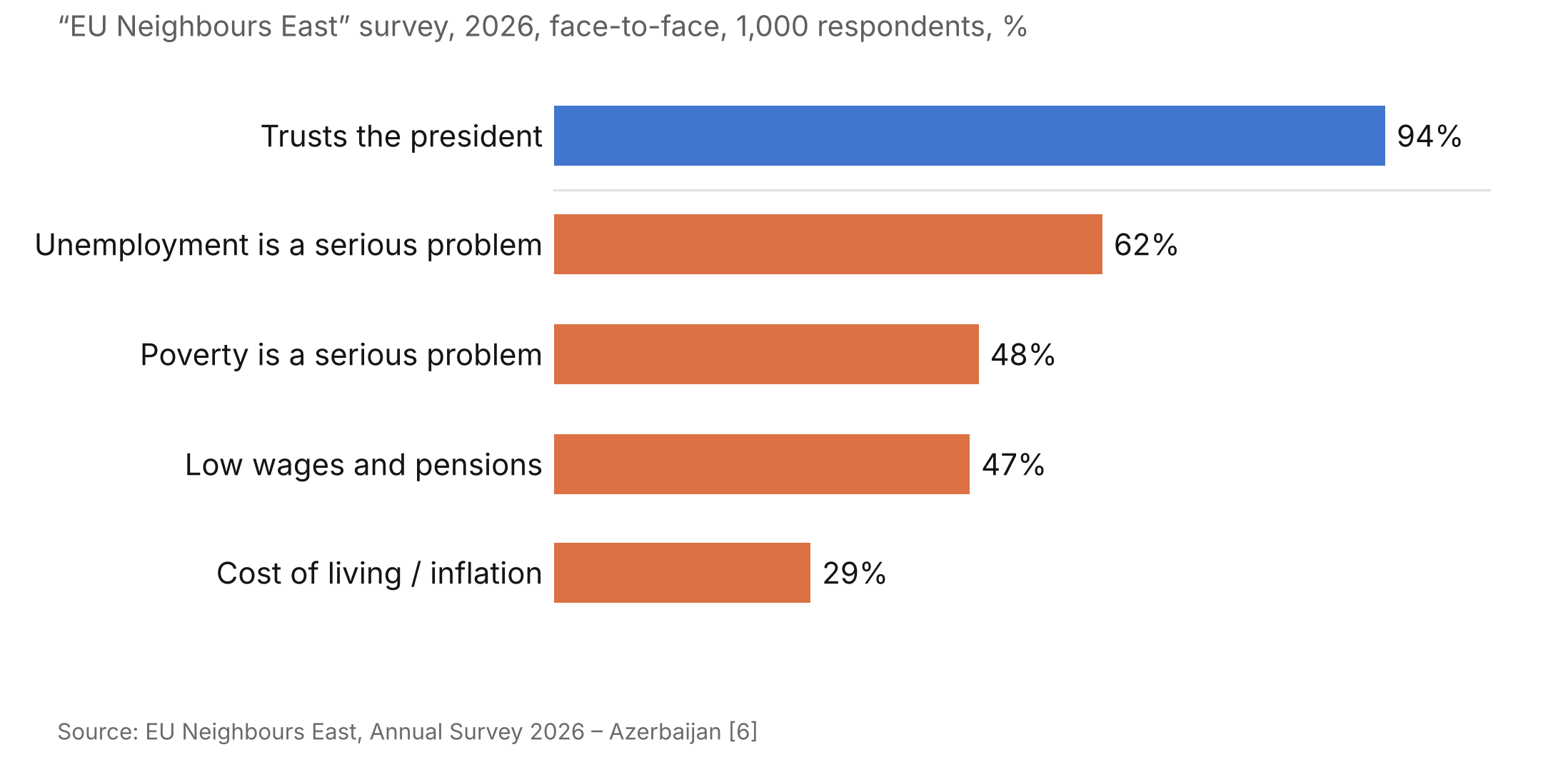
These figures also make it relevant to compare statements about stability with living conditions. In a country where citizens are by no means in the “good mood” that Aliyev speaks of, how sustainable is the balance in government-society relations, and what factors can affect it?
Growing Tax Burden
One of those factors is at whose/what expense the government increases budget revenues.
In the first nine months of 2026, oil and condensate production in Azerbaijan fell from 20.7 million tonnes in the same period of the previous year to 19.9 million tonnes (Ministry of Energy, 2025; Ministry of Energy, 2026). However, the assets of the State Oil Fund (74 billion dollars as of the end of September – State Oil Fund, 2026) allow the government to soften the impact of the decline in production on the budget and the exchange rate. Another factor that increases this capacity is the rise in oil prices. The average price of “Brent” oil was 116.8 dollars per barrel in September and 125 dollars in October (World Bank, 2026).
However, the draft budget for 2027 envisages reducing the transfer from the Oil Fund from 12.835 billion manat to 11.9 billion manat, while increasing revenues from the State Tax Service by 1.5 billion manat (Milli Majlis, 2025a; Milli Majlis, 2026a; Milli Majlis, 2026b).
This could be considered good news for the country’s citizens only if the government planned to increase tax revenues through new jobs and more productive enterprises. In the current case, part of the increase will be ensured through the abolition of tax exemptions, that is, the budget’s gain will turn into an additional expense in the citizen’s budget.
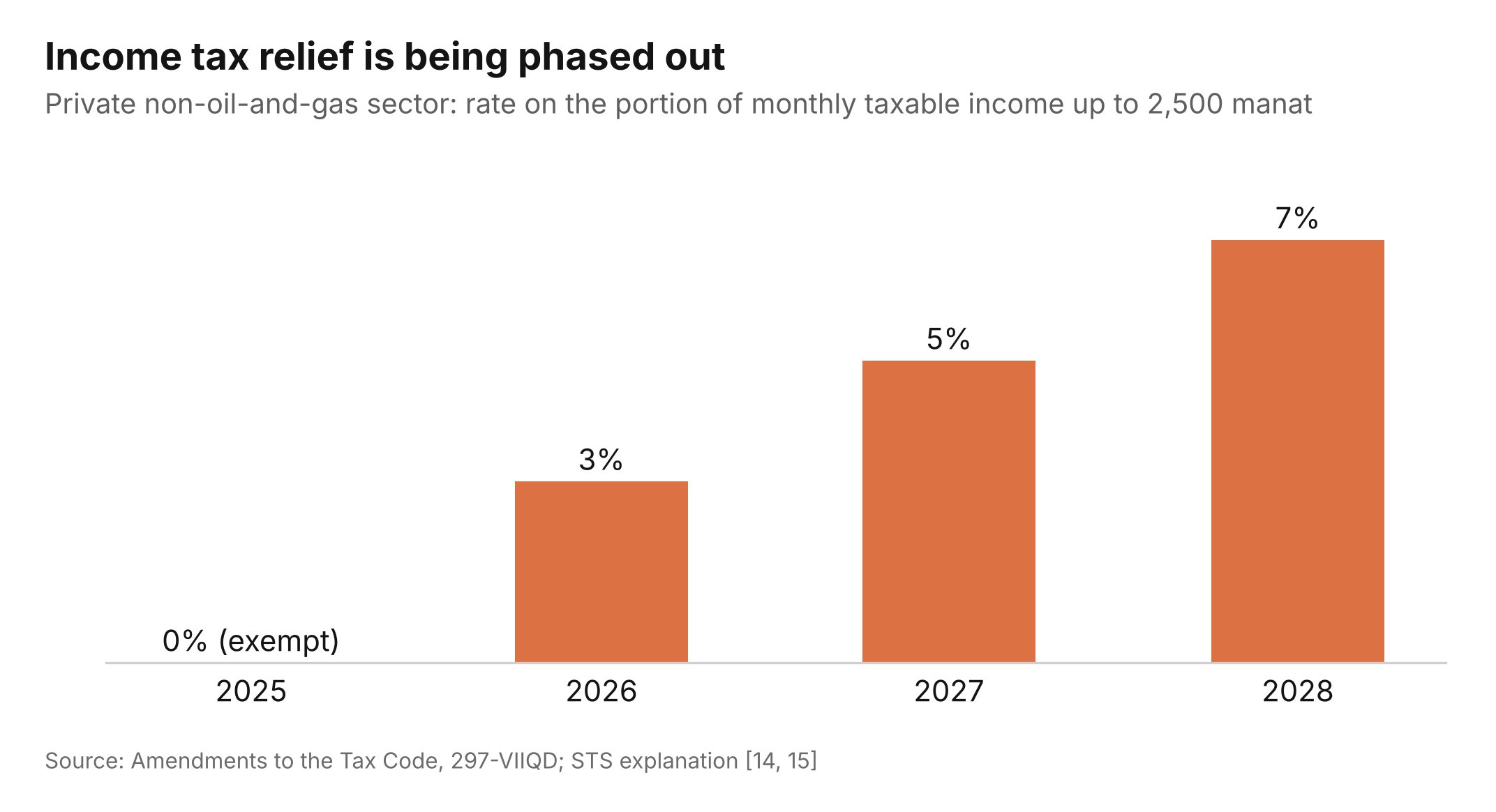
In fact, the process began at the start of the year. The seven-year exemption that freed monthly salaries of up to 8 thousand manat from income tax in the private part of the non-oil-and-gas sector expired at the beginning of this year. Under the new rule, a rate of 3 percent applies this year to the portion of monthly taxable income up to 2,500 manat. In 2027 this rate will be raised to 5 percent, and in 2028 to 7 percent (Milli Majlis, 2025b; State Tax Service, n.d.-a). With the exception of exemptions for the sale of passenger cars produced in Azerbaijan, VAT exemptions on the import/sale of electric passenger cars and the import/sale of hybrid cars meeting the exemption criteria also expired at the beginning of this year (Milli Majlis, 2025b; Milli Majlis, 2023a; State Tax Service, n.d.-b).
At the end of the year, the full tax exemption applied to interest income on manat deposits placed for 18 months or longer expires (Milli Majlis, 2023b). The right of individual micro-entrepreneurs to deduct 25 percent of the compulsory state social insurance contributions they pay for themselves from accrued income or simplified tax also ends at the end of the year (Milli Majlis, 2023b).
The bill being discussed in the Milli Majlis, meanwhile, envisages replacing, from 2027, the full exemption of agricultural producers from income and profit tax with a 90 percent relief for a period of five years. If the bill is adopted, 10 percent of a producer’s income or profit will be taxed under the general procedure (Orkhan Nazarli, 2026).
Although the Oil Fund’s resources allow the government to reduce the impact of the decline in production on the state budget, increasing budget revenue also through the abolition of tax exemptions – even if it does not provoke open protests in the country – the growing tax burden may weaken trust in the government and upset the balance between the government and society.
A Minimum Wage That Does Not Cover the Subsistence Minimum
Another factor affecting citizens’ attitude towards the government is whether earning opportunities in the country are accessible or not.
The IMF’s 2026 report on Azerbaijan states that “The state’s large footprint in the economy continues to hamper successful diversification” (International Monetary Fund, 2026). According to the enterprise surveys cited by the Fund, Azerbaijan’s private firms not engaged in extraction are more likely to receive orders from the state or financing from a state-owned entity than those in comparable countries of the Caucasus and Central Asia (International Monetary Fund, 2026).
Political scientist Jody LaPorte, who studies Azerbaijan’s political economy, has described the situation in this area as follows: “Political and economic life is largely concentrated around the institution of the presidency” (Jody LaPorte, 2025). Using the example of international mega-events, LaPorte examines cases in which new sectors create additional income opportunities for companies connected to political power.
So how much does the average Azerbaijani citizen earn?
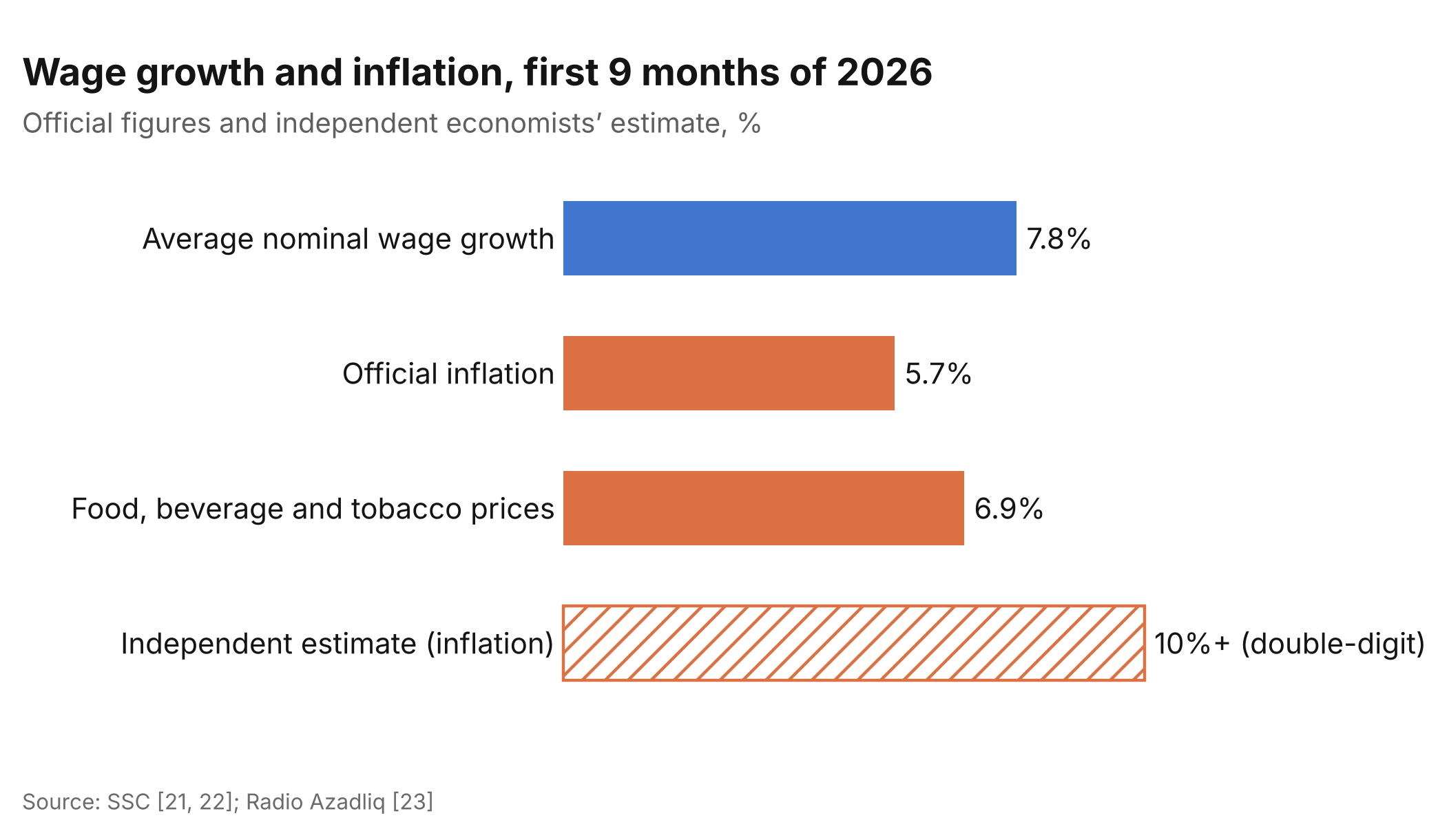
According to official statistics, the average nominal wage in Azerbaijan grew by 7.8% in the first 9 months of 2026 (SSC, 2026a). In the same period, official inflation was 5.7%, while price growth for food, alcoholic beverages and tobacco products was 6.9% (SSC, 2026b). «Radio Azadliq» writes that independent economists estimate inflation at a double-digit level ("Radio Azadliq", 2026).
According to the SSC’s household budget survey, in 2025, in the 20 percent group with the lowest per capita consumption expenditure, 48 percent of expenditure went to food products. In the 20 percent group spending the most per capita, this share was 34.9%. The SSC also includes expenditure on alcoholic beverages and tobacco products in this indicator (SSC, 2026c).
The monthly earnings of an employee in the private part of the non-oil-and-gas sector receiving a gross salary of 400 manat at their main place of work and having no additional personal tax relief were 364 manat in 2025. In 2026, as a result of the application of income tax, the net salary fell to 358 manat (Milli Majlis, 2025b; State Tax Service, n.d.-a; State Tax Service, n.d.-c). If both parents in a family with two children receive the minimum wage, their monthly earnings would total only 716 manat (State Tax Service, n.d.-c; President of the Republic of Azerbaijan, 2024). The total amount of the per capita subsistence minimums set for 2026 is 1,154 manat for a family with two children. A family with monthly wage earnings of 716 manat can cover only 62 percent of this amount. The gap is 438 manat (Milli Majlis, 2025c).
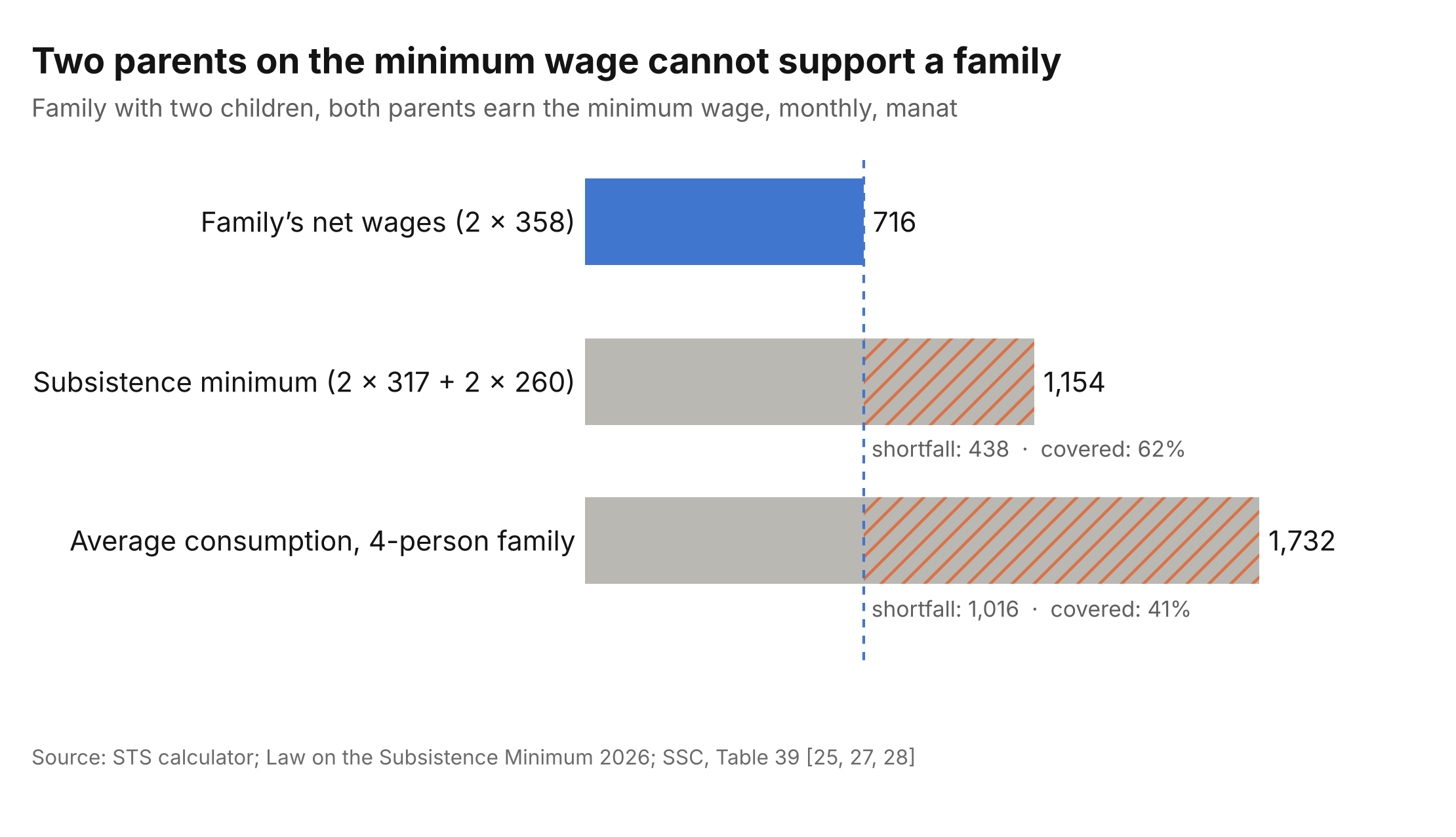
Moreover, in the first half of 2026, the average monthly consumption expenditure of four-person households was about 1,732 manat (SSC, 2026d). A net wage income of 716 manat covers less than half of this expenditure – 41 percent. In other words, the real gap is 1,016 manat.
It should be noted that the SSC does not show the number of those earning the minimum wage (400 manat) separately. The table for November 2025 shows that 23.4 percent of employees who worked the full month, that is, 387,482 people, were paid a gross wage in the range of 400–500 manat (SSC, 2025).
In Azerbaijan, targeted social assistance is provided to a certain portion of low-income families (Milli Majlis, 2005a). But this practice increases both the state’s role in the family budget and the number of problems in government-citizen relations.
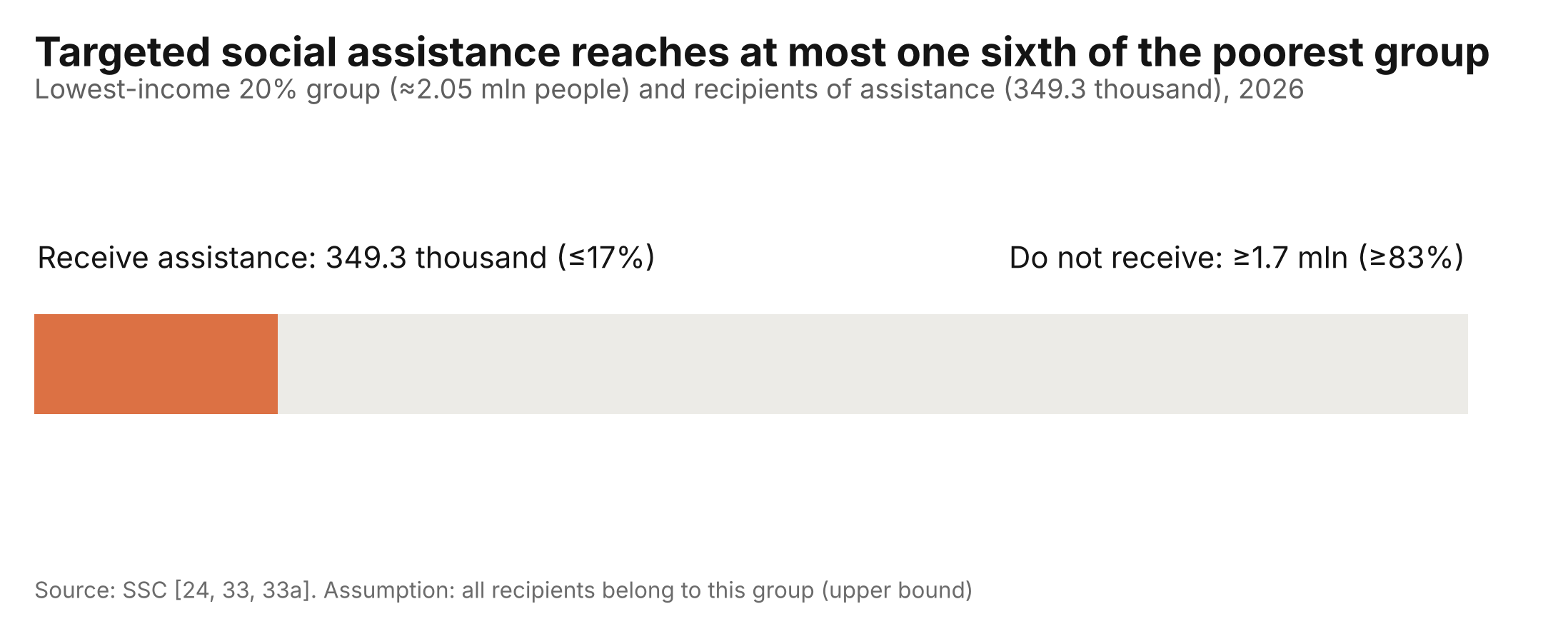
According to the SSC, as of 1 July 2026, 78.9 thousand families in Azerbaijan received targeted social assistance from the state. This assistance covered 349.3 thousand people. The average monthly amount of assistance per person was 97.9 manat (SSC, 2026e).
In the SSC survey, the population is divided into five equal groups according to per capita income level. Based on the population at the beginning of 2026, the lowest-income 20 percent group corresponds to approximately 2.05 million people (SSC, 2026c; SSC, 2026f). The SSC does not show separately how many people from that group receive assistance (SSC, 2026e). But even if all 349.3 thousand people who benefited from social assistance were included in that group, it would cover about one sixth of the group, that is, 17%.
If minimum wages do not cover even the minimum needs of a family, and this situation continues for years, over time citizens’ expectations of the government decrease and their attitude towards it changes for the worse.
The Big Trouble of Small Farmers
According to the State Statistical Committee, at the end of 2025, 34.8 percent of the employed population in Azerbaijan, that is, approximately 1.77 million people, worked in agriculture, forestry and fishing (SSC, 2026g). The share of these sectors in the country’s gross domestic product in 2025 was 5.9 percent (SSC, 2026h).
In the first 10 months of 2026, the real volume of agricultural production grew by 1.4% (SSC, 2026i). But this growth also includes farmers’ irrigation, fuel and labour costs. The government’s agricultural programme for 2026–2030 also contains notes on the problems in the sector (President of the Republic of Azerbaijan, 2026). Nevertheless, in family farms with up to five hectares of land, the monthly social insurance contribution for each able-bodied member with social insurance obligations has been raised from 8 manat to 20 manat (Milli Majlis, 2020; Milli Majlis, 2025b; President of the Republic of Azerbaijan, 2024).
According to the changes proposed for next year, the rule fully exempting producers of agricultural products from income and profit tax will be replaced with a 90 percent relief for a period of five years. To benefit from this relief, farmers must register in the Electronic Agriculture Information System and report their transactions in their tax returns. It is also proposed to keep the full exemption under the simplified tax for another five years under certain conditions (Orkhan Nazarli, 2026).
Large farms entrust this type of tax reporting to accountants, while in a small family farm the farmer will either have to prepare the report himself or set aside money for a professional accountant’s services. Economic expert Rovshan Agayev notes that concluding an electronic purchase act and making tax and insurance transfers to the budget for workers will also create the need to turn to an accountant: “Because in order to enter this act into the system, the farmer must log in to his tax account, enter all the necessary information about himself and the worker he will engage into the system, and confirm it with an electronic signature. After that, an SMS code arrives on the phone registered in the name of the farmer or the person providing the service to him, and that person logs in to the online tax office with this code and either confirms the act or rejects it. The situation looks very complicated” (Rovshan Agayev, 2026a; State Tax Service, 2024).
Agayev stresses that Azerbaijan’s agricultural sector resembles a person dependent on crutches; if support is not given, and if, on top of that, there is interference in how it walks and stands, it is doomed to fall: “It may be that the government, looking at the small number of people who have made huge investments and earn money from greenhouses, mega-farms, and orchards and vineyards covering dozens of hectares, thinks that profitability in the agricultural sector is high and that a decent resource for taxation lies there. But micro and small family farms that have no opportunity to apply advanced technologies and make the necessary investments, and that have nothing in hand except their 2–3 hectares of land, can provide only a middling livelihood even in a season when their earnings could be considered high. At least 70–75 percent of farms in the agricultural sector are farms of exactly this category” (Rovshan Agayev, 2026a).
The expert believes that with the abolition of tax exemptions, farms of this kind are being made ready for the next administrative intervention:
“The issue is not only the taxation of their income. An even bigger problem will be formalising contracts for the workers that micro and small farmers engage on an hourly or daily basis when they need hired labour. You may say that this is good for those workers and will help their pension provision. Rest assured, it will not. Because for people who work a maximum of 70–80 days a year, and for a considerable part of those days only a few hours, neither will the small funds they accumulate be enough for their minimum insurance capital, nor will the incomplete working days suffice for 25 years of pensionable service” (Rovshan Agayev, 2026a).
Agayev also notes that those who abolished the tax exemption and introduced the concept of an hourly wage into labour legislation for the agricultural sector have either forgotten to create a more favourable mechanism on this issue at least for micro and small farms, or appear to have forgotten because it suits them:
“If a family farm that is not a taxpayer needs hired worker(s) for 3–5 days a month or 3–5 hours a day, it will have to pay tax at source – 14% income tax, 25% social insurance contribution. That is, a tax and insurance burden of 39% arises for a payment of 100 manat. Registering for tax purposes as an individual entrepreneur will not change the situation either, and this time, taking medical and unemployment insurance into account, it will pay about 37%. Because although the law defines this as an obligation of the insured person and the employee, the hired worker will demand his net hourly or daily amount”.
The expert believes that a government abolishing tax exemptions should, at least for micro and small farmers, make concessions for hired labour in terms of withholding at source, the income tax rate and insurance contributions:
“Farmers’ dark days are still ahead. The agencies that in the last two years have immediately intervened in the construction of a chicken coop or a barn will now follow farmers closely to find out whether they employ workers without contracts in their orchards and fields. Can there be a 40% tax and insurance burden on wages in a sector that cannot stand on its own feet? At this rate, in 5 years, as soon as the relief you have given on profit (income) tax ends, you will see a sector that has been abandoned and left desolate”.
As can be seen, the proposed changes to the rules in the agricultural sector will increase the costs of small farms before their products even reach the market. Farmers will have to pay not only workers’ wages but also their tax and insurance payments; if they hire an accountant, yet another expense item will arise. In other words, the new changes will increase the problems of small farmers. As a result, this will further worsen the already poor situation of a sector with a large share in agriculture and will increase the discontent with the government of the people working in this sector.
Rising Law Enforcement Expenditure in a “Socially Oriented” Budget
In the initial state budget for 2026, 12.054 billion manat was allocated to defence and national security, the judiciary, law enforcement and prosecution bodies. The funds allocated to education, health and social security amounted to 11.914 billion manat (Milli Majlis, 2024; Milli Majlis, 2025a). Yet in the initial budget for 2025, the funds allocated to these three social sectors were 94.3 million manat more than the sum of the first two budget sections, including defence and law enforcement.
Table prepared by the author based on statistical calculations.
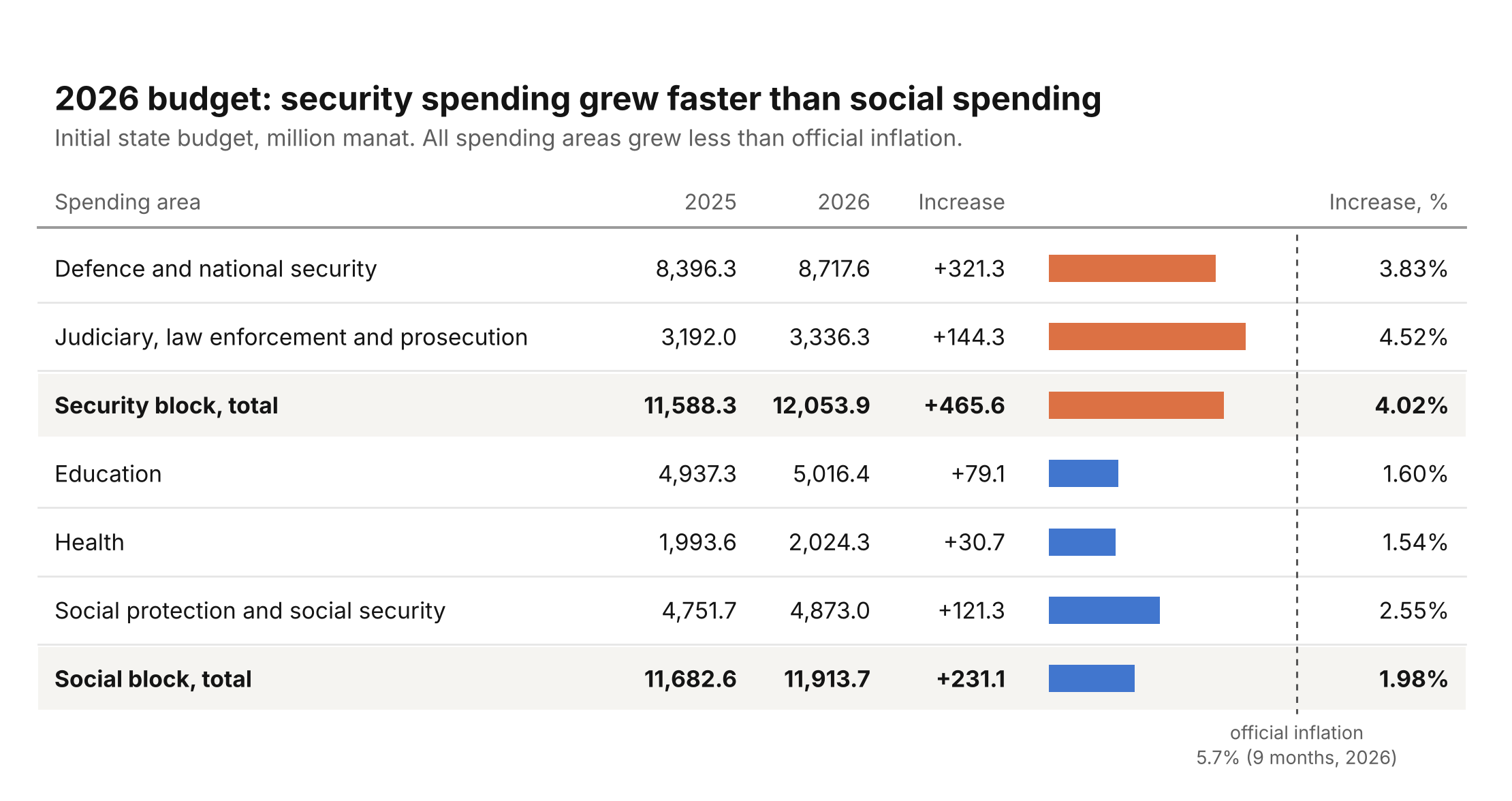
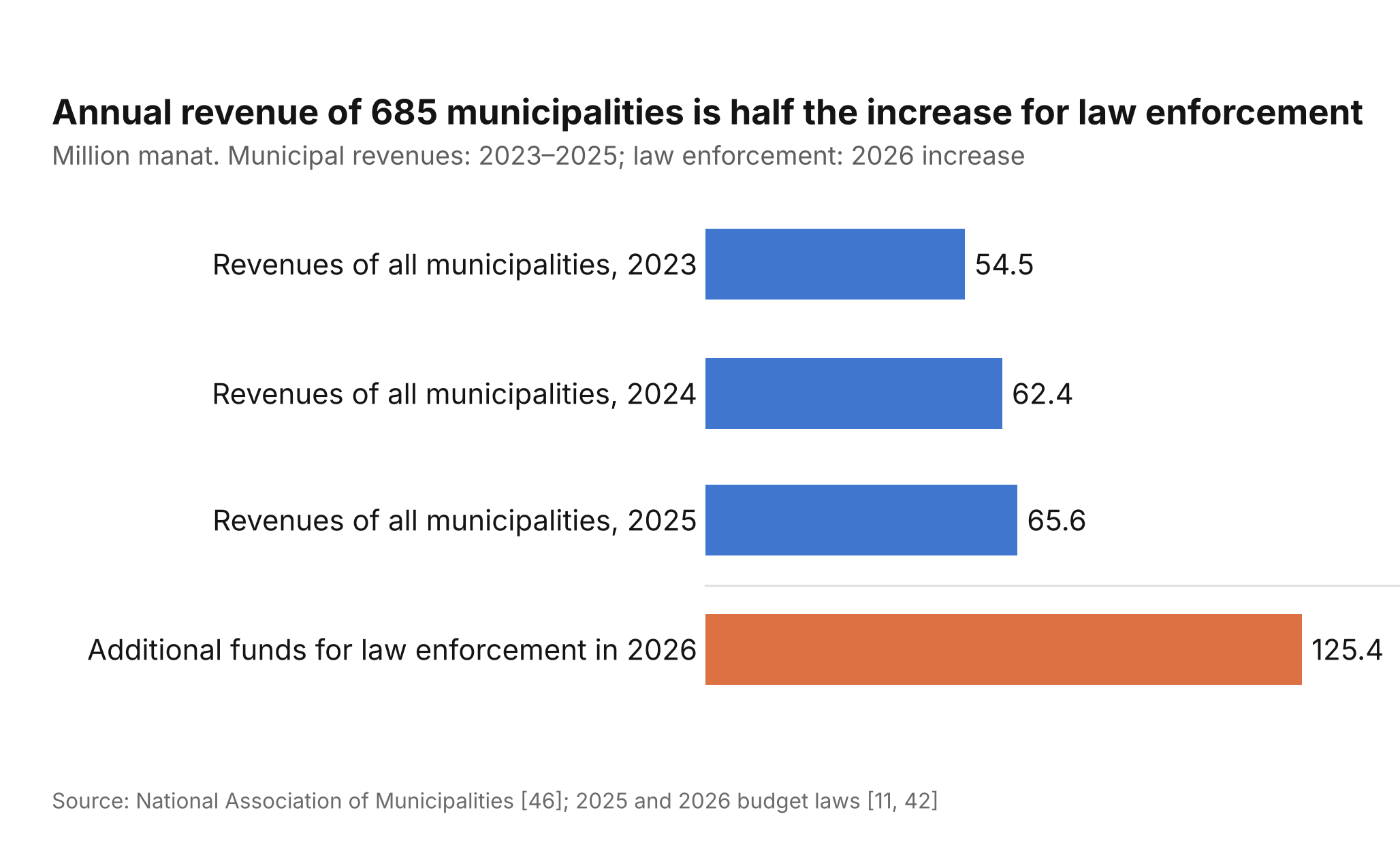
In the section on the judiciary, law enforcement and prosecution, the bulk of the increase went to law enforcement (125.4 million manat). The judiciary was allocated an additional 2.8 million manat, and the prosecutor’s office 1.2 million manat. The additional funds allocated to law enforcement alone exceed the combined increase in education and health (109.9 million manat).
This distribution alone calls into question the official presentation of the budget as socially oriented. While the funds allocated to defence, security, the judiciary, law enforcement and the prosecutor’s office were increased by 465.6 million manat, the increase for education, health and social protection was about half of that (231.1 million manat). The 17.1 billion manat (41.1 percent of the budget) that the government presented as “socially oriented expenditure” during the budget discussion is an indicator based on a broader calculation.
The Chamber of Accounts notes that in 2026 part of the funds intended for state orders and subsidies was transferred to wages and other expenditure items. This change also increased the amount presented as “socially oriented expenditure”. The Chamber therefore proposes defining by a legal act which expenditures are included in this indicator and applying the same rule both in the budget plan and in the execution report (Chamber of Accounts, 2025).
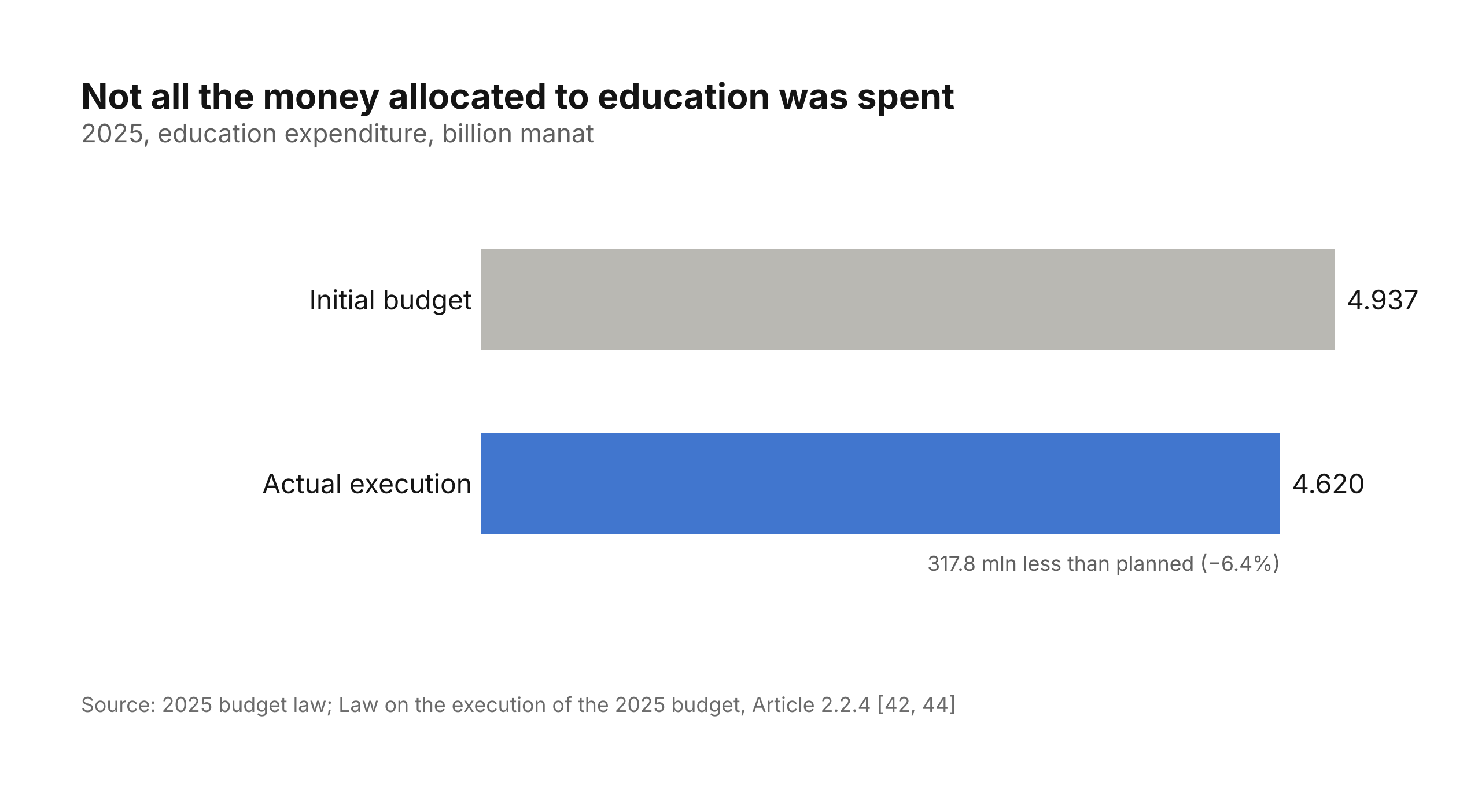
There is also a difference between the amount written in the budget and actual expenditure. For example, in the initial budget for 2025, 4.937 billion manat was allocated to education. At the end of the year, however, it turned out that 4.619 billion manat had been spent, that is, 317.8 million manat less than the initial plan (Milli Majlis, 2024; Milli Majlis, 2026c).
Whether budget spending creates a “good mood” among citizens is seen more clearly in everyday life. For example, which examinations have become available at the district hospital thanks to funds allocated to healthcare, and have people been able to use compulsory health insurance to undergo those examinations? Has the quality of teaching in schools improved, and has parents’ financial burden from paying tutors decreased? Has the number of families that previously received social assistance from the state decreased? The statistical data in open sources do not contain answers to these questions in the citizen’s favour.
If the additional funds allocated in the budget to law enforcement exceed the sum of the additional financing directed to the education and health sectors, and if education and health expenses increase the family’s financial burden, the citizen’s belief that his needs are secondary for the government may grow stronger, and the limits of society’s loyalty to the government may narrow.
Penniless Municipalities, Wealthy Officials
One of the key links in government-society relations is local governance bodies. In Azerbaijan, there are serious problems in this area as well.
For example, there are many districts, settlements and villages in the country whose roads need repair; but residents’ appeals to municipalities do not result in the problem being solved, because the problem of limited budgets paralyses the activities of these bodies (Milli Majlis, 2026c). Milli Majlis deputy Bahruz Maharramov also spoke about this at the parliamentary session of 14 February 2025. He stated that some village roads in Bilasuvar are still on the balance sheet of municipalities and said: "But the repair of these roads is beyond the capacity of that municipality" (Milli Majlis, 2025d).
There are 685 municipalities in Azerbaijan. Before the mergers in 2024, there were 1,606 (Milli Majlis, 2025d). According to the comparative table of the National Association of Municipalities of Azerbaijan, the total budget revenues of municipalities amounted to 54.5 million manat in 2023, 62.4 million in 2024 and 65.6 million manat in 2025. The annual growth rate fell from 14.4 percent in 2024 to 5.2 percent in 2025 (National Association of Municipalities of Azerbaijan, n.d.; SSC, 2023–2025; "Report", 2026).
Stewart Dickson, co-rapporteur of the Congress of Local and Regional Authorities of the Council of Europe, expressed this problem in 2021 as follows: “Azerbaijani municipalities are still unable in practice to perform the main tasks entrusted to them by legislation” (Council of Europe, 2021).
The Congress report also noted that the division of responsibilities between municipalities and local executive authorities was unclear (Congress of the Council of Europe, 2021).
Under Article 124 of the Constitution, heads of executive authorities are appointed and dismissed by the president. The powers of local executive authorities are also determined by the president (Constitution of the Republic of Azerbaijan, 1995, Article 124). One of the main factors affecting the lives of the country’s citizens is how these powers are used. For example, when the executive authority orders road repairs, residents should be able to find out to whom the work was entrusted, how the company was selected and how much money was allocated for the repair.
Accountability in public procurement begins precisely with these points. Disclosure of the contract allows residents to compare the work to be done and its price. To verify the decision on selecting the company, however, another piece of information is needed. Does the official who made the decision have a stake or any financial interest in that company (Milli Majlis, 2023c; Cabinet of Ministers, 2023)?
The Bertelsmann Foundation’s 2026 report on Azerbaijan notes that in recent years a number of individuals appointed to senior state positions built their careers working in companies linked to the ruling family. The report also emphasises that entrusting economic management to young technocrats facilitates the coordination of decisions within the government (Bertelsmann Foundation, 2026). In a country where such connections exist, information about officials’ income and their stakes in companies, and its verification, is of particular importance for exposing conflicts of interest.
The rules for public officials to declare their financial information were adopted in Azerbaijan in 2005 (Milli Majlis, 2005b). But the OECD monitoring report published 20 years later – in 2025 – stated that a standard declaration form and a working mechanism for verifying the information provided in it had still not been created (OECD, 2025).
In the IMF report published in May this year, the organisation’s experts called on the Azerbaijani government to launch the declaration system (International Monetary Fund, 2026).
A government that requires farmers to document the produce they sell and the money they earn is in no hurry to find out the income of senior officials and their stakes in companies. This discrimination is one of the factors that seriously worsen society’s attitude towards the government.
Political Arrests and Non-Competitive Elections
The regime’s repression and electoral policy also cast doubt on the Azerbaijani government’s statements about socio-political stability.
International human rights organisations have documented numerous facts about the restriction of freedom of expression in the country and the persecution and arrest of people with opposition views during the Aliyevs’ rule.
On 5 October 2026, human rights defenders Leyla Yunus and Elshan Hasanov shared a new list, announcing that there are 322 political prisoners in the country (Leyla Yunus and Elshan Hasanov, 2026).
On 12 November, the Committee to Protect Journalists (CPJ) condemned the 10- and 9-year prison sentences handed down to «Meclis.info» staff Imran Aliyev and Elgiz Gahraman and called for an end to the use of foreign funding charges to silence the independent press (Committee to Protect Journalists, 2026). “Amnesty International” considered the charges against “Meydan TV” journalists politically motivated and demanded their immediate release ("Amnesty International", 2026b). Reporters Without Borders (RSF) demanded the immediate release of the journalists arrested in the “Toplum TV” case and condemned the Supreme Court’s upholding of the sentences in the “Abzas Media” case (Reporters Without Borders, 2026a; Reporters Without Borders, 2026b). The EU’s External Action Service and the Council of Europe Commissioner for Human Rights have also called for the release of journalists and human rights defenders (EU External Action Service, 2024; Council of Europe Commissioner for Human Rights, 2025).
In a resolution adopted on 24 June 2026, PACE noted that the May list of local human rights defenders included 328 political prisoners. The Assembly called for a review of those cases, the withdrawal of charges or the quashing of sentences in politically motivated cases, and the release of persons meeting the criteria of political prisoners (PACE, 2026).
In a resolution adopted on 8 October 2026, the European Parliament considered the arrest of PFPA chairman Ali Karimli, Anar Mammadli and Anar Abdullayev politically motivated and demanded the immediate and unconditional release of them and other political prisoners. The Parliament called on the EU High Representative for Foreign Affairs to prepare targeted sanctions measures (European Parliament, 2026).
Serious violations have been recorded in almost all elections held during the Aliyevs’ rule. The few international observers who monitored the 1993 presidential election noted that candidates did not have equal opportunities (CSCE/ODIHR, 1993). In the 1995 parliamentary election, the joint OSCE and UN mission found serious shortcomings in candidate registration and voting[67]. In the 1998 presidential election, OSCE observers stressed the lack of conditions for equal competition in the election campaign (OSCE/ODIHR, 1998). In the 2000 parliamentary election, the vote count drew serious criticism (OSCE/ODIHR, 2001).
In 2003, when Ilham Aliyev was elected president for the first time, OSCE observers documented pressure during the campaign and widespread violations in the vote count (OSCE/ODIHR, 2003). In the 2005 parliamentary election, it was also noted that local executive bodies interfered in the process and that serious violations were committed in the vote count (OSCE/ODIHR, 2006). In the 2008 presidential election, international observers stated that opportunities for political competition were limited (OSCE/ODIHR, 2008).
In the 2009 municipal election, the Congress of Local and Regional Authorities of the Council of Europe stated that there were few real alternatives and that it encountered cases during the count that cast doubt on the integrity of the vote (Congress of the Council of Europe, 2009). In the 2010 parliamentary election, the joint mission of the OSCE, PACE and the European Parliament did not consider the election meaningful progress in terms of democratic development (OSCE, PACE and European Parliament, 2010).
In the 2013 presidential election, OSCE observers stated that equal conditions were not created for candidates and that there were serious violations in the vote count (OSCE/ODIHR, 2014). In the 2015 parliamentary election, the organisation cancelled its mission because the Azerbaijani authorities limited the number of observers the OSCE could send (OSCE/ODIHR, 2015). In the 2018 presidential election, the joint OSCE and PACE mission issued a joint opinion that there was no genuine competition (OSCE and PACE, 2018).
In the 2020 parliamentary election, the OSCE and PACE once again stated that the political environment did not allow genuine competition (OSCE and PACE, 2020). The OSCE Office for Democratic Institutions and Human Rights stressed that in the 2024 presidential and parliamentary elections there were no genuine political alternatives and that serious violations were committed in the vote count (OSCE/ODIHR, 2025b; OSCE/ODIHR, 2025a).
This chronology shows that the same criticisms have been repeated over a period of more than thirty years – candidates are not given equal opportunities, and the correct counting of votes raises serious doubts. The risk of arrest for criticism, meanwhile, deters citizens from open protest. In such conditions, the government’s claims of socio-political stability do not look convincing, to put it mildly.
The Judicial Woes of Azerbaijani Citizens
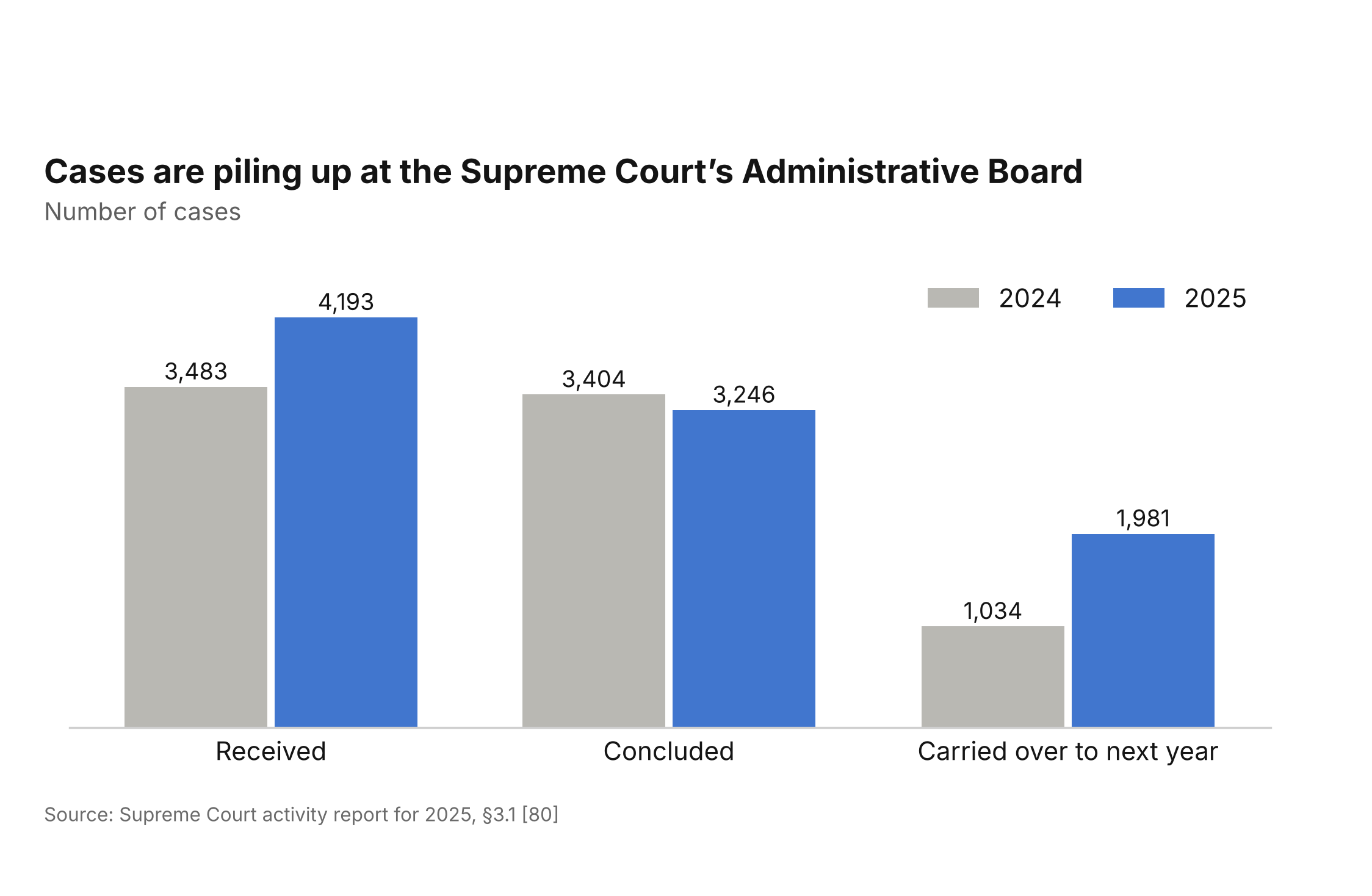
In 2025, 4,193 cases were received by the Administrative Board of the Supreme Court, compared with 3,483 the year before. Compared with 2024, the number of cases concluded fell from 3,404 to 3,246, while the cases carried over to the next year rose from 1,034 to 1,981 (Supreme Court, 2025). These statistics indicate that cases are piling up year after year.
In politically sensitive criminal cases, additional problems also arise. According to the 2026 report of the International Commission of Jurists entitled “Justice Under Pressure. Independence of Lawyers and the Right to a Fair Trial in Azerbaijan”, the admission procedure to the Bar Association is used to keep lawyers known as human rights defenders out of this body. Disciplinary proceedings have become a tool for controlling lawyers. Lawyers representing their clients in politically sensitive cases face disbarment, criminal prosecution and other forms of pressure (International Commission of Jurists, 2026).
The report also notes that the existing shortcomings in this area and the lack of independence of the judiciary deprive persons accused in criminal cases of the basic safeguards provided for by the International Covenant on Civil and Political Rights and the European Convention on Human Rights within the framework of the right to a fair trial (International Commission of Jurists, 2026; International Covenant on Civil and Political Rights, 1966, Article 14; European Convention on Human Rights, 1950, Article 6).
The document also assesses the situation following the Commission’s 2016 report «Defenceless Defenders» (International Commission of Jurists, 2016) and its 2017 briefing on legislation restricting representation in courts (International Commission of Jurists, 2017). According to the Commission’s conclusion, there has been no significant progress in implementing its recommendations and those of other international organisations, and the executive’s interference in the institution of the legal profession has continued (International Commission of Jurists, 2026).
University of Chicago political scientist Scott Gehlbach stresses that the policy of repression also creates a problem for the authoritarian leader himself. According to him, as the regime toughens repression, the dictator becomes less certain that the people support him (Emily Rosenbaum, 2024).
It is journalists, lawyers and, of course, competitive elections that make the scale of support for the government visible. As opportunities for activity in these areas narrow, the government learns about the scale of discontent in the country later – even at the moment when it already needs police intervention.
When there is no independent media and public oversight, the country’s leader’s opportunities to obtain information about the real situation diminish. In their study “Why Resource-poor Dictators Allow Freer Media”, Georgy Egorov, Sergei Guriev and Konstantin Sonin show that a free media helps the leader improve governance by exposing shortcomings in the work of officials. But because revenues from oil and other natural resources help to “patch up” the poor economic results of weak governance, the leader’s interest in this kind of oversight decreases (Georgy Egorov, Sergei Guriev and Konstantin Sonin, 2009).
In such a situation, it becomes difficult to determine the true scale not only of discontent with the government, but also of support for it. Because people refrain from open criticism, the leader does not know how much of the applause stems from satisfaction and how much from fear and dependence. The study by Scott Gehlbach, Zhaotian Luo, Anton Shirikov and Dmitriy Vorobyev entitled «Is There Really a Dictator’s Dilemma? Information and Repression in Autocracy» notes that this uncertainty can lead to underestimating the threat or to seeking threats everywhere, and both cases increase the likelihood of an inadequate response (Scott Gehlbach et al., 2026).
The Azerbaijani government prefers the second option more – seeking threats. Since 2020, it has particularly intensified repression against critics. If the regime weakens for any reason, this may become one of the main causes affecting the balance between government and society.
Conclusion
The data collected in this study allow three conclusions to be drawn.
First, silence is not proof of consent. The 94 percent trust in the president was measured in face-to-face surveys. In a politically sensitive environment, such surveys have difficulty measuring people’s true thoughts. The same respondents consider unemployment, poverty and low incomes serious problems. This shows a clear contradiction between the “good mood” claim and the assessment citizens give of their own living conditions. In Timur Kuran’s terms, neither society nor the government knows the size of this gap between public and private opinion.
Second, the government is depriving itself of the opportunity to learn the scale of discontent. The independent media, the opposition, competitive elections and functioning municipalities are the channels that convey society’s “voice” to the government. As shown in the article, each of these channels has either been closed or has completely lost its function. This is exactly the dictator’s dilemma described by Ronald Wintrobe: the repression that protects the leader’s security deprives him of accurate information. The experiments of Kelly See and her colleagues point to a factor that further increases this risk. Power poisoning increases the leader’s confidence in his own judgement and reduces his willingness to listen to outside advice. Thus, the claim of stability is hollow for two reasons: few signals arrive, and little attention is paid to the signals that do arrive.
Third, the terms of the authoritarian bargain are changing against the citizen. For many years, oil revenues allowed the government to demand little from citizens. Now the transfer from the Oil Fund to the budget has been reduced, tax revenues are being increased, tax exemptions are being abolished one after another, and taxes are rising. Two parents earning the minimum wage can cover only 62 percent of the family’s subsistence minimum. Targeted social assistance reaches at most one sixth of the poorest group. In the budget, security spending is growing twice as fast as social spending. The government requires small farmers to document every transaction, but for twenty years it has not launched the income declaration system for public officials. Michael Ross’s “taxation effect” shows that the more the state takes from citizens, the more citizens expect accountability. In Azerbaijan today, it is precisely what is demanded of citizens that is growing, while there is not even a glimmer of accountability on the part of the government.
Of course, this does not mean that the regime will soon be shaken. The Oil Fund’s assets worth billions of dollars and high oil prices allow the government to soften discontent by financial means. World experience also shows that authoritarian regimes can survive for decades amid discontent. But this is an indicator not of stability, but of time. There is no need to recall that this calendar started long ago in Azerbaijan.
Note: The article you have read was originally written in the Azerbaijani language. Artificial intelligence tools were used only in the translation.
References:
"Human Rights Watch", 1999. "Azərbaycan. İşgəncəyə görə cəzasızlıq" (Azerbaijan: Impunity for Torture), "Background". https://www.hrw.org/reports/pdfs/a/azerbjn/azer0799.pdf
Tomas de Vaal, 2016. "Azərbaycan müstəqilliyinin 25-ci ilində. Dəyişikliklər və təlatümlər dövrü" (Azerbaijan at Twenty-Five: A New Era of Change and Turbulence), Carnegie. https://carnegieendowment.org/russia-eurasia/research/2016/10/azerbaijan-at-twenty-five-a-new-era-of-change-and-turbulence
ATƏT/DTİHB, 2025a. Azərbaycanda 1 sentyabr 2024-cü il növbədənkənar parlament seçkiləri üzrə yekun hesabat (Azerbaijan: Early Parliamentary Elections, 1 September 2024 – Final Report), 27 fevral 2025. https://odihr.osce.org/sites/default/files/f/documents/3/f/586290_0.pdf
"Freedom House", 2026. Azerbaijan: Freedom in the World 2026 Country Report, E1 bəndi. https://freedomhouse.org/country/azerbaijan/freedom-world/2026
Avropa Şurasının Nazirlər Komitəsi, 2025. Gafgaz Mammadov group v. Azerbaijan. 12 iyun tarixli qərar, 1-ci və 5-ci bəndlər. https://rm.coe.int/0900001680b64823
ATƏT/DTİHB, 2011. Azərbaycan. 7 noyabr 2010-cu il parlament seçkiləri üzrə yekun hesabat (Azerbaijan, Parliamentary Elections, 7 November 2010: Final Report). https://odihr.osce.org/sites/default/files/f/documents/3/c/75655.pdf
ATƏT/DTİHB, 2025. Azərbaycan. 1 sentyabr 2024-cü il növbədənkənar parlament seçkiləri üzrə yekun hesabat (Azerbaijan: Early Parliamentary Elections, 1 September 2024 – Final Report). https://odihr.osce.org/sites/default/files/f/documents/5/8/587972.pdf
Azərbaycan MSK, 2024. 1 sentyabr 2024-cü il növbədənkənar parlament seçkilərində səsvermənin ümumi yekunlarına dair protokol (Protocol on the Overall Voting Results of the 1 September 2024 Early Parliamentary Elections). https://www.msk.gov.az/uploads/MM2024/AR_MSK_PRT_2024_MM.pdf#page=2
Parlamentlərarası İttifaq, 2026. Ermənistan. 2026-cı ilin iyununda keçirilmiş parlament seçkilərinin nəticələri (Armenia National Assembly June 2026 Election). https://data.ipu.org/parliament/AM/AM-LC01/election/AM-LC01-E20260607/
ATƏT/DTİHB, 2024. Beynəlxalq müşahidəçilər Azərbaycanda parlament seçkilərinin səmərəli hazırlandığını, lakin əsas azadlıqların məhdudlaşdığı şəraitdə real rəqabət olmadan keçdiyini bildiriblər (Azerbaijan’s elections devoid of real competition amid diminishing respect for fundamental freedoms, but efficiently prepared: international observers). https://odihr.osce.org/odihr/elections/575509
ATƏT/DTİHB, 2026. Ermənistanda birbaşa xarici təzyiq və qeyri-bərabər kampaniya imkanları fonunda seçicilərə real seçim imkanı verilib (Armenia’s voters were offered a genuine choice against a backdrop of direct foreign pressure and uneven campaign opportunities). https://odihr.osce.org/odihr/665473
Timur Kuran, 1991. NOW OUT OF NEVER The Element of Surprise in the East European Revolution of 1989. https://www.rochelleterman.com/ComparativeExam/sites/default/files/Bibliography%20and%20Summaries/Kuran%201991.pdf
Ronald Wintrobe, 1998. The Political Economy of Dictatorship. https://books.google.com.cu/books?id=0gzgP5hkToIC&printsec=frontcover&hl=es&source=gbs_atb#v=onepage&q&f=false
Albert O. Hirschman, 1998. Exit, Voice, and Loyalty. https://pages.ucsd.edu/~bslantchev/courses/ps240/05%20Cooperation%20with%20States%20as%20Unitary%20Actors/Hirschman%20-%20Exit,%20voice,%20and%20loyalty%20%5BCh%201-5%5D.pdf
İlham Əliyev, 2026. İlham Əliyevin Zəfər Günü münasibətilə Azərbaycan xalqına müraciəti (Ilham Aliyev Congratulated Azerbaijani People on Victory Day), 8 noyabr 2026. <https://president.az/az/articles/view/74598>
Medianın İnkişafı Agentliyi, 2026. Prezidentin fəaliyyətinə dair ictimai rəy sorğusu (Media Development Agency Public Opinion Survey on the President’s Performance), 20–30 may 2026. Agentliyin açıqlamasını APA 1 iyulda dərc edib. https://apa.az/daxili-siyaset/respondentlerin-936-faizi-prezidentin-fealiyyetini-musbet-qiymetlendirir-sorgu-977789?locale=az
"Aİ-nin Şərq Qonşuları", 2026. 2026-cı il üzrə Azərbaycan sorğusu ("EU Neighbours East": Annual Survey 2026 – Azerbaijan), metodologiya, institutlara etimad və ölkənin ən aktual problemləri üzrə qrafiklər. https://euneighbourseast.eu/wp-content/uploads/2026/06/2.-euneighbours-east_as2026_country-overview_azerbaijan.pdf
Energetika Nazirliyi, 2025. Doqquz ayda 20,7 milyon ton neft və 38,2 milyard kubmetr qaz hasilatı (During 9 Months, 20.7 Million Tons of Oil and 38.2 bcm of Natural Gas Were Produced). https://minenergy.gov.az/en/xeberler-arxivi/00634
Energetika Nazirliyi, 2026. Doqquz ayda 19,9 milyon ton neft və 37,9 milyard kubmetr qaz hasilatı (In 9 Months of This Year, 19.9 Million Tons of Oil and 37.9 Billion Cubic Meters of Natural Gas Were Produced), 15 oktyabr 2026. https://minenergy.gov.az/en/xeberler-arxivi/00914
Dövlət Neft Fondu, 2026. 2026-cı ilin yanvar–sentyabr ayları üzrə gəlir və xərclər (SOFAZ Revenue and Expenditure Statement for January–September 2026), 20 oktyabr 2026. https://oilfund.az/en/fund/press-room/news-archive/1782
Dünya Bankı, 2026. Əmtəələrin qiymət göstəriciləri ("World Bank" Commodities Price Data – The Pink Sheet), 3 noyabr 2026. https://thedocs.worldbank.org/en/doc/74e8be41ceb20fa0da750cda2f6b9e4e-0050012026/related/CMO-Pink-Sheet-November-2026.pdf
Milli Məclis, 2025a. Azərbaycan Respublikasının 2026-cı il dövlət büdcəsi haqqında Qanun (Law on the 2026 State Budget of the Republic of Azerbaijan), ilkin mətn, maddələr 2.13 və 7.2–7.6. https://static.president.az/upload/Files/2025/12/29/a1529c63a4321a66ff528fbab582268b_7879904.pdf
Milli Məclis, 2026a. Azərbaycan Respublikasının 2027-ci il dövlət büdcəsi haqqında qanun layihəsi (Draft Law on the 2027 State Budget of the Republic of Azerbaijan), maddə 2.13. https://meclis.gov.az/news-layihe.php?id=2730&lang=az&par=0
Milli Məclis, 2026b. İqtisadi siyasət, sənaye və sahibkarlıq komitəsində 2027-ci il dövlət büdcəsinin müzakirəsi (Discussion of the 2027 State Budget by the Committee on Economic Policy, Industry and Entrepreneurship), maliyyə nazirinin açıqlaması. https://meclis.gov.az/news.php?id=7032&lang=az
Milli Məclis, 2025b. 2026-cı ildən tətbiq olunan vergi və sosial sığorta dəyişiklikləri haqqında Qanun (Law Amending the Tax Code, the Law on Social Insurance and Other Legislative Acts), 297-VIIQD, maddələr 101.1-1, 164.1.41–164.1.41-4 və sosial sığorta üzrə 14.5.1-2. https://static.president.az/upload/Files/2025/12/29/7a3e34ba6528174f7d60b6ecd030d556_5628101.pdf
Milli Məclis, 2023a. Yerli minik avtomobillərinə ƏDV güzəşti verən 2023-cü il qanunu (Law Amending the Tax Code of the Republic of Azerbaijan). https://president.az/az/articles/view/60489
Dövlət Vergi Xidməti, tarixsiz-a. Qeyri-neft-qaz sektorunun özəl bölməsi üçün yeni gəlir vergisi mexanizmi (New Personal Income Tax Relief Mechanism for the Private Non-Oil and Gas Sector). https://www.taxes.gov.az/az/post/4461
Dövlət Vergi Xidməti, tarixsiz-b. Tez-tez verilən suallar, hibrid avtomobillərin ƏDV-yə cəlb edilməsi (Frequently Asked Questions: VAT on Hybrid Vehicles), sual 5. https://www.taxes.gov.az/az/page/faq
Milli Məclis, 2023b. Vergi Məcəlləsində dəyişiklik edilməsi haqqında Qanun (Law Amending the Tax Code of the Republic of Azerbaijan), 5 dekabr 2023, əmanətlər üzrə 102.1.22-4, mikrosahibkarlar üzrə 152.3 və 221.1-1. https://www.taxes.gov.az/uploads/2023/qanunvericilik/05122023.pdf
Orxan Nəzərli, 2026. Milli Məclisin komitə iclasında çıxışı (Statement by Orkhan Nazarli, Head of the State Tax Service, at a Parliamentary Committee Meeting), 6 noyabr 2026. https://www.taxes.gov.az/az/post/5124
Beynəlxalq Valyuta Fondu, 2026. Azərbaycan Respublikası üzrə 2026-cı il IV Maddə məsləhətləşməsinin heyət hesabatı (The Republic of Azerbaijan: Staff Report for the 2026 Article IV Consultation), № 26/112, §25–26, 27 may 2026. <https://www.imf.org/en/publications/cr/issues/2026/05/27/the-republic-of-azerbaijan-staff-report-for-the-2026-article-iv-consultation-576375> · <https://www.imf.org/-/media/files/publications/cr/2026/english/1azeea2026001.pdf>
Jody LaPorte, 2025. "Nüfuzdan qazanc. Azərbaycanda meqatədbirlərin siyasi iqtisadiyyatı" (Profiting from Prestige: The Political Economy of Mega-Events in Azerbaijan). <https://link.springer.com/article/10.1057/s41268-025-00342-z>
DSK, 2026a. Ölkədə muzdla çalışan işçilərin sayı və əməkhaqqı barədə (Number of Employees and Salaries in the Country), 2026-cı ilin yanvar–sentyabr ayları üzrə əməkhaqqı. <https://www.stat.gov.az/news/index.php?id=7010&lang=az>
DSK, 2026b. İstehlak qiymətlərinin dəyişməsi (Changes in Consumer Prices), 2026-cı ilin yanvar–sentyabr ayları. <https://www.stat.gov.az/news/index.php?id=6961&lang=az>
"AzadlıqRadiosu", 2026. "Bu pulla ayın sonunu necə gətirim?! – Gələn ildən pensiyalar fərqli artacaq" ("How Can I Make It to the End of the Month on This Money?!" – Pensions Will Rise Differently Next Year), 6 oktyabr 2026. <https://www.azadliq.org/a/pensiya-indeksasiya/33871158.html>
DSK, 2026c. "Ev təsərrüfatları tədqiqatının yekunları" (Results of Household Budget Survey), 2026-cı il nəşri, 2025-ci ilin məlumatları. İstehlak xərcləri üzrə qrupların metodologiyası və xərclərin tərkibinə dair 59-cu cədvəl. <https://www.stat.gov.az/menu/6/statistical_yearbooks/source/evtes_2026.pdf> · <https://www.stat.gov.az/menu/6/statistical_yearbooks/source/evtes_2026.pdf#page=71>
Dövlət Vergi Xidməti, tarixsiz-c. Əməkhaqqından tutulmaların hesablanması (Calculation of Payroll Deductions). 364, 358 və 716 manat mətndəki şərtlərlə hesablanıb. <https://www.taxes.gov.az/az/page/emek-haqqindan-tutulmalarin-hesablanmasi>
Azərbaycan Respublikasının Prezidenti, 2024. Minimum aylıq əməkhaqqının artırılması haqqında Prezidentin sərəncamı (Presidential Order on Increasing the Minimum Monthly Wage), 23 dekabr 2024. <https://president.az/az/articles/view/67602/print>
Milli Məclis, 2025c. Azərbaycan Respublikasında 2026-cı il üçün yaşayış minimumu haqqında Qanun (Law on the Subsistence Minimum in the Republic of Azerbaijan for 2026). Əmək qabiliyyətli şəxsə 317 manat, uşağa 260 manat. <https://president.az/az/articles/view/71146/print>
DSK, 2026d. Ev təsərrüfatları tədqiqatının 2026-cı ilin yanvar–iyun ayları üzrə yekunları (Results of Household Budget Survey, January–June 2026), cədvəl 39. Dörd nəfərlik ev təsərrüfatında adambaşına orta aylıq istehlak xərci 433,1 manatdır. <https://www.stat.gov.az/source/budget_households/az/bul/bul_evtes_2026_1-6.pdf#page=44>
DSK, 2025. 2024 və 2025-ci illərin noyabr ayını tam işləmiş işçilərin hesablanmış əməkhaqqına və iqtisadi fəaliyyət növünə görə bölgüsü (Distribution of Fully Worked Employees in November 2024–2025 According to Size of Wages and Salaries by Economic Activities), 2025-ci il cədvəli. <https://www.stat.gov.az/source/labour/az/004_11-12.xls>
Milli Məclis, 2004. Yaşayış minimumu haqqında Qanun (Law on the Subsistence Minimum), maddə 1.0.2. <https://frameworks.e-qanun.az/5/f_5518.html>
Nazirlər Kabineti, 2005. Nazirlər Kabinetinin minimum istehlak səbətinin tərkibini təsdiqləyən 118 nömrəli qərarı (Cabinet of Ministers Decision No. 118 Approving the Composition of the Minimum Consumer Basket), 23 iyun 2005, konsolidə edilmiş mətn. <https://frameworks.e-qanun.az/10/c_f_10061.html>
Milli Məclis, 2005a. Ünvanlı dövlət sosial yardımı haqqında Qanun (Law on Targeted State Social Assistance). <https://frameworks.e-qanun.az/10/f_10854.html>
DSK, 2026e. Ölkədə sosial təminat haqqında (Social Security in the Country), 1 iyul 2026-cı il vəziyyətinə. <https://www.stat.gov.az/news/index.php?id=6890&lang=az>
DSK, 2026f. "Aylıq makroiqtisadi göstəricilər" (Monthly Macroeconomic Indicators), 2026-cı il yanvarın 1-nə ölkə əhalisinin sayı. <https://www.stat.gov.az/news/macroeconomy.php?arxiv=1&lang=az&page=8>
DSK, 2026g. "Azərbaycan rəqəmlərdə 2026" (Azerbaijan in Figures 2026), cədvəl 5.3, iqtisadi fəaliyyət növləri üzrə məşğulluq. <https://www.stat.gov.az/menu/6/statistical_yearbooks/source/azfigures_2026.pdf#page=50>
DSK, 2026h. 2025-ci ildə ümumi daxili məhsul istehsalı (Production of Gross Domestic Product in 2025). <https://www.stat.gov.az/news/index.php?id=6590&lang=en>
DSK, 2026i. Kənd təsərrüfatı məhsulu istehsalı haqqında (Agricultural Production), yanvar–oktyabr 2026, 13 noyabr 2026. <https://www.stat.gov.az/news/index.php?id=7019&lang=en>
Azərbaycan Respublikasının Prezidenti, 2026. 2026–2030-cu illər üçün kənd təsərrüfatı, balıqçılıq və akvakultura məhsullarının istehsalı və emalı üzrə Dövlət Proqramı (State Programme for 2026–2030 on the Development of Agricultural, Fisheries and Aquaculture Production and Processing in Azerbaijan), §3. <https://president.az/az/articles/view/72533>
Milli Məclis, 2020. "Sosial sığorta haqqında" Qanuna əvvəlki dəyişiklik (Law Amending the Law on Social Insurance), beş hektaradək torpaq üçün əvvəlki 2 faizlik dərəcə. <https://president.az/az/articles/view/38965>
Rövşən Ağayev, 2026a. Aqrar vergi layihəsində elektron alış aktı və mühasib xidmətinə ehtiyac barədə paylaşım (Facebook Post on Electronic Purchase Acts and Accounting for Farmers). <https://www.facebook.com/share/p/19pcn2Aqzt/?mibextid=wwXIfr>
Dövlət Vergi Xidməti, 2024. Elektron alış aktının tətbiqi qaydalarında dəyişiklik (Changes to the Rules for Electronic Purchase Acts). <https://www.taxes.gov.az/az/post/3754>
Rövşən Ağayev, 2026b. Kiçik fermerlərin və mövsümi işçilərin vergi-sığorta yükü barədə paylaşım (Facebook Post on the Tax and Social Insurance Burden of Small Farms and Seasonal Work). <https://www.facebook.com/share/p/1EPN6tzXqG/?mibextid=wwXIfr>
Milli Məclis, 2024. Azərbaycan Respublikasının 2025-ci il dövlət büdcəsi haqqında Qanun (Law on the 2025 State Budget of the Republic of Azerbaijan), ilkin mətn, maddələr 7.2–7.6. <https://static.president.az/upload/Files/2024/12/27/8a2923c19ec9fa2e68e687545a6bb92b_6706128.pdf>
Hesablama Palatası, 2025. Hesablama Palatasının 2026-cı il dövlət büdcəsi layihəsinə rəyi (Opinion of the Chamber of Accounts on the Draft State Budget for 2026), §4.3.4. <https://sai.gov.az/files/R%C9%99y_31.10_son%20sayta-67424737.pdf>
Milli Məclis, 2026c. 2025-ci il dövlət büdcəsinin icrası haqqında Qanun (Law on the Execution of the 2025 State Budget of the Republic of Azerbaijan), maddə 2.2.4. <https://static.president.az/upload/Files/2026/07/07/666a373995599d5fd19ef49c9632ddff_4462424.pdf#page=3>
Milli Məclis, 2025d. Milli Məclisin 14 fevral 2025-ci il plenar iclasının stenoqramı (Verbatim Record of the Plenary Sitting of the Milli Majlis on 14 February 2025), bələdiyyələrin birləşdirilməsi və Biləsuvarda kənd yolları barədə çıxış. <https://meclis.gov.az/documents/14.02.2025.pdf#page=30> · <https://meclis.gov.az/documents/14.02.2025.pdf#page=44>
Azərbaycan Bələdiyyələrinin Milli Assosiasiyası, tarixsiz. Ölkə bələdiyyələrinin illik büdcə gəlirləri barədə müqayisəli cədvəl (Comparative Table of Annual Municipal Budget Revenues). <https://abma.gov.az/az/haqqmzda>
DSK, 2023–2025. DSK, 2023, 2024 və 2025-ci illər üzrə bələdiyyə büdcəsinin icrası bülletenləri (Municipal Budget Execution, 2023–2025). <https://www.stat.gov.az/source/finance/index.php?mode=desktop>
"Report", 2026. Ötən il Azərbaycanda bələdiyyələrin gəliri 5,2 faiz artıb (Municipal Revenues in Azerbaijan Rose by 5.2 Percent Last Year). Ədliyyə Nazirliyinin açıqlaması. <https://report.az/daxili-siyaset/oten-il-azerbaycanda-belediyyelerin-geliri-5-2-faiz-artib>
Avropa Şurası, 2021. Azərbaycanda yerli özünüidarəetmə, bələdiyyələrin məhdud səlahiyyətləri və zəif maliyyə vəziyyəti (Local Self-Government in Azerbaijan: Few Improvements Observed, Limited Powers and Weak Financial Position of Municipalities Must Be Urgently Addressed), 18 iyun 2021, Stüart Diksonun açıqlaması. <https://www.coe.int/en/web/baku/-/local-self-government-in-azerbaijan-few-improvements-observed-limited-powers-and-weak-financial-position-of-municipalities-must-be-urgently-addressed>
Avropa Şurası Konqresi, 2021. Azərbaycanda Yerli Özünüidarəetmə haqqında Avropa Xartiyasının tətbiqinin monitorinqi (Monitoring of the Application of the European Charter of Local Self-Government in Azerbaijan), CG(2021)40-21final, 461 saylı tövsiyə və izahlı memorandum, §100. <https://rm.coe.int/monitoring-of-the-application-of-the-european-charter-of-local-self-go/1680a2a356>
Azərbaycan Respublikasının Konstitusiyası, 1995. (Constitution of the Republic of Azerbaijan), maddə 124. <https://president.az/az/pages/view/azerbaijan/constitution/> · <https://president.az/en/pages/view/azerbaijan/constitution>
