
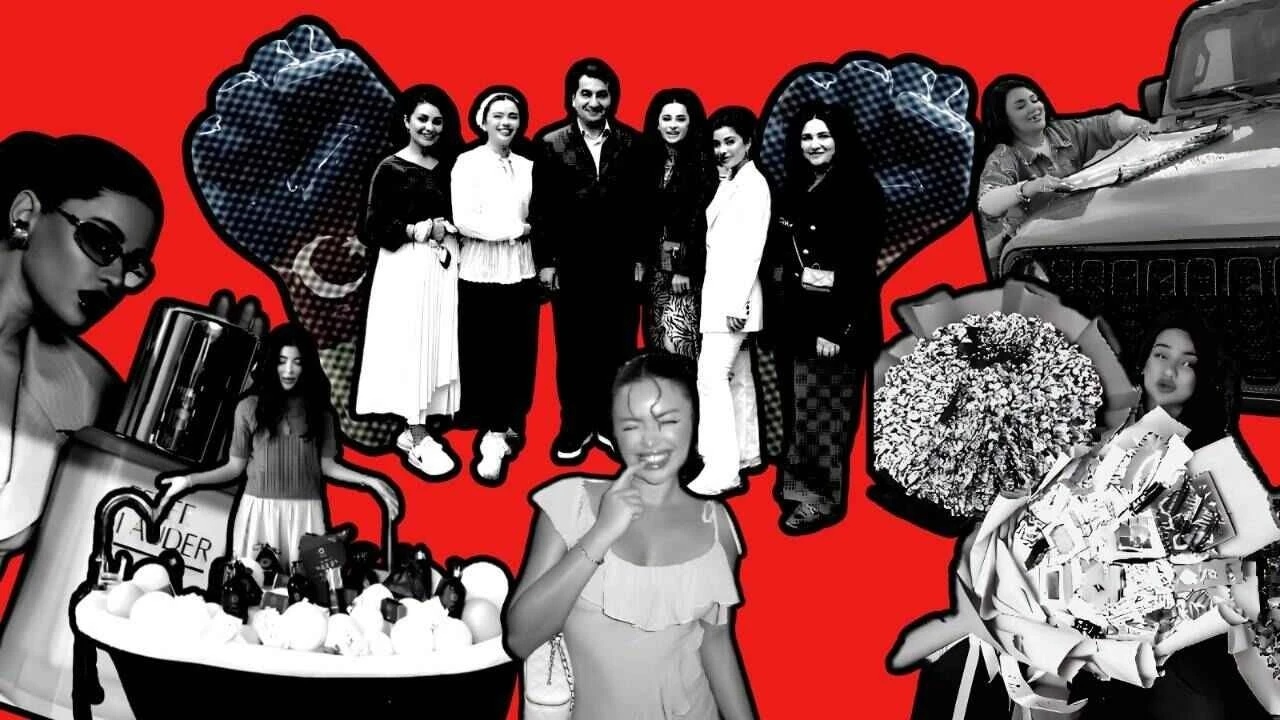
Samira Huseynli (Elmar) is a freelance researcher, journalist, and documentary filmmaker. She has an M.A degree in Future Media and Journalism from Vytautas Magnus University and B.A degree in Journalism from Baku State University. Her research interests include digital storytelling and subcultures in Azerbaijan.
(The article was prepared by the "Khar Center" within the framework of research on Azerbaijani authoritarianism)
Introduction
It is hardly contested that social media now constitutes a significant component of our social lives. According to Statista's 2025 report on social media usage (2026), internet users globally spent an average of 141 minutes per day on social media platforms. This figure is projected to rise by 2030. As the number of "mobile-savvy users" (Abidin, 2016) continues to increase, numerous studies have examined the drawbacks of social media platforms. These investigations encompass psychological aspects, as explored by Gong et al. (2025), Hogsnes and Gronli (2024), and Baccarella et al. (2018), as well as the platforms' gradual integration into politics as a form of “soft power” (Costagliola, 2021) or merely its political side as analyzed by Arnesson and Reinikainen (2024), Lewis (2019), and Grandien and Arnesson (2024). Across these studies, the term "influencer" is prominently featured, referring to individuals who gain economic and social capital through their online activities and followers. The marketing and tourism industries have extended these activities as lucrative opportunities. When an individual with a substantial following, such as a million followers, shares content online, it inherently becomes a potential focal point of attraction, regardless of promotional intent (mostly they have). In other words, under the frame of scholar Katy E. Pearce “more eyes mean more revenue” (2015). Nevertheless, certain governments with repressive regimes may perceive influencer culture as a mechanism for, as researcher Alessandra Costagliola notes, "softening their appearance" (2021) or, more concerningly, for rehabilitating their reputation, particularly during periods of political crisis.
In Azerbaijan, the trend of becoming an influencer and garnering popular attention through social media began circa in late 2010s, which continued to spread rapidly, especially among girls and young women. It has become so popular that even the president’s daughter poses as an influencer. When searching for “Influencers in Azerbaijan” on Google, the algorithm even pops her name first (FeedSpot, 2026). Although the number of internet users in Azerbaijan has sharply increased over the last century (International Telecommunication Union, 2025), the scope of studies on the political aspects of influencer culture remains limited. Its significance also lies in the fact that the Azerbaijani government seeks to foster aspirations among young people to become active “micro-celebrities” (Marwick, 2013. p. 112), through media (see Report.az, 2017), while simultaneously encroaching on freedom of expression on social media, one of the few spaces available for young activists and opposition thinkers to express political discontent in the face of authoritarian restrictions (Freedom House, 2025).
To put it another way, while the branding and tourism appeal of Azerbaijani influencer culture has been valorized in multiple studies, including those by Hasanova and Magalashvili (2025) and Abedah (2025), the extent to which the government exploits, or seeks to exploit, this culture for its own benefit remains a live issue. The aim of this article is to underscore the importance of digitally active, self-branding individuals and their growing visibility in government-aligned media. I seek to answer the following research questions: What are the main discourses through which influencers’ image is framed in Azerbaijan? and Why might influencers’ popularity, when combined with subtle political messaging, become politically significant in an authoritarian context?
For answering these questions, I conducted a media analysis of two main media outlets in Azerbaijan: Report.az and Qafqaz.info alongside digital participant observation of some most followed influencers’ pages. These two media organizations are pro-governmental in nature.
Through discourse analysis of media texts, this article examines how government narratives about influencer culture are produced, circulated, and legitimized in the media. This, in turn, can help us gain a better understanding of the reasons behind its diffusion into politics subtly. Building on prior literature on influencer practices, this article aims to enrich the existing scholarship by providing insights from a post-Soviet context, with Azerbaijan serving as a case study.
The onset of this article provides the situation of influencer culture in Azerbaijan. It then delineates how influencer culture has gained political importance as a form of soft power at an unprecedented level, before moving on to the analysis and conclusion.
1. Influencer culture in Azerbaijan
In Azerbaijani, Instagram is piquing influencers’ interest more than other social media platforms, providing with various audio-visual tools. According to a recent Statista analysis, ad spending on influencer marketing has been increasing steadily in Azerbaijan (Statista, 2025), with growing emphasis on micro- and nano-influencers, who mostly share their everyday experiences. One would even call the latter influencer-based neophytes; they are increasingly valuable for marketing companies and political interests as well, for being more active online. Micro- and nano-influencers are generally understood as influencers with relatively small follower bases, typically ranging from 500 to 50,000 followers. By contrast, macro- and mega-influencers are associated with substantially larger audiences, usually ranging from 100,000 to one million or more followers (Hudders et al., 2020). Globally, influencers are associated with several related categories, such as “digital opinion leaders”, “Internet marketers”, “public figures” and “content creators” (Casero-Ripolles, 2020, p. 171; Kanopy, “Public Figure”; Levin et al., 2025), which brings to the fore their powerful force in shaping the choices and lifestyles of the audiences they attract. Based on estimates by Meta’s advertising, Instagram had 4.25 million users in Azerbaijan in late 2025 (Kemp, 2025).
At the heart of the debate is also the ethical dimension of being a game changer in shaping someone’s opinion, sometimes through incorrect information about a product (Johansen, 2022) or by promoting a brand without any firsthand trial (Borchers & Enke, 2022). To curb this process, in 2025, the Azerbaijani government imposed a ban on influencers sharing posts for advertising purposes without disclosing words such as “advertisement,” “sponsorship,” or “collaboration” (Hüseynzadə, 2025). This law also entailed the formal inclusion of the word “influencer” into the legislation. This point is crucial in the case of Azerbaijan, especially considering that the first local influencer management company was launched in 2022, inviting fledgling influencers to register online. This process assists companies in locating influencers according to their needs. The website discloses the number of influencers in Azerbaijan as “+1,251” (Influencer.az, 2026). As Liselot Hudders argues, influencer marketing derives much of its power from influencers’ capacity to create content that resonates with their followers’ preferences and expectations (Hudders et al., 2020). This helps to explain why such practices have gained traction among decision-makers. The following chapter will examine this issue in more detail.
2. The Political dimensions of influencer culture in Azerbaijan
The purpose here is not to prescribe how influencers should behave or what kinds of issues they should address. Nevertheless, influencer activity in some countries has extended into discussions of human rights and other progressive political issues. Norway provides a particularly relevant example. In 2022, Norway introduced a requirement that advertisements, including influencer advertisements, in which a person’s body shape, size, or skin has been digitally manipulated must be labelled accordingly (Hognes & Gronli, 2024). This demonstrates that influencer culture in Norway, not only associated with engagement in social and human-rights issues, but also subject to public scrutiny and institutional regulation. Compared with influencers in the Nordic countries like Denmark, Finland, Iceland, Norway, and Sweden, the content produced by Azerbaijani influencers appears to remain largely outside explicitly political and rights-based debates. These Nordic countries are used here as contrasting democratic contexts rather than as prescriptive models for Azerbaijan. The comparison is therefore approached cautiously, given the substantial differences between these democratic societies and Azerbaijan’s authoritarian political context.
In Nordic contexts, the most successful influencers often engage with progressive social issues such as feminism, LGBTQ+ rights, sustainability, animal rights, and anti-racism, a tendency that can be understood in relation to freedom of speech and political consciousness (Arnesson & Reinikainen, 2024). In this sense, they are more visibly engaged with socio-political matters. Sometimes, more explicitly political cases may complicate the presumed trustworthiness of influencers, as illustrated by the French case (Kayali, 2023). Thus, in 2021 social media influencers collaborated with President Emmanuel Macron in an effort to reshape his public image following the negative reception of his COVID-19-related communication (Sadoun-Kerber, 2026). Political actors themselves may also adopt influencer techniques to engage audiences through social media (Ekman & Widholm, 2017; Grandien & Arnesson). In Azerbaijan, such forms of openly political influencer engagement appear to be largely absent. However, more subtle forms of collaboration between members of the ruling elite and influencers can be observed (See: Figure 1). These include, for instance, the president’s daughters or close persons attending influencer-related events or appearing on influencers’ social media pages, often accompanied by affirming language from the influencers themselves (See: Baku.ws, 2019; narmin_kazymzade, 2022; @aynurbabakhan, 2025; @aynurbabakhan, 2026; @nurluperfumelab, 2026).
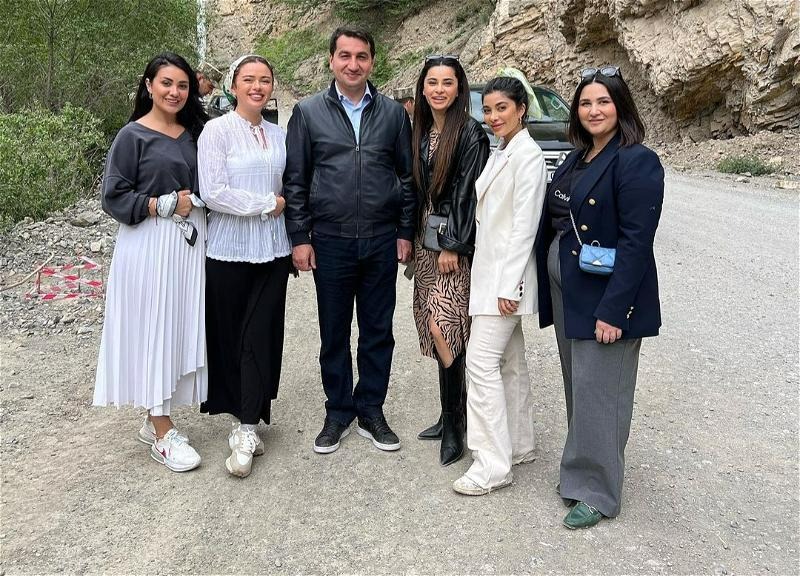 (c) @narmin_kazymzade. (Instagram)
2.1 Why subtle political messaging become significant in an authoritarian context
As Arnesson and Reinikainen (2024) argue, influencers’ informal and conversational sharing of their personal choices and everyday lives can make them appear to followers as “big sisters.” This perceived intimacy may, in turn, transfer trust to the individuals they are framed with in their posts and may impact on publicly support of those people. Furthermore, “behind-the-scenes visuals” (Grandies & Arnesson, 2024) that include political content can be understood as analogous to Goffman’s (1959) concept of “backstage” presentation, in which informal self-presentation becomes part of impression management. In the Azerbaijani context, influencers may take on this role on behalf of political actors by producing videos in which they appear in front of billboards carrying direct or indirect political messages. To exemplify, a lifestyle and comedy influencers @ulvifatime_ posted a video whose cover image showed Ulvi standing in front of a large billboard of the former president, who is also the father of the current president. However, the actual content of the video was a far cry from the topic inside (2024). Likewise, macro lifestyle influencer @shafasfashionhouse shared the content in comedy style where we see in her background the huge billbord is glorifing president with the title “Live, the Supreme Commander-in-Chief!..” (2024). Such content cannot be understood as a purely backstage presentation, since it contains explicit political symbolism. Rather, it may be described as a hybrid form in which backstage-style intimacy is used to make political endorsement appear more spontaneous, personal, and emotionally relatable. This kind of indirect presentation is significant because openly political content may not attract the same level of audience interest, particularly in a context where “society lives in a general sense of apathy and fear” (Abbasov, 2010). Under the country’s increasingly authoritarian conditions, implicit political symbolism may still retain the power to shape public perceptions. In some cases, however, such symbolism appears not merely implicit but explicitly politically supportive (See: @sabiorudjeva, 2025).
Based on my digital observations, mostly Azerbaijani influencers position themselves as lifestyle, beauty and self-care, travel, comedy, and relationship-focused influencers. At the same time, influencers operating within these seemingly non-political content categories may also be mobilised by the authorities in moments of reputational or political crisis, either to endorse the ruling family publicly or to contribute to broader efforts of damage control. In a recent case, more than ten influencers (all are macro-infleuncers), most of whom were women, posted short statements on Instagram Reels about daughter-in-law of current president following the circulation of images and videos of her former partners and luxirous choices on her clothes as a public figure. This had damaged the public image of the ruling family before the public. Those reels were framed through themes of women’s solidarity, references to her charity work, condemnation of offensive language, or personal admiration for her style and fashion taste (Toplum TV, 2026). In their support videos, the influencers highlighted their statements as expressions of solidarity with Azerbaijani women, using the sentences like “I am always supportive to all women in the society of Azerbaijan...”(00:16, @Mesi_rekhman); “It is the time to stand together...” (01:06, @AynurBabakhan). In this way, their messages appeared less as direct political approval than as expressions of sympathy, moral judgment, or personal appreciation. Indeed, these posts effectively functioned as support for the president’s family. The reason behind agitation in Civil Society (@tural.farzili, 2026, with 29.5K likes) subsequently was influencers’ silence regarding earlier cases in which women were beaten, humiliated, or killed by their husbands in acts of domestic violence, incidents that frequently appear in Azerbaijani news coverage (France 24, 2021). They brought attention particularly to the issue that at times, violence against women is also perpetrated by state authorities. One illustrative example is the Söyüdlü protests in western Azerbaijan, where residents protested the government’s plan to construct a reservoir and dispose of waste from a nearby gold mine in the area. Women were particularly active in these protests and, as a result, faced serious repercussions from the police. The event attracted public attention not only because of the authority blockaded the village, but also because chemical irritants were reportedly used against elderly female protesters (Isayev, 2023). In the end, “one major insight was the understanding that the credibility of a message often hinged not on its content but on the nature of the messenger, whose effectiveness was enhanced by similarity with the audience” (J.Cull, 2015, p.9).
Both theory and practise prove that ostensible character of political endorsement through influencer content, which is deemed as everyday life are expedient for the current political nature of the government, particularly in crisis times. This chapter gave a deeper understanding of this matter before embracing discourse in the following section.
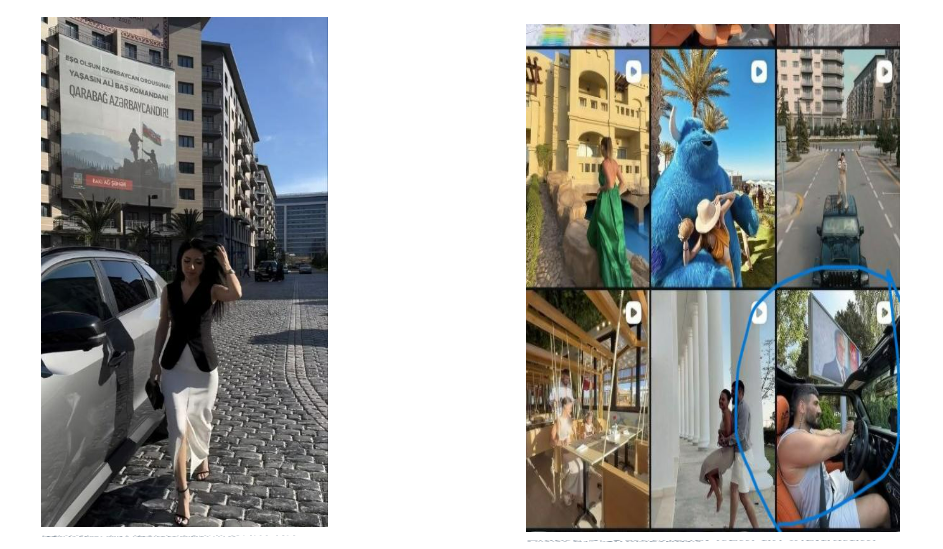 (c) @shafasfashionhouse; @ulvifatime_ (Instagram)
3. Discourses on influencers’ image is framed in Azerbaijan
This chapter aims to analyse how Azerbaijani media discursively frame the image of influencers. This study applies qualitative media analysis (Croucher & Cronn-Mills, 2015. pp. 195-203) to 19 news stories published by Qafqaz.info and Report.az between 2017 and 2025 alongside the content of 10 mega influencers’ personal pages. These news stories mainly focus on topics related to becoming an influencer and the growing visibility of influencer culture in Azerbaijan. When it comes to influencers’ own content, this self-presentation contributes to the borader discourse around them. I began my analysis by searching for keywords such as “influencer” and “social media” in order to identify relevant news stories in the selected media outlets.
In my media analysis, I identify one dominant discourse. Therefore, I present my findings by examining different viewpoints and narrative patterns within this discourse.
3.1. Influencers as a role model and influencer culture as a lucrative sector
Generally, being an influencer is espoused in Azerbijani media, although the extent to which this discourse affects young people who are at the initial stage of their career search remains unclear. However, it is conspicuous that media narratives frequently interpellate influencers as individuals to be revered or emulated. Frequently inviting them to the various education center like universities is Inter alia of this process. From this perspective, the practice of influencers sharing their success stories with young people has recently gained wider prevalence (@aynurbabakhan, 2024; @adu_tgt, 2024; @aslanovasyaa, 2024; @adu_tgt, 2025; @shafasfashionhouse, 2025). In such sessions, influencers typically deliver presentations in which they present themselves as individuals who have achieved success from scratch, potentially generating affinity and enthusiasm among young people to pursue a similar career path. Even the appearance of an “influencer” section in job vacancies may be seen as an indication of the growing interest in the influencer industry in Azerbaijan (Xəzər Xəbər, 2026). Nevertheless, whether the provenance of this appeal lies in the genuine interest of young people or in “constructed social realities” produced by the media remains equivocal (Ayolov, 2026, p. 7). As scholar Bryn Austin pointed “It’s human nature...When a message repeated again and again, it’s natural to then take that as truth’ (Newton, 2024. 20:29).
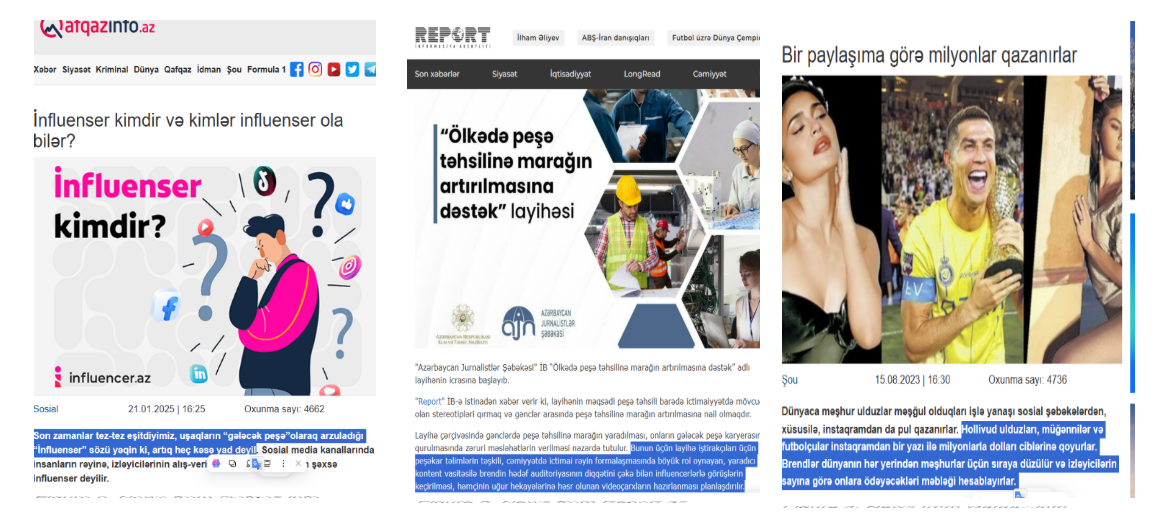
The same trend is reproduced in the media in a range of ways. To illustrate, in its news article “Who is an Influencer?”, Qafqaz.info presents the term “influencer” as a widely recognized concept and associates it with children’s aspirations for future employment (Qafqaz.info, 2025, 4761 reading. See: Figure 6). More problematically, in the body of the same article, the unknown author urges readers to become influencers, stating: “You should commence your influencer activity without delay by sharing your personal hobbies, areas of expertise, lifestyle, cuisine…” Similarly, Report.az claims in its news article that the project is created with the purpose of promoting interest in vocational education among young people and to challenge existing societal stereotypes about vocational training. However, in stark contrast to its cover image, the article’s content does not refer to any profession other than “influencer” (Səftərov, 2025. See: Figure 5).
This is not the sole way in which the influencer business is presented as remunerative. The discourse also centers on the possibility of becoming affluent through the accumulation of a large number of followers, similar to traditional celebrities who actively display ostentatious lifestyles on social media. In some cases, the aspiration to become an influencer is even associated with globally wealthy figures such as Elon Musk, thereby further reinforcing the perception of influencing as a financially rewarding and prestigious field (Qafqaz.info, 2021; Qafqaz.info, 2023. See: Figure 4). It is not surprising that young individuals, being at an impressionable age, are influenced by the content they consume, as well as by broader pressures and representations in the media when they make a decision (Handayani & Giovanny, 2024, pp. 23-29). Scholars such as Claudiu Coman et al. make a similar point, arguing that “exaggerated representations of certain professions can create false expectations, leading to disappointment and reduced academic satisfaction” (Coman et al., 2025). This point is particularly relevant in the Azerbaijani context, where the unemployment rate among young people aged 15-24 is twice as high as that of other age groups (SSCRA, 2024), a situation mainly linked to the lack of decent jobs and the inadequacy of education (Qurbanova Mirzali, 2025). Given such a situation, it is little wonder that engagement with a “profession” that appears to require neither formal education nor access to conventional workplaces may seem preferable, even at the governmental level. What is particularly interesting in these news stories is that they also reveal the existence of financial support for the flourishing of this sector, including sponsorship of projects and participation in global meetings, mainly by Gilan Holding (company of Kamaladdin Heydarov, Minister of Emergency Situations) as well as by the government itself. For instance, the director of “A-Zone” influencer agency Aliyə Cəlil state in her interview: “with the assistance of the government, I participated with the influencers in the Digital Marketing World Forum Global held in England” (Qafqaz.info, 2024).
Overall, an upward trend can be observed in the recent media coverage of the influencer theme, particularly in news stories that seek to explain the nature and function of influencer marketing (see Əliyeva, 2017; Report.az, 2018a; Report.az, 2018b; Qafqaz.info, 2024a; Qafqaz.info, 2024b; Qafqaz.info, 2025a; Qafqaz.info, 2025b). This of course begs the question of why such practices become necessary in a political context, an issue that will be examined in the following chapter.
3.2. The distractive function of influencer culture in Azerbaijan’s current political system
Globally, influencers are generally inclined to avoid political involvement, especially formal politics, in order to minimize the risk of political confrontation (Borchers, 2024, p. 55). This tendency is also observable in the Azerbaijani context. However, as influencers gain wider public recognition, the very notion of “influence” may attract policymakers seeking to exploit their persuasive power. At the same time, influencers may become politicized without being fully aware of it. The Azerbaijani government appears to recognize that many people take influencers’ opinions at face value. Moreover, unlike traditional media, influencers’ platforms often consist of relatively homogeneous audiences, making them more open to targeted messaging (Kerber, 2025). In Azerbaijan, traditional broadcasting is increasingly giving way to streaming platforms in terms of audience preferences (Statista, 2025). Against this broader shift in media consumption, political figures have also begun to appear more frequently on influencers’ pages. The Fourth Shusha Global Media Forum provides a recent example. During the forum, Hikmet Hajiyev, Assistant to the President of Azerbaijan, commented on a new law through an influencer’s page (@asolia, 2026) and expressed concern about citizens airing their grievances on social media (Toplum TV, 2026). This development coincides with concerns expressed by a pro-government journalist about declining television audiences (REAL TV, 2026). At the same time, a considerable number of influencers attended the forum and appeared to enjoy greater access to political figures after the event than many journalists did.
In an authoritarian political context, it may be easier to gain popularity as a lifestyle influencer precisely because privileged and affluent lifestyles appear both inaccessible and desirable, while still being made to feel intimate and attainable through social media. This point becomes especially important against the backdrop of worsening financial circumstances caused by rising prices (Eslamdoust, 2024). Raymond Williams, through the concept of “the structure of feeling” draws attention to the ways in which social problems have historically been resolved in unrealistic or “magical” ways in cultural texts (Storey, 2018). For example, novels may resolve unhappy marriages through the sudden death or madness of a spouse, or depict poor men returning from abroad with unexpected wealth. Similarly, in contemporary authoritarian contexts, young people may be drawn toward forms of entertainment that distract them from the multiple problems generated by authoritarian political rule. Theodor W. Adorno’s analysis of American sitcoms is particularly relevant here: he shows how a young teacher’s struggle for survival, being poorly paid and repeatedly fined by her principal, is transformed into a humorous situation rather than treated as a serious social problem.
If you are humorous, good natured, quick witted, and charming as she is, do not worry about being paid a starvation wage. . . . In other words, the script is a shrewd method of promoting adjustment to humiliating conditions by presenting them as objectively comical and by giving a picture of a person who experiences even her own inadequate position as an object of fun apparently free of any resentment
(Storey, 2018. pp.62-63).
Although Adorno’s critique was directed at the film industry as part of popular culture, a similar tendency can be observed today in influencer culture in Azerbaijan. For instance, mega-influencer Arifa Mammadova (@baylarsoylar), while explaining how she gained the affection of her 1.2 million followers, states: “The themes that attracted the most attention in our content were primarily money-related topics, such as women asking men for financial support. By addressing people’s sensitive issues...” (Husein, 2025, 09:56-10:16). In a similar vein, another influencer, @ulvifatime_, whose page is largely composed of humorous videos and has 45.7K followers, recently addressed the inability to travel during the summer because of financial difficulties and debt, presenting the issue in a staged and humorous manner. Since macro- and mega-influencers are often associated with regular travel and aspirational lifestyles, such content appears to be geared towards accumulating likes by tapping into users’ emotional vulnerabilities (Instagram, 2026). The widespread appeal of such content highlights users’ willingness to divert attention from the very problems they are unable to overcome. However, this dynamic may also exacerbate what Adorno described as the “circle of manipulation” thereby indirectly contributing to the consolidation of governmental power (Storey, 2018). Les Leopold, the author of Wall Street’s War on Workers, poses the question, “Why would people gravitate toward authoritarianism?” He argues that people are not necessarily “gravitating towards authoritarians”, rather, they are “gravitating away from the political system”, thereby “making room for authoritarians” (Wayne, 2025, 25:37–26:13).
Conclusion
Influencer marketing has gained considerable popularity in Azerbaijan in recent years. Since its emergence, it has created new opportunities for particular actors to shape public discourse. Although it may broaden the space for online expression, in an authoritarian political environment it also risks replacing traditional local media as a key intermediary of political communication. Influencers may therefore serve as an increasingly important tool for filling the communicative space gradually vacated by conventional media outlets. Regarding media discourses around influencer culture, I found that this market is often glorified through advertising-oriented narratives produced by marketing agencies, as well as through comparisons with the luxurious lifestyles of global celebrities. Taken together, these findings suggest that influencer culture is framed as a “profession” in two popular Azerbaijani media outlets in a way that may encourage emulation among young people. At the same time, this culture appears to diffuse incrementally into politics, often in less visible ways. Rather than understanding influencers only as actors involved in the marketing of everyday life activities (Abidin, 2016; Khamis et al., 2017), this study argued that influencer culture is becoming an expanding sphere of social life and is gradually entering political life as well. In this sense, it may operate as a form of soft power through the use of the “testimonial propaganda technique” (Cull, 2015, p. 6). Although this term emerged in the context of the Cold War, it can be productively applied to contemporary influencer culture, where famous or trusted individuals are used to support particular ideas, lifestyles, or political messages.
This is particularly relevant in the post-Soviet context, where the redirection of well-known public figures’ visibility toward explicit or implicit political purposes is a familiar practice. In the Azerbaijani case, the findings suggest that the government may use influencer culture as part of a broader effort to reinvent, manage, or consolidate its public image.
Note: The text you are reading was originally written in English. AI tools were used only for translation into other languages.
References:
Abbasov, S. (2010). Civil society in Azerbaijan: Under Fire but still resisting. Caucasus Analytical Digest.
Abedah, M. (2025). Influence of branding on increasing speed and limits of shopping dynamics in Azerbaijan. Türkiye Mesleki ve Sosyal Bilimler Dergisi.
Abidin, C. (2016). Please subscribe!: influencers, social media, and the commodification of everyday life. The University of Western Australia. Doctoral Thesis. 10.26182/5ddc899d698cb
Arnesson, J and Reinikainen H. (2024). Influencer Politics at the Intersection of Personal, Political, and Promotional. De Gruyter.
Ayolov, P. (2026). The tragedy of narrative. SAMIZDAT.
Baccarella, C., Wagner, T., Kietzmann J., McCarthy, I. (2018). Social media? It's
Baku.ws. (2019, Nov. 01). Leyla Əliyeva bloqer Hüseyn Həsənovla görüşüb – FOTO.https://baku.ws/politics/leyla-eliyeva-bloqer-huseyn-hesenovla-gorushub-foto
BİZ KİMİK? (Who we are?) (2026). Influencer.az.
Borchers, N. and Enke, N. (2022). “I've never seen a client say: ‘Tell the influencer not to label this as sponsored’”: An exploration into influencer industry ethics. Public Relations Review, 48(5), Article 102235. https://doi.org/10.1016/j.pubrev.2022.102235
Casero-Ripolles, A. (2020). Introduction. Political influencers in the digital public sphere. Communication & Society.
Coman, C., Dalban, C., Pitea, I., Iordache, M., and Bucs, A. (2025). Influence of Mass Media on Career Choices of Final-Year High School Students in Brașov County, Romania. Journal Media. https://doi.org/10.3390/journalmedia6030126
Corso, B. (2019). Public Figure. Kanopy.
Ekman, M. and Widholm, A. (2017). Politicians as Media Producers: Current trajectories in the relation between journalists and politicians in the age of social media. Routledge.
Eslamdoust, A. (2024, Feb. 02). Everything You Need to Know About Poverty in Azerbaijan. The Borgen Project. https://borgenproject.org/poverty-in-azerbaijan/
Əliyeva, A. (2017, Sep.30). Azərbaycanda "Influencer" Akademiyası yaradılacaq. (2017). https://report.az/biznes-xeberleri/azerbaycanda-influencer-akademiyasi-yaradilacaq
FeedSpot (2026). Top 40 Azerbaijan Influencers in 2026
https://influencers.feedspot.com/azerbaijan_instagram_influencers/
France 24. (2021). Azerbaijan activists sound alarm over wave of killings of women.
Goffman, E. (1959). The presentation of self in everyday life. Anchor Books.
Gong, Z., Guo, Y., Tan.J. (2025) Social media use and academic performance among college students: the chain mediating roles of social anxiety and fear of missing out and the moderating effect of teacher-student relationship. Frontiers in Psychology. https://doi.org/10.3389/fpsyg.2025.1649890
Grandien, C. and Arnesson, J. (2024). Behind-the-scenes of the parliament: Influencer genres and political authenticity on Swedish politicians’ YouTube channels. Convergence. https://doi.org/10.1177/13548565241260486
Gurbanova, M. I. (2025). Labor Market and Youth Employment: Statistical Analysis and International Comparison for Azerbaijan. Journal of recycling economy & sustainability policy 14-24. 0000-0002-4761-8452
H. Parmele. (2022). Personalization of politicians on Instagram: what Generation Z wants to see in political posts. Taylor & Francis.
Handayani, P., & Giovanny, E. C. (2024). An overview of career decision-making among high school students at PSAA Putra Utama two and three in Jakarta Province Atlantis Press.
Hasanova, G. and Magalashvili, T. (2025). Digital engagement through Instagram- enhancing Azerbaijan’s tourism appeal. PAHTEI.
Hogsnes, M and Grønli, T. (2024). Body and beauty pressures in the Norwegian influencer industry. Influencer Politics.
Hudders, L. And De Jansa, S & De Veirman, M. (2020, Oct. 28). The commercialization of social media stars: a literature review and conceptual framework on the strategic use of social media influencers. Taylor & Francis.
https://doi.org/10.1080/02650487.2020.1836925
Husein, S. (2025, Aug.). Xalası oğlu ilə ailə quran influencer Arifə Məmmədovanın sevgi hekayəsi. https://www.youtube.com/watch?v=kmhZ5qBl-OA&t=3120s
Hüseynzadə, C. (2025, May 23). "Influencer"in reklam xidmətləri haqqında qanun təsdiqlənib. Fintech.az. https://fin.tech.az/az/posts/quot-influencer-quot-in-reklam-xidmetleri-haqqinda-qanun-tesdiqlenib-4988
Xəzər Xəbər. (2026, June 24). İş elanlarında “ınfluencer” və blogerlərə tələbat artır. https://youtu.be/nPlcYdvLnyA
Influencers as a Rhetorical Strategy. De Gruyter. https://doi.org/10.1007/s10503-026-09689-0
@adu_tgt (ADU-Azerbaijan University of Languages) (2024, Oct.19). Instagram page. https://www.instagram.com/reel/DBUBOAwN51Z/?utm_source=ig_web_button_share_sheet
@adu_tgt. ( 2025, Oct.06). Instagram page.
https://www.instagram.com/reel/DPegYfcjApw/?utm_source=ig_web_button_share_shet
Instagram page. @nurluperfumelab. (2026).
https://www.instagram.com/reel/DV0oGTPjXn4/?utm_source=ig_web_button_share_sheet
İsayev, H. (2023, Jul. 06). Azerbaijani village still under lockdown after protest, arrests continue. Eurasianet. https://eurasianet.org/azerbaijani-village-still-under-lockdown-after-protest-arrests-continue
J. Cull, N. (2015, July). Counter Propaganda: Cases from US Public Diplomacy and beyond. The Legatum Institute. www.li.com/programmes/beyond-propaganda
Johansen, F. M. (2022, Oct. 12). Dear, powerful influencer – be aware of your responsibility. https://www.vg.no/nyheter/i/jla4l0/kjaere-mektige-influenser-vaer-ditt-ansvar-bevisst
Kemp, S. (2025, Nov. 08). Digital 2026: Azerbaijan.
https://datareportal.com/reports/digital-2026-azerbaijan
Khamis, S., Ang, L., Welling, R. (2017). Self-branding, 'micro-celebrity' and the rise of Social Media Influencers. Celebrity Studies, 8(2), 191-208.
https://doi.org/10.1080/19392397.2016.1218292
Qafqaz.info. (2018, Oct. 31). “Gilan Holding” dən daha bir layihəyə dəstək. https://qafqazinfo.az/news/detail/gilan-holding-den-daha-bir-layiheye-destek-234170
Qafqaz.info. (2021, Dec.10). İlon Mask işdən çıxıb “influencer” olacaq? https://qafqazinfo.az/news/detail/ilon-mask-isden-cixib-influencer-olacaq-346047
Qafqaz.info. (2023, Aug.15). Bir paylaşıma görə milyonlar qazanırlar. https://qafqazinfo.az/news/detail/bir-paylasima-gore-milyonlar-qazanirlar-409388
Qafqaz.info. (2024, May 08). “A-Zone” agentliyi influenser marketinqin incəliklərini açıqladı. https://qafqazinfo.az/news/detail/a-zone-agentliyi-influenser-marketinqin-inceliklerini-aciqladi-435324
Qafqaz.info. (2025, Ap.23). İnfluenser və brend əməkdaşlığı necə yaranır?. https://qafqazinfo.az/news/detail/influenser-ve-brend-emekdasligi-nece-yaranir-468439
Qafqaz.info. (2025, Jan. 21). İnfluenser kimdir və kimlər influenser ola bilər? https://qafqazinfo.az/news/detail/influenser-kimdir-ve-kimler-influenser-ola-biler-459510
Qafqaz.info. (2025, March 19). İnfluencer.az nədir?
https://qafqazinfo.az/news/detail/influenceraz-nedir-465240
Levin, T., Tiggemann, M., Harriger, J., Fardouly, J. (2025, Dec.). The influencer effect: Current findings and future directions for research on social media influencers and body image. Elsevier. 10.1016/j.bodyim.2025.102000
Lewis, R. (2019). “This Is What the News Won’t Show You”: YouTube Creators and the Reactionary Politics of Micro-celebrity. Television & New Media. https://doi.org/10.1177/1527476419879919
Marwick, A. (2013). STATUS UPDATE: celebrity, publicity, and branding in the social media age. Yale University Press.
Newton, D. (2024). Generation Flex. ( Documentary film). Kanopy.
Pearce, K. E. (2015). Counting to Nowhere: Social Media Adoption and Use as an Opportunity for Public Scholarship and Engagement. Social Media + Society. https://doi.org/10.1177/2056305115578672
@aslanovasyaa. (2024, Sep.22). Bu gün, ADU Tələbə Gənclər Təşkilatı ilə görüşümüz baş tutdu,...Personal Instagram page.
https://www.instagram.com/reel/DAN-vCeN9ll/?igsh=MWIzdXV0N3phaGRlYw==
@aynurbabakhan. (2024, March 14). Bu gün gənclərlə çox maraqlı görüşümüz baş tutdu,....Personal Instagram page.
https://www.instagram.com/reel/C4fd40zt8Q2/?utm_source=ig_web_button_share_sheet
@aynurbabakhan. (2025, Feb.25). Məryəmin çıxışını paylaşmamışdım sizinlə❤️😇. Personal Instagram page.
https://www.instagram.com/p/DGfYURyt_cy/?utm_source=ig_web_button_share_sheet
@asolia. (2026). Bir sıra ölkələr artıq bu sahədə qanun qəbul edib... Personal Instagram page. https://www.instagram.com/reel/Da0nqixKt2Z/?utm_source=ig_web_copy_link&igsh=NTc4MTIwNjQ2YQ==
@shafasfashionhouse. (2025, Oct.24). Hər şey bir az inamla, bir az səbrlə... Personal Instagram page.
https://www.instagram.com/reel/DQM3UsagmlM/?utm_source=ig_web_button_share_sheet
@turalfarzili. (2026, May. 13). Bu tip oliqarxiya kölələrini, iki ayaqlı reklam lövhələrini... Personal Instagram page.
https://www.instagram.com/reels/DU8fh-9gkpu/
@ulvifatime_ (2024, May 29). Kim beledi? Tag edin😂😂😂. Personal Instagram page.
https://www.instagram.com/reel/C7jx9p_NAYD/?utm_source=ig_web_button_share_sheet
Influencer- @aynurbabakhan. (2026). @bakufashionweek.az Day 1.Personal Instagram page.
https://www.instagram.com/reel/DXzzoQ9oyH8/?utm_source=ig_web_button_share_sheet
@narmin_kazymzade. “Kəlbəcər”. Personal instagram page. (2022, June 01).
https://www.instagram.com/reel/CeRC97DDskb/?utm_source=ig_web_button_share_sheet
@sabiorudjeva (2025, Aug. 08). Related to president “So Proud❤️🇦🇿 @presidentaz”. Personal Instagram page.
https://www.instagram.com/reel/DNG3_m1gHZR/?utm_source=ig_web_button_share_sheet
@ulvifatime_ (2026, June 29). Siz hara seyahet edeceksiz bu yay? 😂. Personal Instagram page.
https://www.instagram.com/reel/DaLPPhiiSp/?utm_source=ig_web_button_share_sheet
REALTV. "Televiziyanın birləşdirmək xüsusiyyəti var". (2026, Jan 26). https://www.facebook.com/share/v/18w8uGrrpQ/
Report.az. (2018, Aug.28). “Azərbaycan Beynəlxalq Bankı” və "ASAN kadr" karyera mərkəzi birgə layihəyə başlayıb. https://report.az/maliyye-xeberleri/azerbaycan-beynelxalq-banki-ve-asan-kadr-karyera-merkezi-birge-layiheye-baslayib
Sadoun-Kerber, K. (2026). When Emmanuel Macron Goes Social: Using Social Media
serious! Understanding the dark side of social media.
https://doi.org/10.1016/j.emj.2018.07.002
Səftərov, T. (2025, Feb. 27). Peşə təhsili ilə bağlı layihənin icrasına başlanılıb. Report.az. https://report.az/elm-ve-tehsil-xeberleri/pese-tehsili-ile-bagli-layihenin-icrasina-baslanilib
SSCRA. (2024). The youth of Azerbaijan.
https://www.stat.gov.az/source/demoqraphy/ay/
Statista. (2025, Dec). TV & Video – Azerbaijan.
https://www.statista.com/outlook/amo/media/tv-video/azerbaijan/#revenue
Statista (2025, Aug.). Influencer Advertising – Azerbaijan. https://www.statista.com/outlook/amo/advertising/influencer-advertising/azerbaijan#ad-spending
Statista (2026). Social media - statistics & facts.
https://www.statista.com/topics/1164/social-networks/#topicOverview
Storey, J (2018). Cultural Theory and Popular Culture. Pearson.
Toplum TV. (2026). İnflunserlərin Alyona Əliyeva kampaniyası: Dəstək yoxsa “tapşırıq”?. https://youtu.be/kSoqFw7TPiY?si=pqiMtjnz6WK24vJO
Toplum TV. (2026). Hikmət Hacıyev: "TikTok"a çıxıb hər şeydən şikayət etməyin".
https://youtube.com/shorts/seSidp3kQ7U?si=9_tM0ugHvg535yMA
Wayne, M. (2025). How to Save Democracy. Documentary film. Kanopy.
