
As 2025 draws to a close, one of the most significant developments in global geopolitics has been the announcement of the new U.S. National Security Strategy. Announced on December 5, the document represents a clear departure from earlier strategies and reflects a coherent vision shaped by the Trump–Vance administration. (Whitehouse.gov, 2025). Overall, the strategy is written in the spirit of isolationism and political realism in a concise, laconic style. The sentence “The days when the United States upheld the entire world order like Atlas are now behind us” can be regarded as a manifesto that explains and encapsulates the entire essence of the strategy. (Atlas, or Atlant, is the Titan in ancient Greek mythology who holds up the sky on his shoulders.) By scaling back the emphasis on global leadership and democracy promotion, the strategy reflects an acknowledgment that the international system is becoming more diversified in terms of power and influence.
Trump Administration’s Flexible Realism
The new strategy reviews U.S. foreign policy developments since the end of the Cold War, including those of Trump’s first presidential term. In the threat assessment of the National Security Strategy announced by Trump in 2017, a fundamental shift had already occurred: great-power competition was brought back to the forefront, and China and Russia were assessed as threats to U.S. interests. It was stated that “China and Russia want to shape a world antithetical to U.S. values and interests. China seeks to displace the United States in the Indo-Pacific region, expand the reach of its state-driven economic model, and reorder the region in its favor; Russia seeks to restore its great-power status and establish spheres of influence near its borders” (Trumpwhitehouse.archives.gov).
That strategy marked the closure of one era and the declaration of a new one, because after the September 11, 2001, attacks, the United States had regarded international terrorism as its sole enemy and viewed Moscow as a partner in combating this asymmetric threat. In the strategies of the George W. Bush and Obama administrations, terrorism and the proliferation of weapons of mass destruction were identified as the primary threats. Of course, when discussing the 2017 strategy, the conditions of that period must be taken into account. In fact, that perspective did not reflect Trump’s own worldview; it emerged against the backdrop of the scandal surrounding Russia’s interference in the 2016 presidential election and the investigation conducted by Special Prosecutor Mueller. At that time, Trump was compelled to operate within a framework of consensus with the system, and this compulsion manifested itself both in personnel choices and in the shaping of foreign policy.
During Biden’s presidency, the United States continued to view Russia and China as the main sources of threat. Following Russia’s invasion of Ukraine, the new National Security Strategy announced in October 2022 described Russia as a direct threat to international peace and stability. Emphasizing the need for U.S. global leadership, Biden’s strategy presented the struggle between democracy and autocracy as the principal antagonism in international relations and pledged to strengthen democracy worldwide (Bidenwhitehouse.archives.gov).
However, Trump’s new strategy also closes this phase and entails a transition to a completely different paradigm. It stresses that foreign policy will be based on the slogan “America First” and will focus solely on vital national interests. Highlighting the principle of flexible (or adaptive, variable) realism, the document declares that U.S. policy will be a realist one aimed at determining what is possible and desirable in relations with other countries. The sentence “The disproportionate influence of larger, wealthier, and more powerful countries is an enduring reality of international relations” acknowledges enduring power asymmetries, while signaling a realist approach that places secondary emphasis on legal and normative constraints.
A Return to Historical Roots
The strategy effectively announces a return to the principles that guided U.S. foreign relations at the time of the country’s founding and in the early years of independence. Referring to the Declaration of Independence, it is stated that the Founding Fathers preferred not to interfere in the internal affairs of other countries, and that this principle (a tendency toward non-intervention) will remain one of the guiding principles of foreign policy today. Although there is no explicit reference to George Washington’s Farewell Address to the American people, the advice of the first Founding Father is clearly felt in the spirit of the text. Having declined to run for a third term, Washington in his address published in September 1796 strongly urged vigilance against foreign influences and called on Americans to keep their distance from Europe: “Why forego the advantages of so peculiar a situation? Why quit our own to stand upon foreign ground? Why, by interweaving our destiny with that of any part of Europe, entangle our peace and prosperity in the toils of European ambition, rivalship, interest, humor or caprice? The great rule of conduct for us, in regard to foreign nations, is in extending our commercial relations, to have with them as little political connection as possible…” (Americanyawp.com).
What is written in Trump’s strategy resonates with Washington’s advice: “The United States will unequivocally defend its sovereignty. This includes preventing the erosion of sovereignty by transnational and international organizations; attempts by foreign powers or entities to censor our discourse or restrict our citizens’ freedom of speech rights; lobbying and influence operations aimed at steering our policies or drawing us into foreign conflicts; and the manipulation of our immigration system to create voting blocs loyal to foreign interests. The United States will determine its own path and destiny in the world without external interference.”
A Return to the Monroe Doctrine
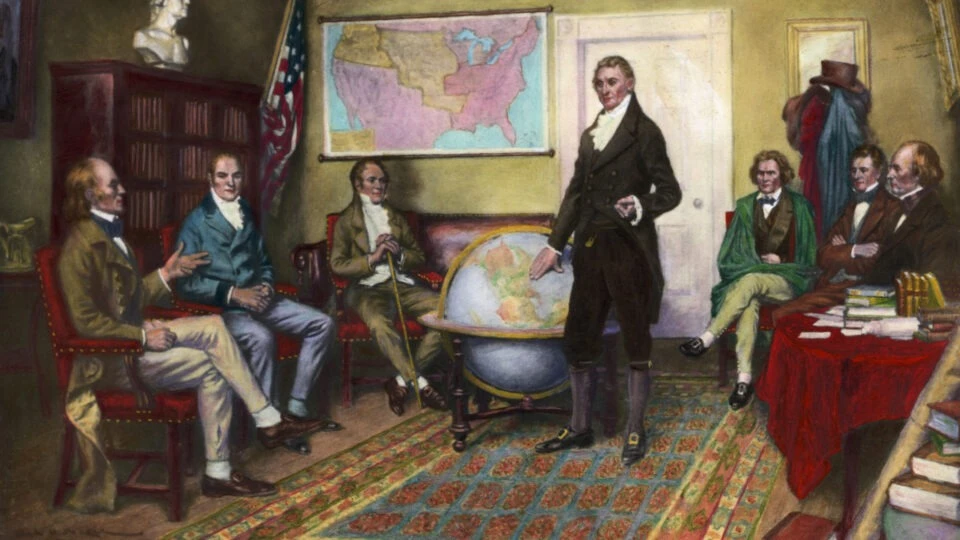
The reference to the Monroe Doctrine of 1823 is one of the most important messages the strategy sends to the world and another manifestation of the return to historical roots. In the Regions section of the document, the Western Hemisphere is placed first, under subsection A. It is stated that allowing rival powers to interfere in the Western Hemisphere has been another strategic mistake over recent decades, and that the United States will apply a “Trump addendum” to the Monroe Doctrine to restore its dominance there. Accordingly, the United States is currently reassessing the global projection of its military power and, from the perspective of the current administration, reducing its military presence in regions deemed less important and redirecting it toward the Western Hemisphere. The regions whose importance is declining are Europe and the Middle East.
Developments around Venezuela in recent weeks—the buildup of major U.S. military forces in the Caribbean region, the interception of drug-trafficking boats, Trump’s declaration of a naval blockade to halt the Maduro regime’s oil trade, and the seizure of tankers within this framework—are steps aligned with the strategy’s priorities (Truthsocial.com, 2025). The U.S. government declares that it will not allow its rivals from outside the Western Hemisphere to deploy troops or other threatening forces in the region, to own strategic assets there, or to control them. It is also explicitly stated that governments, political parties, and movements aligned with the United States in the region will be supported and rewarded.
The restoration of a Monroe-style approach to the Western Hemisphere stands in stark contradiction to the principles of respect for sovereignty and non-interference in internal affairs emphasized elsewhere in the strategy. While condemning the belief of previous American elites that global dominance better served national interests, the Trump administration, by invoking a doctrine born of the regional and international conditions of the early nineteenth century and by asserting a right to dominate an entire hemisphere without regard for the will and choices of its states and peoples, effectively accepts the division of the world into spheres of influence. This perspective aligns with broader interpretations of international order that prioritize influence, balance of power, and regional primacy.
Trump Wants to “Make Europe Great Again” as Well
The section of the document devoted to Europe (C) is titled “Supporting European Greatness” and follows the Western Hemisphere and Asia (B). This title, a clear play on the slogan “Make America Great Again” (MAGA), expresses the Trump administration’s vision of Europe in accordance with its own worldview. Unlike previous strategies, the document does not characterize Russia as a threat to U.S. security or interests; instead, it targets the institutions and governments of allied Europe.
The authors sharply criticize the continent’s current condition, arguing that European civilization faces the prospect of extinction. This claim is justified by noting that while Europe’s share of global GDP was 25 percent in 1990, it has now fallen to 14 percent, primarily due to domestic and transnational rules and stifling regulations that undermine creativity and industriousness. It is asserted that the European Union and other transnational structures erode political freedoms and sovereignty; censorship is imposed on freedom of speech, and political opposition is suppressed; migration policy is transforming Europe and generating conflicts; birth rates are sharply declining; and national identity and self-confidence have been lost. The conclusion is drawn that if current trends continue, the continent will become unrecognizable within 20 years or even sooner.
Vice President J.D. Vance voiced similar views in his speech at the Munich Security Conference in February (Presidency.ucsb.edu). Emphasizing its confrontational stance toward European officials, the Trump administration views the rise of patriotic (i.e., radical right) forces as a hopeful factor and sets as its goal helping Europe correct its current course, while simultaneously declaring—without naming names—that it will not allow any rival power to dominate the continent.
Notably, while the administration adopts a pragmatic, interest-driven approach in many regions of the world—emphasizing power dynamics and strategic realities—it applies a more values-oriented framework in its approach to Europe, particularly with regard to democracy and freedom of expression. The strategy itself offers an explanation for this distinction. It states that freedom of speech, freedom of religion and conscience, and the right to choose one’s government and participate in governance are fundamental rights that must never be violated, and that the United States will firmly defend adherence to these values in countries that share them—or claim to share them. “We will oppose antidemocratic restrictions imposed by elites on fundamental freedoms in Europe, the English-speaking world, and the rest of the democratic world, especially among our allies,” the document emphasizes.
As presented in the strategy, the administration signals a greater focus on human rights, freedoms, and democratic standards in its engagement with Europe, while adopting a more sovereignty-centered approach toward other political systems, which are framed as outcomes of distinct historical paths and national choices.
Alongside these considerations, the strategy’s assessment of Europe–Russia relations can be considered notable. It notes that Europe’s lack of self-confidence is most evident in its relations with Russia, even though—nuclear weapons aside—Europe surpasses Russia on almost all indicators.
Discussions within the EU in recent weeks and the decision taken regarding the provision of a “reparations loan” to Ukraine using frozen Russian funds confirm the accuracy of Washington’s analysis. After lengthy debates, European leaders agreed to provide Ukraine with a €90 billion interest-free loan without touching Russia’s assets in Europe (BBC, 2025). The bulk of Russia’s frozen assets in Europe (€193 billion) is held in Belgium’s Euroclear depository, and Belgium, despite calls and pressure from the European Union and Germany, refused to transfer those funds to Ukraine. The Belgian prime minister openly admitted fear of Russia by stating: “Moscow has clearly told us that if its assets are confiscated, Belgium—and I—will feel the consequences forever” (Lalibre.be, 2025). His statement that Russia’s defeat would be undesirable will remain in the archives as another instructive confession.
France, which has sought to assume the initiative and does not conceal its ambition for European leadership after the United States limited its involvement in supporting Ukraine, as well as Italy, joined Belgium in opposing the confiscation of Russia’s billions, leaving Germany isolated on the issue (Financial Times). Even the United Kingdom, which has taken the toughest stance in the West against the Putin regime and pursued an unwavering policy of support for Ukraine, refrained from confiscating £8 billion in Russian assets held in the country (Financial Times, 2025). In addition, according to President Zelensky, some European countries are delaying the delivery of air-defense missiles to Ukraine due to Russian threats and drone provocations (Gordonua.com, 2025).
While such caution is partly related to the lack of vision of the current generation of politicians on the continent and, in some cases, to policies that undermine European unity and do not share common values, the fundamental reason is the insufficiency of Europe’s military power component (including the United Kingdom). Dependence on the United States in this area persists. Europe needs time to ensure its own strategic autonomy. The bitter reality for Ukraine is that if the United States halts its military and intelligence support and fully withdraws from the process, Europe lacks both the capacity and the will to fill the gap and force Russia into compromises.
Taking these factors into account, the authors of the U.S. National Security Strategy write that managing Europe–Russia relations requires serious U.S. diplomatic engagement, as there is a need to reduce the risk of conflict between European countries and Russia and to restore strategic stability in Eurasia. French President Macron’s declaration of his intention to resume dialogue with Putin can be interpreted as a reaction to the Americans’ claim to a moderating role in Europe–Russia relations.
The U.S. National Security Strategy includes a brief reference to Ukraine. It states that stabilizing the European economy, preventing targeted escalation and the expansion of the war, restoring strategic stability with Russia, and ensuring Ukraine’s post-war reconstruction so that it can survive as a viable state are within U.S. interests.
REFERENCES:
1.National Security Strategy of the United States of America. November 2025. www.whitehouse.gov/wp-content/uploads/2025/12/2025-National-Security-Strategy.pdf
2. National Security Strategy of the United States of America. December 2017. https://trumpwhitehouse.archives.gov/wp-content/uploads/2017/12/NSS-Final-12-18-2017-0905.pdf
3. NATIONAL SECURITY STRATEGY. October 2022. https://bidenwhitehouse.archives.gov/wp-content/uploads/2022/11/8-November-Combined-PDF-for-Upload.pdf
4. George Washington, “Farewell Address,” 1796. https://www.americanyawp.com/reader/a-new-nation/george-washington-farewell-address-1796/
5. https://truthsocial.com/@realDonaldTrump/posts/115731908387416458
6. Remarks by the Vice President at the Munich Security Conference. https://www.presidency.ucsb.edu/documents/remarks-the-vice-president-the-munich-security-conference-0
7. EU agrees €90bn loan for Ukraine but without using Russian assets. https://www.bbc.com/news/articles/c3e025vyppeo
8. Bart De Wever: "Moscou nous a fait savoir qu'en cas de saisie de ses avoirs, la Belgique et moi allions le sentir passer pour l'éternité..." https://www.lalibre.be/belgique/politique-belge/2025/12/02/bart-de-wever-dans-la-crise-politique-autour-du-budget-le-roi-ma-aide-5KDD7VZ5YBFRPBDS3GMGGTOOME/
9. Role reversal: how foot-dragging France blindsided newly assertive Berlin. https://www.ft.com/content/99d256e6-8501-4ab8-81d2-d937d5888f01
10. UK rules out using frozen Russian assets to aid Ukraine. https://www.ft.com/content/d899e28f-40f4-4031-aa51-8bb0bea9c7b4
11. Зеленский рассказал, почему партнеры "придерживают" поставки ракет ПВО для Украины. https://gordonua.com/news/war/zelenskij-rasskazal-pochemu-partnery-priderzhivajut-postavki-raket-pvo-dlja-ukrainy-1767738.html
