Introduction
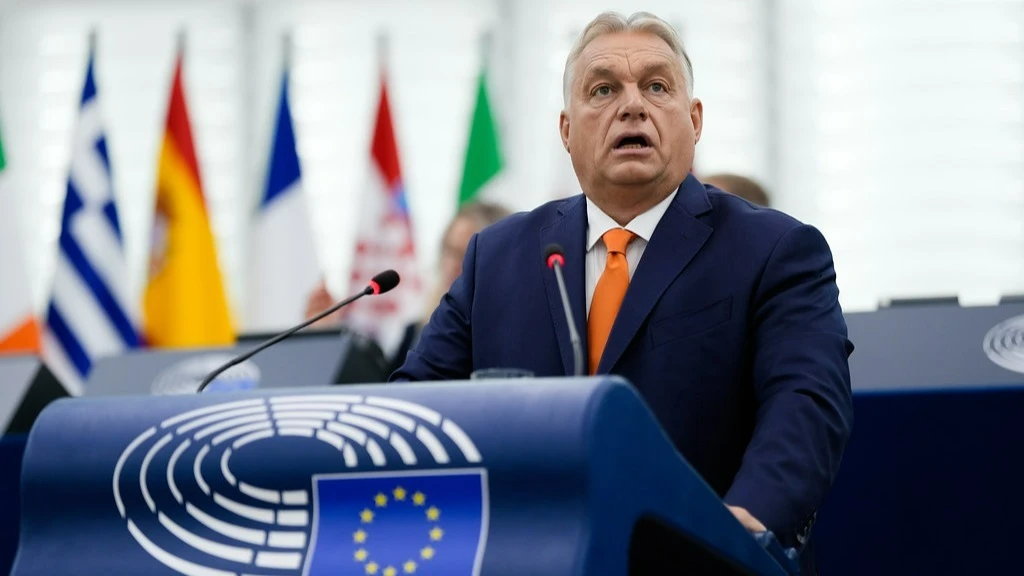
The assumptions put forward by researchers and theorists that the 21st century would become the age of information and that information would turn into real power are being confirmed today. Modern authoritarian leaders and dictators, having understood this reality, have successfully turned the opportunities of technological progress into useful tools within the framework of their own interests. As a result, many of them have built information dictatorships based not on harsh repressive instruments, but on manipulation. Hungary’s Prime Minister Viktor Orbán is among the authoritarian leaders who were the first to understand that they live in the age of information.
In this KHAR Center opinion piece, we outline Viktor Orbán’s political portrait through the conceptual nuances of leadership, showing how he has implemented illiberal democracy without resorting to force, using manipulation, the power of information, autocratic legalism, and other political and economic tools.
The objective in preparing Viktor Orbán’s political portrait is to demonstrate, through his example, the mechanisms through which an authoritarian political leader can exist within a democratic geography.
Who is Viktor Orbán?
Within the borders of the European Union, personalist authoritarian rule is embodied in Hungary’s “strong ruler,” Viktor Orbán (Comelli & Horvath 2018a). He came to power entirely through democratic means and, by using the legal instruments at his disposal, gradually restricted liberal freedoms, political opposition, media freedom, and civil society, while simultaneously personifying power.
Contrary to situational theory, which studies leadership as the result of specific conditions “intersecting,” Viktor Orbán did not emerge from a chance conjunction of circumstances. Rather, he rose due to possessing the qualities deemed important for a leader in “trait theory” (Kettel 2014). Orbán is energetic and persistent in achieving his goals, capable of resisting frustration, unafraid of risks, courageous and proactive, self-confident, able to influence the behavior of people around him, and skilled at structuring social interactions.
During the late Soviet period—when the USSR was weak but had not collapsed—publicly demanding free elections and the withdrawal of Soviet troops from Hungary could be considered a bold, taboo-breaking act against the regime. In 1989, Viktor Orbán entered the political scene with this debut, presenting himself to Hungarians as the new face of revolutionary change. However, the young politician who had fought for liberal values soon sensed the public mood and, after the death of former Prime Minister József Antall in 1993 left the conservative right without a leader, shifted his ideological orientation. Orbán seized the opportunity to fill the vacuum on the right, transformed his party Fidesz into a nationalist-conservative party, and the election results confirmed that his calculations were correct (Magyar & Bálint 2016).
In fact, these developments reflected the logic of “expectation strengthening” theory: within the process of group interactions, members’ expectations that each individual would act in a corresponding manner increased. A person’s leadership potential depends on their ability to initiate and direct the necessary interactions and expectations (Avdeev 2017a).
Viktor Orbán also owes his success to his ability to sense and interpret public sentiment and to “appeal emotionally to the lumpenized, marginalized victims of globalization” (Comelli & Horvath 2018b). He was intelligent enough to understand that the ineffective management of liberal economic reforms during the post-communist period had led the country into crisis. Seeing Hungarians’ disappointment with the liberal transition, Orbán turned away from the liberal values he had once fought for, first moving toward conservatism and, after losing the 2002 elections, shifting toward right-wing authoritarianism, emphasizing the need for strict governance.
Rhetorical Skills
Orbán also possesses the ability to speak with the same sincerity and energy about completely opposite things. He always finds the “right explanation” for everything and knows which words can serve as a “hook” for voters (Lopatto 2014). He is capable of speaking about politics in the everyday language of ordinary people—something that distinguishes him from most Hungarian politicians, who speak in the language of the elite. This talent helps Orbán attract and consolidate supporters. As a political leader, he fulfills the integrative function and has undeniable power of persuasion.
Legitimacy Based on Rational-Legal Leadership
The legitimacy of Viktor Orbán’s leadership theoretically corresponds to one of Weber’s three ideal types—rational-legal or bureaucratic leadership (Avdeev 2017b). In rational-legal rule, people obey not the personality of the ruler but the written laws that embody state bureaucracy. This type of political leadership is characteristic of modern Western societies that recognize the supremacy of formal legal principles and the rule of law. Viktor Orbán came to power through democratic elections and began governing the country with an authoritarian leadership style.
Having constitutional dominance in parliament serves not only as the main institutional tool to change legislation according to the interests of the ruling power, but also as a guarantee for maintaining its control. Orbán’s general strategy is therefore described as “autocratic legalism” (Beauchamp 2024a). Fidesz uses legal and procedural mechanisms to gradually replace democratic practices with authoritarian ones while adopting laws resembling those in democratic states, thus preserving democratic façades and presenting itself as a defender of freedom.
Orbán’s autocratic legalism forms the basic component of democratic imitation. He has built a system in which, although the state dominates the citizen, the citizen believes that they themselves are the holder of power over the state (Beauchamp 2024b).
Alternative Tools to the “Iron Fist”
Orbán’s behavior and style of governance show that he maintains the support of the largest and most organized segment of the domestic electorate while possessing the ability to polarize and divide voters. He does not use the typical authoritarian “strong hand” or “iron fist”; the tools he employs are non-democratic yet formally competitive. The main instruments of Orbánist governance include disinformation and manipulation enabled by control over the informational ecosystem, institutional and normative tools, administrative leverage, and economic resources.
Orbán is not a traditional conservative. He is an authoritarian leader who deliberately attacks democratic institutions and consciously employs the core elements of conservatism to preserve power (Rupnik 2018). His emphasis on traditions and existing social norms serves this purpose. His harsh rhetoric toward democratic institutions must be examined within the broader confrontation between authoritarianism and democracy.
The Motive Behind the Desire for Power
Researchers of leadership who emphasize personal traits draw attention to the motivation-needs sphere, identifying several fundamental needs that drive a leader’s behavior (Egorova-Gantman 1993). For example, the desire to dominate others and/or limit their actions, or the aspiration to achieve political success, can serve not only compensatory but also instrumental functions. Sometimes leaders experience a sense of euphoria that compensates for aspects of underlying low self-esteem.
A trait more commonly associated with authoritarian leaders—the need for control over events and people—can clearly be observed in Orbán’s governance style. Orbánist rule is characterized by two main features. First, Orbán is portrayed as a politician without firm ideological commitments—one who prioritizes maximizing his personal power and control. Second, he is described as a flexible figure capable of adopting different ideological stances whenever necessary to preserve and expand his authority.
However, Luke Cooper disputes this interpretation, arguing that Orbán is not driven solely by a desire for power. According to him, the political system created by Fidesz exhibits ideological consistency. At its core lies Orbán’s hatred of liberalism and his promotion of the illiberal state (Cooper 2023a). From this perspective, he characterizes Orbán as a consistent autocratic nationalist.
Nevertheless, Orbán’s life story—including his pragmatic evolution from liberal (1989) to conservative (1994), and later to authoritarian (2010), especially authoritarian populist—makes it difficult to deny that his behavior is influenced by an inherent desire for power.
The Leader’s Psychological and Emotional Techniques
Focusing on the psychological characteristics of political behavior, G. Lasswell argues that leaders who turn toward dramatization in their style of rule seek to gain the emotional support of the masses (Avdeev 2017c). Unlike many authoritarian leaders, Orbán does not strive to become the “father of the nation.” Instead, he frequently reminds Hungarians—who live with a sense of ressentiment—of their imperial past. By manipulating post-imperial trauma and nostalgia for the historical greatness of the state, Orbán creates the image of a leader fighting for national sovereignty, earning sympathy among his electorate (Medvedev 2024). His supporters perceive his struggle as a fight for restoring the nation’s former strength and might.
The leitmotif of Orbán’s rhetoric is composed of the phrases “national interest” and “national purpose,” and he believes that all of Hungary’s problems stem from deviation from this purpose (Orbán 2014). Orbán’s autocratic nationalism rests on two main tools. First, he mobilizes ethno-nationalist identity and interest concepts to pursue hegemony. Second, he uses corruption practices at the intersection of state and society to raise autocratic control over various instruments and the media to a higher level (Cooper 2023b). Without using violence, Orbán has turned the state itself into an instrument for acquiring economic and political power. The essence of this hegemonic trick is to mobilize hostility against liberal thought and thereby “feed” the existence of the autocratic state. Thus, he created a link between hegemony and corruption practices, providing a legitimate framework for state actions that block public accountability through nationalist rhetoric.
The Presentation of the Leader’s Image Globally
Among conservatives in Europe and the United States, Hungary under Viktor Orbán is viewed as an example of effective Christian conservative governance and as a bulwark against the void created by cultural leftists. Presenting himself as the protector of patriarchal society, Orbán has banned same-sex couples from adopting children, prohibited changing the gender assigned at birth on state identity documents, and built a fence on the Serbian border to stop migration.
Orbán portrays himself and the Hungarian people as the “rear guard of the pure white European,” protecting the West from self-destruction and fighting for the “true legacy” of the racially pure white Christian character of Europe (Halasz 2025). He claims that European elites cannot solve this acute problem because they are dominated by “left-liberal figures who, instead of building a Christian Europe, propose a depersonalized open Europe” (Shishelina 2018). Simultaneously, he presents himself to Hungarians as the only political leader capable of ensuring peace and stability in the face of a “real war” taking place beyond their borders.
In reality, however, the power of authoritarian populists like Orbán does not lie in the institutions they capture but in the new electoral coalition they build, because some radical authoritarian-right voters are motivated by fanaticism and hatred arising from fears of the cultural threats of globalization (Scheiring 2019).
Conclusion
Unlike traditional authoritarians, Viktor Orbán relies primarily on legal-institutional, psychological, persuasive, and manipulative methods rather than violent tools. Autocratic legalism, combined with the transformation of corruption into a central instrument of governance, has played a crucial role in cementing Orbán’s dominance as a political leader. This has enabled him to implement an illiberal democracy without openly rejecting democracy itself, facilitating a comfortable return to authoritarianism.
Free but unfair elections—competitive in form yet unequal in substance—create the appearance that power is formed through the will of the citizen and ensure the legitimacy of Orbán’s rule. The majority of society, perceiving such conditions as genuine choice, fails to recognize the imitation and accepts illiberal democracy as real democracy, believing themselves to be the actual source of power. As a result, without stripping citizens of their formal political subjectivity, Orbán has been able to shape the political system according to his own interests while maintaining controlled political participation.
Researchers of leadership theory argue that the image of the leader in the public consciousness may appear incompatible with their non-charismatic external appearance. The Hungarian example of authoritarian governance shows that followers pursue not the leader they personally know, but rather the leader who exists in their “virtual reality.” It is this image that awakens their emotions, creates emotional attachment, and drives decision-making.
References:
1. Comelli, Martin and Horvath, Vera. 2018a. "What Orbán Knows and His Enemies Don’t", Jacobin
https://jacobin.com/2018/03/viktor-orban-hungary-fidesz-authoritarian-opposition
2. Кеттел Рэймонд. 2014. Структурная теория черт личности. Психологический журнал. 13 October
https://psychojournal.ru/psychologists/95-reymond-kettel-strukturnaya-teoriya-chert-lichnosti.html
3. Мадьяр, Балинт. 2016. Анатомия посткоммунистического мафиозного государства на примере Венгрии. http://kyiv-heritage.com/sites/default/files/%D0%9C%D0%90%D0%94%D0%AC%D0%AF%D0%A0%20-%20%D0%90%D0%BD%D0%B0%D1%82%D0%BE%D0%BC%20%D0%9F%D0%BE%D1%81%D1%82-%D0%BA%D0%BE%D0%BC%20%D1%80%D0%B5%D0%B6%20(%D0%BD%D0%B0%20%D0%BF%D1%80%20%D0%92%D0%B5%D0%BD%D0%B3%D1%80%D0%B8%D0%B8)%202016%20324%D1%81.pdf
4. Авдеев Павел. 2017a. Эволюция и современные тенденции теории лидерства. Sci-Article. 31 May
https://sci-article.ru/stat.php?i=1496056150
5. Comelli, Martin and Horvath, Vera. 2018b. "What Orbán Knows and His Enemies Don’t", Jacobin
https://jacobin.com/2018/03/viktor-orban-hungary-fidesz-authoritarian-opposition
6. Лопатто Мария. 2014. Орбан. Без альтернативы. Радио Свободы. April 7
https://www.svoboda.org/a/25323508.html
7. Авдеев Павел. 2017b. Эволюция и современные тенденции теории лидерства. Sci-Article. 31 May
https://sci-article.ru/stat.php?i=1496056150
8. Beauchamp, Zack. 2024a. Make America Hungary Again. The Atlantic. July 17
9. Beauchamp, Zack. 2024b. Make America Hungary Again. The Atlantic. July 17
10. Rupnik Jacques. 2018. Portrait of Viktor Orbán - Prime Minister of Hungary. Intitute Montaigne. November 6
https://www.institutmontaigne.org/en/expressions/portrait-viktor-orban-prime-minister-hungary
11. Егорова-Гантман Е.В. 1993. Политиками не рождаются. Центр политического консультирования «Николо М». С.142
12. Cooper, Luke. 2023a. Autocratic Nationalism in Hungary: Viktor Orbán as a Hegemonic Actor, LSE Research Online
https://eprints.lse.ac.uk/118153/
13. Авдеев Павел. 2017с. Эволюция и современные тенденции теории лидерства. Sci-Article. 31 May
https://sci-article.ru/stat.php?i=1496056150
14. Медведев Сергей. 2024. Анфан террибль" Евросоюза. Радио Свободы. August 21
https://www.svoboda.org/a/anfan-terriblj-evrosoyuza-/33085925.html
15. Viktor Orban. 2014. Prime Minister Viktor Orbán’s Speech at the 25th Bálványos Summer Free University and Student Camp. website of the Hungarian Government. 26 July
http://2010- 2015.miniszterelnok.hu/in_english_article/_prime_minister_viktor_orban_s_speech_at_the_25th_balvanyos_summer_free_unive rsity_and_student_camp
16. Cooper, Luke. 2023b. Autocratic Nationalism in Hungary: Viktor Orbán as a Hegemonic Actor, LSE Research Online
https://eprints.lse.ac.uk/118153/1/Book_chapter_autocratic_nationalism_in_Hungary_.pdf
17. Halasz Kataline. 2025. Bodies of whiteness: Space invading Viktor Orbán’s ethnonationalism. Sage Journals. February 27
https://journals.sagepub.com/doi/10.1177/13675494251319698
18. Шишелина Л.Н. 2018. Самая цитируемая речь премьер-министра Венгрии // Научно-аналитический вестник Института Европы РАН. 2018. № 5.
19. Scheiring, Gabor. 2019. I watched Hungary’s democracy dissolve into authoritarianism as a member of parliament − and I see troubling parallels in Trumpism and its appeal to workers. The Conversation. May 13
