(This article was prepared within the framework of KHAR Center’s “Security and State Architecture” research project)
✍️ Elman Fattah – Head of KHAR Center
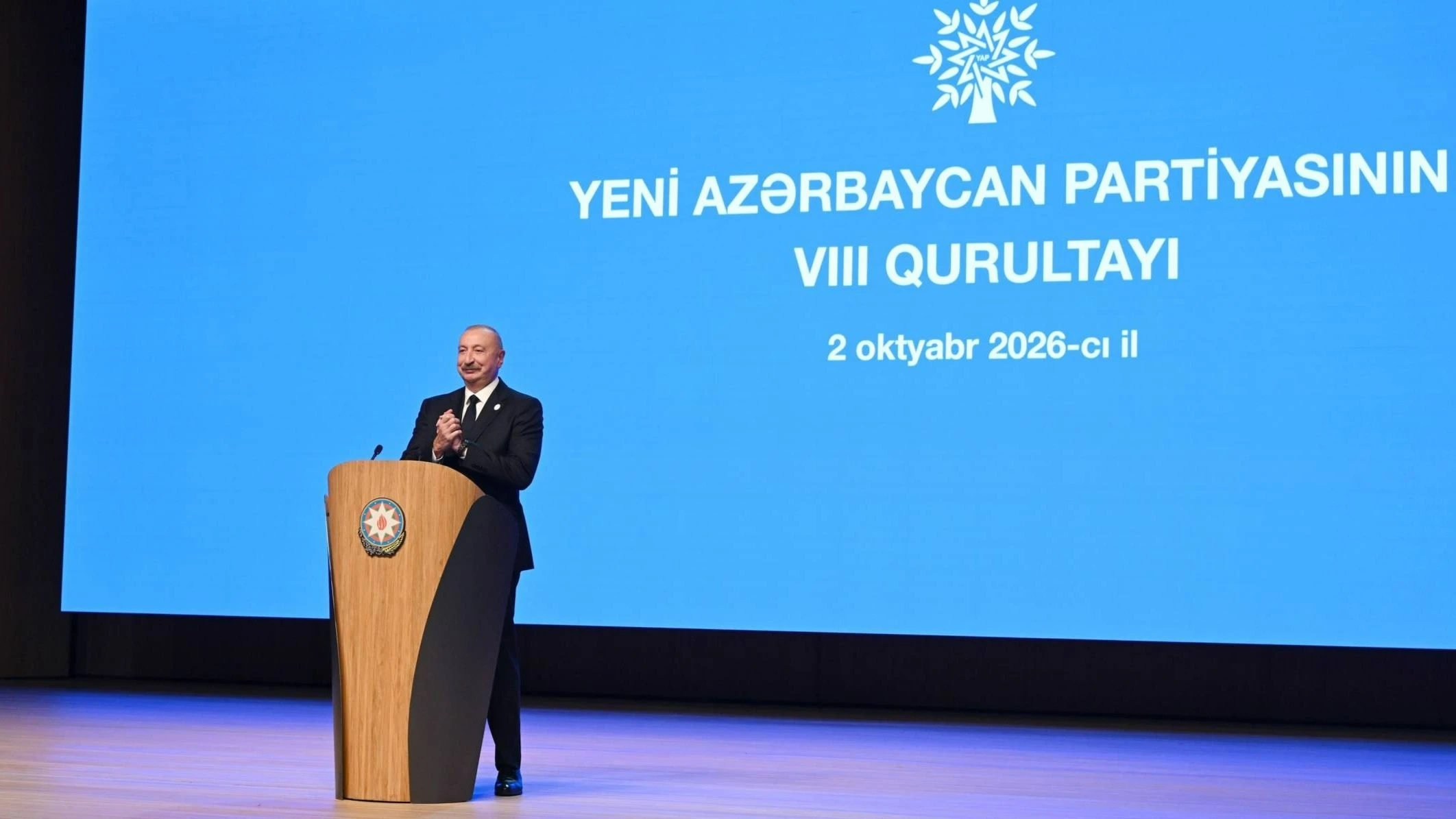
The core substance of the speech Ilham Aliyev delivered at the party event is that it defines the government’s political course for the period following Azerbaijan’s restoration of sovereignty over its entire territory in 2023. The speech is a set of political messages addressed both to the domestic audience and to the outside world. What deserves attention here is not how harsh or mild individual statements are, but the mindset and political purpose that stand behind them.
Since the Second Karabakh War, the Aliyev regime has built the foundations of its legitimacy precisely on the military victory. Ilham Aliyev has now turned Azerbaijan into a state that no longer feels the need to consult anyone and that increasingly takes a combative stance in foreign policy. This approach is understandable to a certain extent. The military victory has indeed increased Azerbaijan’s regional weight. However, while the war resolved the country’s main problem, it has also created new challenges. After the victory, the main objective should be “how to turn the victory into lasting peace, regional stability, economic development and strong institutions.” Yet the instruments at Azerbaijan’s disposal, instead of being used to develop the region’s opportunities for peace, are being used as threats against both its neighbors and the political centers that have an interest in establishing peace in the region.
Viewed through this prism, Ilham Aliyev’s speech at the 8th Congress of the New Azerbaijan Party (YAP) makes it clear that the political self-confidence generated by the military victory, instead of being converted into diplomatic restraint, institutional opening and regional integration, has essentially slid into an arrogant psycho-political course, obsessed with regional and global ambitions that exceed the country’s resources.
In this article, I will analyze Ilham Aliyev’s speech precisely through the relationship between political psychology, foreign policy, domestic control and economic resilience.
My main thesis concerns the purpose for which Ilham Aliyev uses and exploits the political capital created by the victory.
The Dangerous Line Between Self-Confidence and Arrogance
Great military victories create a special psychological atmosphere both in societies and among political elites. In parts of society, national pride and self-confidence grow, while governments begin to become obsessed with the absolute correctness of the decisions they make. The most dangerous moment in statecraft, however, is when self-confidence gradually turns into a sense of infallibility and the leader becomes sanctified. Yet victory on the battlefield does not vindicate all of the government’s decisions. An army can win a war, but this does not justify arrogance in foreign policy or corruption at home, nor does it by itself heal the wounds inflicted by governance that rests on force.
Lord David Owen’s “hubris syndrome” thesis clearly explains the behavioral tendencies of leaders who have long held power and achieved political success: euphoria, excessive confidence in their own decisions, an inflated sense of personal political mission, and a tendency to view reality only through the window of their own political narratives (Lord David Owen, 2007).
Several signs of this thesis can also be seen in Ilham Aliyev’s speech at the YAP Congress.
First, criticism coming from human rights organizations is not merely questioned as to its motives but is immediately declared biased. Expressions such as “double standards,” “bias,” “Islamophobia” and “anti-Azerbaijan campaign” may at times reflect reality. But placing all critical approaches in the same category is a manifestation of a complete refusal to see the mistakes in one’s own policy.
Second, the conviction that the military victory has granted the regime immunity is treated as beyond reproach. The Karabakh victory is, of course, an important event in Azerbaijan’s history. But when its political outcome turns into the logic of “we are absolutely right on every issue,” the name for this is not self-confidence but arrogance.
Third is the insistence on turning military power into the sole political argument. “We have power, so no one can impose conditions on us” is an approach that turns everyone against oneself (President.az, 02 October 2026a). A strong state strategy, by contrast, requires aligning one’s own interests with those of the other side, building alliances and turning rivals into partners.
One of the important features of the foreign policy doctrine that took shape in Azerbaijan as far back as Heydar Aliyev’s time was balancing (Kaspi, 2026). Baku cooperated with the West in the fields of energy and security, maintained high-level political relations with Russia, deepened its strategic ties with Türkiye, and at the same time tried to maintain a certain balance in its relations with Iran. It cannot be said that this was an entirely correct strategy, but at least the resulting image was of an Azerbaijan that got along with everyone rather than one that quarreled with everyone.
After the Karabakh war, however, the situation changed completely. The growth of Azerbaijan’s military power and the consolidation of its regional position have naturally strengthened Baku’s hand in negotiations. But instead of increasing its diplomatic responsibility as its hand grew stronger, official Baku has become eager to expand its list of hostile countries. The rhetorical line that could be felt in Ilham Aliyev’s congress speech – even responding to one blow with ten, entering into disputes with every international institution, presenting every expression of discontent as foreign hostility, and even burning bridges with an allied state such as Türkiye – was reminiscent of the reckless displays of will of medieval rulers (President.az, 02 October 2026b). Yet in the modern world, one of the most important indicators of power is self-control. Leaders who lose their sense of self-control end up sharing, at worst, the fate of Saddam Hussein and, at best, that of Putin.
Multi-Front Confrontation: Independence or Isolation?
“We are not dependent on anyone” is a phrase that always sells well in politics. In a society that has endured outside pressure for years, the applause for these words is ready in advance. But independence must not be confused with isolation. An independent policy is one in which the state makes its own decisions. Isolation is something else: the partners and institutions around you with whom you can talk and work grow fewer, and you mistake this for freedom. In reality, the guarantee of a state’s independence is measured by a high capacity for cooperation.
Roughly speaking, Azerbaijan faces two paths. The first is the “no one can tell us what to do” position. The second is more laborious: we still make our own decisions, but we work with as many parties as we can so that we have many options. The second path does not bring applause, but it is durable. The speech at the congress, however, showed that Ilham Aliyev has chosen the first path. His rhetoric is a display of an eagerness to dictate to everyone without listening to anyone.
The plain truth, however, is that not only small states like Azerbaijan, but even medium-sized ones, cannot ensure their security on their own. The energy market is tied to logistics, logistics to finance, finance to technology, and technology in turn to the defense industry and cybersecurity. Azerbaijan’s geopolitical weight derives precisely from its place within this network. Therefore, if it quarrels with several foreign players at the same time – even if this is called “strategic independence” – its room for maneuver will narrow as the years pass, and the claim to super-independence will end in systemic isolation.
Oil and Gas Still Sell, but Relations Keep Cooling
The most undesirable trend is unfolding in relations with the West and Türkiye (Kharcenter, 2026). For many years, Azerbaijan has been an important partner in Europe’s energy security, and Baku has gained more than just money from this. Energy ties with Europe increase the country’s geopolitical weight, protect it from near and distant threats, and open favorable opportunities for ensuring the country’s security within the international system. And all of this is made possible by Türkiye’s transit support and security guarantees. However, damaging relations with Türkiye, and becoming economically dependent on the West while quarreling with it politically, promises nothing good. This is a well-trodden and very dangerous path. The bitter experience of Gaddafi’s Libya, Saddam’s Iraq and Assad’s Syria lies not in the distant past.
Double standards certainly exist; it would be pointless to deny this. Great powers apply the same principle to different parties in whatever way suits them – international politics has always been like this. However, to conclude from this that human rights, the rule of law and democratic institutions are empty words, and to perceive international law merely as a political tool, creates the danger that Azerbaijan will find itself alone in upholding international law – on which it relied when defending its own rights – and sovereignty, which is that law’s fundamental cornerstone.
The decisions of the European Parliament and PACE may involve political calculation, and they may also contain mistakes. But branding every step they take as “biased” gains Azerbaijan nothing. Slamming the door and walking out is easy. The hard part is staying inside and being able to protect one’s own interests. Here, too, Ilham Aliyev has taken the wrong path – he has moved relations with both institutions onto the plane of dictation.
The Question of Peace
On this issue, too, serious complacency and arrogance are glaringly evident. On the one hand, it is said that “the war is over”; on the other, military warnings to the other side never cease. There is talk of the possibility of erecting a third triumphal arch in Yerevan (President.az, 02 October 2026c). When the two messages are voiced together, Yerevan does not know which one to believe and, naturally, prepares for the worse. In other words, such threats do not neutralize the other side; on the contrary, they arm it and push it to grow stronger.
If the goal is truly peace, one cannot get far with the mindset of “we will defeat them again!” The goal should be to build an order in the region such that war never again crosses anyone’s mind. A strategic security approach demands precisely this. Otherwise, the military advantage gained in the war will create a new security dilemma without ever being converted into peace capital.
Ideological Security
Politically, the most striking part of the speech is the narrative of “ideological security” (President.az, 02 October 2026d). Protecting oneself from disinformation, external threats and intelligence games is the natural right of every state, and there is nothing strange about that. The issue lies not in protecting against external threats, but in what is perceived and presented as an external threat. It is clear to everyone that when Ilham Aliyev spoke of ideological security in this speech, he mainly had in mind not proven cases of interference, but the journalists, public figures, scholars and opposition members who have been forced to leave the country and who criticize the government – and, as has become clear in recent days, also the way of life of religious believers (Elman Fattah, 2026). This reflects a tendency, as in every authoritarian regime, to turn an instrument of national security into a political cudgel.
This mechanism has worked many times in the history of authoritarian systems. First, society is split in two. On one side stands “us”: the state, the national interest, patriotism, stability. On the other side stand “them”: foreign influence, subversion, hostility. Under such a division, criticizing the government comes to be regarded as the same as opposing the state. The damage, however, falls first and foremost on the system itself, because it silences the very people who could point out its mistakes; and since it is deprived of the ability to correct those mistakes, it never “weakens” – it simply collapses all of a sudden.
Low Debt Does Not Yet Mean Economic Independence
In his congress speech, Ilham Aliyev speaks proudly of the low ratio of external debt to GDP as proof of economic independence. But economic independence is not measured by this alone. If the economy of a state with little debt depends on the world-market price of a single product – oil – this is a situation that calls for concern, not pride. This is precisely Azerbaijan’s structural problem. The country’s economy is entirely dependent on raw-material exports. The state’s coffers are filled with oil money. When the budget is fed not from the taxpayer’s pocket but from energy revenues, the terms of the relationship between the government and the citizen change. The people factor, human capital, loses its significance (Hazem Beblawi, 1987).
In a state that lives on taxes, the citizen asks, “What do I get in return for the money I pay?” In a rentier system, by contrast, he asks, “What will the state give me?” In the first case, the citizen holds sway over the state; in the second, the state holds sway over the citizen. The content of the social contract changes accordingly, turning the citizen from an individual who seeks rights into a subject who seeks privileges.
For an economy to remain on its feet in the long run, other things are needed: courts independent of the government, inviolable property, a competitive market in which monopolies are reined in, and free entrepreneurship. To these we must also add quality education, human capital, innovation and transparent governance.
Therefore, however appealing the “our debt is low” argument may be, it does not answer the strategic question: will Azerbaijan be able to preserve its current room for political and economic maneuver once oil revenues decline?!
The Most Dangerous Illusion – Believing That Power Is Eternal
One of the most striking features of authoritarian regimes is their belief that they can forever preserve the power they currently hold (Daniel Ziblatt & Steven Levitsky, 2018). But they forget that the world is constantly changing. Energy markets are being reshaped, technologies become obsolete, the nature of warfare is transformed, and new alliances and economic centers emerge. The geopolitical situation of 2020 and 2023 underpins Azerbaijan’s current power, but it offers no guarantee for the decades ahead. When a system intoxicated by power fails to adapt to a changing reality and begins to present yesterday’s successes as the answer to every question of tomorrow’s policy, it drags not only itself but the entire country to the edge of the abyss.
Historical examples also confirm this bitter truth. Argentina’s military junta was likewise able, for a time, to rally society around itself through the Falklands War, but that fervor did not make anyone forget the economic or political problems for good. When the public fervor faded, the rot within the system was laid bare for all to see (Jack S. Levy & Lily I, 1992).
The Ottoman Empire, too, in its final period, was clashing with several centers of power at the same time. Saddam Hussein’s Iraq, for its part, is the most destructive example of believing that one’s military power is enough to rewrite international rules.
The purpose of citing these examples is not to claim that Azerbaijan will share the same fate. Historical parallels never align perfectly; Azerbaijan is not Iraq, nor the Argentine junta, nor the Ottoman Empire of the early twentieth century. But the same lesson emerges from all three: military power never promises success in a confrontation with everyone. Moreover, a strategic mistake born of power comes at an even higher cost.
If we were to gather the political consequences of the rhetoric at the YAP Congress into a table, we could summarize them as follows.
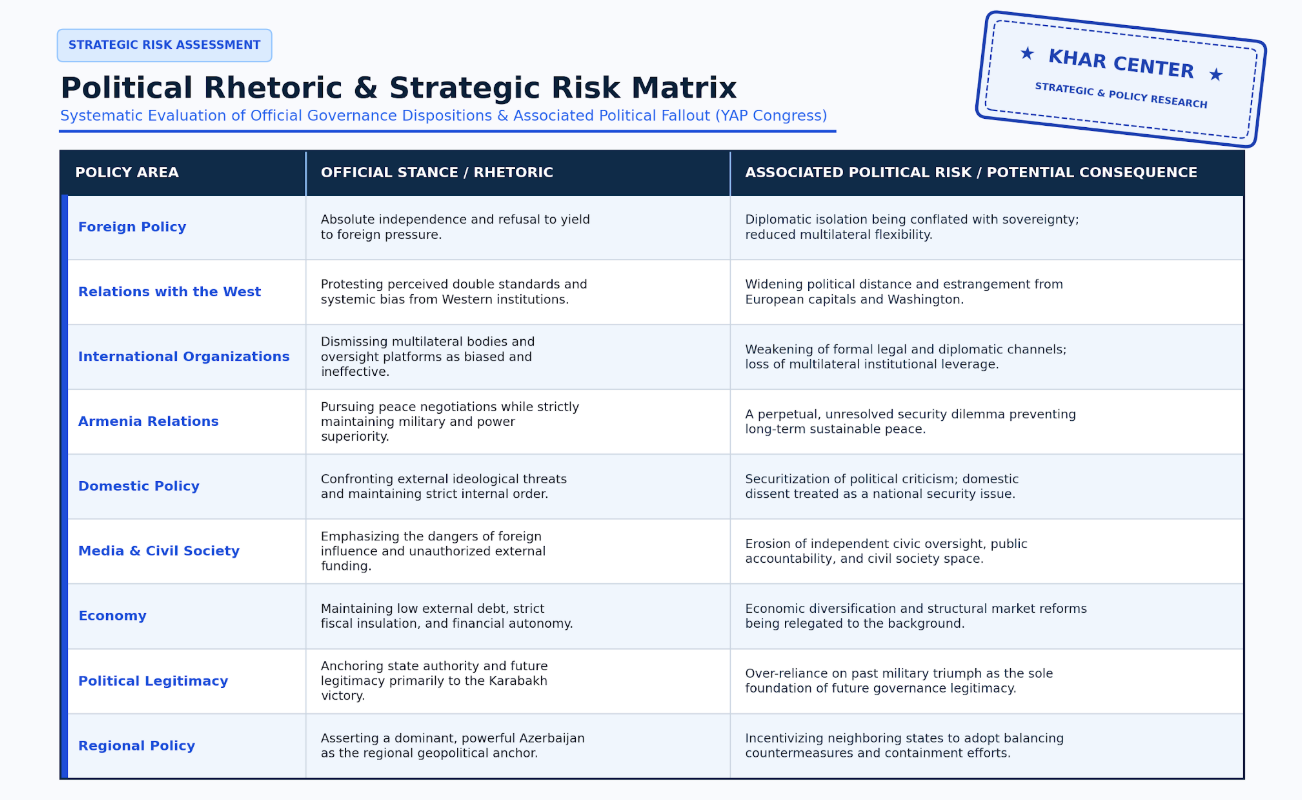
In view of the risks shown in the table, we can say without hesitation that Azerbaijan must stop being a state that lives with the grief of occupation. Its territorial integrity has been restored, its weight in the region has grown, and it occupies an advantageous place on the energy and logistics map.
A new status should bring new responsibility. From now on, Baku should stop presenting itself as a “state under threat.” This should manifest itself in the following direction:
- The victory must be converted into peace and diplomatic capital. The advantage gained should be spent not on creating new enemies, but on finding new partners.
In Lieu of a Conclusion
The Karabakh victory, instead of fostering healthy diplomatic restraint within the government, has paved the way for dangerous arrogance and an illusion of power. Rather than building regional stability and international cooperation, official Baku is dragging the country into isolation by choosing an ever-widening line of multi-front confrontation. In particular, in relations with Western institutions and neighboring states, every form of criticism is declared biased on the strength of military power, while in domestic politics legitimate criticism of the regime is cast as hostile under the banner of “ideological security.”
Historical examples, meanwhile, show that believing power is eternal and quarreling with everyone around can ultimately lead to severe political crises. Therefore, the regime must stop presenting Azerbaijan as a state that is still under threat and must accept that there is no alternative to turning the military success it has achieved into lasting peace and regional partnership.
Note: The article you have read was originally written in the Azerbaijani language. Artificial intelligence tools were used only in the translation.
References
Lord David Owen, 2007. The Hubris Syndrome: Bush, Blair and the Intoxication of Power. P. 1-3
President.az, 02 October 2026. Ilham Aliyev’s speech at the 8th Congress of the New Azerbaijan Party (in Azerbaijani). https://president.az/az/articles/view/73633/videos/3
Kaspi, 2026. The architect of the balanced foreign policy course (in Azerbaijani). https://kaspi.az/balansli-xarici-siyaset-kursunun-memari
President.az, 02 October 2026b. Ilham Aliyev’s speech at the 8th Congress of the New Azerbaijan Party (in Azerbaijani). https://president.az/az/articles/view/73633/videos/3
Kharcenter, 2026. Azerbaijan-Türkiye relations: not unity, but competition. https://kharcenter.com/en/researches/azerbaijan-turkiye-relations-not-unity-but-competition
President.az, 02 October 2026c. Ilham Aliyev’s speech at the 8th Congress of the New Azerbaijan Party (in Azerbaijani). https://president.az/az/articles/view/73633/videos/3
President.az, 02 October 2026d. Ilham Aliyev’s speech at the 8th Congress of the New Azerbaijan Party (in Azerbaijani). https://president.az/az/articles/view/73633/videos/3
Elman Fattah, 2026. Girls Kept at the School Gate: The Rivals Aliyev Chose for Himself. https://kharcenter.com/en/expert-commentaries/girls-kept-at-the-school-gate-the-rivals-aliyev-chose-for-himself
Hazem Beblawi, 1987. The Rentier State in the Arab World. https://newuniversityinexileconsortium.org/wp-content/uploads/2022/02/41857943.pdf
Daniel Ziblatt & Steven Levitsky, 2018. How Democracies Die. https://psi424.cankaya.edu.tr/uploads/files/Levitsky%20%26%20Ziblatt%2C%20How%20Democracies%20Die_%20What%20History%20Reveals%20about%20Our%20Future%20%282019%20--%20Penguin%20Books%29.pdf
Jack S. Levy & Lily I, 1992. "Diversionary Action by Authoritarian Regimes: Argentina in the Falklands/Malvinas Case." In Manus I. Midlarsky, ed. The Internationalization of Communal Strife. New York: Routlege,. Pp. 118-146. https://www.sipa.columbia.edu/sites/default/files/migrated/documents/Levy_Jack.pdf
