(The article was prepared by the "Khar Center" within the framework of research on Azerbaijani authoritarianism)
✍️ Elman Fattah – Head of the KHAR Center
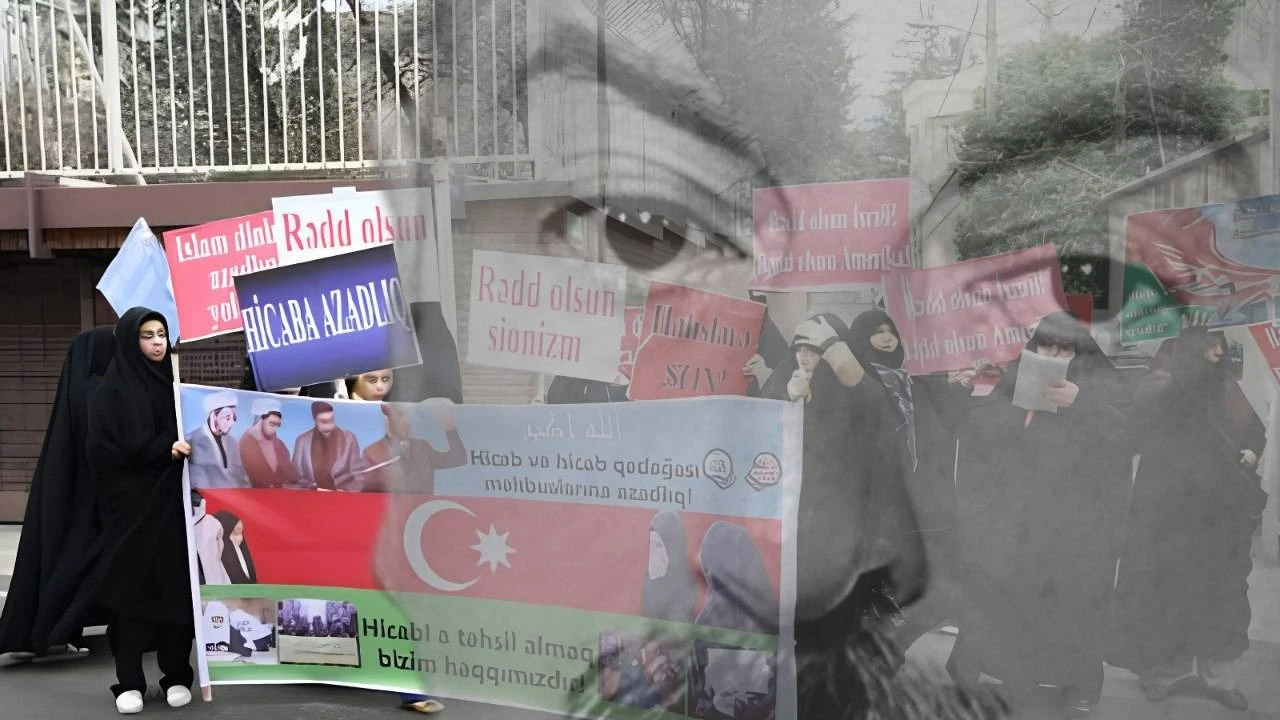
In mid-September, the same scene played out in several cities across Azerbaijan: ten- to twelve-year-old girls standing at the school gate, not allowed inside, with a bewildered parent beside them. What they are told is brief: either take off your hijab or go back home.
With the July amendment to the Law on General Education and the new dress requirements approved by the Cabinet of Ministers in September, the state moved an issue it had kept in a gray zone for fifteen years onto the regulatory plane.
Two widespread versions explaining this decision are circulating in the Azerbaijani segment of social media and in the state’s proxy media. The first: the state is protecting secularism, school must be a neutral space, and children must be shielded from radical influences. The second is the version heard more often in opposition and liberal circles: Over the decades, Aliyev made a strategic mistake by crushing the secular opposition, NGOs, and independent media. Now he finds himself face to face with the religious; the hijab ban is a confused reaction to this dead end.
The purpose of this article is to show that both versions are wrong and to explain that the regime’s aim is to dramatize the claim that a religious threat exists in the country.
The official version is undoubtedly wrong, because there is no real threat to secularism in Azerbaijan. The “Ilham Aliyev’s mistake” version is also wrong, because what is called a mistake is in fact Ilham Aliyev’s design for making the lack of any alternative to secular authoritarianism in Azerbaijan look credible.
The Appeal and Emptiness of the “Mistake” Thesis
The appeal of the “Aliyev made a mistake” thesis is clear. It gives meaning to the secular opposition’s loss: by crushing us, the regime harmed itself, and sooner or later it will need us again. This is a political story that is both comforting and well-intentioned. But the assumptions on which this thesis rests lose out to Ilham Aliyev’s three-stage strategy of authoritarian consolidation (consultative, bureaucratic, and one-man authoritarianism).
First assumption: the regime’s goal is a political stability that carries partially pluralist elements, and the weak secular opposition was a “buffer” layer of that stability. If this were so, destroying it would indeed have been a mistake. However, every step the regime has taken over the past twenty years is irrefutable proof that it does not accept even the “p” in pluralism as a value. For the regime, stability means having no political (traditional) rivals, not a balance among rivals.
Second assumption: the religious are a force the regime does not want but inevitably runs up against. Yet in Azerbaijan, religion is one of the spheres most tightly controlled by the state. The Caucasus Muslims Board, the State Committee for Work with Religious Organizations, the registration of mosques, the appointment of imams, the ban on people who received religious education abroad from conducting religious rites — all of this shows that the regime itself determines by whom and in what form the religious outlook will be represented. To be left face to face with someone, the other side has to be independent. The state, however, defines both the stage and the role of the other side by itself (without asking it). Of course, this is not to say that the state has brought all religious communities under its control. The point is that it dominates the administrative and regulatory framework governing religious activity. With the regulatory tools at its disposal, it can also push communities beyond its control into a given activity or deter them from it. Moreover, in Azerbaijan religious unity is sharply polarized along sectarian lines as well. Shiism, Sunnism, Salafism, and Wahhabism are, to put it mildly, diametrically opposed to one another on the ideological plane. In other words, it is impossible for them to gather around a single center and turn into a synchronized movement.
A Parallel That Is No Coincidence
At the end of 2010, Education Minister Misir Mardanov declared that the hijab was impermissible in schools. In December, on the day of Ashura, a protest was held in front of the Ministry of Education, and participants were arrested. What stands out is this: at the same time, the regime was also targeting secular youth movements, the “Arab Spring”-inspired street protests of 2011, and activists of the APFP and Musavat. In the official narrative, media interest in the secular protesters was snuffed out, while the religious protesters were put on television screens under the labels “Iran’s hand” and “radicals” (Eldar Mamedov, 2011).
In 2009–2014, NGO legislation was tightened, foreign grants were effectively blocked, and secular-minded human rights defenders were arrested. A year later, in November 2015, the Nardaran operation was carried out. Taleh Baghirzade, leader of the Muslim Unity Movement, and his supporters received long prison sentences. Official propaganda presented the event as the foiling of a coup attempt. There were even attempts to link the secular Popular Front Party to this religious movement. Note that the aim was not to spread a narrative that the religious supported the secular opposition, but to fabricate a narrative that the APFP was not secular but religious (525.az, 2016).
Finally, starting at the end of 2023, journalists from Abzas Media, Toplum TV, and Meydan TV, numerous human rights defenders, activists, and APFP leader Ali Karimli were thrown into prison. What remained of independent journalism and the principled opposition in the country was eliminated. And in 2026, the hijab ban is being raised to the level of law.
The pattern in this chronology is clear: every time the space for secular criticism narrows, the religious “threat” is brought onto the stage. If it were a mistake, it would have happened once. A repeated mistake is a method.
Two Audiences, One Fear
The logic of the strategy is simple and nothing new for authoritarian regimes. Mubarak’s Egypt, Ben Ali’s Tunisia, Karimov’s Uzbekistan, and Saparmurat Niyazov’s Turkmenistan all applied the same scheme: create only two poles in the country — the religious and those who fear them. Then ask society and the West: which do you choose? The religious, or secular authoritarianism?! (Elman Fattah, 2017)
The first audience is the segment of the country that is sensitive to secularism. These are people devoted heart and soul to the idea of the first democratic, secular Azerbaijani state, founded in 1918. Yet they are deeply dissatisfied with the secular authoritarian regime: with corruption, unjust courts, and the absence of freedom of speech. But now that no secular alternative to the regime remains, only two futures are left before their eyes: the status quo, or the fear of a sharia state. This is how the regime condemns the majority of society to stand “on its side,” either openly or subconsciously. The regime does not give them freedom, but it sends the message that it is protecting them from their greatest fear.
The second audience is abroad: the European Union and the United States. Oil and gas contracts, the Middle Corridor, a firm stance against Iran. Even the cooling of relations with Erdoğan’s Turkey. All of this, under the brand of a secular Muslim country, makes up some of the regime’s most valuable diplomatic assets. The hijab ban is also a message sent to Brussels: in Azerbaijan, we are now the representative of secularism that holds state power and, at the same time, its only electoral representative. Drop trivial topics like the issue of political prisoners. Can’t you see who our alternative is?! And here the most critical part of the strategy comes to light: pressure on the religious increases the credibility of the religious-threat narrative. The regime first inflates the threat, then puts it on display both at home and abroad.
Why Does the “Face to Face” Story Serve the Regime?!
Paradoxical as it may seem, the story that “Aliyev is now left alone with the religious” feeds the regime’s wish. This story affirms two things. First, that the religious are a truly strong, dangerous force with a real claim to power. As I noted above, the reasons that make this impossible are far more convincing. Second, that the secular opposition is already out of the game — that is, the only real choice left is between the regime and the religious. Both claims contribute to the realization of the regime’s plan for a society split in two, with each half hostile to the other. In other words, the biggest victims of this course are precisely the people with secular sensibilities.
What Should Secular People Do?
The way out of the trap the regime has set is to refuse the choice. The question is not “the regime or the Islamists?” This question is false, and accepting it means falling into the regime’s trap.
Secular people should not fall for the fallacy that there is no option other than being against religion or showing solidarity with the religious. The point is not to take the same position as the religious, but to oppose the state overstepping the limits of its authority over the citizen. The state that expels a girl in a headscarf from school today will, by the same logic, arrest a young atheist for a Facebook post tomorrow. And it already does.
There is an important lesson for religious communities themselves as well: not to fall into the trap of the regime casting them as the enemy on stage. The regime’s goal is not the hijab ban. It is to choose a rival/enemy for itself through this ban. The religious can naturally argue that the demand for the hijab rests on the articles of the Constitution concerning freedom of conscience and the right to education. But when they lean on theocratic rhetoric, they end up serving the regime’s purpose without even realizing it. Ilham Aliyev also knows very well that for the religious, God, the Quran, and the hijab form an indivisible trinity. Whichever one you touch, the anger it provokes will be the same. He touches it deliberately, precisely so that the religious cannot remain indifferent to this sensitive issue and so that they confirm the conclusion about what a great threat they are.
Note: The article you have read was originally written in the Azerbaijani language. Artificial intelligence tools were used only in the translation.
References
Numerous amendments to the Law on Freedom of Religious Belief. https://e-qanun.az/framework/7649
Eldar Mamedov, 2011. https://eurasianet.org/azerbaijan-evaluating-islamists-strength-in-baku
525.az, 2026. “The radical opposition and radical religious groups are run from the same center.” https://525.az/news/64327-radikal-muxalifet-ve-radikal-dindarlar-eyni-merkezden-idare-olunurlar
Elman Fattah, 2017. The “Religious Threat”: Backbone of the Aliyev Regime. https://www.meydan.tv/en/article/the-religious-threat-backbone-of-the-aliyev-regime/?shem=aimgspe,
