(This article was prepared within the framework of KHAR Center’s “Security and State Architecture” research project)
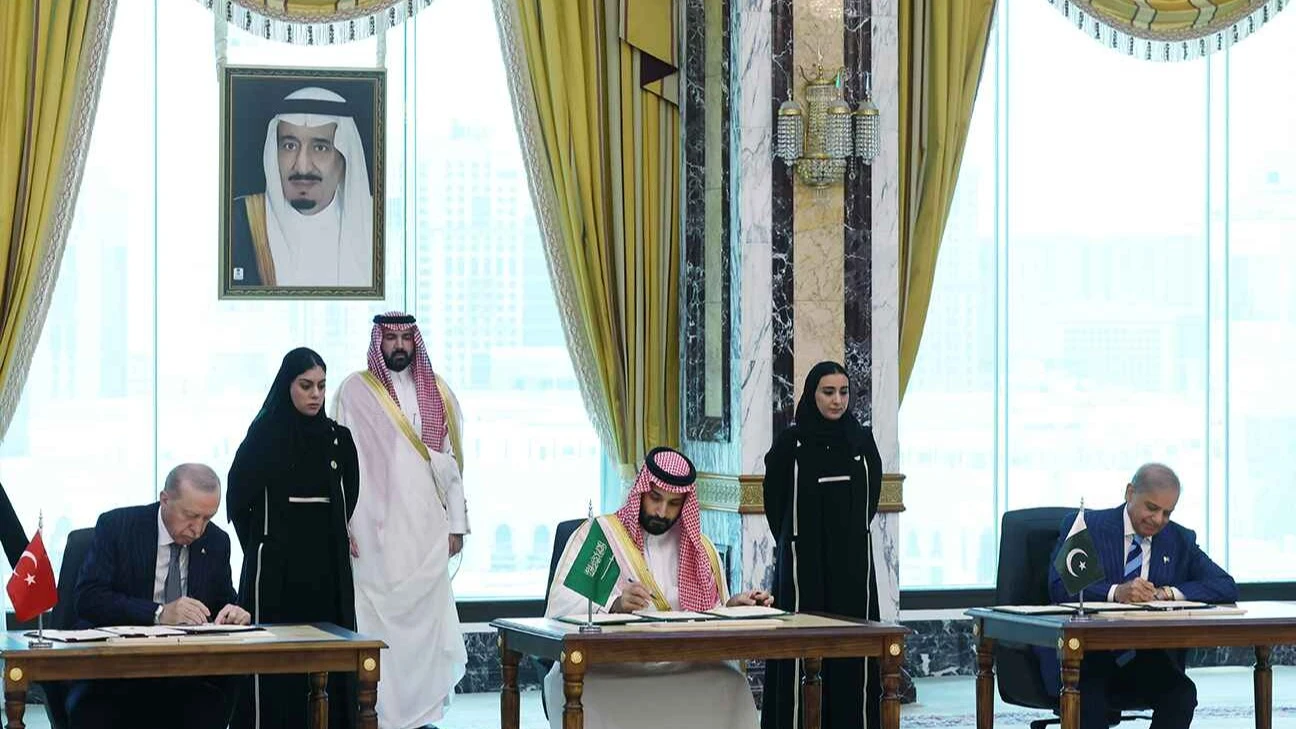
The Joint Defense Agreement signed by Türkiye, Pakistan, and Saudi Arabia in Mecca has caused a great resonance in the international arena, igniting discussions of a "Muslim NATO." Is this agreement, which considers an attack on one country as an attack on all three, a harbinger of a new security architecture in the Middle East, or is it merely a political gesture?
According to the KHAR Center, behind this agreement, which outwardly gives the impression of a unified military pact, lie the distinct strategic interests of all three countries rather than joint action against common threats.
Turkish President Recep Tayyip Erdogan returned from his visit to Saudi Arabia with the Mecca Joint Defence Agreement. The fact that the agreement signed between Saudi Arabia, Pakistan, and Türkiye in the city of Mecca contains a commitment similar to Article 5 of the NATO Treaty—meaning the parties agreed that an attack on one country is considered an attack on the other two—has led to widespread international discussion of the document (Reuters, 2026a). Although it has not been disclosed what duties this document, signed at the level of country leaders, imposes on the three countries or what military obligations the parties have undertaken, various interpretations regarding the agreement, such as a "Muslim NATO," "unity against Iran," "Sunni alliance," and "new security vector," have particularly flooded the Turkish media. The world media also evaluated the signed agreement as a manifestation of growing doubts and concerns about US security guarantees, as well as a search for regional security autonomy (Financial Times, 2026), and noted that combining the military and economic powers of the three countries could change the security architecture in the Middle East (Wall Street Journal, 2026).
Turkish President Recep Tayyip Erdogan stated that the agreement aims at collective deterrence and does not target any country, simultaneously adding that it is "open to the participation of all brotherly countries." Erdogan said the document would serve to advance security and defense cooperation, develop joint projects in the defense industry, and combat terrorism (Directorate of Communications, 2026). Foreign Minister Hakan Fidan noted that the document is not directed against Iran and that Türkiye wants other countries, including Egypt, to join it. Fidan also emphasized regarding how the mutual defense principle in the agreement would work, that if one of the parties is attacked, a decision would be made through consultation (AA, 2026).
Pakistani Prime Minister Shehbaz Sharif stated that the three countries are united by a "common will for faith, friendship, peace, and security." Sharif wished for the Mecca agreement to be a "shield of peace for future generations" and to bring prosperity to the three countries as well as to the Muslim world (Radio Pakistan, 2026a).
Saudi Arabia's Foreign Minister Faisal bin Farhan also stated that the agreement is an important milestone in defense cooperation. He emphasized that the document is the result of the will to unite efforts against threats affecting the region's security and stability (Radio Pakistan, 2026b). Meanwhile, Saudi official Rayed Krimly, in a statement to "Reuters," denied that the agreement was an attempt to create a "military axis" or a "sectarian bloc," as well as any connection to nuclear ambitions or an arms race (Reuters, 2026a).
Undoubtedly, the agreement signed by Türkiye, which has NATO's second-largest army; Pakistan, the only country in the Islamic world possessing atomic weapons; and Saudi Arabia, one of the world's largest oil exporters—with probabilities voiced about Egypt and other countries joining in the future—draws attention both in terms of the geography it covers and its timing. At a time when the conflict initiated by US and Israeli attacks on Iran has spread to the Gulf region, and energy routes and oil infrastructure are under threat, the documentation of the intention of Türkiye (which has issues with Israel), Saudi Arabia (which has issues with Iran), and Pakistan (which provides military support to them) to unite in a single military pact cannot fail to draw attention. However, it must be taken into account that, contrary to how it appears, this agreement did not emerge directly in the context of the Iran conflict—it is an expanded form of the military cooperation signed between Saudi Arabia and Pakistan a year ago, with the addition of Türkiye. On the other hand, the differing interests of all three countries raise many questions regarding the seriousness of the agreement.
Although a strong political declaration and a promise of collective defense have been noted by the three countries, there is no statement, detail, plan, or serious estimate on how this promise will be implemented. It remains uncertain whether the three countries will create a joint military command structure, how decisions will be made in crisis situations, with what forces and to what extent the parties will support an attacked country, what attacks the agreement covers, or how Pakistan's nuclear potential or the Turkish army's deterrence capability will be utilized. On the other hand, while Saudi Arabia's need for security and Pakistan's need for economic and strategic support are clear, the motivation of Türkiye, which already has a strong security shield under the NATO umbrella, is unclear. The estimates voiced in this regard—the expansion of defense industry borders, investments in the Gulf, and the currency flow from Saudi Arabia—are not sufficient for the ambitious evaluation of the agreement as a "Muslim NATO."
Out of what necessity did the Mecca agreement emerge?
No matter how much of a surprise effect it gives, the Mecca agreement is not a document signed directly in relation to the Iran conflict. As we noted above, Saudi Arabia and Pakistan had already signed a joint defense agreement in September 2025. And essentially, that agreement serves to formalize an alliance that has been ongoing for a much longer time than this new alliance. Namely, the Pakistani army has been performing training, advisory, and security functions in Saudi Arabia for decades. Military cooperation between the two countries dates back to the 1960s, when Islamabad first sent troops to protect Saudi Arabia (Tol, 2026). The joint defense agreement signed between the parties last year is the structuring of this long-term and deep cooperation. Türkiye entered the process later—earlier in the year, Pakistan's Minister for Defence Production, Raza Hayat Hiraj, stated that they were working to include Türkiye in the agreement, that discussions had been ongoing among the three countries for ten months, and that a draft text had been prepared (Dawn, 2026).
Thus, the document in question is not the result of reflexive behavior related to the Iran conflict, but rather an attempt to rethink the regional security architecture as a whole. Saudi Arabia stands at the center of this attempt. For years, Riyadh has relied on strategic alliance relations with the US in security matters. However, in recent years, serious questions have arisen regarding US security guarantees in crisis situations. According to Chatham House analysts, the US's observer stance, especially in September 2019 when missile and drone attacks were carried out on two Saudi oil facilities and more than half of its oil production was temporarily halted, was a breaking point for Riyadh. Another breaking point indicated is the soft reaction to Israel's 2025 attacks targeting Hamas leaders in Qatar, one of the US's closest allies. It is noted that it was exactly after these two events that Saudi Arabia began searching for new military alliances (Chattell, 2026).
This should not be evaluated as Saudi Arabia distancing itself from the US or searching for an alternative to its security guarantee. The signing of a strategic defense agreement between the US and Saudi Arabia in November 2025 (SPA, 2025) also shows that Riyadh still prefers Washington's security guarantees. This agreement is simply an attempt to create an additional shield for itself in the region. This is because the Iran conflict has made Saudi Arabia's search for diversified additional insurance for its security partnerships even more pressing. On one hand, Iran's attacks and threats targeting the oil, electricity, water, and transport infrastructure of Gulf countries, and on the other hand, the threat of attacks from Iraqi groups close to Iran and the Houthis in Yemen, have turned multi-layered security and defense cooperation into a necessity for Saudi Arabia. As paradoxical as it may seem, this actually aligns with the burden-sharing policy implemented by Trump. Washington is not against its regional allies taking on additional responsibilities, provided they remain tied to it within a strategic framework; on the contrary, it wants them to share more of the burden.
The second partner of the Mecca agreement, Pakistan, is one of the most important military powers in the region, with its 660,000-strong combat-experienced army, advanced missile systems, and approximately 170 nuclear warheads (Reuters, 2026b). However, it also needs economic power, diplomatic influence, energy security, and broader markets for the export of defense industry products. Saudi Arabia has been one of the main countries meeting Pakistan's financial needs for years (Reuters, 2026c). In this regard, Pakistan's participation in the Mecca agreement does not raise specific questions—Riyadh receives additional security support, and Islamabad receives funding. This "barter" is not limited to economic support alone; it simultaneously earns Pakistan regional influence and prestige. The Pakistani leadership wants its country to be recognized not as a geography where oppression and terrorism are widespread, but as a useful and influential global actor. On the other hand, the Middle East is a region of importance for Pakistan's strategic interests. At the same time, Pakistan views this agreement as a significant step regarding its relations with the US (Atlantic Council, 2026).
The situation of the third partner, Türkiye, which joined the agreement later, is somewhat different. Unlike Saudi Arabia, Türkiye does not need to obtain additional security guarantees from the US or any other country. The NATO umbrella, of which it is a member, meets this need. Secondly, it has a defense industry that has developed very rapidly, especially in the last 10 years, and thanks to this, its international opportunities have significantly expanded. Thirdly, Turkish President Erdogan has a very good relationship with US President Donald Trump, and this keeps Ankara away from Washington's policy of threatening its allies for the time being. Fourthly, Trump's policy of threatening his European allies has turned Türkiye into an important partner for the Europeans as well, a situation that considerably strengthens Erdogan's hand in international bargaining. Fifthly, no matter how much it is claimed that the Mecca agreement creates a nuclear weapons shield for Türkiye (via Pakistan), this does not seem realistic. First of all, Pakistan's nuclear missiles are not within range to reach Türkiye's potential adversaries. It is also unconvincing that Pakistan would transport these weapons abroad and enter into a war with a NATO country like Greece. On the other hand, Türkiye is currently protected by higher-quality US and British weapons. Moreover, with nearly fifty US nuclear warheads stationed at the Incirlik base, it already possesses a nuclear shield (Chattell, 2026). Finally, Saudi Arabia and Pakistan previously announced that the joint defense agreement they concluded did not encompass nuclear weapons deterrence (Dawn, 2025). There is no expression suggesting that this has changed in the Mecca agreement either.
Thus, it is not possible to explain Türkiye's motivation for signing the Mecca agreement with a need for defense. What remains, then, is expanding its regional influence, creating new markets for its defense industry, obtaining foreign currency revenue, and expanding the area of strategic bargaining among various power centers. In this regard, Ankara's interests appear closer to Pakistan's desires. Especially considering that highly critical elections for the Erdogan administration will be held in a year and a half, Saudi funding could play a very important role for the Turkish economy, which is being crushed under inflation pressure. At the same time, this alliance among Muslim countries will also appeal to Erdogan's pious electorate and serve the Turkish president's desire to be seen as the leader of the Muslim world—Erdogan may have thought of this as an electoral investment. Furthermore, Ankara wants the agreement, which aims to structure the already strong military cooperation with Riyadh and Islamabad, to also be read as a message of Muslim solidarity against Israel. Concurrently, the new alliance will serve the continuation of Türkiye's characteristic maneuvering policy—Ankara had previously sought to expand its bargaining opportunities within NATO and the West through maneuvers such as a desire for BRICS membership and membership in the Shanghai Cooperation Organisation. Now, it will add the Mecca agreement to this list.
Can the Mecca alliance be a Muslim NATO?
Interpretations that the Mecca alliance could be the "NATO of the Muslim world" are often based on the thesis that the Türkiye-Saudi Arabia-Pakistan alliance is against the strengthening of Israel and the United Arab Emirates in the region. However, this is an exaggerated assessment. According to Gönül Tol, the Director of the Türkiye Program at the Middle East Institute, from Yemen to Syria, Libya, and Africa, Türkiye's regional perspective increasingly aligns more with Saudi Arabia and moves further away from the United Arab Emirates. On the other hand, Ankara is trying to build a closer alliance with Riyadh because it believes that the Saudi Arabian leader has stronger ties than the UAE leader, and this will be useful in its relations with Washington. Nevertheless, Ankara would not dare to be represented in an alliance against the UAE, because even though Saudi Arabia's investment support helps Erdogan at critical moments, the UAE's impact on the Turkish economy and the regime's economic power is greater. This impact extends from currency swap lines to the investment market and partnerships. Abu Dhabi's lobbying power in Washington is also on Ankara's radar. In this regard, Türkiye is more interested in creating a balance between Saudi Arabia and the UAE rather than choosing between them (Tol, 2026).
On the other hand, like many analysts, Gönül Tol also believes that despite the promise of joint defense, the Mecca agreement should be evaluated as a political signal showing Israel and the US that Saudi Arabia has alternatives, rather than an automatic military action commitment. Because although the details of the current agreement have not been disclosed, the framework of the Saudi Arabia-Pakistan agreement, which forms its basis, was formulated as "increasing regional security and ensuring peace." This is language that serves deterrence rather than an obligation to war. In practice, it falls far short of the mutual defense guarantee in NATO. The main point distinguishing NATO's "one for all, all for one" principle from the Mecca agreement is its strictly institutional character. The Mecca agreement is far from this institutionalism. On the other hand, just as the three countries have common interests, they also have very different and contradictory interests, and most importantly, they do not have a named common enemy. Events in recent years in particular have shown that NATO is not an ideal military alliance either. However, it is precisely institutionalism and the identification of common enemies and common threats that are the key features of the NATO alliance.
The situation in the countries signing the Mecca agreement, however, is complicated. For Saudi Arabia, Iran is the main security problem; for Türkiye, it is Israel; and for Pakistan, it is India. That is, there is no common enemy or common threat for the partners of the Mecca agreement. For example, in the event that tensions between Pakistan and India turn into a military confrontation again, Ankara might support Islamabad, but how will Saudi Arabia, which has signed major trade, energy, and investment projects with India, behave? Or if a war breaks out between Saudi Arabia and Iran, or if the conflict with the Houthis in Yemen reignites, what position will Türkiye—which managed to remain neutral during the US attack on Iran—take? Will Pakistan, which tries to protect its relations with Iran, stand by Saudi Arabia? Or if a conflict occurs between Türkiye and Greece, will Saudi Arabia and Pakistan defend one NATO member against another? If there is a war between Türkiye and Israel, will the Mecca agreement work? An institutional mechanism to answer all these questions does not exist in the Mecca agreement.
In Lieu of a Conclusion
Presenting the Mecca agreement as a "Muslim NATO" is far from reality. The document in question rather shows that all three countries are trying to protect their interests with new cooperation formats in a changing international and regional security environment.
Saudi Arabia wants to diversify its security, Pakistan wants to translate its military power into political and economic capital, and Türkiye wants to breathe new life into its weakening economy and expand its regional influence and bargaining opportunities. The Mecca agreement could, in a certain sense, provide the three countries with the opportunity to realize these interests. However, questions remain open regarding whether this agreement will turn into a real military defense alliance and how the clause stipulating that an attack on one country is considered an attack on other countries will be applied in practice.
Note: The article you have read was originally written in the Azerbaijani language. Artificial intelligence tools were used only in the translation.
REFERENCES
Reuters, 2026a. Saudi Arabia, Turkey, Pakistan pledge mutual defence as Middle East turmoil escalates.https://www.reuters.com/world/asia-pacific/saudi-arabia-turkey-pakistan-sign-joint-defence-deal-amid-regional-turmoil-2026-08-07/.
Financial Times, 2026. Saudi Arabia, Turkey and Pakistan sign defence pact in Mecca.
https://www.ft.com/content/a988ae61-a218-4872-a4d7-a3061c6ca7ab?syn-25a6b1a6=1
Wall Street Journal, 2026. Saudi Arabia, Turkey and Pakistan Sign Defense Pact.
https://www.wsj.com/world/middle-east/saudi-arabia-turkey-and-pakistan-sign-defense-pact-ba80d84d
İletişim Başkanlığı, 2026. Cumhurbaşkanı Erdoğan’dan “Mekke Ortak Savunma Anlaşması” mesajı. https://www.iletisim.gov.tr/turkce/haberler/detay/cumhurbaskani-erdogandan-mekke-ortak-savunma-anlasmasi-mesaji
AA, 2026. Dışişleri Bakanı Fidan: (Mekke Anlaşması) Bize saldırmayan hiçbir ülke hedefimizde değil.” https://www.aa.com.tr/tr/gundem/disisleri-bakani-fidan-mekke-anlasmasi-bize-saldirmayan-hicbir-ulke-hedefimizde-degil/4021924.
Radio Pakistan, 2026. Makkah Joint Defence Agreement will remain shield of peace: PM Shehbaz https://www.radio.gov.pk/07-08-2026/pakistan-ksa-turkiye-united-by-shared-resolve-for-peace-pm
Radio Pakistan, 2026 b. Mecca Agreement for Joint Defence reflects deep strategic ties: Saudi FM. https://www.radio.gov.pk/07-08-2026/mecca-agreement-for-joint-defence-reflects-deep-strategic-ties-saudi-fm.
Tol, Gönül, 2026. What Ankara sees in Riyadh — and why it still needs Abu Dhabi.
https://mei.edu/publication/what-ankara-sees-in-riyadh-and-why-it-still-needs-abu-dhabi/.
Dawn, 2026. Pakistan-Saudi-Turkiye defence deal in pipeline, minister confirms.
https://www.dawn.com/news/1967120/turkish-fm-says-talks-held-on-defence-pact-with-pakistan-and-saudi-arabia-points-to-need-for-broader-regional-trust.
Chattell, Tim, 2026. Talk of a Turkish military alliance with Saudi Arabia and Pakistan reflects Ankara’s opportunistic ‘hedging’ strategy.
https://www.chathamhouse.org/2026/01/talk-turkish-military-alliance-saudi-arabia-and-pakistan-reflects-ankaras-opportunistic.
SPA (Saudi Press Agency), 2025. HRH the Crown Prince, U.S. President Sign Strategic Defense Agreement.
https://www.spa.gov.sa/en/N2447917.
Reuters, 2026b. What is Pakistan military's strength and capability?
https://www.reuters.com/world/asia-pacific/what-is-pakistan-militarys-strength-capability-2026-07-17.
Reuters, 2026c. Pakistan, Saudi in talks on JF-17 jets-for-loans deal, sources say.
https://www.reuters.com/world/asia-pacific/pakistan-saudi-talks-jf-17-jets-for-loans-deal-sources-say-2026-01-07/.
Atlantic Council, 2026. Why Saudi Arabia, Pakistan, and Turkey just signed a defense pact. https://www.atlanticcouncil.org/dispatches/why-saudi-arabia-pakistan-and-turkey-just-signed-a-defense-pact/
Dawn, 2025. Defence Minister’s contradictory take fuels conjecture over nuclear-angle in Saudi pact. https://www.dawn.com/news/1943355/defence-ministers-contradictory-take-fuels-conjecture-over-nuclear-angle-in-saudi-pact.
