
(This article was prepared as part of the KHAR Center's "Authoritarian Regimes and Transregional Influence Mechanisms" research.)
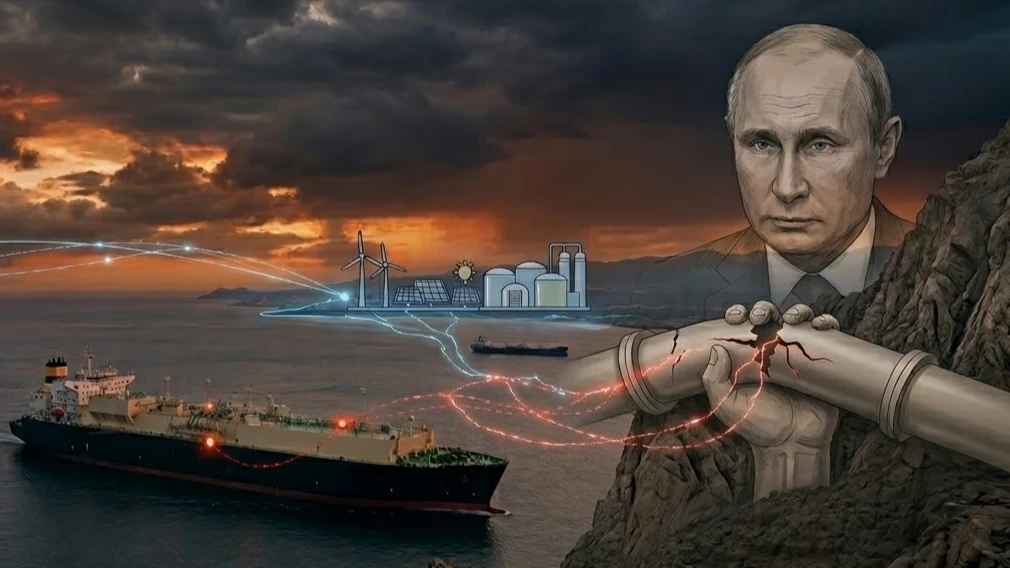
As the world discusses the potential impacts of a war in Iran on the global energy market, a new gas threat to Europe has emerged from Russian President Vladimir Putin. In an interview with the Russian press, Putin stated: “They want to impose restrictions on Russian gas, including liquefied gas, and cut it off completely from 2027. Currently, new markets are opening up in the world; perhaps it is more in our interest to cut off the gas to Europe now.” Putin noted that this is not yet a formal decision but rather a "thought out loud," though he added that he would instruct state agencies to discuss the matter with energy companies (Kremlin.ru, March 4, 2026).
What stands out in Putin's statement is undoubtedly the timing rather than the content. Although the Russian president linked the “we will cut the gas” announcement to the European Union's (EU) deadline of 2027 to end gas dependency, it is clear that without the Iran war and the anxiety its consequences have caused in Europe, this threat would likely have gone unnoticed.
Following the intervention by the US and Israel on February 28, Iran’s attacks on the energy facilities of Gulf countries have seriously affected the global energy flow. After attacks on QatarEnergy facilities, Qatar was forced to suspend liquefied natural gas (LNG) supplies (QatarEnergy, March 2, 2026). This affects Italy (30%), Poland (17%), and Belgium (8%), which import significant amounts of LNG from Qatar. Overall, Qatar provides 8% of the EU's LNG imports (CeenergyNews, March 4, 2026).
The effective closure of the Strait of Hormuz, through which one-fifth of the world's seaborne oil and LNG passes, combined with uncertainty regarding the war's progression, is increasing panic in Europe, where gas storage levels have dropped to 2022 levels. While there is some optimism in energy markets that LNG flows will not be completely severed—due to both Donald Trump's pragmatism and Iran’s budgetary dependence on energy—the prevailing consensus is that price increases and transportation difficulties are inevitable (The Guardian, March 2, 2026).
Just one day before Putin's statement, Norway’s Energy Minister Terje Aasland said, “The military confrontation involving the US, Israel, and Iran and its impact on global energy flows could force the European Union to reconsider its decision to ban Russian gas” (CeenergyNews, March 4, 2026). It is evident that these concerns lie behind Putin's "cut the gas now" threat.
On the other hand, all this coincides with a period when Europe’s determination to rid itself of Russian energy is at an all-time high. For one, the implementation of the EU's final phased plan for a ban on Russian gas imports, including LNG, is set to begin at the end of this month. Furthermore, it is reported that the European Commission is preparing to propose a new draft resolution on April 15 to permanently halt oil imports from Russia (The Japan Times, February 2026). Allegedly, the European Commission wants to ensure that even if a peace agreement is signed in the Russia-Ukraine war and includes the lifting of EU sanctions, no oil will be purchased from Russia. This decision is undoubtedly political rather than economic (the EU imported only 1% of its oil from Russia in the last quarter of last year) and primarily aims to rescue Hungary and Slovakia from Russia's "clutches." For this reason, the Commission reportedly plans to put forward the proposal exactly three days after the elections in Hungary to avoid influencing the results (The Japan Times, February 2026). Putin’s statement that he would continue trading with Hungary and Slovakia further demonstrates that the issue is not about energy competition, but about European unity.
If Russia Cuts the Gas Now...
Undoubtedly, Putin's "we can cut the gas right now" statement is largely a bluff and propaganda. Even with the Iran war, the Russian energy threat is not more relevant for Europe than it was in 2022. The vast majority of EU countries—Estonia, Lithuania, Latvia, Denmark, Finland, Sweden, Germany, Poland, Croatia, Malta, Ireland, Luxembourg, Austria, and the Czech Republic—have either completely stopped or significantly limited gas imports from Russia. This has drastically reduced the EU's dependence on gas supplied via Russian pipelines (Khar Center, February 2026).
Russia's natural gas exports to Europe via pipelines have fallen by 44%, reaching their lowest level in decades (Reuters, 2025). In 2025, the EU imported 38 billion cubic meters (bcm) of natural and liquefied gas from Russia. This represents 12% of the union's total gas imports. The bulk of this—20 bcm—was LNG, while 18 bcm was natural gas, primarily coming through the "TurkStream" pipeline (ING, 2026).
The main buyers of Russian natural gas within the EU are Hungary and Slovakia, and outside the EU, Serbia. The resistance of the first two countries to reducing dependence on Russian gas is the primary reason why the EU's total natural gas imports from Russia remain around 6% rather than decreasing further. Nevertheless, the EU remains the largest buyer of Russia's pipeline-exported natural gas at 43% (CREA, 2025).
Another reason why total gas imports from Russia have not dropped to even more minimal levels is the continued import of LNG, which was not included in the sanctions framework until late 2025. Countries such as France, Belgium, Spain, the Netherlands, Italy, and Portugal continue to buy LNG from Russia, resulting in total EU gas imports from Russia remaining around 12–13% (CREA, 2025). France alone was the largest importer of Russian LNG, purchasing 4 million tons in the first eight months of last year, followed by Belgium, Spain, the Netherlands, and Italy.
LNG from Russia’s Yamal field in northwest Siberia brought the Kremlin 7.2 billion in revenue in 2025 alone. Of the 19.7 million tons of LNG exported from the Yamal field, nearly 15 million tons (76.1%) were exported to the EU. EU supplies from Yamal actually increased in 2025 compared to the previous year (rising from 75.4% to 76.1%). In this regard, EU ports act as the "lungs" for Russia’s largest LNG terminal (The Independent, January 2025).
Taking all this into account, it seems unrealistic for Putin to cut gas exports to Europe, especially while searching for new resources to spend on the war in Ukraine. Firstly, even if Putin cuts the pipeline gas to Hungary and Slovakia, it would not pose a serious problem for the EU's overall supply. On the contrary, it might benefit the EU politically by removing one of the biggest blackmail cards used by the Kremlin-aligned leaders of Hungary and Slovakia. From this perspective, Russia is not interested in cutting off the Hungary-Slovakia channel. On the other hand, if Russia cuts pipeline gas while there is an LNG shortage, Moscow could face serious logistical problems selling that gas elsewhere unless Turkey buys a portion of it. Diverting LNG to other markets, as Putin claims, also presents problems—such as seasonal restrictions on the Northern Sea Route (ING, 2026) and the recent increase in the West's crackdown on Russia's "shadow fleet."
Even if we theoretically accept the possibility of Russia cutting LNG exports now, it is unlikely to create the "collapse" or "catastrophe" frequently cited by the Kremlin. While 14% of imports is not a small figure, the EU's dependence on Russian LNG is not critical. The US provides 56% of the Union's total LNG imports; combined with Norway’s 4% share, this figure reaches 60% (Energy EC, 2025).
The statement by Dan Jørgensen, the European Commissioner for Energy—“We have a very diversified, global supply chain. Prices are naturally a concern, but not how the gas will be supplied”—indicates that Brussels is prepared for this threat. Before the Iran war began, it was predicted that European gas storage levels would reach 89% by November 1, largely due to LNG imported from the US. Jørgensen noted that if disruptions in LNG supply continue, there might be a slight decrease in this figure, but the impacts are still being evaluated (Euronews, March 3, 2026)
In lieu of Conclusion
All these factors suggest that Putin's "we can cut the gas now" statement is a bluff designed for political and psychological impact. Since 2022, the European Union has moved toward diversifying its energy supply, significantly reduced its dependence on Russia, and plans to end it entirely by 2027. The Iran war will certainly affect the EU's energy diversification and supply plans, but this impact will likely manifest as price fluctuations and rising costs rather than a systemic collapse. The volume of gas Putin claims he can "cut now" might cause serious problems for a few individual countries, but it would not result in an energy catastrophe for the European Union as a whole. On the contrary, it would mean significant losses for Russia itself, which is spending and needs massive resources to maintain its war against Ukraine—it is hard to believe Putin would risk this. Despite all restrictions, the European market remains one of Russia's accessible revenue streams and, as seen in Hungary and Slovakia, a tool for political influence.
Putin is using the energy anxiety created by the Iran war as an opportunity to blackmail Europe. However, the Russian gas threat is not as powerful or relevant for Europe as it was in 2022.
References:
Kremlin.ru, 4 mart 2026. Интервью телеканалу «Россия 24». http://kremlin.ru/events/president/news/79260
QatarEnergy, 2 Mart, 2026. QatarEnergy to stop production of LNG https://www.qatarenergy.qa/en/MediaCenter/Pages/newsdetails.aspx?ItemId=3892
CE Energy News. 4 mart 2026. Norwegian Energy Minister: Iran war may reopen EU debate on Russian gas ban. https://ceenergynews.com/oil-gas/norwegian-energy-minister-iran-war-may-reopen-eu-debate-on-russian-gas-ban/
The Guardian. 2 mart 2026. Iran, the Strait of Hormuz and how conflict could drive up the cost of living worldwide. https://www.theguardian.com/world/2026/mar/02/iran-strait-hormuz-oil-global-prices-cost-of-living
The Japan Times, fevral 2026. EU prepares law to permanently ban Russian oil imports after Hungary election. https://www.japantimes.co.jp/news/2026/02/25/world/politics/eu-russian-oil-hungary/
KHAR Center, fevral 2026. Rusiya-Ukrayna müharibəsinin 4-cü ili: sanksiyalar niyə yetərsiz qalır? https://kharcenter.com/arasdirmalar/rusiya-ukrayna-muharibesinin-4-cu-ili-sanksiyalar-niye-yetersiz-qalir
Reuters, 30 dekabr 2025. Russia’s pipeline gas exports to Europe fall by 44% to lowest in decades. https://www.reuters.com/business/energy/russias-pipeline-gas-exports-europe-fall-by-44-lowest-decades-2025-12-30/
ING Think, 5 mart 2026. The Commodities Feed: Putin’s gas threat to the EU is another upside risk for markets. https://think.ing.com/articles/the-commodities-feed-putins-gas-threat-to-the-eu-is-another-upside-risk-for-markets050326/
CREA (Centre for Research on Energy and Clean Air), dekabr 2025. December 2025 monthly analysis of Russian fossil fuel exports and sanctions. https://energyandcleanair.org/december-2025-monthly-analysis-of-russian-fossil-fuel-exports-and-sanctions/
The Independent, yanvar 2025. EU ports remain key to Russian Yamal LNG exports despite efforts to cut dependence. https://www.independent.co.uk/news/world/europe/eu-russia-liquefied-natural-gas-b2896255.html
European Commission, Directorate-General for Energy. 2025. Quarterly Report on European Gas Markets, Q2 2025. https://energy.ec.europa.eu/document/download/d80fd3b6-6f3d-48b0-bd6e-db2f21dcd796_en?filename=New+Quarterly+Report+on+European+Gas+Markets+Q2+2025.pdf
Euronews. 3 mart 2026. EU praises Azerbaijani gas partnership amid energy disruption triggered by Middle East crisis. https://www.euronews.com/my-europe/2026/03/03/eu-praises-azerbaijani-gas-partnership-amid-energy-disruption-triggered-by-middle-east-cri
