

Author: Ismail Djalilov
An American journalist originally from Azerbaijan.
He is the host of the YouTube channel "Let's Talk Straight".
He conducts interviews in Azerbaijani, Russian, and English with politicians, diplomats, and other newsmakers on developments in Azerbaijan and the wider Eurasian region.
For centuries, the competitive edge of the West was not merely its geography or its wealth, but its cognitive architecture. It was built on empirical thinking and free, science-based discourse—an ecosystem largely, if not completely, free of the rigid ideological frameworks, religious taboos, and fear of political reprisal that stifled inquiry in the rest of the world. This intellectual freedom was the 'secret sauce' that allowed the best ideas to survive and the worst to die, regardless of who held them.
From Library To Carnival
The internet was supposed to be the ultimate accelerator of this architecture, a tool to democratize access to the facts that underpin our reality. Instead, it has done the opposite. In the hands of for-profit social media monopolies, the internet has been transformed from a library into a carnival. By grouping users into silos based on preference rather than proof, and by prioritizing 'engagement' over truth, these platforms have reintroduced the very pathologies the West fought to escape: tribalism, dogmatism, and a terrifying new fear of reprisal for speaking against the consensus of the mob. We traded the Age of Reason for the Age of the Algorithm. It was a bad trade. We are dismantling the machinery of our own success.
Media Metamorphosis
The internet did not fix the sins of television; it automated them. Much like the cable news era that preceded it, social media found that nuance is bad for business. To capture attention, these platforms—and the legacy media outlets dragging behind them—systematically absconded their primary responsibility: to educate and inform the electorate. Instead, they pivoted to a toxic form of entertainment, both political and cultural. They chose to feed the users’ existing biases rather than challenge them, prioritizing the perpetuation of our delusions over the discomfort of learning. The result is a media landscape that no longer serves citizens; it serves fans.
Conflating Popularity With Competence
The polarization of society isn't the real danger. The real danger is that we have lost the ability to distinguish between popularity and competence. We have applied the logic of 'American Idol' to the machinery of survival.
Consider the power grid. It is a complex, fragile system requiring high-level engineering, long-term planning, and specialized expertise to maintain. It does not care about public opinion. Yet, we are drifting toward a world where we would choose the manager of that grid not based on their engineering credentials, but on their 'likability,' their relatability, or their ability to deliver a witty soundbite. We are treating the management of civilization as a popularity contest, forgetting that while a charismatic leader can win an election, they cannot negotiate with the laws of physics.
We are standing on a terrifying precipice. Call it the revolt of the Aggressive Amateur. We have entered an era where the 'Democracy of the Intellect'—the mistaken belief that my ignorance is just as valid as your knowledge—has become the dominant cultural force. It is the rise of the Kakistocracy: rule by the least competent.
By stripping away the authority of expertise and replacing it with the 'wisdom of the crowd,' we have emboldened a new class of citizen who views education not as an achievement, but as an elitist affectation. They are not merely uninformed; they are actively hostile to the concept of being informed. They are the beneficiaries of a digital world that told them their 'gut feeling' was a valid substitute for data. And now, they are demanding to fly the plane.
There was a time when we comforted ourselves with a specific hope: that no matter how chaotic the political theater became, the institutional guardrails would eventually kick in. We believed that the helm of our increasingly complex, knowledge-based state machinery had a built-in immune system—that the sheer weight of reality would force the system to wrestle itself back from the hands of ill-informed but socially intelligent populists. We assumed that when the rhetoric met the road, competence would ultimately overrule charisma.
We were wrong…
Instead of acting as a firewall, the institutions were overwhelmed by a populace that the internet had not just misled, but weaponized. Organized by algorithms that fed them madness. The Earth is flat. The pandemic was a hoax. Political opponents are running a pedophile ring from a pizza parlor basement. Vaccines contained microchips designed to enslave the population—this new coalition exercised a newly found political dominance over the educated class.
In this new reality, the very request for proof became an act of aggression. The demand for fact-based opinion was dismissed as elitist trickery, rejected a priori in a bout of anti-intellectual fervor that has been fueling the last few election cycles. To know became a sin; knowledge was replaced by the 'authenticity' of feeling. The objective constants that hold civilization together—the 2+2=4 of governance, medicine, and engineering—were suddenly opened up for debate. And in the court of public opinion, the answer is no longer four. Depending on the crowd’s mood, the outcome is now three, five, six, or an elephant.
21st Century Civilization With Paleolithic Mentality
We have arrived precisely where the political philosopher Hannah Arendt warned we would: a state where the distinction between fact and fiction no longer exists. But this is not merely a philosophical decline; it is an existential gamble. As anthropologist Joseph Tainter noted, complex societies collapse when they lose the capacity to solve the problems they create.
We have built a civilization that runs on doctoral-level complexity—interconnected supply chains, high-level virology, nuclear power—but we have handed the keys to a culture that celebrates the 'gut feeling' of the uninformed and congratulates itself on the ‘victory for democracy.’ We are attempting to run a Twenty-First Century machine with a Paleolithic 'us-versus-them' operating system.
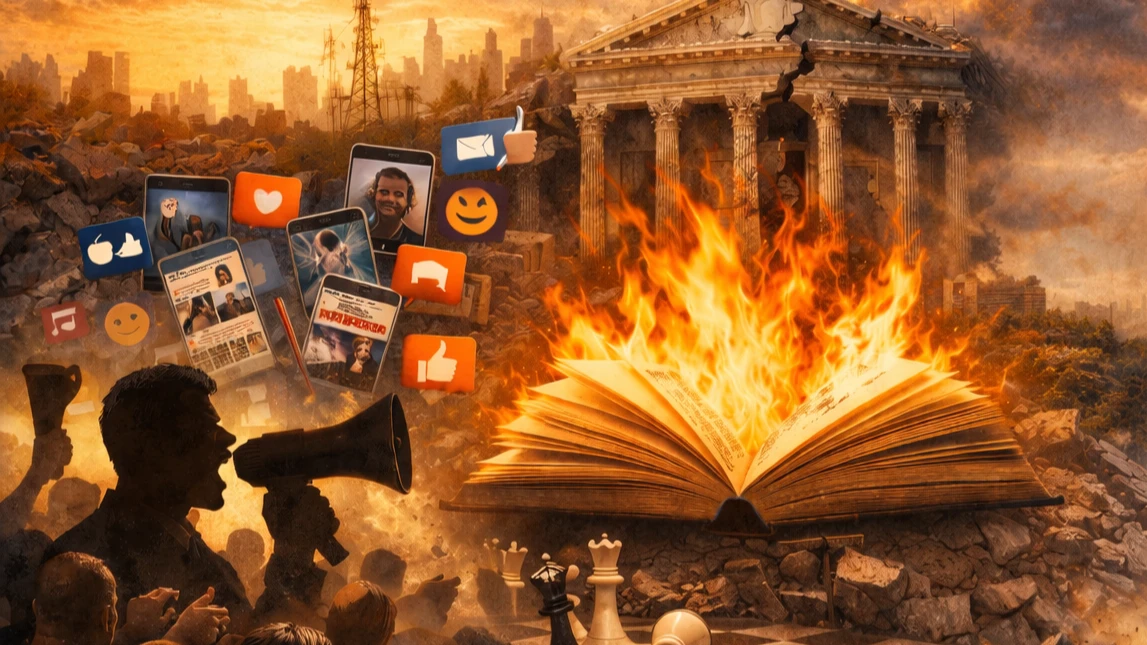
I fear this transformation may be irreversible. The Aggressive Amateur has not just stormed the gates; they have burned down the library. As someone who fled a world where incompetence was shielded by ideology, it is terrifying to watch the West voluntarily dismantle the very immunity that made it exceptional.
But while we can vote against the experts, and we can cancel the engineers, we cannot legislate away the consequences. Reality is the ultimate non-partisan actor. It does not care about our 'point of view,' our cultural grievances, or the fervor of our online silos. A bridge does not stay standing because it is popular; it stands because the math is correct. A virus does not retreat because we voted it a hoax.
We have spent the last decade treating the truth as a flexible commodity, an 'opinion' to be debated in the marketplace of feelings. But the bill for this luxury is coming due. And when the bridge finally collapses, or the grid fails, or the next pandemic arrives, we will learn the hardest lesson of all: Civilization is not a democracy of ideas. It is a dictatorship of facts. And reality is a dictator that cannot be voted out.
Sources:
Hannah Arendt, 1951. The Origins of Totalitarianism. https://cheirif.wordpress.com/wp-content/uploads/2014/08/hannah-arendt-the-origins-of-totalitarianism-meridian-1962.pdf
"The ideal subject of totalitarian rule is not the convinced Nazi or the convinced Communist, but people for whom the distinction between fact and fiction (i.e., the reality of experience) and the distinction between true and false (i.e., the standards of thought) no longer exist."
Joseph Tainter, 1968. The Collapse of Complex Societies. https://www.amazon.com/Collapse-Complex-Societies-Studies-Archaeology/dp/052138673X#:~:text=Book%20details%0A%0AThe%20Collapse%20of%20Complex%20Societies%2C%20though,societies%20in%20both%20the%20present%20and%20future.
"Complexity is a problem-solving strategy. The problems with which the universe can confront any society are, for practical purposes, infinite... As stresses necessarily arise, new organizational and economic solutions must be developed, typically at increasing cost and declining marginal return... At this point, a complex society reaches the phase where it becomes increasingly vulnerable to collapse."
