
(This article was prepared within the framework of KHAR Center's study "Russia's Influence Mechanisms in Post-Soviet Countries")
Kazakhstan occupies a special place in Russia's influence policy in the post-Soviet space. The Kremlin's capacity for influence in this country is not limited to propaganda and information manipulation. Moscow possesses long-term and multiple levers of influence over Kazakhstan, formed in the economic, political, military, energy and information spheres. The widespread use of the Russian language, the two countries' membership in the same economic and security organizations, and the fact that a significant part of Kazakhstan's energy exports passes through Russian territory are among the main factors strengthening Moscow's capacity for influence.
However, in recent years, especially after Russia launched its full-scale war against Ukraine in 2022, important changes have occurred in the character of these relations. The appearance, alongside this war, of statements in the Russian political and information space questioning Kazakhstan's statehood has brought the risks of relations with Moscow into sharper relief for Astana. On the one hand, Kazakhstan has maintained close economic and security ties with Russia; on the other, it has not recognized the annexation of the occupied Ukrainian territories to Russia and has sought to expand its relations with China, the European Union, Türkiye and other partners.
Yet Astana's pursuit of a multi-vector foreign policy does not mean that Russia's capacity for influence in the country has disappeared. Moscow still retains significant influence potential over Kazakhstan's economy, security system and information space. Moreover, the narratives the Kremlin uses to justify the war against Ukraine are also spreading in Kazakhstan's Russian-language information space.
In this study, “KHAR Center” analyzes, on the basis of facts, Russia's influence mechanisms in Kazakhstan, their historical and structural foundations, and especially the changes that have taken place since 2022. The study aims to identify what levers of influence the Kremlin has in Kazakhstan's political, economic and information space, how it uses these capabilities, and how it affects Astana's attempts to pursue an independent policy.
RUSSIA'S STRATEGIC GOAL IN KAZAKHSTAN
Russia sees Kazakhstan as one of the main pillars for preserving its geopolitical dominance in the post-Soviet space. For the Kremlin, maintaining its capacity for influence over this country is not merely a matter of bilateral relations, but an important part of its strategy to retain its position in Central Asia as a whole. Holding sway in this region is one of the key indicators of great-power status for Russia. In this respect, Kazakhstan is of particular importance in Moscow's policy of influencing the strategic choices of post-Soviet countries and keeping them within its own orbit. Sharing the world's longest continuous land border with Russia (more than 7,000 metres) and possessing the largest economy in Central Asia, this country is a member of the Eurasian Economic Union (EAEU) and the Collective Security Treaty Organization (CSTO), both of which Moscow “patronizes”.
The fact that Russia's full-scale aggression against Ukraine in 2022 did not produce the expected effect and turned into a years-long war of attrition, together with sanctions and isolation, had created the impression that post-Soviet countries, including the Central Asian states led by Kazakhstan, would gradually pursue a policy of distancing themselves from Moscow. This impression was further reinforced by the visibly growing influence of China in the region and by Kazakhstan's efforts to diversify its foreign policy by taking advantage of the situation (Umarov, 2024). Episodes such as Tokayev speaking in Kazakh rather than Russian for the first time during his 2023 visit to Moscow, his ironic remark about elections in Russia, and his statement that Kazakhstan would not recognize the independence of the Ukrainian territories occupied by Moscow were also cited as arguments reinforcing this conclusion (Mallinson, 2024).
There were certain grounds for such an expectation, because Central Asia's role in the international system has been reshaped by Russia's aggression against Ukraine. Although Moscow has retained a significant part of its political and economic instruments of influence in the region, the growing activity of other powers has weakened its former dominance. On the one hand, the threat posed by Russian imperialism has now taken on a more concrete form. On the other hand, this aggression has increased the region's importance for other international powers. This undoubtedly strengthens the hand of the countries of the region. Taking advantage of the situation and of its own position, Kazakhstan has defined a category of functional partners in every sphere. It has entrusted security to Russia, designating the Collective Security Treaty Organization as its guarantor. The Eurasian Economic Union and the Caspian Pipeline Consortium ensure fuel access to global markets. China's Belt and Road Initiative supports east–west infrastructure across Kazakhstan. The Middle Corridor, which Astana is building together with Azerbaijan, Georgia and Türkiye with financing from the EU and the Gulf states, serves as an outlet for transit. As for critical minerals, Astana has turned to the United States. In November 2025, an agreement was signed between the US company Cove Capital and Kazakhstan's National Mining Company on the creation of a USD 1.1 billion joint venture for tungsten extraction. Seventy per cent of the venture belongs to the US side, and a letter of intent has been submitted stating that up to USD 900 million will be provided for the project by the Export–Import Bank of the United States. Since China controls more than 80 per cent of the global tungsten supply, none of Kazakhstan's other partners could create the capacity needed for independent processing of this metal. Washington, however, is able to do so (Murtazashvili, 2026).
Undoubtedly, in the long run competition and tensions will also emerge among these powers, and China will most likely retain its dominant position here. But this will not be in Russia's favour either. In this respect, one of Moscow's main current goals is to prevent Kazakhstan's rapprochement with alternative partners from reducing its strategic dependence on Russia (OSW, 2026).
This concern of Moscow is also reflected in documents from a strategic meeting held by the Russian government in April 2024, which were later leaked to the press. According to them, the Russian leadership regards the expansion of Central Asian countries' ties with China and the West as a problem for its sphere of influence. According to the documents, Moscow's goal is to bind the region more closely to Russia and to preserve there its own sphere of influence rivalling China, the United States and the European Union (Financial Times, 2025).
Although Kazakhstan seeks to pursue a diversified foreign policy, in practical terms this policy cannot be called fully balanced, because its ties with Russia and its structural dependencies are stronger than its relations with other actors. The limits of Astana's diversification are determined by Russia's view of Kazakhstan, Kazakhstan's economic and security dependence on Russia, and the authoritarian form of governance in the country. The Russian political elite treats Kazakhstan not so much as an independent and equal partner, but rather as a state that must remain within Moscow's sphere of influence. In this respect, the Kremlin regards interference in Astana's domestic and foreign policy as its legitimate right. Because Moscow's positions in energy transit, trade and strategic sectors give it the potential to inflict serious damage on Kazakhstan's economy, Astana is forced to take the Kremlin's interests into account in its foreign policy. Alongside this structural dependence, the political governance system in Kazakhstan and the ruling elite's intention to continue strategic cooperation with Russia are also among the factors that sustain Moscow's influence over Astana.
In other words, the Kremlin's influence in Kazakhstan stems not only from Russia's power but also from the local authorities' need to preserve their own political system. For a long time, the Kazakh authorities have built their legitimacy on economic development and stability. For this reason, an economic crisis is not only a social but also a political threat to the government. A sharp reduction in economic dependence on Russia could create short-term economic problems, and such problems would in turn affect the stability of the government. In this respect, as long as the Tokayev administration continues authoritarian governance and a legitimacy model built on economic well-being, it will be difficult to significantly reduce dependence on Russia (Silvan, 2026).
Thus, Russia's main strategic goal in Kazakhstan is not so much to subordinate Astana's foreign policy entirely to Moscow, but rather to limit its capacity for independent decision-making through existing mechanisms of dependence. By preserving the positions it has gained in Kazakhstan's economy, energy transit, security system and relations with political elites, the Kremlin seeks to retain its ability to influence the country's strategic choices.
The Foundations of Russia's Influence in Kazakhstan
The roots of Russia's influence in Kazakhstan stretch from the Russian Empire's expansion towards Central Asia and the colonial policy of the tsarist authorities, through the demographic and economic changes carried out in the Soviet period, to the authoritarian character of the regimes in Kazakhstan.
Ethnic Russians and the Russian Language as a Factor of Hybrid Interference
After the annexation of the Kazakh lands to the Russian Empire in the late 19th and early 20th centuries, more than 1.5 million Russian peasants were resettled from European Russia to the Kazakh steppes. The process changed the traditional way of life of the Kazakhs and the socio-demographic structure of the region (Cameron, 2018). Russian settlement, especially in Northern Kazakhstan, created pressure on the Kazakhs over land resources (Aldashev, Quirkinger, 2017). During the Soviet period, collectivization, forced resettlement, industrialization and the policy of Russification further strengthened this factor. Although for a short period after the occupation of the Kazakh lands by the Soviet Union local Bolsheviks pursued a policy of decolonization, this process was reversed again in subsequent years. In particular, with the Soviet Union's change of economic policy in 1928, Kazakhstan became the centre of grain-farming and industrialization plans. After this change, which re-legitimized peasant colonization from Russia, systematic steps began to be taken to distance Kazakh society from its national identity and to strengthen its subordination. Kazakhstan's wealthy peasants, its elite and those who had held office in the tsarist period were subjected to systematic repression: their possessions were confiscated, they and their families were exiled, and for the first time young Kazakhs were conscripted into the Soviet army. In 1929, a plan for the complete sedentarization of Kazakh nomadic herders was announced. However, with the collectivization campaign that began immediately afterwards, this issue was taken off the agenda. Between 1930 and 1932, the livestock of Kazakh peasants began to be slaughtered en masse to feed the populations of Moscow and Leningrad and the Soviet army. This led to a great catastrophe – a famine. The famine, which killed one third of the Kazakhs, turned the country's titular nation into an ethnic minority (Pianciola, 2019). Factors such as the deportation of other Soviet peoples to Kazakhstan and the Virgin Lands campaign launched in the 1950s also contributed to this. Russians settled in particularly large numbers in the north of the country and in large industrial cities. According to the last census held in the USSR in 1989, ethnic Russians made up 37.8 per cent of Kazakhstan's population (MPI, 2022).
Although Kazakhstan gained independence after the collapse of the Soviet Union, its demographic, cultural and institutional dependence on Russia continued. The severe economic crisis the country faced in the first years of independence, the existence of a large ethnic Russian community and historical ties were the main factors that conditioned the continuation of cooperation with Moscow. These conditions also affected other post-Soviet countries, but only Belarus and Kazakhstan remained in Russia's orbit as strategic allies. In Kazakhstan, the image of Russia as the dominant ally took shape in the shadow of historical development, and this has remained a defining factor in relations between the two countries to this day (Stevens, 2020). Moreover, the deepening of integration with Russia was not solely Moscow's initiative. Kazakhstan's first president, Nursultan Nazarbayev, also acted as one of the main initiators of this process (Bohr, Mallinson et al., 2019).
After independence, the demographic situation changed considerably. As a result of ethnic Russians emigrating to Russia, Kazakhs returning from other countries to their historical homeland, and natural population growth, the share of Kazakhs in the population increased. According to the latest statistics, Kazakhs make up 71.5 per cent and ethnic Russians 14.4 per cent of the country's population of 20.5 million (Bureau of National Statistics of Kazakhstan, 2026a). However, this change is not uniform across all regions of the country. In regions bordering Russia, such as North Kazakhstan, Kostanay and East Kazakhstan, the share of ethnic Russians remains well above the national average. In some of these regions, Russians make up more than 40 per cent of the population. Against the background of the Kremlin's invasions under the pretext of “protecting Russians” and of statements by Russian politicians questioning Kazakhstan's statehood and territorial integrity, such a demographic situation is assessed as fertile ground for potential hybrid interference (OSW, 2025).
On the other hand, the decline in the number of ethnic Russians does not mean a decline in the influence of Russia and the Russian language. One of Russia's most enduring instruments of influence in Kazakhstan is the Russian language. During the Soviet period, Russian gained a dominant position in public administration, industry, science, higher education and the mass media. This made Russian the main means of communication not only for ethnic Russians but also for Kazakhs and the other peoples living in the country. Although Kazakh was declared the state language after independence, the legal status of Russian in public administration was preserved. Russian is officially used alongside Kazakh in state organizations and local self-government bodies. This has allowed the Russian language to retain its broad position in the country's public and institutional life. According to official data, 83.7 per cent of Kazakhstan's population, including 79.5 per cent of ethnic Kazakhs, speak Russian (MDPI, 2026).
Economic Dependence
One of the main pillars of Russia's influence in Kazakhstan is the close connection with Moscow, formed in the Soviet period, of industrial enterprises, raw material production, and transport and supply infrastructure. Even after Kazakhstan gained independence, this connection retained its strategic importance. The Eurasian Economic Union, which Nazarbayev initiated together with Putin, was implemented as the first stage of the dream of reviving the former USSR. EAEU membership has given Kazakh companies easier access to the Russian market, customs preferences and the opportunity to use common economic rules. However, this has not been a union of equals: Moscow's economic weight within the union has caused these integration mechanisms to be unequal in character and has increased Kazakhstan's sensitivity to changes in the Russian economy.
Russia's share of Kazakhstan's imports was 42.5 per cent in 2021. Although after the war in Ukraine and Western sanctions this figure fell to 26.5 per cent in 2023, it rose again to 30.5 per cent in 2024 (OECD, 2025). These changes show that, despite Kazakhstan turning to alternative sources of supply, Russia's position in the import market has not changed. This position has also remained stable in recent years. In 2025, trade turnover between the two countries amounted to USD 27.4 billion. Russia accounted for 29.7 per cent of Kazakhstan's total imports and 10.3 per cent of its exports (ETSE, 2026). In January–August 2026, Russia's share of imports rose to 31 per cent, while its share of exports fell to 8.5 per cent. For comparison, China's share of Kazakhstan's imports in the same period was 29.8 per cent. In other words, despite the rapid expansion of economic ties with China, Russia still remains Kazakhstan's number one supplier. Russia also accounted for 87.3 per cent of Kazakhstan's trade with EAEU countries (Bureau of National Statistics of Kazakhstan, 2026b).
Russia also outpaces other countries in terms of the number of companies with its capital in Kazakhstan. In 2025, 22,628 Russian-owned legal entities, branches and representative offices were registered in the country, of which 17,049 were operating. In addition, 4,732 jointly owned entities with Russian capital participation were registered, 3,711 of which were operating. In the same period, the number of registered Chinese-owned entities was 9,694 (Bureau of National Statistics of Kazakhstan, 2026c).
Russia's capacity for economic influence took on a new character after the war against Ukraine. Western sanctions imposed on Moscow forced Russian companies to look for alternative trade and logistics routes. Kazakhstan's EAEU membership, its long border with Russia and its access to international markets turned the country into an important intermediary in this process. These new trade and investment opportunities increased the interest of Kazakh business groups in cooperating with Moscow. For this reason, in discussions with Moscow, Central Asian leaders speak of the threats posed by secondary sanctions imposed by the West. In discussions with Western leaders, by contrast, they ask that these sanctions not be applied to them, citing pressure from Moscow as their argument (Bohr, 2025).
Energy and Transit Dependence
One of the most serious structural dependencies in Kazakhstan's relations with Russia has formed in the energy sector. Kazakhstan's rich energy resources have not ensured its economic independence from Russia. On the contrary, reliance on existing infrastructure to deliver energy resources to world markets, cooperation in the gas sector and new projects in nuclear energy have become important factors sustaining Moscow's capacity for influence.
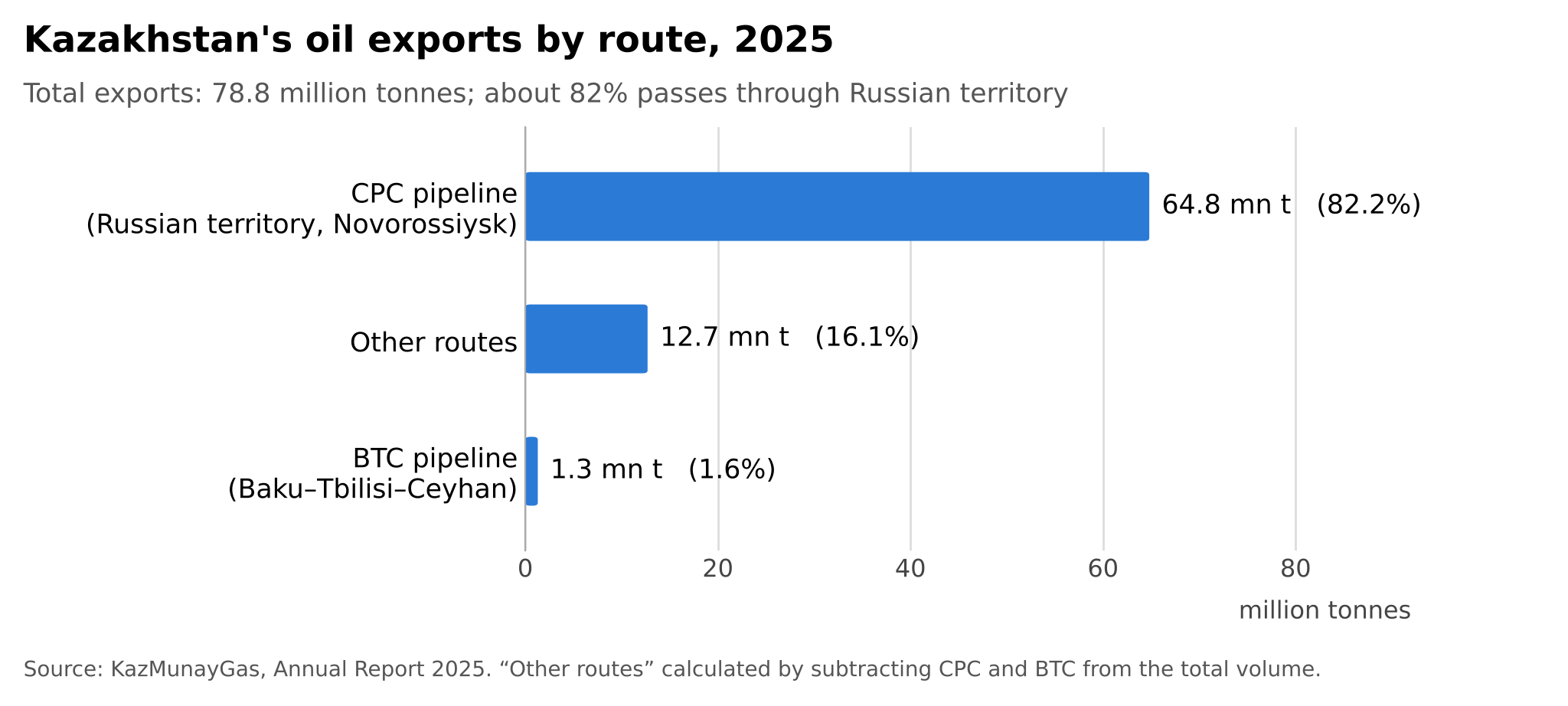
Part of the country's main oil export routes passes through Russian territory. The main dependence relates to the Caspian Pipeline Consortium (CPC). The pipeline, which connects large oil fields in western Kazakhstan such as Tengiz, Kashagan and Karachaganak to the Novorossiysk terminal on Russia's Black Sea coast, is the country's main export artery: about 80 per cent of Kazakhstan's oil exports pass through this route. At the same time, crude oil and petroleum products generate more than half of the country's export revenues (OSW, 2026).
The risks of such dependence have become more pronounced since 2022. That year, Russian authorities, citing environmental violations, adopted decisions aimed at suspending the CPC's operations. These events intensified discussions about Russia's potential to exert pressure on Kazakhstan's energy exports. However, the continuation of the war in Ukraine has created not only political but also direct military threats to the CPC. In November 2025 and January 2026, oil infrastructure on Russian territory was damaged as a result of attacks by Ukrainian unmanned aerial vehicles. It was reported that these disruptions could cause Kazakhstan losses of up to USD 1.5 billion in January 2026 (OSW, 2026).
Astana is trying to develop alternative routes to reduce this dependence. In particular, expanding access across the Caspian Sea to Azerbaijan and Georgia, and from there to the Baku–Tbilisi–Ceyhan (BTC) pipeline, has become one of the priority directions. However, the current capacity of this route is considerably limited compared with the CPC. Thus, in 2025, about 1.3 million tonnes of Kazakh oil were shipped via BTC, whereas 64.8 million tonnes of the 78.8 million tonnes of oil exported by Kazakhstan reached world markets via the CPC, which passes through Russian territory. This is equivalent to about 82 per cent of the country's total oil exports (KazMunayGas, 2025).
Russian gas is used as an additional source of supply to meet Kazakhstan's domestic demand, especially during periods of peak consumption and during repair work at local production facilities. Kazakhstan also participates in the transit of Russian gas to Uzbekistan (SK, 2025). In 2025, a consortium led by Russia's state corporation Rosatom was selected to build Kazakhstan's first nuclear power plant. The parties signed an agreement on the USD 16.5 billion project, which is expected to be partly financed by a Russian export credit. This also means lasting dependence on Russia in technology, spare parts, nuclear fuel and long-term technical maintenance (Reuters, 2026).
Military and Security Dependence
Another important pillar of Russia's influence in Kazakhstan is the deep institutional and technological ties of the country's security system with Moscow. Although armed forces were created in independent Kazakhstan, dependence on Russia did not end. Kazakhstan's participation in the Collective Security Treaty Organization (CSTO), which Russia “patronizes”, has further strengthened these ties. In 2024, more than 90 per cent of Kazakhstan's military equipment was of Soviet or Russian origin. Dependence on Russia is particularly high in key areas such as air defence systems, combat aircraft, helicopters, tanks and artillery. At the same time, about 90 per cent of Kazakh servicemen receiving military education abroad have been trained at Russian military academies (Grantseva, Abdrakhmanov, 2025).
Kazakhstan's post-independence political elite was not concerned about this dependence; on the contrary, it was interested in keeping Russia as its main partner in the security sphere. This was not limited to Nazarbayev; the same process continued under Tokayev. The most vivid demonstration of Moscow's dominance in the security sphere came during the protests in Kazakhstan in 2022. The deployment of a 2,500-strong Russian military contingent to Kazakhstan helped suppress the protests and strengthen Tokayev's authoritarian rule (OSW, 2022).
The war in Ukraine has prompted Kazakhstan to make efforts to reduce its dependence on Russia in the security sphere (IISS, 2025). One of the important steps in this direction is the deepening of military-technical cooperation with Türkiye. In 2022, a memorandum was signed between Kazakhstan's Kazakhstan Engineering company and Türkiye's TUSAŞ on the joint production of ANKA unmanned aerial vehicles in Kazakhstan and on technology transfer. In May 2026, the parties reached a new agreement on establishing a joint venture for the production and maintenance of UAVs (İletişim Başkanlığı, 2026).
Kazakhstan has also diversified its cooperation in the field of military exercises. In July 2024, the “Birlestik-2024” military exercises were held together with Azerbaijan, Kyrgyzstan, Tajikistan and Uzbekistan, without the participation of Russia and China (Ministry of Defence of Kazakhstan, 2024). In addition, Kazakhstan continues its cooperation in military training and peacekeeping operations within the framework of NATO's Partnership for Peace programme. For many years the country has taken part in the “Steppe Eagle” exercises and has made use of programmes aimed at training military personnel according to NATO standards (NATO, 2025).
However, the expansion of alternative areas of cooperation has not eliminated dependence on Russian-made weapons systems, military personnel training and existing defence infrastructure.
Another of Russia's strategic instruments of influence in Kazakhstan is the Baikonur Cosmodrome. Although this complex, left over from the Soviet period, is owned by Kazakhstan, it is leased to Russia until 2050 under an agreement signed in 1994 and later extended (Kazakhstan State Space Agency, 2026). Baikonur is important not only for civilian space programmes but also for Russia's space infrastructure and strategic interests.
In addition, Russia also uses Kazakhstan's military test ranges. Moscow leases the Sary-Shagan missile test range, the 929th State Flight Test Centre and the 4th State Central Interservice Test Range. Furthermore, the Taysogan test range is also part of the territory of Russia's 929th State Flight Test Centre. The range's territory originally amounted to 749.6 thousand hectares. Russia later returned 624.6 thousand hectares (83.3 per cent) of this territory to Kazakhstan and currently leases the remaining 125.1 thousand hectares. The Sary-Shagan range in particular is of strategic importance for testing Russia's missile and missile defence systems. Russia's 110th training centre there has the right to conduct missile tests until 2030 (Faktcheck KZ, 2023).
Thus, Russia's security positions in Kazakhstan are reinforced not only by military cooperation but also by strategic military facilities located on the country's territory and used under long-term agreements.
INFLUENCE CAPACITY AND MECHANISMS OF INTERFERENCE
Russia's institutional positions in the security sphere, its economic ties and, in particular, the dependence arising from energy transit remain serious levers of influence that Moscow can use.
Political Pressure and the Issue of Territorial Integrity
One of the sensitive topics the Kremlin uses to influence Kazakhstan is the country's statehood and territorial integrity. Statements questioning the historical affiliation of Kazakhstan's northern territories and presenting Kazakh statehood as a political entity created by the Soviet authorities have long been voiced in the Russian political and information space. Such remarks by Russian politicians increased especially in 2022–2024. Although such statements do not mean that the Russian state has officially put forward territorial claims, they resemble the historical and ethnic arguments the Kremlin has used in Ukraine (Grantseva, Abdrakhmanov, 2025). In particular, the predominance of ethnic Russians in Kazakhstan's northern regions and the risk that Moscow might use this as a pretext for hybrid interference are regarded as factors that heighten the threat.
Information Operations and Kremlin Narratives
The widespread use of the Russian language has made it easier for Moscow to access Kazakhstan's information space. Russian television channels, Russian-language news websites, social networks and entertainment programmes have long been an integral part of the country's information environment. Thus, the Kremlin has not needed to create a separate Kazakh-language propaganda infrastructure to convey its messages to Kazakh audiences. Political narratives spread in the Russian information space have also reached the Kazakh public through linguistic proximity and shared media consumption. After the start of the war in Ukraine in 2022, a convergence with Russian positions was observed among Kazakhstan's Russian-speaking population. This trend was recorded even among ethnic Kazakhs. Consumption of Russian news websites and social networks increased among the Russian-speaking population. Studies have identified a link between the consumption of pro-Kremlin propaganda content and the justification of evading sanctions against Russia. A large increase in the re-export of sanctioned goods to Russia was also recorded from regions where Russia's information influence is greater (Tkachenko, Karpa et al., 2026).
According to recent surveys, 45.4 per cent of Kazakhstanis prefer to receive information in Kazakh, 31.1 per cent in both languages, and 21.1 per cent mainly in Russian. Although these figures show the expansion of the Kazakh-language information space, they confirm that the Russian language still retains a significant audience within the country. The combined share of those who receive information in Russian or in both languages shows that Kremlin narratives have quite a large clientele in Kazakhstan (Demoscope, 2026). At the same time, according to recent surveys, trust in Russian media has declined in Kazakhstan, but the fact that social networks are the main source of news preserves the Kremlin's capacity for influence (Demoscope, 2026).
Russia's open and institutionalized influence infrastructure in Kazakhstan consists of state-affiliated media organizations. One of the main actors in this field is Sputnik Kazakhstan, which is affiliated with Rossiya Segodnya, the Russian state's international news agency (EUvsDisinfo, 2025). In television, one example demonstrating Russia's capacity for influence is Eurasia Channel One. Twenty per cent of the channel's shares belong to Russia's Channel One, and 80 per cent to state-controlled media structures in Kazakhstan (SMM, 2026).
In recent years, Russia's influence has expanded from traditional television to digital platforms. Studies show that from October 2025 to February 2026, 3,008 instances of narratives and 32 distinct narrative lines were identified in more than 580,000 monitored social media posts in the information space of Kazakhstan and Uzbekistan. Research covering platforms such as Telegram, YouTube and Facebook identified Russia as the main foreign information influence actor in the region (EN Council, 2026). Among these platforms, Telegram occupies a special place. According to a study conducted in 2025, numerous Telegram channels have appeared in Kazakhstan's information space in recent years that ostensibly support the government's narratives but at the same time promote themes such as hostility towards the West and sympathy for Russia. It was found that their content on Western and Ukrainian topics, aligned with Kremlin narratives, was disseminated in a coordinated manner similar to Russia's “Matryoshka” operations (De Jong, 2025).
Russia also seeks to maintain its influence in the neighbouring country through local public organizations, expert networks, and cultural and educational projects. Part of this activity is carried out within the framework of open state programmes. One of the main state actors in this field is the federal agency Rossotrudnichestvo, which promotes the Russian language and culture abroad. From January 2015 to August 2021, structures affiliated with the Russian state supported 150 public organizations in Kazakhstan through 249 projects. Of these, 126 organizations and 167 projects were linked to the activities of Rossotrudnichestvo. Russian-speaking compatriot organizations, Cossack communities and other public associations featured prominently in the projects supported by the Russian state. Russian state media, meanwhile, have frequently accused Western-backed Kazakh NGOs of promoting nationalism and straining inter-ethnic relations (AidData, 2023).
Another part of Russia's influence activity is carried out in the form of foreign interference and covert political operations. One of the most striking facts about such operations came to light last year. Documents obtained by the Dossier Center describe plans by individuals linked to the Main Intelligence Directorate of the Russian General Staff (GRU) to create a political influence network in Kazakhstan. The documents, dating from late 2022 and early 2023, proposed the establishment of an organization that would operate under the guise of a research centre and, through it, the study of public opinion, the conduct of information-psychological influence campaigns and the building of ties with political elites, as well as increasing the number of pro-Russian experts, creating information channels, working with young people and forming public organizations supporting Moscow's position. This large-budget plan also included drawing representatives of political elites into cooperation by offering them business opportunities and legal guarantees. The creation of a pro-Russian public organization and media outlet, starting from Northern Kazakhstan, and the future formation of a political party were also considered. According to the Kazakh service of Radio Liberty, the documents name the Kazakh left-wing activist Ainur Kurmanov as a possible leader of the pro-Russian political party. Although the full authenticity of the documents has not been independently confirmed, journalists established that some of the planned measures had indeed been implemented (Azattyk, 2025).
As everywhere in the world, in Kazakhstan too the main thrust of the Kremlin's information activity is discrediting Western institutions, portraying the West as a weakening and unreliable geopolitical actor, and preserving Russia's image as the region's natural and reliable partner. Disinformation and manipulation activities concerning Kazakhstan are adapted to the country's domestic political sensitivities. This shows that the Kremlin does not confine itself to spreading general anti-Western messages, but also uses information content tailored to the concerns of local audiences (EN Council, 2026).
Russia's war against Ukraine is one of the Kremlin's main information narratives in Kazakhstan. Moscow's theses presenting the war as a struggle against alleged Nazism in Ukraine, as Russia defending its own security and as a response to Western provocations have also spread widely in Kazakhstan's information space.
CONCLUSION
The military operations Russia has been conducting in Ukraine since February 2022 have also affected its relations with other post-Soviet countries. However, the changes in these relations have created a different situation with each country. Kazakhstan is no exception in this respect.
Moscow's policy of occupation and its statements questioning Kazakhstan's statehood have clearly demonstrated the Russian threat to Astana. Moreover, the new global situation has opened up new opportunities for resource-rich countries such as Kazakhstan. Taking advantage of this, the Kazakh authorities have sought to expand ties with alternative political and economic partners and to increase their room for manoeuvre. At the same time, the authoritarian Tokayev government has not given up either of the “two watermelons in one hand”. On the contrary, while exploring alternative opportunities, it has, on the one hand, maintained political and institutional dependence on Russia and, on the other, benefited considerably from Moscow's efforts to evade sanctions. This has enabled Russia to preserve its influence in Kazakhstan.
Although its positions have weakened, the political, economic, demographic and institutional infrastructure of influence between the two countries, formed in the periods of tsarist Russia and the Soviet Union and continued under Nazarbayev and Tokayev, can still provide a basis for Moscow's influence operations today. In addition to the Kazakh political elites' interest in preserving existing relations, the economy's dependence on the Russian market and transit infrastructure, and institutional ties in the security system, the Kremlin continues to exert influence over this large Central Asian country through state media, cultural and educational organizations, expert networks and digital platforms.
The growing number of Kazakhstan's foreign partners, the expansion of the Kazakh-language information space and the situation Moscow faces in the war in Ukraine have weakened the Kremlin's former dominance. However, it is still too early to say that Kazakhstan has fully left Russia's sphere of influence. Astana still takes Moscow's positions in the economic, energy and security spheres into account in its strategic decisions – and at this point, structural dependencies coincide with the interests of the authoritarian regime.
Note: The article you have read was originally written in the Azerbaijani language. Artificial intelligence tools were used only in the translation.
REFERENCES
Umarov, Temur, 2024. Дружба за влияние. Как Россия и Китай уживаются в Центральной Азии. Carnegie Endowment for International Peace. https://carnegieendowment.org/ru/research/2024/04/druzhba-za-vliyanie-kak-rossiya-i-kitaj-uzhivayutsya-v-centralnoj-azii
Mallinson, Kate, 2024. Russia’s influence in Kazakhstan is increasing despite the war in Ukraine. Chatham House. https://www.chathamhouse.org/2024/02/russias-influence-kazakhstan-increasing-despite-war-ukraine
Murtazashvili, Jennifer B., 2026. Continental Asia and the Rise of Portfolio Politics. Carnegie Endowment for International Peace.https://carnegieendowment.org/research/2026/05/continental-asia-and-the-rise-of-portfolio-politics
OSW, 2026. Central Asia: A New Chapter. Opportunities and Challenges for Poland and the EU. Centre for Eastern Studies. https://www.osw.waw.pl/en/publikacje/osw-report/2026-05-19/central-asia-a-new-chapter
Financial Times, 2025. Russia’s fears over ex-Soviet nations laid bare in leaked paper. https://www.ft.com/content/2bb87769-805a-4270-bab2-2382e0b84cec
Silvan, Kristina, 2026. The limits of Kazakhstan’s foreign policy balancing: Domestic authoritarianism and linkages to Russia. Finnish Institute of International Affairs. https://fiia.fi/en/publication/the-limits-of-kazakhstans-foreign-policy-balancing
Cameron, Sarah, 2018. The Hungry Steppe: Famine, Violence, and the Making of Soviet Kazakhstan. Cornell University Press, p. 19.
Aldashev, Gani; Guirkinger, Catherine, 2017. Colonization and changing social structure: Evidence from Kazakhstan. Journal of Development Economics, 127, p. 413–430. https://www.sciencedirect.com/science/article/abs/pii/S0304387816301043
Pianciola, Niccolò, 2019. Nomads and the State in Soviet Kazakhstan. Oxford Research Encyclopedia of Asian History. Oxford University Press. https://doi.org/10.1093/acrefore/9780190277727.013.314
MPI, 2002. Migration Dilemmas Haunt Post-Soviet Russia. https://www.migrationpolicy.org/journal/country-profile/migration-dilemmas-haunt-post-soviet-russia
Stevens, Christopher A., 2020. Russia–Kazakhstan Relations in the Early Post-Soviet Era: Explaining the Roots of Cooperation. Europe-Asia Studies, 72(7), p. 1153–1185. https://doi.org/10.1080/09668136.2020.1719979
Bohr, Annette; Mallinson, Kate et al., 2019. Kazakhstan: Tested by Transition. Chapter 7: Relations with Russia and China. Chatham House. https://www.chathamhouse.org/2019/11/kazakhstan-tested-transition/7-relations-russia-and-china
Bureau of National Statistics of Kazakhstan, 2026a. Demography Statistics: Publications. https://stat.gov.kz/en/industries/social-demography/demography/publications
MDPI, 2026. Languages, Vol. 11, No. 9, Article 189. https://www.mdpi.com/2226-471X/11/9/189
OECD, 2025. Kazakhstan: Enhancing the Competitiveness of the Trans-Caspian Transport Corridor in Central Asia. https://www.oecd.org/en/publications/enhancing-the-competitiveness-of-the-trans-caspian-transport-corridor-in-central-asia_f261e7fa-en/full-report/kazakhstan_ee932d55.html
ETSE, 2026. Kazakhstan’s Global Trade and EAEU Trade Statistics. https://etse.kz/en/about/press/news/kazakhstan-global-trade-eaeu-decline
Bureau of National Statistics of Kazakhstan, 2026b. Foreign Trade Turnover of the Republic of Kazakhstan, January–August 2026. https://stat.gov.kz/en/industries/economy/foreign-market/publications/519027/
Bureau of National Statistics of Kazakhstan, 2026c. Statistics of Registered and Operating Legal Entities. https://stat.gov.kz/en/industries/business-statistics/stat-org/publications/508043/
Bohr, Annette, 2025. Playing both sides: Central Asia between Russia and the West. Chatham House. https://www.chathamhouse.org/2025/03/playing-both-sides-central-asia-between-russia-and-west
OSW, 2026. Ukrainian attacks on the CPC oil pipeline: Outlook for Kazakhstan’s oil sector. Centre for Eastern Studies. https://www.osw.waw.pl/en/publikacje/analyses/2026-02-04/ukrainian-attacks-cpc-oil-pipeline-outlook-kazakhstans-oil-sector
KazMunayGas, 2026. Annual Report 2025. Operating Review: Midstream. https://ar2025.kmg.kz/en/strategic-report/operating-review/midstream
SK, 2025. Oil and Gas. https://www.sk.kz/en/oil-gas.html
Reuters, 2026. Russia signs agreement to build nuclear power plant in Kazakhstan. https://www.reuters.com/business/energy/russia-signs-agreement-build-nuclear-power-plant-kazakhstan-2026-05-28/
Grantseva, Vera; Abdrakhmanov, Rakhimbek, 2025. Kazakhstan After the Double Shock of 2022. French Institute of International Relations (IFRI). https://www.ifri.org/sites/default/files/2025-10/ifri_grantseva_abdrakhmanov_kazakhstan_2025_en.pdf
OSW, 2022. Kazakhstan: CSTO intervenes, protests pacified. Centre for Eastern Studies. https://www.osw.waw.pl/en/publikacje/analyses/2022-01-10/kazakhstan-csto-intervenes-protests-pacified
IISS, 2025. The Military Balance 2025: Russia and Eurasia. https://www.iiss.org/publications/the-military-balance/2025/russia-and-eurasia/
İletişim Başkanlığı, 2026. Kazakhstan, Türkiye sign deal on joint drone production.
https://www.iletisim.gov.tr/english/dis_basinda_turkiye/detay/kazakhstan-turkiye-sign-deal-on-joint-drone-production-xinhua-english
Ministry of Defence of Kazakhstan, 2024.Подведены итоги международного учения «Бірлестік-2024». https://www.gov.kz/org/mod/press/news/details/811202?lang=ru
NATO, 2025. Relations with Kazakhstan. https://www.nato.int/en/what-we-do/partnerships-and-cooperation/relations-with-kazakhstan
Kazakhstan State Space Agency, 2026. Байконур. Пусковые услуги.https://www.gov.kz/org/kazcosmos/activities/801?lang=ru&parentId=5
Faktcheck KZ, 2023. Правда ли, что Казахстан сдаёт России земли под военные полигоны за 1050 тенге за гектар? https://factcheck.kz/articles/pravda-li-chto-kazahstan-sdayot-rossii-zemli-pod-voennye-poligony-za-1050-tenge-za-gektar\
Tkachenko, Andrey, Karpa David et al., 2026. Speaking the Aggressor’s Language: Identity and Sanctions Evasion. https://dkarpa.github.io/assets/pdf/Speaking_the_Aggressors_Language.pdf
DEMOSCOPE, 2026. Опрос: казахстанцы выбирают соцсети и казахский язык. https://demos.kz/opros-kazahstancy-vybirajut-socseti-i-kazahskij-jazyk/
EUvsDisinfo, 2025. Western-funded NGOs instil hostility between Kazakhstan and Russia. https://euvsdisinfo.eu/report/western-funded-ngos-instil-hostility-between-kazakhstan-and-russia/
SMM, 2026. Eurasia Channel One. https://statemediamonitor.com/2026/08/eurasia-channel-one/
EN Council, 2026. Information Under Pressure: Research on Foreign Information Manipulation and Interference in Kazakhstan and Uzbekistan. https://encouncil.org/2026/05/18/information-under-pressure-research-on-foreign-information-manipulation-and-interference-in-kazakhstan-and-uzbekistan/
De Jong, Henry, 2025. Russian Pressure and Kazakhstan’s Embattled Civil Society. The Diplomat. https://thediplomat.com/2025/05/russian-pressure-and-kazakhstans-embattled-civil-society/
AidData, 2023. Kazakhstan: Civic Space Country Report, 2010–2021. William & Mary. https://docs.aiddata.org/reports/civic-space/country-reports/kaz/kazakhstan-civic-space-2010-to-2021.html
Azattyq Radiosy, 2025. От обвинений в «русофобии» до подкупа элит. Как российские агенты раскинули свои сети в Казахстане. https://www.azattyqasia.org/a/kak-rossiyskie-agenty-raskinuli-seti-v-kazahstane/33502175.html
