
Araz Aliyev – researcher, analyst
Founding member of the Third Republic Platform
Introduction
From 29 November 2025, the day when another wave of repression against the political opposition began, pro-government media outlets started publishing analytical articles about political arrests in the country. The main thesis advanced in these articles claimed that Russia, having lost influence in the post-Soviet region during the war in Ukraine, would attempt to restore it (Qafqazinfo.az, 2025a). To this end, Moscow could provoke social discontent within Azerbaijan and use political parties that the authorities label as the “radical opposition” for “destructive activities.” The articles also stated that Russia’s objective was “to weaken Baku’s independent political course, affect internal stability, and draw the country back closer to its own orbit” (APA, 2025; Azadlıq Radiosu, 2025).
This thesis was voiced at the same time at the level of members of the Milli Majlis (parliament). MP Kamal Jafarov noted that “especially against the backdrop of the Russia–Ukraine war entering a post-conflict phase, Moscow’s attempts to restore its spheres of influence in the region will intensify” (Qafqazinfo.az, 2025). Media outlets such as Azadlıq Radiosu also prepared reports on how Russia’s relations with its neighbors might develop in a potential post-conflict period (Azadlıq Radiosu, 2025a).
It should be noted that from the very beginning of the war, numerous claims and statements appeared in local media suggesting that “after Ukraine, Russia’s next target would be Azerbaijan” (Musavat.com, 2022; Oxu.az, 2025a). However, unlike in recent weeks, these statements were not voiced by officials but were mainly discussed by political experts and analysts (Yeni Musavat, 2025; Qaynarinfo.az, 2025). Moreover, the content of these claims differed from one another: they mostly considered the possibility of Russia opening a “second front” in the South Caucasus and did not rely on arguments related to a post-conflict period.
From this perspective, expectations that Russia would restore its influence in the post-war period differ sharply from earlier assumptions. While previous claims were based on hypothetical ideas such as “Russia will open a second front in the South Caucasus” or “Russia will carry out a coup d’état in Azerbaijan,” the new claim represents a more realistic approach that incorporates expectations related to the post–Russia–Ukraine war period. The emergence of this claim is primarily linked to developments in recent months regarding the war, particularly in the context of a peace plan prepared with U.S. mediation. It is no coincidence that in local media, discussions about relations with Russia in the post-conflict period have become more salient precisely against the backdrop of debates surrounding the U.S. 28-point peace plan. Even in October 2025 (one month before the peace plan), in the accusations brought against Ramiz Mehdiyev, who was charged with criminal responsibility on allegations of a “coup d’état,” the post-conflict argument was almost never used. By the post-conflict argument, we mean claims circulating in local media that, as a result of a possible peace agreement, a Russia that has achieved a strategic victory would increase pressure on Azerbaijan.
In this article, we aim to identify the possible effects of a potential peace agreement between Russia and Ukraine and the end of the active phase of the war on Azerbaijan, as well as expectations regarding the nature of Russia–Azerbaijan relations during that period. We assume that Russia, having emerged from the war with a strategic victory, will take action to “tame” Azerbaijan, which in recent months has drifted even further away from its geopolitical sphere of influence. This is a geopolitical necessity stemming from Russia’s historical imperial tradition. Azerbaijan’s authoritarian government, in turn, will have to take steps to adapt to the serious geopolitical changes unfolding in the region and to insure itself against risks.
Research question: If the peace plan proposed by the Trump administration (USA) is implemented and the active phase of the Russia–Ukraine war comes to an end, how will the new geopolitical reality affect Russia–Azerbaijan relations? What will be the outcome of Russia’s attempts to return Azerbaijan to its geopolitical orbit after emerging from the conflict with a “strategic victory”?
Is the Russia–Ukraine War Ending?
The war that began in February 2022 with Russia’s aggression against Ukraine will complete its fourth year in two months. Despite numerous attempts to halt the war during this period, no tangible result has yet been achieved. The course of military operations shows that both sides remain far from their original objectives.
In November 2025, it was reported that U.S. President Donald Trump had prepared a 28-point peace plan to resolve the conflict and presented it to the Ukrainian side (Axios, 2025). The proposed plan places extremely difficult choices before Ukraine, including territorial concessions, a reduction in the size of its army, and renunciation of NATO membership. In return, Ukraine would be provided with opportunities such as confirmation of its sovereignty, security guarantees, and cooperation with the United States for reconstruction and the restoration of infrastructure projects. Russia, for its part, would gain recognition by the United States of the occupied Ukrainian territories, full reintegration into the G8 and the global economy, a halt to NATO enlargement, freezing of the front line, and mutual economic relations with the United States (CNN, 2025).
It is noted that the proposed plan is clearly against Ukraine and is even tantamount to “capitulation,” while Russia would emerge from the war with a strategic victory (Vox, 2025). On the other hand, it is also observed that the United States has been openly and implicitly pressuring Ukraine to accept the proposed peace agreement. Nevertheless, the draft peace plan contains many controversial and ambiguous points. Therefore, it is beyond doubt that additions and changes will be made to the initial plan and that some clauses will be revised (Reuters, 2025).
The U.S. special envoy for Ukraine, Keith Kellogg, stated on 6 December that they were very close—“about 10 meters away”—to reaching an agreement on the peace deal. According to him, there are currently two main unresolved issues: the future of Donbas and the Zaporizhzhia nuclear power plant under Russian control. An agreement on these two issues would give impetus to the completion of the overall process (CNBS, 2025).
At the same time, it is known that the Ukrainian side has agreed with the U.S. plan on many points and has even agreed that the clause on territorial concessions—considered the most principled—be decided by referendum (The Kyiv Independent, 2025). This course of events increases expectations that the peace plan proposed with U.S. mediation could be effective in stopping the war. However, it is still too early for optimistic forecasts. Negotiations are being conducted on a very fragile basis, and experience shows that similar discussions do not always end successfully.
From a realist perspective, however, the probability of the new peace plan being accepted appears higher compared to previous similar attempts. This is because the United States is openly interested in ending the war and reopening Russia’s resource potential to the U.S. and Western European economies (Reuters, 2025). This step is particularly important for the United States in the context of ongoing and intensifying economic competition with China. Europe, meanwhile, does not seem particularly willing to organize Ukraine’s defense without the United States. According to the latest data provided by the Kiel Institute, since March 2025 U.S. aid to Ukraine has virtually ceased, while the volume of assistance provided by the European Union has decreased by up to twofold (Kielinstitut.de, 2025)
Russia’s Attempts to Restore Its Geopolitical Influence
The peace plan put forward by the United States creates an opportunity for Russia to emerge from the four-year war with a significant strategic gain. Along with the recognition of the territories it has occupied, Russia would achieve the freezing of the front line, economic cooperation with the United States, and the realization of several of its demands regarding Ukraine, such as a reduction in Ukraine’s armed forces and its non-membership in NATO. For Russia, which is currently subject to severe Western sanctions, this can be considered a major geopolitical success.
For this reason, if a final agreement is reached, it would be accurate to describe the peace achieved in Ukraine through U.S. mediation as a “strategic victory” for Russia. Russia will openly seek to build on this success and extend it into other domains. From this perspective, the first step may be a reassessment of relations with post-Soviet states. Russia has always regarded this space as its “backyard” and believes it must preserve its influence over it. The goal is to maintain Russia’s “neo-imperial” influence over the former USSR (IRIS, 2024).
Russia’s attitude toward the post-Soviet region is also explicitly reflected in its National Security Strategy adopted in 2021. That document states that certain unfriendly states are encouraging disintegration processes within the CIS and are attempting to weaken ties between Russia and its traditional allies (Baku Research Institute, 2021). Accordingly, the importance of integration within the CIS space and of maintaining relations with traditional allies (read: satellites) is emphasized.
In August 2025, it was announced that a new body—the Executive Office for Strategic Partnership and Cooperation—had been established under the Russian Presidential Administration (Consultant.ru, 2025). On October 28, Vadim Titov was appointed as the head of this office. One of its main areas of activity is explicitly defined as the development of relations with post-Soviet countries. News of its establishment was presented in local media as a “new threat for former Soviet countries” (Musavat.com, 2025).
On the other hand, for Europe, which has abandoned Russian gas, Azerbaijan now serves as a key energy corridor. In a potential post-conflict period, it is also expected that Russia will exert pressure on Azerbaijan in order to restore its influence or to gain a stake in this energy corridor. Gaining control over this corridor or securing a share in it is of crucial importance for Russia (Asiatimes.com, 2025).
These factors provide grounds to argue that Russia has always been interested—and will remain interested—in using its geopolitical influence to the maximum extent possible vis-à-vis post-Soviet states. Over the four years of the ongoing war, many analysts explained developments in the post-Soviet space primarily through the argument of “the weakening of Russia’s geopolitical power” (Jam-news, 2023; BBC, 2025). However, the current situation—especially the position demonstrated by the Trump administration—strengthens the likelihood that Russia will emerge from the war with a strategic victory. This, in turn, will undoubtedly create serious opportunities for Russia to restore its weakened geopolitical influence, particularly in the post-Soviet region, and to attempt to curb the centrifugal tendencies of certain countries.
The New U.S. National Security Strategy and the “Backyard” Precedent
In November 2025, the Trump administration published its new National Security Strategy. Unlike previous years, the document reassesses U.S. priorities in a changing global geopolitical environment. The Trump administration explicitly declares the “Western Hemisphere” as its primary priority, emphasizing that its main objective is to “ensure sustained U.S. access to key strategic locations in a Western Hemisphere free from foreign intervention.” The strategy document notes that the historic Monroe Doctrine—designed to prevent European interference in the Western Hemisphere—will be revitalized, and that a “Trump version” of the doctrine will be approved and implemented. It is explicitly stated that “we will not allow extra-hemispheric rivals to deploy forces or other threat-generating capabilities in this region, nor to own or control strategically vital assets” (Whitehouse.gov, 2025).
These points—particularly the U.S. approach to the Western Hemisphere—may reinforce Russia’s already existing ambitions and create an important precedent. Russia could easily use the priorities derived from this strategy to legitimize its own geopolitical sphere of influence in the post-Soviet space. If the United States invokes the historic Monroe Doctrine to declare the Western Hemisphere its “backyard,” Russia could similarly claim the post-Soviet space as its own “backyard.” As a result, drawing inspiration from the U.S. example, Russia could adopt a strategy of “preventing foreign intervention” in the post-Soviet region and “not allowing external powers to engage in activities that pose a threat to Russia.”
This precedent, emerging from November 2025 onward, could further strengthen Russia’s historical approach toward the post-Soviet space and create tensions with the independent foreign policy capacities of post-Soviet states. Undoubtedly, such a development would pose serious risks for countries like Armenia, Azerbaijan, Kazakhstan, and others that in recent years have sought to distance themselves from Russia’s geopolitical sphere of influence.
Azerbaijan–Russia Tensions
Systematic tensions between Azerbaijan and Russia began on December 25, 2024, when a passenger aircraft belonging to AZAL was shot down in Russian airspace. Azerbaijan’s demands for an apology and compensation from Russia—and the failure to meet these demands—further escalated the tensions (BBC, 2024). In February 2025, Azerbaijan responded by suspending the activities of the “Russian House” operating in Baku (Oxu.az, 2025).
In May 2025, it became known that Azerbaijani deputies had been banned from entering Russia. At the same time, Azerbaijani media outlets reported that Russia-based cyberattacks had been carried out against Azerbaijani media resources (Report, 2025).
Subsequently, in June 2025, tensions between the two countries rose again. Ethnic Azerbaijanis who were Russian citizens were detained by police with extreme brutality; during these operations, two people died as a result of torture, followed by the launch of mass arrests of businesspeople (Qafqazinfo, 2025b). In response, Azerbaijan conducted an operation at the editorial office of Sputnik.az, and employees of the media outlet as well as individuals of Russian origin were arrested (BBC, 2025). These processes were accompanied by strong anti-Russian propaganda in local media.
At the meeting between the presidents of Azerbaijan and Russia in Dushanbe on October 9, 2025, Vladimir Putin stated that he was disappointed by what had happened and declared that “everything would be done regarding compensation by the Russian side, and that all actions of officials would be given legal assessment.” This news was presented in local media as Putin’s “apology,” as a “victory” over Russia, and as the end of tensions in bilateral relations (President.az, 2025). Following the meeting, the editor-in-chief and executive editor of Sputnik.az were released and sent to Russia.
Nevertheless, the Dushanbe meeting can be characterized more as a “ceasefire” between the two countries. This “diplomatic ceasefire” currently satisfies the Azerbaijani side, as Russia appears as an actor that “comes to terms” with Azerbaijan and treats it as an equal neighbor. However, it is highly questionable to what extent this outcome would satisfy Putin after emerging from Ukraine with a “victory.”
On the eve of the Dushanbe meeting, Russia’s geopolitical situation was far from favorable: with U.S. support, Ukraine was striking Russian oil refineries, and serious problems were emerging in the energy sector. Under such circumstances, escalating confrontation with Azerbaijan was not advantageous for Russia. Undoubtedly, this factor was decisive among those influencing the outcome of the Dushanbe meeting. However, if an agreement is reached around the peace plan and Russia emerges from the process with a strategic victory, the new conditions and balance of power will be entirely different. For this reason, it is highly likely that the Russian side will take new steps to reframe relations and alter the outcomes of the Dushanbe “ceasefire.” Depending on how the Azerbaijani side responds to these steps, the process may develop in different directions.
The Authoritarian Image of Leaders as a Determining Factor
When examining relations between Azerbaijan and Russia, it is important to emphasize that both countries operate under single-man regimes. That is, relations between the two states can be assessed not so much as relations between national interests, but rather as relations between two authoritarian individuals. If the peace process is successful and Russia achieves a strategic victory, the nature of Moscow–Baku relations will primarily depend on the relationship between these two authoritarian figures.
Since 2020, Ilham Aliyev has sought to cultivate an image domestically as a “victorious supreme commander” and an authoritarian leader who “knows what to do and when to do it.” After his meeting with Donald Trump in August 2025, he also adopted the image of a “smart and strong” leader for the international community. It is difficult to expect him to easily abandon this image, which has been shaped by geopolitical circumstances and realpolitik (Kharcenter.com, 2025).
On the other side stands the image of Putin—close to achieving a strategic victory in Ukraine, constantly emphasizing Russia’s military power, and aspiring to serve as the locomotive of the global authoritarian bloc. If Putin seeks to give a new character to relations with Baku, Aliyev is likely to attempt to preserve the existing status quo. However, it is difficult to say to what extent this will be possible.
How Is Azerbaijan Preparing for the Expected Competition?
I should also note that, in the geopolitical arena, the Azerbaijani side is actively using the factor of alliance with Turkiye as an insurance mechanism against possible regional risks and pressures. From this perspective, it is expected that Azerbaijan will try to rely on official Ankara’s support in its stance toward Russia, which is attempting to restore its geopolitical power in the region. However, in the current situation, at best, official Ankara can provide Baku with an opportunity to insure itself against risks such as military pressure.
In our view, it is not coincidental that the memorandum on strengthening mutual military security, signed between the defense ministers of Turkiye and Azerbaijan, has recently been brought to discussion in the Milli Majlis. According to the memorandum signed on 22 July 2025, the parties have undertaken an obligation to provide each other with mutual military assistance in order to exercise their rights of individual and collective self-defense in accordance with Article 51 of the UN Charter (Musavat.com, 2025).
There is no doubt that Azerbaijan will use this mutual obligation to deter Russia from active military pressure. However, if confrontation emerges in relations with Russia, Turkiye’s capacity to insure Azerbaijan against risks in non-military spheres remains uncertain.
Possible Scenarios and Future Prospects
Of course, if the discussions around the peace plan—currently at a critical stage—collapse, this could be a windfall for the Azerbaijani authorities. Such an outcome could lead to the continuation of the war, Russia moving further away from a strategic victory, serious losses, and new sanctions and pressures. Each of these would help preserve the relations established between Azerbaijan and Russia through the Dushanbe meeting, and would serve to make Russia “take Azerbaijan into account” more. A Russia that “takes Azerbaijan into account” and “treats it as an equal neighbor” is currently the ideal option for Azerbaijan.
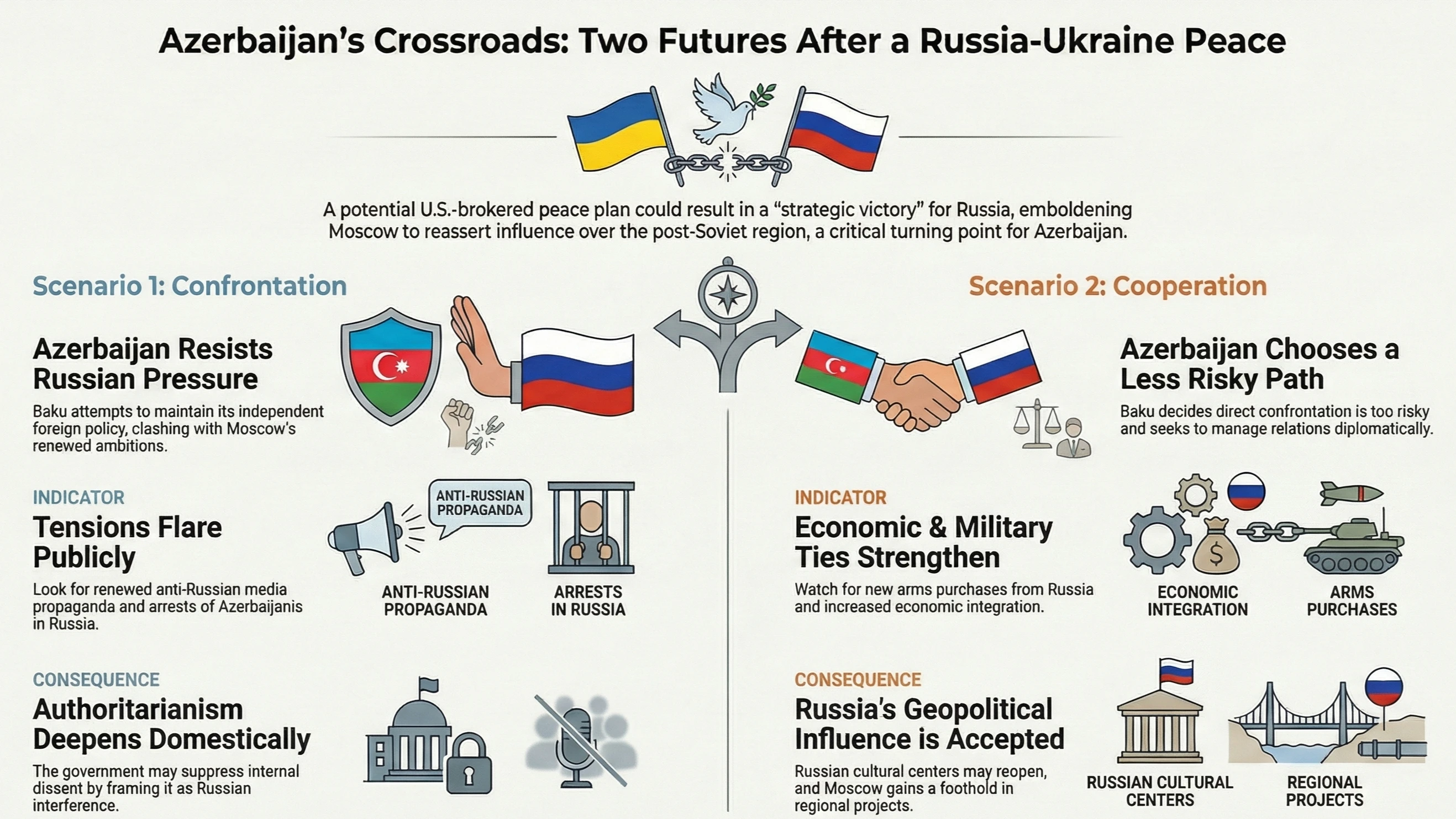
However, if peace talks dictated by the United States deliver concrete results—if the Russia–Ukraine war ends according to the plan proposed and imposed by the United States—then Russia will have achieved a strategic victory. Under such conditions, it can be predicted that Azerbaijan–Russia relations will not develop in a desirable form and will evolve according to two main scenarios.
First scenario: Confrontation with Russia
According to this scenario, the tensions observed between the two countries in recent months could flare up again and continue in various forms. Possible Russian pressure and steps may provoke a response because they would not be compatible with the bilateral relationship Azerbaijan has tried to shape through the Dushanbe “ceasefire.” If Azerbaijan responds adequately to Russia’s actions, this will further raise tensions and relations between the two countries will again enter a problematic phase.
The first signs that events are moving along this scenario could be renewed arrests in Russia of Azerbaijani businesspeople and individuals close to the Azerbaijani diaspora.
In parallel, the re-emergence of anti-Russian propaganda in Azerbaijani media can be interpreted as an indicator of growing tension in relations.
Official Baku is aware that, if the peace plan succeeds, Russia’s potential pressure could be multi-dimensional. For this reason, in the coming months, any dissatisfaction or protest could easily be portrayed as “Russia’s doing.” Political parties could be accused of “cooperating with Russia” and become targets of a new wave of arrests.
By emphasizing the Russian threat, the Azerbaijani authorities will try to further strengthen their position as the sole and real power in the country. Especially in relations with the United States and European countries, Russia’s increasing pressure could be highlighted and the government’s traditional image as the “last bastion” could be reinforced. Protesters and dissatisfied groups could be branded as “Russia’s people,” the authoritarian regime could be strengthened further, and the wave of repression could intensify.
The opposite is also possible. In order to strengthen its position in a confrontation with Russia, the Azerbaijani authorities may soften somewhat in relations with the West (especially Europe) and take steps toward resolving recent problems (political prisoners, peace, etc.). In this way, it could try to reduce the number of geopolitical rivals and gain potential partners against Russia.
Second scenario: Cooperation with Russia
Within this scenario, it is expected that Azerbaijan will try to preserve the current status quo. Any differences of opinion and contradictions will be resolved through mutual discussions by diplomatic means. Anti-Russian propaganda in public opinion and the media will cease, and a framework of neighborhood relations and mutual respect will be brought to the fore. In parallel, opportunities will gradually be created for the operation of instruments that serve as Russia’s levers of influence (the Russian House, support for Russian-language schools, and perhaps Sputnik.az).
This scenario may also be considered the most successful approach for the authoritarian image of the leader in Azerbaijan. Direct confrontation with an authoritarian like Putin under unfavorable conditions is extremely risky. Instead, gradually expanding cooperation, developing diplomatic relations, and meeting Russia’s interests may carry fewer risks.
Such a course of events could be reflected in an acceleration of economic ties with Russia and, specifically, in the purchase of new weapons and ammunition from Russia. In recent months, against the backdrop of rising tensions with Russia, Azerbaijan has done important work to diversify its sources of weapons and ammunition. The purchase of fighter jets from Pakistan and naval drones from Israel is an indication of this diversification.
Russia, however, has always considered itself the main arms supplier for post-Soviet countries and does not want these countries to move away from the Russian arms market. If Azerbaijan enters into new arms and ammunition purchases from Russia in the coming months, this would be the most important indicator of a shift in relations.
Another point concerns the strategic cooperation agreement planned in the near future between Azerbaijan and the United States. The signing of this agreement could also push Russia to move toward a new agreement of a similar nature. For Russia, it is an important factor to create new economic instruments of influence in relations with Azerbaijan, to prevent external powers like the United States from gaining footholds in the region, and to establish a framework of equal competition. As with Kazakhstan, the signing of such an agreement with Azerbaijan is to be expected.
Under this scenario, we may gradually observe that Russia’s position strengthens within projects such as the Organization of Turkic States and the Middle Corridor, and that regional economic projects involving both Turkiye and Russia are brought to the forefront.
Conclusion
At present, discussions continue around the peace plan proposed and dictated by the Trump administration, and there are more expectations than concrete results regarding the process. These expectations provide grounds to say that the parties are closer to an outcome than in previous peace processes. Claims voiced in local media show that scenarios related to the possibility of a Russia–Ukraine peace agreement and the geopolitical realities that would change after such an agreement are already being discussed in Azerbaijan.
The end of the war under the current conditions will lead Russia to emerge from the conflict with a “strategic victory” and to attempt to restore the geopolitical influence that has weakened over the past four years. This will once again bring Russia into confrontation with Azerbaijan, which in recent times has sought to distance itself from its northern neighbor’s sphere of influence. While Russia will seek to return relations to the “old format” (geopolitical dependence), Azerbaijan will undoubtedly try to preserve the “current format” (equal-neighborly relations). It is expected that this clash of interests will develop along one of two scenarios—confrontation or cooperation—and that each scenario will produce its own specific consequences.
If processes develop according to the confrontation scenario, alongside open escalation of tensions in relations, this could spur the deepening of the authoritarian system in Azerbaijan and the launch of new waves of repression aimed at preventing Russian influence. The cooperation scenario, on the other hand, could lead—against the backdrop of improved relations with Russia—to the expansion of ties in economic, military, and cultural spheres, and, within the diplomatic framework, to the acceptance of Russia’s geopolitical superiority. The logical outcome of the peace talks and the fate of a Russia–Ukraine peace agreement will, with high probability, determine the future of these claims, especially Azerbaijan’s future steps in relations with Russia.
Note: During the publication process of the article, the 28-point Trump plan was replaced by an updated 20-point peace plan following negotiations between U.S. and Ukrainian officials. On 29 December 2025, it was reported that 90% agreement had been reached between U.S. and Ukrainian representatives on the updated plan (BBC, 2026). In the first week of 2026, it was further claimed that a final agreement on the 20-point plan had been achieved and submitted to the Russian side for consideration (Axios, 2026).
References
Axios, 2026, Trump advisers met Putin's envoy in Paris to discuss Ukraine plan, https://www.axios.com/2026/01/08/russia-ukraine-talks-dmitriev-witkoff-kushner
Apa.az, 2025, Dövlət təhlükəsizliyi üçün vacib addım: Şimalın istifadə edəcəyi radikallar vaxtında zərərsizləşdirilir – TƏHLİL, https://apa.az/siyasi/dovlet-tehlukesizliyi-ucun-vacib-addim-simalin-istifade-edeceyi-radikallar-vaxtinda-zerersizlesdirilir-tehlil-928381
Asiatimes.com, 2025, Russia-Azerbaijan thaw reshapes Middle Corridor prospects, https://asiatimes.com/2025/10/russia-azerbaijan-thaw-reshapes-middle-corridor-prospects/
Azadliq.org, 2025, Əli Kərimlinin saxlanması: Rusiyanın təsir dairəsini daraltmaq, yoxsa total təmizləmə?, https://www.azadliq.org/a/eli-kerimli-ramiz-mehdiyev/33609289.html
Azadliq.org, 2025a, Putinin "böyük Rusiya" planı: Ukrayna uduzsa, Rusiyanın qonşularını nə gözləyir?, https://www.youtube.com/watch?v=K1s4cKrB9ZM
Bakuresearchinstitute.org, 2021, Rusiyanın yeni Milli Təhlükəsizlik Strategiyası, https://bakuresearchinstitute.org/russias-new-national-security-strategy-2/
BBC, 2026, Zelensky says peace deal is 90% ready in New Year address, https://www.bbc.com/news/articles/cddg7100ym2o
BBC.com, 2024, AZAL təyyarəsi qəzası: Komissiya nə aşkarlayıb? https://www.bbc.com/azeri/articles/c8xj9z8de8ko
BBC.com, 2025, Daha iki şərt. Niyə Azərbaycanla Ermənistan hələ də sülh müqaviləsi imzalamayıb? https://www.bbc.com/azeri/articles/c0788r2v0vdo
BBC.com, 2025a, "Sputnik"in beş azərbaycanlı jurnalisti polis nəzarətinə verilib, https://www.bbc.com/azeri/articles/c0q8nje8gjgo
Cnbc.com, 2025, Ukraine peace deal is really close, U.S. envoy Kellogg says, https://www.cnbc.com/2025/12/07/ukraine-peace-deal-is-really-close-us-envoy-kellogg-says-.html#:~:text=The%20Ukraine%20war%20is%20the,which%20is%20under%20Russian%20control
Consultant.ru, 2025, Указ Президента РФ от 29.08.2025 N 607 "О мерах по дальнейшей оптимизации структуры Администрации Президента Российской Федерации", https://www.consultant.ru/document/cons_doc_LAW_513433/
Edition.cnn.com, 2025, The 28-point peace proposal for Ukraine, annotated, https://edition.cnn.com/2025/11/21/europe/peace-proposal-russia-ukraine-annotated-intl-vis
Jam-news.com, 2023, “Rusiya olan yerdə xəyanət və alçaqlıq var”. Gürcü ekspertlər Qarabağda baş verənləri dəyərləndirirlər, https://jam-news.net/az/rusiya-olan-yerd%C9%99-x%C9%99yan%C9%99t-v%C9%99-alcaqliq-var-gurcu-ekspertl%C9%99r-qarabagda-bas-ver%C9%99nl%C9%99ri-d%C9%99y%C9%99rl%C9%99ndirirl%C9%99r/
İris-france.org, 2024, Russia in the Post-Soviet Space: What Strategies of Influence? https://www.iris-france.org/en/russia-in-the-post-soviet-space-what-strategies-of-influence/#:~:text=These%20accusations%20align%20with%20a,%E2%80%9Cthe%20weaponization%20of%20everything.%E2%80%9D
Kielinstitut.de, 2025, Ukraine support tracker, https://www.kielinstitut.de/topics/war-against-ukraine/ukraine-support-tracker/
Kyivindependent.com, 2025, 'Elections or referendum' – Zelensky affirms Ukrainians will decide territorial concessions, https://kyivindependent.com/elections-or-referendum-zelensky-affirms-ukrainians-will-decide-territorial-concessions/
Qafqazinfo.az, 2025, AXCP sədrinin evindəki axtarışın – Detalları, https://qafqazinfo.az/news/detail/axcp-sedrinin-evindeki-axtarisin-detallari-490556
Qafqazinfo.az, 2025a, “Boz kardinal”ın Kərimliyə açdığı “pəncərələr” - Sıradakı nə idi? https://qafqazinfo.az/news/detail/boz-kardinalin-kerimliye-acdigi-pencereler-siradaki-ne-idi-490553
Qafqazinfo.az, 2025b, Rusiyada əməliyyat - Onlarla azərbaycanlı saxlanıldı, https://qafqazinfo.az/news/detail/rusiyada-emeliyyat-onlarla-azerbaycanli-saxlanildi-475018
Qaynarinfo.az, 2025, "Buna gedərsə, Rusiya özü-özünü məhvə aparacaq" – Politoloq, https://qaynarinfo.az/az/buna-gederse-rusiya-oezu-oezunu-mehve-aparacaq-politoloq-1
Musavat.com, 2022, Rusiyanın hədəfində olan iki dövlətdən biri - Azərbaycana təhlükə varmı...,https://musavat.com/news/rusiyanin-hedefinde-olan-iki-dovletden-biri-azerbaycana-tehluke-varmi_945920.html?d=1
Musavat.com, 2025, Azərbaycan və Türkiyə arasında TARİXİ ANLAŞMA parlamentdə, https://musavat.com/news/azerbaycan-ve-turkiye-arasinda-tarixi-anlasma-parlamentde_1225421.html
President.az, 2025, Düşənbədə Azərbaycan Prezidenti İlham Əliyevin Rusiya Prezidenti Vladimir Putin ilə təkbətək görüşü olub, https://president.az/az/articles/view/70298
Report.az, 2025, Komissiya sədri: Azərbaycanın bir sıra media resurslarına kiberhücum Rusiyadan qaynaqlanıb, https://report.az/hadise/komissiya-sedri-azerbaycanin-bir-sira-media-resurslarina-kiberhucum-rusiyadan-qaynaqlanib
Reuters.com, 2025, Trump plans envision major U.S. investment in Russia, restoring oil flows to Europe, WSJ says, https://www.reuters.com/world/europe/trump-plans-envision-major-us-investment-russia-restoring-oil-flows-europe-wsj-2025-12-11/
Oxu.az, 2025, Bakıdakı "Rus Evi" fəaliyyətini dayandırır – RƏSMİ, https://oxu.az/siyaset/bakidaki-rus-evi-fealiyyetini-dayandirir-resmi
Oxu.az, 2025a, Ukraynadan sonra Azərbaycan hədəfdədir? - Kreml yeni düşmən axtarışında, https://oxu.az/siyaset/ukraynadan-sonra-azerbaycan-hedefdedir-kreml-yeni-dusmen-axtarisinda
TV Musavat, 2025, Ukraynadan sonra növbəti HƏDƏF Azərbaycandır! SƏBƏBİ isə... - Oqtay Qasımovdan PROQNOZ, https://www.youtube.com/watch?v=av41w-btV2E
Whitehouse.gov, 2025, National Security Strategy of the United States of America https://www.whitehouse.gov/wp-content/uploads/2025/12/2025-National-Security-Strategy.pdf
