
(The article was prepared within the framework of the "Khar Center" research on Azerbaijani authoritarianism)
Authors:
Araz Aliyev - researcher, analyst.
Founding board member of the Third Republic Platform.
Gulara Ismayilova - Activist.
Feminist and peacebuilding activist, Baku State University political science graduate.
Introduction
For a long time, the issue of "child allowance" has been among the main topics on the public agenda in Azerbaijan. Particularly against the backdrop of rising consumer expenses, the year-by-year increase in the cost of raising a child keeps the child allowance issue constantly relevant. On the other hand, the continuous decline in birth rates and marriages in Azerbaijan also expands the scale of the discussions. Today, the demand for child allowance in Azerbaijan is proposed not only as an economic support program but also as a primary tool for addressing demographic trends. The official attention and attitude towards the child allowance issue, however, are unambiguous. It is observed that the discussions regarding the importance and necessity of this topic are not sufficiently substantiated, are not supported by academic and empirical evidence, and simply remain an unrealized demand of social groups. In our research, we try to investigate whether demographic incentives are necessary for Azerbaijani society by referring to statistical data and academic studies. We review the period between 2003 and 2024 as the research timeframe. This period allows us to see the demographic picture following the abolition of the systematic child allowance (2006) and during the era when the political system became authoritarian. The research also attempts to determine the reasons for the declining trend in marriage and birth indicators in Azerbaijan during this period. We believe that identifying the real reasons for the decline in the number of marriages and births can be important in terms of understanding demographic problems and identifying measures aimed at their resolution. The analysis of official statistical data concerning Azerbaijan, based on academic research and its results, reveals that the main reasons for the decline in marriage and birth indicators are of an economic nature. We observe that the demographic changes in Azerbaijan are shifting in accordance with the trends found in modern academic research. In particular, we identify a correlative relationship between unexpected inflation and the economic uncertainties it creates, and marriage and birth rates. We argue that the main reason for this is the economic manipulation policy of authoritarian governance. It is exactly this manipulative political course that causes family planning in Azerbaijan to be continuously affected by unexpected inflation. In the next section of the research, we attempt to predict the consequences that will arise over the next 10-15 years if the current demographic trend continues. Referring to the analysis of statistical data and the results of academic studies, we note that the old-young ratio in Azerbaijan will equalize in 10-15 years, and this equalization will lead to serious economic consequences. After determining the causes and probable consequences of the problem, we present a discussion framework regarding its solution. Referring to academic research, we try to identify tools that will provide an impetus to increase birth rates, and we review the potential effects of these tools on birth indicators. When discussing demographic solution tools, to avoid reinforcing the patriarchal discourse, we present a gender perspective and review women's childbirth, work, income, and career opportunities within the framework of available solution options, as well as intra-family relations and the role of invisible labor in this matter.
The purpose of the research: To determine the reasons for the decline in marriage and birth indicators in Azerbaijan during the period between 2003 and 2024, the future consequences of this trend, the approaches proposed to solve the problem, and their effectiveness.
The questions of the research: How have marriage and birth indicators changed in Azerbaijan during the period between 2003 and 2024? What are the reasons for this change? What kind of role does the authoritarian political system have in this change? What risks will the current trend pose for the country over the next 10-15 years? Can the restoration of the child allowance system solve the demographic problem? How can the balance between childbirth and employment be regulated?
The sources of the research: During the investigation, statistical data regarding Azerbaijan and academic research conducted on this topic were referenced.
I. What is the reason for the decline in birth rates?
What the government says: The political government's approach to the decline of birth rates in Azerbaijan and to the issue of child allowance, which is brought to public discussion as a solution to this process, is not unambiguous. Unfortunately, during public discussions, the official position of the political authority does not become entirely clear. For this reason, we will accept the statements of deputies, official functionaries, as well as pro-government journalists who periodically become parties to public discussions as an expression of the political government's position on these topics. At the official level, representatives of the political authority note that there are no demographic risks in Azerbaijan, that demographic indicators have been calculated up to the year 2050, and that no problematic situation is predicted for the next 10-15 years (Report, 2022). Such statements are used to justify the question "why is child allowance not given?" against the backdrop of discussions that regularly surface in public opinion. However, marriage and birth indicators in the country have been on a declining trend for years. According to statistical data, while 176 thousand births occurred in 2011, this figure dropped to 102 thousand in 2024. The number of marriages for the same dates also dropped from 42.6 thousand to 23.4 thousand, decreasing by approximately 2 times (DSK, 2026). Although the declining birth and marriage indicators are acknowledged as a problem at the official level, the claims put forward regarding its causes and solutions are mostly manipulative in nature. Bahar Muradova, the Chairwoman of the State Committee for Family, Women and Children Affairs, notes that the decline in the number of births in Azerbaijan is not an issue related to state institutions but is related to the mindset of the people (Oxu.az, 2026). Deputy and party chairwoman Gunay Agamali also presents the people's lifestyle and mindset model as the reason for the current situation. She is of the opinion that the influence of social networks, the prioritization of personal life, and tendencies to evade responsibility affect the family model. Zahid Oruj, on the other hand, thinks that the family institution is in crisis due to factors such as the post-modern value system and the aggressive promotion of Europeanization (Zahid Oruj, 2026). Similar views manifest themselves in the approach to the child allowance issue proposed for solving the declining trend. Sahil Babayev, the current Minister of Finance, stated during his tenure as the Minister of Labor and Social Protection of the Population that there was no need for a child allowance or any stimulating measures at all, and that the child allowance was not given to avoid instances of corruption (Modern.az, 2021). These days, Gunay Agamali claims that providing a child allowance will make men lazy, while another deputy, Erkin Gadirli, says there is no connection between child allowance and birth indicators, advising not to burden the budget with child allowances (Azadliq Radiosu, 2026, Pravda.az, 2026). Despite this, from time to time, albeit in a limited form, some deputies speak about the existence of demographic risks in the country and the application of solution tools such as child allowance to prevent them (BBC, 2023). It should be noted that although the systematic child allowance was abolished in Azerbaijan in 2006, a number of social benefit forms related to children exist. Currently, a one-time allowance of 600 manats is provided upon the birth of a child, and monthly allowances of 44 manats (up to 1.5 years of age) and 28 manats (1.5-3 years of age) are designated for child care up to 3 years old. Other benefits are intended for children belonging to various social groups (orphans, children with disabilities, children placed in foster care) within the targeted social assistance system. For low-income families, a monthly assistance of 100 AZN per child under 1 year of age is envisioned (Operativ media, 2025). However, the extent to which these benefits are accessible to families and the extent to which they cover childcare expenses is doubtful. On the other hand, the fact that the benefits are not applied to all children but only to specific groups (low-income families, etc.) creates a fertile ground for corruption. In addition to all this, in June 2026, a decree was signed regarding changes to the financing mechanism of kindergartens, which play an important role in the field of childcare. According to the new decree, kindergartens will now be financed through the joint participation of the state, private companies, and parents; in short, parents will now participate with their own funds in financing kindergarten services that were previously free of charge (Azadliq Radiosu, 2026a). It seems that the government not only fails to implement measures to reverse the declining trend in birth and marriage indicators, but it even restricts the existing "family-friendly" measures.
What academic sources say: The fact that economic changes directly affect family planning and birth rates has long been studied by sociological and economic literature. Classical theory stated that there was a negative relationship between the economic status of individuals and their rates of bringing children into the world. It was accepted that as the economic situation improved, individuals' career opportunities also expanded, making the time spent on a child more valuable. For this reason, individuals prioritize career and income growth over having children. However, studies conducted in recent decades have revealed empirical evidence showing that this approach is not correct. Gary Becker, considered one of the primary sources on this topic, notes that there is proportionality between the desired number of children and household income. He states that the analysis of raw data may show us a negative relationship between family income and the number of children. This is because while poor families appear to have more children, rich families seem to have fewer children. However, according to the author, this approach is incorrect, and an important point is omitted in the analyses: literacy regarding "birth control." Having many children in poor families does not mean that all of these children are "desired" children. This is more of a result of a lack of knowledge about birth control mechanisms. Excluding this condition, Becker emphasizes that there is a positive relationship between the desired number of children and the family's income. That is, as the family's income level increases, the desired number of children also increases (Becker, 1960). Studies show that in developed countries, the increase in birth rates occurs in direct proportion to the improvement of families' economic situations. That is, contrary to classical theory, an increase in the income indicators of families stimulates an increase in birth indicators as well. (Bar and Hazan, 2018) At the individual level, an increase in earnings leads not only to marriage but also to an increase in out-of-wedlock births (Kearney, 2017). Conversely, unemployment, crises, and economic uncertainties significantly reduce birth indicators (Goldstein, Örsal, 2010, Comolli 2017). Tomas Sobotka and other authors, investigating the effects of countries' periods of economic stagnation on birth indicators, concluded that birth indicators possess a procyclical character, rising and falling in tandem with the ups and downs in the business environment. In most countries, economic stagnation leads to a decline in birth indicators and a sharp halt to the rising birth rates of the previous decade (Sobotka, Skirbekk, 2011). A study published by Ferret and Gobbi in 2018 also emphasizes that having a child is considered more risky for families during periods of high economic uncertainty. Risk-averse families postpone their desire to become parents during periods of economic fluctuation in hopes of a more stable tomorrow. According to the authors, a sufficiently long period of high economic uncertainty can not only delay childbirth, but can even reduce the total number of children a woman has over her lifetime. (Chabe-Ferret and Gobbi, 2018). In academic research, this approach has been further expanded to investigate the effects of various forms of economic uncertainty on birth indicators. It has been determined that factors such as rising unemployment rates and the deterioration of labor market conditions (Schaler, 2016), central banks raising interest rates, and soaring mortgage rates (Dietling and Cumming, 2024) negatively impact birth indicators. The clearly positive impact of opposing trends on birth indicators has also been observed. A study published by the University of Mississippi in January 2026 explains the correlation between unexpected inflation and birth indicators in the US based on statistical data. The study, authored by Clara A. Piano and Ahmed Adeste, concludes that inflation indicators affect families' future plans, especially birth rates. According to the conclusion reached by the authors, an increase in unexpected inflation contributes to a significant decline in the overall fertility rate. Furthermore, this negative impact is primarily felt by young women and causes them to postpone their childbearing decisions in response to unexpected inflation. Continuous economic uncertainty due to unexpected inflation can accelerate population aging and negatively impact even economic growth in the long-term perspective (Adeste and Piano, 2026). According to the authors, when the inflation level is low, stable, and close to expectations, households maintain their existing birth plans and are not inclined toward any changes. Conversely, when the inflation level exceeds expectations, households react with more uncertainty and concern, thinking about future wages, prices, and borrowing. High inflation reduces the real purchasing power of families and increases the cost of raising children. Rising costs push households to turn to their savings reserves, cut extra expenses, and postpone childbirth decisions (Adeste and Piano, 2026). Thus, one can conclude that academic studies reveal a proportionality between birth indicators and the income level and economic status of families. According to this proportionality, while families are interested in bringing children into the world during periods of economic boom, they largely postpone childbirth during periods of economic uncertainty.
II. What does the Azerbaijani experience show?
Methodology: In this article, by continuing the dominant approach noted in academic sources, we try to clarify whether the decline in birth rates in Azerbaijan has occurred due to economic uncertainties. Because this approach can provide us with a comprehensive picture of the real reasons for the decline in birth rates in Azerbaijan. Referring to Adeste and Piano's approach, we attempt to determine the correlation between unexpected inflation indicators and birth indicators in Azerbaijan based on statistical data. Since the rise of inflation indicators in Azerbaijan is directly related to global economic trends, this approach can also allow us to determine the impact of economic uncertainty on birth rates. We found it appropriate to include not only birth indicators but also marriage indicators concerning Azerbaijan in our research. Because in Azerbaijani society, there are established value mechanisms that strongly encourage married couples to have children. In this regard, we can consider public censure, family pressure, the desire for grandchildren, and viewing children as an investment for old age as the main factors encouraging married couples to have children. We think that learning how economic uncertainties affect marriage indicators can also help make sense of the situation regarding childbirths. In Azerbaijani reality, the marriage act is considered on the plane of relations between two generations rather than just the special day belonging to the couples themselves. For this reason, the marriage act also holds significant economic meaning for families, meaning that the expenses incurred for the marriage are compensated with the support of friends and relatives. On the other hand, the expenses incurred for marriage are directly linked to the prices of consumer goods and overall economic trends. We believe that high price increases, economic stagnation, and recessions directly affect the income indicators of the population, causing the population to postpone marriage during periods of economic uncertainty. Because just as economic uncertainty will increase ceremony expenses, the fact that guests invited to the wedding are also subjected to similar economic impacts will reduce the probability of their participation in the ceremony and in the compensation of expenses. From this perspective, we examine marriage more as an economic phenomenon and investigate whether marriage habits are subjected to the impact of economic fluctuations and inflation in a similar form to birth indicators.
Statistical analysis of the Azerbaijani experience. The infographic below includes marriage and childbirth statistics that occurred in Azerbaijan between the years 2003 and 2024.
Graph 1. Prepared based on SSC data. As can be seen from the graph, there is a highly proportional dependence between the number of marriages and births during the research period.
Based on our analysis of statistical data, it appears that the stagnation and decline in marriage and birth indicators in Azerbaijan during the research period first occurred in 2007-2008. This is the period when Azerbaijan was also seriously affected by the global crisis, which led to an increase in inflation (average annual inflation) indicators. During this period, inflation indicators in Azerbaijan rose to the level of 16.7% (2007) and 20.8% (2008). Price increases primarily caused a decline in the number of marriages, which reacted to economic fluctuations. While 81.8 thousand marriages took place in Azerbaijan in 2007, this indicator dropped to 80 thousand in 2008 and to 78.1 thousand in 2009. Because marriages decreased, the growth rate in the number of live-born children, which had been continuing since 2003, similarly weakened significantly in the following years. In 2008, only 123 more children were born compared to the previous year's indicators, and in 2009, only 53 more children were born. However, in 2007, the number of children born was 3 thousand more compared to the previous year.
In 2009, the inflation level in Azerbaijan gradually decreased, falling to the level of 1.5%. This decrease positively affected marriage and birth indicators as well. In 2010, the number of marriages rose to 79.1 thousand, and the number of live-born children increased to 165.5 thousand. In 2011, the number of live-born children reached a peak, rising to 176 thousand. In the same year, the number of marriages also showed an increase of nearly 10 thousand, rising to 88 thousand.
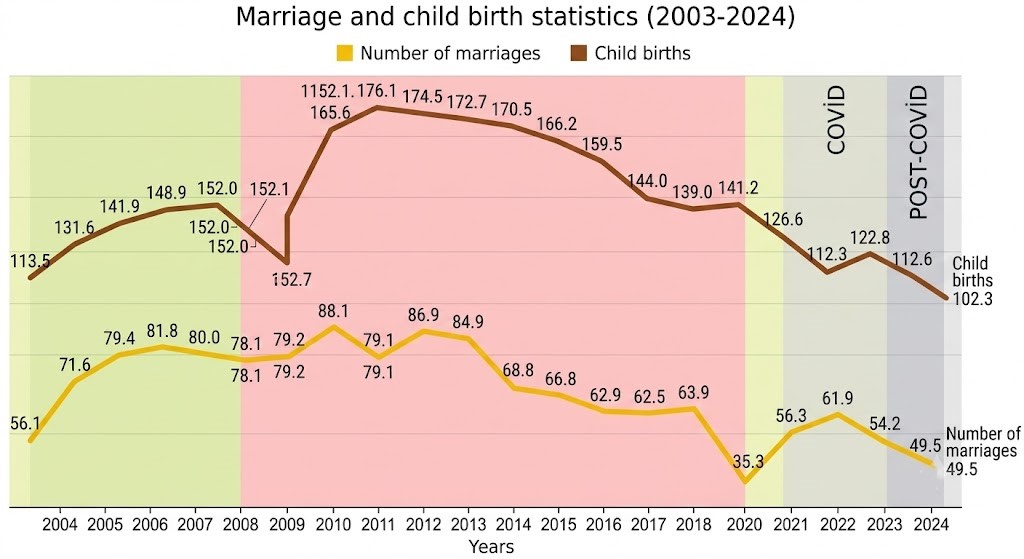
Graph 2. Prepared based on SSC data. The green sections in the graph indicate periods when the average annual inflation is in the range of 1-3%, and the red sections indicate periods when it is high or double-digit.
In 2011, inflation indicators rose again to the level of 7.9%. This increase resulted in the number of marriages falling again to 79 thousand, and the number of live-born children falling to 174 thousand for 2012.
In 2012, 2013, and 2014, the inflation level was at the rates of 1.1%, 2.4%, and 1.4%, respectively. This stagnation caused the marriage indicators to rise to 86 and 84 thousand in 2013 and 2014, respectively. High indicators in live births continued with small decreases. 172.6 thousand children were born in 2013, and 170.5 thousand children were born in 2014.
The next wave of rising inflation indicators covers the years 2015, 2016, and 2017. This period is also a time when energy prices dropped in the global market and the manat experienced devaluation. Inflation indicators rose respectively by 4% (2015), 12.4% (2016), and 12.9% (2017) across these years. This state of economic uncertainty also had a very serious impact on marriage and birth indicators. In 2015, the number of marriages declined to 68.7 thousand from the 84 thousand observed in the previous year. The indicator fell to 66.7 thousand in 2016, and 62.9 thousand in 2017. The number of live births declined from 170 thousand observed in 2014 to 166.2 thousand in 2015. It dropped to 159.4 thousand in 2016, and 144 thousand in 2017. (SSC, 2026)
In 2018 and 2019, inflation indicators partially stabilized and were 2.3% and 2.6% respectively. This change stopped the decline in marriage indicators, causing it to rise from 62.4 thousand in 2018 to 63.8 thousand in 2019. In the number of live births, an increase was also observed with 141.1 thousand in 2019, while it was 138.9 thousand in 2018.
From 2020 onwards, the next global crisis, the Covid-19 pandemic, and the economic problems caused by the pandemic led to a massive decline in marriage and, naturally, birth indicators (although the inflation indicator was 2.8% this year). In 2020, only 35 thousand marriages and 122.2 thousand live births took place. We can evaluate the prohibition of wedding ceremonies here as the primary factor.
However, after the pandemic and when wedding ceremonies were permitted, the next wave of increase is observed. Despite the inflation indicator being 6.7% in 2021, the number of marriages rose to 56.3 thousand this year, and to 61.9 thousand in the following year, 2022. The number of live-born children rose to 122.6 thousand for 2022.
Although the pandemic ended in 2022, the Russia-Ukraine war and the economic problems it brought raised the inflation level again. The inflation of 13.9% in 2022 and 8.8% in 2023 was observed with a sharp decline in marriage and birth indicators. In 2023, the number of marriages declined to 54.2 thousand, and in 2024 to 49.5 thousand. Birth indicators dropped to 112 and 102 thousand. (SSC, 2026)
It should be noted that we have taken the annual inflation indicators based on the official figures of the State Statistics Committee. Taking into account that real inflation indicators could be higher than those given in the official figures can help understand this impact. However, referencing even the official figures gives grounds to say that the trends and mutual dependence principles confirmed by academic research are also observed in the Azerbaijani experience. Marriage and birth indicators in Azerbaijan react to periods of economic uncertainty, crisis, and high inflation. They decrease as uncertainty and inflation rise, and show an increasing dynamic when the situation stabilizes.
On the other hand, it is also necessary to take into account that during the research period, the overall growth rate of the Azerbaijani economy gradually weakened, GDP growth percentages gradually declined from 34.5 percent (2006) to the level of 1-2%, and in some cases even dropped to negative (2016: -3.1%, 2020: -4.2%), and the impacts of these declines on people's daily lives and future plans (Mehtiyev, 2023). We think that such a declining trend in general economic indicators can also be used to explain the general declining trend in birth and marriage indicators.
Furthermore, the extreme political centralization caused by authoritarian governance in Azerbaijan has primarily led to the disruption of the economic balance between the center and the regions. Over the last 23 years, the gradual concentration of core economic opportunities in the center, coupled with the transformation of economic programs intended for regional development into corruption mechanisms, and the absence of a decentralized political system, has triggered internal migration. As regional development weakened, the influx of the population toward the center accelerated with the hope of easier access to jobs and services (Khar Center, 2026).
As a result of internal migration, the acceleration of the population influx from rural to urban areas triggers the depopulation of the regions and, naturally, a decline in reproductive capacity. Although this process increases the population size in urban areas, it does not significantly affect the reproductive capacity. This is because while the economic center provides the population with access to new opportunities, it also significantly increases their expenditure burden. For a family that has migrated from a region to the center, access to jobs and services increases in Baku and surrounding areas; however, parallel to this, expenditure indicators for rent, public transport, consumption, and various service sectors also rise. Consequently, even if individuals and families of regional origin settle in the center, their contribution to demographic growth under existing economic conditions is minimized.
Academic research notes that birth rates in rural (regional) areas are higher compared to cities. The primary reasons for this tendency are cited as education, labor, and housing market conditions in the urban environment, the "increasing cost" of having a child in the urban setting due to these conditions, as well as women's employment indicators, forming a family at a later age, and becoming a mother later (Lerch, 2019). In rural areas, however, educational opportunities, labor market, and housing conditions differ from the urban environment, and core consumption and childcare costs are cheaper compared to the city. Reasons such as these condition the rural areas to lead in demographic growth indicators compared to cities (Reiderer, Beaujouan, 2023).
From this perspective, in the experience of Azerbaijan, the depopulation of villages has led to a major reduction in the rural population's contribution to the country's demographic growth. Statistics show that while the difference in births between rural and urban areas in the country was 13 thousand in 2004, this gap stabilized from 2015 onwards and decreased to about 4-5 thousand (even less in some years) (DSK, 2026). This stems from the influx into the city while maintaining the official registration of the rural population. That is, even if they appear to live in the village in the census, they actually live in the city, adapting to the urban mentality and economic conditions, and turning into a low-child family.
Research shows that even in normally developed countries, birth rates in rural areas gradually decline as a result of the urbanization process (see: Demographic transition theory). However, the process in Azerbaijan is not at all urbanization due to the country's developing industry, but rather an influx of the population from rural to urban areas due to unemployment and economic necessity. It should be taken into account that in countries like Azerbaijan, where extreme political centralization prevails, the regional development narrative has turned into a corruption mechanism, and a deep economic gap has emerged between the center and the regions, this tendency takes on a more serious and dangerous character.
- Academic research notes that economic uncertainty causes serious impacts especially on young women and that they postpone their childbirth decisions in response to this uncertainty. The Azerbaijani experience and statistical data show that this approach is validated, and as economic uncertainty increases, the age at which young women become mothers rises. While analyzing the statistical data on the number indicators of live-born children by the mother's age in Azerbaijan, we observe that the number of children brought into the world by mothers under 20, 20-24, and 25-29 years old reacts to economic uncertainties and high inflation indicators in the form we noted above. The number of children born by mothers aged 30-35, however, has been continuing on an upward line since 2012. As economic uncertainty increases, the birth indicators for this age group do not decrease; on the contrary, they increase. Based on this, we can note that in Azerbaijan since 2012, in response to economic uncertainties, the approach of postponing childbirth by young women and becoming a mother at a later age is validated.
The infographic below provides the statistics of children brought into the world by mothers under 20, 20-24, 25-29, and 30-35 years old (SSC, 2026).
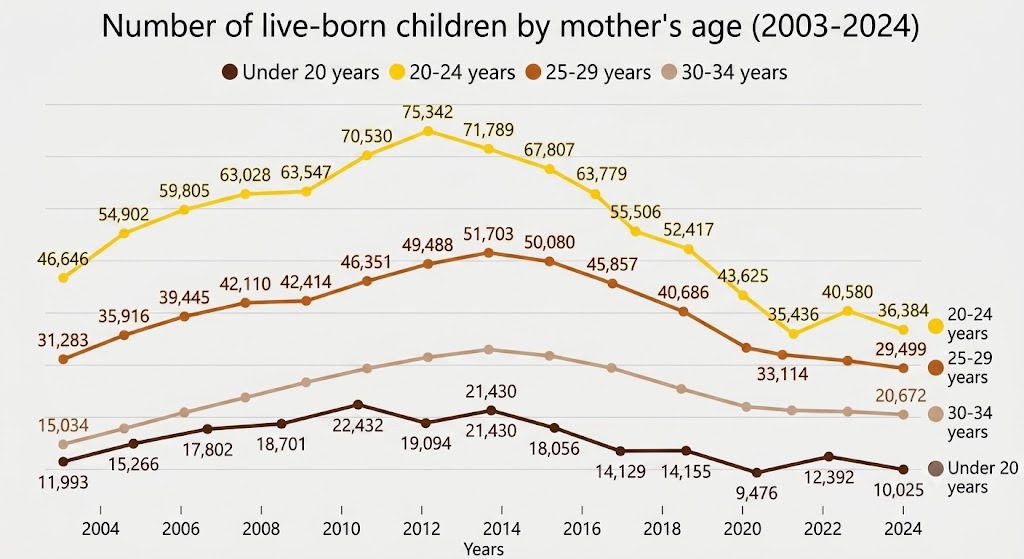
Graph 3. Prepared based on SSC data
“Maybe let’s slow down a bit,” or the economic manipulation of the authoritarian system. The authoritarian political system in Azerbaijan and its approach to the economy play a special role in the continuation of the current demographic trend. The Azerbaijani government sees the country's economic indicators as a primary tool in shaping public opinion and manipulating society. For this reason, official public statements regarding economic decline and stagnation are almost never issued by the political authority. On the contrary, the narrative of "sustainable and unparalleled development" has been repeated in various forms for 23 years. A success image is often created by officials by referencing rising statistical data on GDP growth indicators, the country’s foreign debt, and financial assets (Oxu.az, 2026). Meanwhile, the real situation in the economic sphere, projected crises, and inflation risks are almost never spoken about, and public awareness is not ensured. Even initiatives and individuals who wish to inform society about the real and crisis-ridden economic situation, and who indirectly dismantle the "unparalleled development" narrative, are subjected to pressure and repression. The authoritarian system’s economic manipulation policy weakens, to a great extent, the preparedness level of the country’s population for potential economic problems, crises, and inflation increases. As a result, the Azerbaijani population has to experience every wave of inflation that occurs as an "unexpected," "unplanned" event, and feels the consequences of these events more deeply in their own lives. For this reason, we believe that this is the cause of the Azerbaijani birth indicators reacting so correlatively to unexpected inflations. Research conducted in recent years presents empirical evidence that an inflation-targeting policy could be a strategic tool for solving demographic problems. Inflation targeting aims to ensure price stability by shaping public expectations, creating a favorable, stable economic environment for higher birth rates. Empirical analyses show that states implementing inflation targeting have lower declines in birth indicators compared to those that do not. In other words, when the public is informed about potential inflation risks, they are better prepared for projected economic uncertainties. This level of preparedness has less impact on families' birth planning (Wu, 2014). Along with this, field experiences also show that providing clearer information to the public regarding the general situation can affect birth indicators. Rational individuals can act based on information about future changes in childbirth costs and plan their decisions regarding having children in a more successful manner. (Bergsvik, Fauske, and Hart, 2021)
III. Why is the decline in birth indicators problematic?
Academic perspective: A decline in birth indicators primarily weakens the function of population reproduction in society, leading to a decrease in the young workforce in the future perspective and an increase in the numerical composition of the elderly population. In academic literature, there is research on how the increase in the number of elderly populations and the aging of society affect countries' economies. The general conclusion reached by researchers is that the aging of a country’s population will reduce labor supply, which will result in a slowdown of economic growth. (Anderson, 2014) A study conducted by Japanese researchers Konishi and Ueda shows that the manner in which the aging of societies occurs is important in terms of determining economic impacts. If aging in societies stems from a decline in the birth rate, this leads to a shrinking of the tax base, an increase in financial expenditures, and, consequently, inflation. However, if aging occurs due to an increase in longevity, this, in turn, leads to deflation (Konishi and Ueda, 2014). According to the authors, population aging resulting from increased longevity increases the political influence of the older generation and leads to an increase in voter turnout among elderly voters in elections. Governments that want to satisfy elderly voters prevent price increases by increasing income tax rates (which harms the youth). This is because price increases can harm the older generation. Conversely, population aging resulting from a decline in the birth rate leads to inflation. This is because, in this case, the tax base shrinks as the number of young people who provide the workforce and pay the majority of taxes decreases, and states are forced to increase financial expenditures because the number of elderly people increases. (Konishi and Ueda, 2014)
Azerbaijani experience: Analysis of statistical data shows that if Azerbaijan’s demographic indicators over the last 23 years continue with this trend, it could lead to consequences such as a decrease in the young workforce, an increase in the number of elderly people, and the aging of society. It is known that in the Azerbaijani experience, the life expectancy of the population has risen during the period between 2003 and 2024. The life expectancy, which was 72.3 years in 2003, rose to 76.9 years for 2024. This may have played an important role in the increase in the number of the elderly population. However, the continuous decline observed in birth indicators since 2012 gives reason to say that population aging in the near future will largely occur as a result of the decrease in the number of births. To conduct this comparison, we can compare the numbers of the 20-35 age group and the population over 65. We accept the 20-35 age group as a young and dynamic workforce, and the population groups over 65 as groups that are exiting the labor market and in need of social security. In 2016, the number of people between the ages of 20-35 in Azerbaijan amounted to approximately 2.656 million people. Compared to them, the number of the elderly population over 65 was only 597 thousand people. To simplify, in 2016, there was 1 elderly person for every 4 young people. Ten years later, in 2026, while the number of people aged 20-35 decreased to 2.1 million, the number of the population over 65 rose to 1.1 million. As can be seen, it is no longer 4, but only 2 young people for 1 elderly person. While the number of 20-35 age population groups has decreased by approximately 500 thousand people in the last 10 years, the number of the population over 65 has increased by approximately 500 thousand people. Moreover, this decrease happened not due to reasons like leaving the country, but directly based on the birth indicators of previous years. (SSC, 2026a)
Table 1.Prepared based on SSC data
Statistical data also allows us to determine the number of individuals who will enter the over-65 population group in the next 10 and 15 years. In 2026, the 55-59 and 60-64 age groups will enter the over-65 population category over the next 10 years. Assuming no high mortality rates, based on current statistical data, the total number of this population group is 1,174.1 thousand people. In other words, over the next 10 years in Azerbaijan, an additional 1.1 million citizens (max) will exit the labor market and reach a state of directly benefiting from the state's social allowance and pension system. Over the next 10 years, the population groups currently aged 5-9 and 10-14 (a total of 1,470 thousand people) will enter the labor market. 15 years from today, the number of over-65 population groups exiting the labor market will approximately equal the number of youth entering the labor market (1.2 million people). From this date onward, the proportionality in the current demographic situation will shift in favor of the elderly population. The economic picture that issues such as the continuing declining trend of resource reserves and revenues, and energy transformation will create in the next 10-15 years is clear. In these circumstances, the extent to which Azerbaijan is prepared to take on the demographic risk we noted is doubtful. It should be noted that this trend is also known and acknowledged by the Azerbaijani authorities. At the level of official figures, it has been noted that the population will age between 2035 and 2045, and new challenges will only be necessary after 2045. (Report, 2021) However, it is known that demographic risks and trends are issues that cannot be resolved in a short period and require the continuous and systematic application of demographic tools over the years. For this reason, there is a need to take necessary measures from today to eliminate the demographic risks predicted to occur over the next 10-15 years and the negative consequences of these risks. As can be seen, if the current demographic trend in Azerbaijan continues, the probability of facing serious problems in 15 years at the latest is extremely high. In the simplest form, the increasing elderly population and their social security could lead to large and unmanageable burdens for the budget, and to prevent this, a multiple-fold increase in the tax burden on young population groups. In order to compensate for the declining young workforce, the government may also choose the strategy of raising the retirement age, which it has traditionally used. This means that population groups currently in the labor market will work more. However, if the current demographic trend gradually softens and an increase in birth indicators is ensured, it is possible to insure against the potential risks expected in 15 years. Because the steps to be taken now to regulate birth indicators will, at best, begin to show their effect on the labor market 15 years later.
IV. Do support programs affect birth rates?
Academic perspective: Academic studies show that child care subsidies, assistance, and allowances (child allowance) applied by the state to encourage childbirth are useful in increasing birth indicators. Because economic uncertainties, rising child care costs, and future concerns negatively affect families' decisions to have children in the absence of any support mechanism. The existence and successful application of support mechanisms help families overcome economic uncertainties, reduce future concerns, and positively affect families' decisions to have children. The deterioration of the economic situation and rising inflation usually increase child care costs and directly affect family planning. The rising cost of raising a child leads to a lower birth rate among unemployed women. Increasing care costs also lead to an increase in the rate of women leaving work and a decrease in hiring rates. In this regard, researchers have concluded since the 70s that child care subsidies can significantly affect the potential behavior of families. (Blau and Robins, 1978) More modern studies on this topic also reveal, based on empirical data, that there is a dependence between child care costs and families' fertility decisions, and because of this dependence, subsidies allocated to families are successful in increasing birth indicators. (Milligan, 2002) Researchers Bergsvik, Fauske, and Hart, by analyzing the results of 35 studies conducted in various countries in previous years, show that "family-friendly" incentives implemented by states clearly contribute to the increase in birth indicators. They note in particular that they observe a continuous and significant impact of state-applied child care subsidies and parental leave on families' fertility indicators (Bergsvik, Fauske, and Hart, 2021). Along with the increase in birth indicators, support mechanisms can also affect marriage decisions by changing the relative values of marriage and singlehood in society (Goldstein, 2017). Researcher Olga Malkova from the University of Michigan, based on the Russian experience, investigates the results of the maternity leave and cash benefit policy applied in stages since 1981. According to her conclusion, families' fertility levels start to increase immediately after the introduction of these demographic incentives and rise by about 5% within twelve months. Fertility rates remain at approximately 5% during the first six years. In the following four years, although the effects relatively decrease, the positive trend still continues. This is because the real value of the benefits gradually begins to be eroded by inflation, and the potential positive impact weakens depending on this erosion. The study also shows that such incentives increase the childbirth rate among the rural population more than in other social groups (Malkova, 2014). On the other hand, it is also known that child benefits (child allowance) and other cash payments provided to families unequivocally increase birth indicators. However, researchers also emphasize that if such cash payments are applied alone, the upward trend in the number of births will be short- and medium-term (Bergsvik, Fauske, and Hart, 2021, Gromadzki, 2024). This is because, although cash benefits reduce the financial costs necessary for families to raise children, the value of the benefits erodes over time depending on inflation and economic conditions, and as a result, the expected impact is mainly short-term and does not develop on a continuously rising line. Academic studies agree that such incentive mechanisms will have long-term and continuous positive effects if they are not applied alone, but are definitely supported by other social and structural provisions. (Gromadzki, 2024)
Gender perspective:
a) Labor market. Strategies aiming to increase birth indicators in societies primarily bring the issue of women's participation in the labor market to the agenda. It is thought that an increase in birth indicators in a society can reduce women's roles in the labor market and limit their career and education opportunities. Academic studies remind us that incentives applied to increase birth indicators from this perspective may have undesirable side effects on women's employment. Child benefits can have negative effects on female labor supply, which are usually observed more among uneducated women. Also, following the introduction of the child benefit, it appears that the labor market participation rate of women with children decreases compared to childless women (Schirle, 2015, Haan and Wrohlich, 2011). As we noted above, academic studies agree on the impact of families' income levels on birth indicators. However, approaches regarding the nature of this income increase reveal a different picture. One of the main studies referenced in this direction is the study conducted by Jakobsen, Jorgensen, and Lov in 2025. Referring to the Danish experience, the authors concluded that while an increase in women's wage levels causes a decrease in fertility, an increase in men's wage levels increases fertility. For this reason, state policies aimed at increasing birth indicators can reduce women's labor supply and also worsen the level of gender equality in society (Jakobsen, Jorgensen, 2025). Let us recall that an unequivocal and limited interpretation of the mentioned studies can lead to incorrect conclusions. Such a manipulative perspective can cause new problems in countries like Azerbaijan, where conservative discourse is brought to the forefront in public opinion and is politically supported. It can generate risks such as excluding women from the labor market and public life for the sake of eliminating the demographic problem. Studies showing that incentives increasing the number of births reduce women's employment are largely well-founded. However, when referring to these studies, we must also consider that they are conducted based on only a few criteria (child benefits and employment, male and female wage levels, etc.). The provision of child benefits reduces employment among uneducated and low-income women, but the provision of child benefits also increases employment and birth indicators among highly educated and high-income women.
A study conducted by Anna Raute in 2019, referencing the German example, reveals that assistance aimed at highly educated and high-income women has a positive effect on birth indicators (Raute, 2019). It also shows that child care subsidies are effective in regulating women's employment and birth indicators. Increasing child care subsidies conditional on employment increases the labor supply of all women, as well as the birth rates of childless and highly educated women (Haan, Wrohlich, 2011). The employment level of high-earning mothers is less affected by the negative consequences of child benefits (Brandt, 2018). From here it becomes clear that child benefits have a negative impact on uneducated and unemployed women, and a positive impact on high-income and educated women. It seems that the root of the problem is not the provision of child benefits at all, but the gender wage discrimination existing in the labor market. While child benefits act as support for high-income women, they can become an alternative to wages for low-income women. Under these conditions, even if child benefits are provided, the gender wage discrimination existing in the labor market can weaken the positive impact of these benefits on fertility. Studies show that when the factor of gender discrimination in the work environment exceeds a certain limit, the impact of child benefits on fertility becomes negative. This is because, as long as gender wage discrimination exists, the provided child benefits reduce women's participation in the labor market. Women exit the labor market due to child benefits, but child care prices continue to rise. As a result, family expenses begin to reduce, and consequently, fertility drops. In addition, male child care time also plays an important role in increasing fertility rates. Therefore, gender equality is a prerequisite for child benefits to be effective. (Wang, Xu, 2020) As can be seen, if we approach birth indicators based on just one criterion (the income level of the man or the woman), the results can be negative. From this perspective, it is accepted that the strongest demographic impacts are achieved when child benefits (child allowance) are combined with structural support such as affordable child care subsidies, paid parental leave, and gender equality in the workplace. This approach can be useful in resolving the conflict between women's roles as workers and mothers. Applied together, such incentives can allow parents to retain their jobs while caring for their newborns and then return to paid work as the children grow older (Bergsvik, Fauske, and Hart, 2021).
b) Family. Changes in birth indicators are closely related not only to countries' economic indicators but also to the dynamics of intra-family relations. Although changing economic relations expand women's labor market participation, career, and self-development opportunities, traditional approaches in intra-family relations do not always adapt to this change. Women's strong integration into the labor market is not enough for daily life to automatically be organized more equally. As a result, even if women and men work at the same level in the labor market, at the end of the workday, unlike men, women have to start "second shift" jobs (housework, daily domestic chores). The presence of a child in the family further increases the woman's labor burden, because the daily care of the child is also primarily perceived as the mother's responsibility. Invisible labor within the family restricts women's access to time resources, which is one of the most valuable resources, and causes gender differences in the distribution of unpaid labor within couples to be very large (Monfardini and Pisanelli, 2026). Such heavy conditions cause women to choose between working or being a mother against the backdrop of the economic uncertainties of societies. Although these choices vary on an individual basis, they generally lead to a decrease in birth indicators and the postponement of birth plans. Women are forced to postpone either their work and career opportunities or their plans to become mothers. Many women, on the other hand, are deprived of even the opportunity to make such a choice. In a number of cases, conservative discourse tries to justify birth indicators with the increase in women's labor market participation indicators. However, many studies show that the main problem is not women's participation in the labor market at all, but rather how the internal family care burden and state support are organized. It must be taken into account that bringing a child into the world is the responsibility of both the mother and the father, i.e., both parents, and the father should equally participate in child care. Academic studies confirm the existence of a positive correlation between the equal distribution of domestic labor and fertility rates. In particular, the increase in fathers' participation in household chores leads to an increase in women's likelihood of having a second child and employment indicators. Based on the experience of Central and Eastern European countries, the more equal distribution of household chores within a couple appears to cause an increase in having a second child in the family and female employment indicators (Profeta, Fanelli, 2021). These results find their confirmation even in the example of Turkey, which has a different family value system than Europe and a more conservative character (Kavas, 2019). Conversely, increasing gender inequality within the family conditions young families to have fewer children.
Along with the division of household chores, "paternity leave" also has a significant share in the rise of birth indicators. An analysis of 23 parental leave policies implemented between 1977 and 2009 shows that parental leave opportunities increase women's probability of having another child. The authors note that parental leave affects not only birth decisions but also a more equal distribution of gender roles within the family. This policy, which allows fathers to participate more in child care, not only reduces the family burden on women but also contributes to the increase in the birth rate (Thomas, Rowe, and Williamson, 2022). On the other hand, it must be taken into account that women's birth plans (motherhood penalty), unlike men's, are a factor that directly and negatively affects their participation in the labor market. During job applications, women's marital status and plans to have children become a main determining factor. In particular, the plan to become a mother in the future makes women's likelihood of finding a job even more difficult. Such informal restrictions do not exist for men in the labor market. As can be seen, parenthood creates different outcomes for women and men in the labor market. Becoming a mother directly and mainly negatively affects women's professional skills and wage potential. For this reason, in order to achieve sustainable and quality demographic indicators in societies, there is a need to make changes in both state policy and daily intra-family relations (Gøsta Esping-Andersen, 2017). Policies supporting childbirth should not be limited only to economic measures, but the strengthening of gender equality within the family must also be taken into consideration.
Conclusion
Academic research and empirical evidence largely show the existence of a positive correlation between families' income levels and birth indicators. Families' high income levels and lack of financial worries increase the desired number of children. Economic uncertainties, crisis, unemployment, interest rate hikes, and unexpected inflation factors, accordingly, negatively affect birth indicators and cause plans to have children to be postponed. Statistical analysis of the Azerbaijani experience shows that both marriage and birth indicators react to economic fluctuations, specifically changing depending on the rise and fall of inflation indicators. The economic manipulation policy applied by authoritarian governance in Azerbaijan for years causes every wave of inflation to be perceived by society as an "unexpected shock" effect. Rising inflation indicators, alongside basic consumer expenses, cause childcare and marriage ceremonies to become more expensive. Since the income level of the population does not increase proportionally, this trend negatively affects child birth and marriage indicators.
The continuing downward trend in birth indicators in Azerbaijan since 2016 poses serious risks for the near future. While there has been an increase of 500 thousand people in the over-65 population group in the last 10 years, a decrease at the same level is observed among the 20-35 young population. In 10-15 years, it is expected that both age groups will equalize in terms of numbers. This means a decrease in the number of the tax-paying population group and an increase in the number of elderly population groups needing social support in the country. Academic studies show that policies implemented by the state to eliminate demographic problems can be useful. Incentives such as child care subsidies, child allowances, and parental benefits individually have a positive impact on birth indicators. However, for the growth trend to be sustainable, it appears more beneficial for these incentives to be applied together. As long as wage equality is not ensured in the labor market, child allowances and other incentives can result in a decrease in women's employment indicators. However, the more gender equality is ensured in the labor market and intra-family relations, the more positively birth indicators and women's employment levels can be affected. In summary, in order to prevent the current trend and its resulting demographic problems expected in 10-15 years, there appears to be a need for the application of demographic incentives (child allowance, child care subsidies, parental leaves, etc.) in the Azerbaijani experience. To achieve sustainable, quality, and long-term demographic growth, alongside these incentives, ensuring gender equality in the labor market (equal pay) and in the family environment (paternity leave, sharing of household chores) is also essential.
Note: The article you have read was originally written in the Azerbaijani language. Artificial intelligence tools were used only in the translation.
References:
Adeste, A., Piano, C., 2026, Unexpected Inflation and Fertility Rates in the US, University of Mississippi, https://www.clarapiano.com/_files/ugd/e25ab2_b0471004ec044c1d9260e65a40b701a6.pdf
Anderson, D., Bottman, D., Hunt, B., 2014, Is Japan’s Population Aging Deflationary?, İnternational Monetary Fund, https://www.imf.org/external/pubs/ft/wp/2014/wp14139.pdf
Azadlıq Radiosu, 2026, Deputat: 'Uşaqpulu tənbəllik yaradar' | Ata: 'Bunun üçün hər uşağa 2 min manat verilməlidir', https://www.azadliq.org/a/usaq-pulu-tenbellik/33762781.html
Azadlıq Radiosu, 2026a, Dövlət bağça xərclərini tədricən üstündən atır? - Yeni fərman, https://www.azadliq.org/a/usaq-bagca-ferman/33784562.html
Bar, M., Hazar, M., 2018, Why did rich families increase their fertility? Inequality and marketization of child care, Journal of Economic Growth, Volume 23, pp. 427–463.
BBC.com, 2023, Azərbaycanda uşaqpulu: nədir və nə üçün verilmir? 9 suala cavabda, https://www.bbc.com/azeri/articles/ce9p6l9r95no
Becker, G. 1960, An Economic Analysis of Fertility, Columbia University Press, https://www.nber.org/system/files/chapters/c2387/c2387.pdf
Bergsvik, J., Fauske, A., Hart, R., 2021, Can Policies Stall the Fertility Fall? A Systematic Review of the (Quasi-) Experimental Literature, Population and Development Review, https://onlinelibrary.wiley.com/doi/10.1111/padr.12431
Blau, M., Robins, P., 1989, Fertility, Employment, and Child-Care Costs, Demography, Vol. 26, İss.2. https://read.dukeupress.edu/demography/article-abstract/26/2/287/171259/Fertility-Employment-and-Child-Care-Costs?redirectedFrom=fulltext
Brandt, N., 2018, Child benefits and female labour supply - the case of Poland, https://oecdecoscope.blog/2018/03/19/child-benefits-and-female-labour-supply-the-case-of-poland/
Chabe Ferret, B., Gobbi, P., 2019, Economic uncertainty and fertility cycles: The case of the post-WWII baby boom, Cepr.org, https://cepr.org/voxeu/columns/economic-uncertainty-and-fertility-cycles-case-post-wwii-baby-boom
Comolli, L, 2017, The fertility response to the Great Recession in Europe and the United States: Structural economic conditions and perceived economic uncertainty, Demographic Research, Vol. 36, https://www.demographic-research.org/articles/volume/36/51
Dietling, L., Cumming, F., 2024, Monetary Policy and Birth Rates: The Effect of Mortgage Rate Pass-Through on Fertility, The Review of Economic Studies, Vil. 91, Iss. 1, pp. 229–258
Dövlət Statistika Komitəsi, 2026, Demoqrafiya, https://www.stat.gov.az/source/demoqraphy/
Dövlət Statistika Komitəsi, 2026a, Əhalinin yaş qrupları üzrə sayı (ilin əvvəlinə) https://azstat.gov.az/statHtml/statHtml.do?orgId=994&tblId=DT_AA_002
Espring-Andersen, G., 2017, Education, gender revolution, and fertility recovery, Vienna Yearbook of Population Research 2017 (Vol. 15), pp. 55–59, https://austriaca.at/0xc1aa5576_0x003905eb.pdf
Goldstein, J, and ot., 2017, Evaluating How Child Allowances and Daycare Subsidies Affect Fertility, CFS Working Paper, No. 568. https://papers.ssrn.com/sol3/papers.cfm?abstract_id=2918877#
Goldstein, J., Örsal, D., 2010, The Increasing Importance of Economic Conditions on Fertility, Max Planck Institute for Demographic Research, https://www.demogr.mpg.de/papers/working/wp-2010-014.pdf
Gromadzki, J,., 2024, Universal Child Benefit and Child Poverty: The Role of Fertility Adjustments, IZA - Institute of Labor Economics, https://docs.iza.org/dp17456.pdf
Haan, P., Worlich, K., 2011, Can child care policy encourage employment and fertility?: Evidence from a structural model, Labour Economics, vol. 18, Iss. 4, pp. 498-512
Jakobsen, K., Jorgensen, T., Low, H., 2024, Fertility and Family Labor Supply, https://harris.uchicago.edu/sites/default/files/inline-files/Low%20PPE%20seminar%20paper%2012-10-24.pdf
Kavas, S., 2019, The gendered division of housework and fertility intention in Turkey, Genus, Vol. 75
Kearney, M, 2017, Male Earnings, Marriageable Men, and Nonmarital Fertility: Evidence from the Fracking Boom, https://www.nber.org/system/files/working_papers/w23408/w23408.pdf
Konishi, H., Ueda, K., 2014, Aging and Deflation from a Fiscal Perspective*, Globalization and Monetary Policy Institute, https://www.dallasfed.org/~/media/documents/institute/wpapers/2014/0218.pdf
Malkova, O., 2014, The Effect of Paid Parental Leave and a Child Benefit on Fertility, University of Michigan, https://www.sole-jole.org/assets/docs/14412.pdf
Mehtiyev, A., 2023, Azərbaycan iqtisadiyyatı on yeddi ildə nə qədər və necə böyüyüb?, Baku Research Institute, https://bakuresearchinstitute.org/azerbaycan-iqtisadiyyati-on-yeddi-ilde-ne-qeder-ve-nece-boyuyub/
Khar Center, 2023, Azərbaycan avtoritarizminin ifrat siyasi mərkəzləşməsi niyə tarazlı və effektiv regional iqtisadi inkişafı mümkünsüz edir?, https://kharcenter.com/nesrler/azerbaycan-avtoritarizminin-ifrat-siyasi-merkezlesmesi-niye-tarazli-ve-effektiv-regional-iqtisadi-inkisafi-mumkunsuz-edir
Lerch, M., 2019, Regional variations in the rural-urban fertility gradient in the global South, https://pmc.ncbi.nlm.nih.gov/articles/PMC6641161
Reiderer, B., Beaujouan, E., 2023,Explaining the urban–rural gradient in later fertility in Europe, https://pmc.ncbi.nlm.nih.gov/articles/PMC7615507/
Milligan, K., 2002, Subsidizing the Stork: New Evidence on Tax Incentives and Fertility, https://www.nber.org/system/files/working_papers/w8845/w8845.pdf
Modern.az, 2021, Uşaqpulu niyə verilə bilməz? - Sahil Babayev belə İZAH ETDİ, https://modern.az/az/olke/321644/usaqpulu-niye-verile-bilmez-sahil-babayev-bele-izah-etdi/
Monfardini, C., Pisanelli, E., 2026, Gender, Unpaid Work, and Social Norms in Young Italian Families: Evidence from Couples Time Diaries, Grins discussion paper series, N° 110, https://grins.it/sites/default/files/2026-04/gender__unpaid_work__and_social_norms_in_young_italian_families__evidence_from_couples_time_diaries.pdf
Operativ media, 2025, Azərbaycanda uşağa görə verilən müavinətlər - SİYAHI, https://operativmedia.az/post/88801/azerbaycanda-usaga-gore-verilen-muavinetler---siyahi?
Oxu.az, 2026, Azərbaycan Prezidenti: "İqtisadi inkişafımızla bağlı hər hansı çətinliklər gözləmirik", https://oxu.az/siyaset/azerbaycan-prezidenti-iqtisadi-inkisafimizla-bagli-her-hansi-cetinlikler-gozlemirik
Oxu.az, 2026a, Bahar Muradova: "Ölkədə doğum səviyyəsi kritik həddə deyil", https://oxu.az/cemiyyet/bahar-muradova-olkede-dogum-seviyyesi-kritik-hedde-deyil
Pravda.az, 2026, Erkin Qədirli: ““Uşaqpulu”nun verilməsi ilə bağlı təşəbbüs irəli sürməyi məndən gözləməyin, insan özü işləməlidir...”, https://pravda.az/news/211834
Profeta, F., Fanelli, E., 2021, Fathers’ Involvement in the Family, Fertility, and Maternal Employment: Evidence From Central and Eastern Europe, Demography, https://pmc.ncbi.nlm.nih.gov/articles/PMC9807283/
Report.az, 2022, Sahil Babayev: “2035-ci ilə qədər problem yoxdur”, https://report.az/sosial-mudafie/sahil-babayev-2035-ci-ile-qeder-problem-yoxdur
Reute, A., 2019, Can financial incentives reduce the baby gap? Evidence from a reform in maternity leave benefits, Journal of Public Economics, vol. 169, pp. 203-222.
Schaller, J., 2016, Booms, Busts, and Fertility: Testing the Becker Model Using Gender-Specific Labor Demand, Journal of Human Resources, University of Wisconsin Press, vol. 51(1), pp. 1-29
Schirle, T., 2015, The effect of universal child benefits on labour supply, The Canadian Journal of Economics, Vol. 48, No. 2, pp. 437-463
Sobotka, T., Skirbekk, V., Philipov, D., 2011, Economic recession and fertility in the developed world, https://pubmed.ncbi.nlm.nih.gov/22066128/
Thomas, J., Rowe, F., Williamson, P., Lin, E., 2022, The effect of leave policies on increasing fertility: a systematic review, Humanities and Social Sciences Communications, vol. 9, https://www.nature.com/articles/s41599-022-01270-w
Wang, R., Xu, G., 2020, Can child allowances improve fertility in a gender discrimination economy? Economic Modelling, Elsevier, vol. 93(C), pp. 162-174
Wu, T., 2024, Inflation and reproduction: the impact of inflation targeting on fertility in emerging economies, China Population and Development Studies, https://www.semanticscholar.org/paper/Inflation-and-reproduction%3A-the-impact-of-inflation-Wu/e02bc1dd1b402f02fb62a50a1c8f730a435a432a
Zahid Oruc, 2026, Zahid Oruc: "Ölkəmizdə uğurlu ailə obrazları 100 minlərlədir...", https://www.youtube.com/watch?v=J_4NsXKfFgQ
