(This article was prepared within the framework of the "Khar Center" studies on Azerbaijani authoritarianism)
Viewing the ongoing intensive negotiations between Baku and Brussels merely as another political protocol or a routine diplomatic procedure would mean overlooking the new geopolitical landscape taking shape in the Eurasian space. Currently, we are witnessing one of the most intriguing, profound, and perhaps most contradictory geopolitical paradoxes of the era of global transformation in the 21st century.
At first glance, the contrasts of this picture appear irreconcilable: on one side of the scale lies Azerbaijan's official freezing of relations with the European Parliament, the fundamental crisis experienced with the Parliamentary Assembly of the Council of Europe (PACE), and the ongoing severe, systemic pressures against civil society, independent media, and political parties within the country, alongside a repression that intensifies daily. Yet, on the other side of the same scale, strangely and rather unexpectedly, there is the reality of the European Union (EU) returning the long-shelved Comprehensive Agreement with Baku to the negotiation table and providing impetus to a new phase of talks (oc-media, 2026).
How is it, then, that the EU and Azerbaijan—having drifted further apart on the basis of values and principles over the past period—are able to find ways of rapprochement anew within a strategic partnership format? Why precisely now, and under these specific conditions?
The Defeat of Values to Geopolitics
The liberal-normative approach that has dominated the European Union's foreign policy for many years is rapidly yielding its place to the school of pragmatism. It appears that, according to the new approach of the European political center, Azerbaijan is no longer a transitional country that "must pass a democracy test" for partnership, but is now rather a pure energy, logistics, and security partner.
Today, in Brussels' closed strategic planning cabinets, the priorities discussed with Aliyev's authoritarianism are far removed from the subject of human rights:
Contribution to Europe's energy demand, expanding the capacities of the Southern Gas Corridor, the Middle Corridor and the transit of Central Asia's valuable resources, and the integration of the Caspian region's "Green Energy" potential into Europe via digital grids (European Commission, 2024a).
This strategy buries the normative agenda (democracy, the rule of law, freedom of expression)—which the EU had put forward in previous decades as the fundamental condition for cooperation—into the embellished sentences of procedural statements in the face of the realities brought about by the global storm.
The Search for Balance in the Region and the Armenian Factor
The other critical aspect of the issue is directly linked to the diplomatic architecture of the post-war period in the South Caucasus. With Armenia shifting its foreign policy vector towards the West, Yerevan-Brussels relations have begun to deepen rapidly. The adoption of the new Strategic Agenda, financial assistance to Armenia, and high-level EU-Armenia meetings are clear examples of this. However, it is believed in Brussels that a unilateral rapprochement solely with Armenia in a sensitive region like the South Caucasus could disrupt the regional balance and increase the risks of military-political escalation.
It is considered that closing the channels of dialogue with Aliyev would minimize Brussels' levers of geopolitical influence in the region, jeopardize billions of dollars in investments along with energy and transport infrastructure, and most importantly—as the well-known cliché approach suggests—push the regime in Azerbaijan into Russia's sphere of influence. Therefore, the EU sees no other way than to pursue a balanced policy that simultaneously addresses Yerevan's security and integration needs while accommodating Baku's ongoing repressive authoritarian governance against the backdrop of its claims to regional power and economic advantages.
Baku's Official Rhetoric and the Ruthless Dictate of the Economy
Azerbaijan's political elite frequently subjects Western institutions to a barrage of criticism using the harshest terms, directed at the domestic audience and for conjunctural interests. Yet, behind this sharp rhetoric emerge unchanging and ruthless economic realities. Official Baku realizes that the regime's long-term sustainability remains directly dependent on Western markets and capital.
Today, the European Union remains Azerbaijan's foremost trade partner, the primary purchaser of its exported hydrocarbon resources, and the initial source of high technologies and foreign investments entering the country (European Commission, 2024b).
Consequently, the core philosophy of Baku's diplomacy in the negotiations over this agreement is maximally pragmatic and utilitarian: to extract all possible economic, logistical, and financial dividends, but in return, to reduce to zero the political-democratic conditionalities that could influence the country's domestic political configuration.
The Skeleton at the Agreement Table and the Paradox of Values
Although the text of the new agreement has not been disclosed to the public, its scope and institutional structure are known. The document encompasses not merely gas transit, but rather broader spheres of integration:
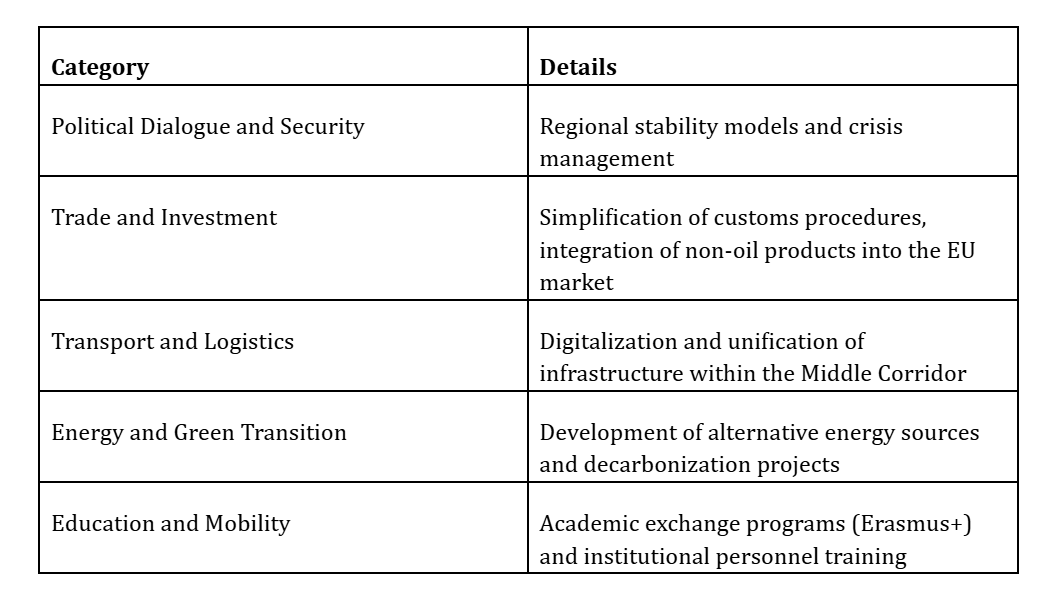
(European Commission, 2025)
Here, the greatest systemic contradiction and institutional paradox is precisely the issue of human rights and fundamental freedoms. In the EU's foreign policy documents, including the charter of the European External Action Service (EEAS), the rule of law and the strengthening of civil society are declared as the "fundamental condition" and "non-negotiable value" of any partnership (European Union External Action, 2025).
However, the domestic political environment in Azerbaijan is developing in a completely different direction: independent media is effectively banned, the legal-financial channels of civil society institutions have been zeroed out, and dozens of independent journalists, human rights defenders, and political activists—such as Akif Gurbanov, speaker of the III Republic Platform, founding board member Ruslan Izzatli, well-known opposition figures like Tofig Yagublu, and even the opposition leader, chairman of the APFP Ali Karimli—have been thrown into prison. Just today (June 8, 2026), the prosecutor requested the sentencing of those arrested in the "Toplum TV" case to terms of imprisonment: Akif Gurbanov to 16 years, Alasgar Mammadli to 15 years, Ruslan Izzatli to 16 years, Ramil Babayev to 14 years, Ali Zeynal to 15 years, Mushfig Jabbar to 14 years, Ilkin Amrahov to 14 years, Farid Ismayilov to 13 years, and Elmir Abbasov to 13 years. Moreover, by also requesting the confiscation of Akif Gurbanov's house and car, as well as the cars of Alasgar Mammadli and Ruslan Izzatli, the will to financially punish even the families of these innocently arrested individuals has been demonstrated (Toplum TV 2026). This ruthless accusation, which is not based on any evidence, is undoubtedly a political order and reflects the personal will of Ilham Aliyev.
Against the backdrop of this picture, Brussels' "dual" or "parallel" policy mechanism appears completely naked: normative liberal values are preserved in Parliament resolutions and the speeches of individual MEPs, while in real working groups and signed agreements, only hard geopolitical and geoeconomic interests enclose the framework. In other words, the institutional segmentation of the EU's foreign policy deepens a little more every day.
If the Comprehensive Agreement is signed as a final document between the parties in the near future, it will have a long-term impact on both Azerbaijan's internal dynamics and its international position:
- The good side is that the legal infrastructure of the Middle Corridor project will be strengthened, and Azerbaijan's status as a transit hub in the global supply chain will be formalized.
- The bad side is that the agreement will play the role of a false international signal for foreign capital and transnational corporations regarding the reliability of Azerbaijan's legal and economic environment. This, in turn, will condition authoritarian cementation in the country:
- The realization of an economic integration model with the EU without any deep institutional and democratic reforms will prove that the domestic governance structure can be long-lasting even without the need for reforms, and will further strengthen the existing political model;
- The "conditionality" mechanism that Europe holds in its hands to intervene or exert influence in the areas of human rights, freedom of expression, and fundamental rights in the country will completely fail;
- Official Baku will present this large-scale agreement to both the domestic audience and its regional rivals as the complete legitimacy of its harsh foreign and domestic political course on the international stage, and as a major diplomatic victory.
Final Assessment
If we summarize all this complex analytical picture into a single formula, the fundamental essence of these large-scale negotiations being conducted is by no means a process of Azerbaijan drawing closer to the European family, nor adopting its political-cultural value system, towards which Aliyev has repeatedly declared his hatred. This is an act of Europe surrendering to geopolitical realities and adapting to security fears.
Today, the main question for Brussels' strategic decision-makers is no longer, "How many democratic institutions does Azerbaijan possess internally?" Today's main and only question is this: What critical role can Aliyev play in Europe's global energy security, transport logistics, and Eurasian security architecture, and how can maximum advantage be drawn from this potential?
Although tension and mutual criticism in rhetoric continue between Baku and Brussels, the real and pragmatic formula for the behind-the-scenes channels of strategic and economic cooperation functioning so rapidly is hidden precisely in the answer to this question.
Sources:
European Commission, 2024a. Joint statement: 10th ministerial meeting of the Southern Gas Corridor Advisory Council and 2nd ministerial meeting of the Green Energy Advisory Council. https://energy.ec.europa.eu/news/joint-statement-10th-ministerial-meeting-southern-gas-corridor-advisory-council-and-2nd-ministerial-2024-03-01_en
European Commission, 2024b. EU trade relations with Azerbaijan. Facts, figures and latest developments. https://policy.trade.ec.europa.eu/eu-trade-relationships-country-and-region/countries-and-regions/azerbaijan_en
European Commission, 2025. EU – Azerbaijan Cooperation. https://enlargement.ec.europa.eu/countries/azerbaijan_en
European Union External Action, 2025. https://www.eeas.europa.eu/eeas/human-rights-democracy_en
Oc-media, 2026. Azerbaijan and EU resume negotiations over partnership agreement. https://oc-media.org/azerbaijan-and-eu-resume-negotiations-over-partnership-agreement/
Toplum TV. 2026. "Prokuror 'Toplum TV işi' üzrə həbs olunanlara 13-16 il cəza istəyib." Toplum TV. Accessed June 8, 2026. https://toplummedia.tv/mehkeme/pprokuror-quottoplum-tv-isirdquo-uumlzre-hebs-olunanlara-13-16-il-ceza-isteyibnbspp.
