(This article was prepared within the framework of KHAR Center’s “Security and State Architecture” research project)
Looking at the expressions that President Ilham Aliyev consistently uses in his speeches, and even at his refusal to attend the Ankara summit of the Organization of Turkic States (OTS), it draws attention that he seems to be interested in keeping relations with Türkiye tense. At the summit hosted by Erdoğan, Türkiye will take over the organization's next chairmanship from Azerbaijan. That is, Aliyev is not going to the event at which he will hand over his own chairmanship. This is a deliberately chosen, undisguised message. Moreover, media outlets that spread the government narrative, such as APA, have come out with an article substantiating that Ilham Aliyev's not going to Ankara is a political message (APA, October 2026).
Well, but why? Are Israel-Azerbaijan relations really valuable enough to erase Türkiye? In the article you are reading, I will try to answer precisely these questions through the prism of Israel-Azerbaijan relations.
When Azerbaijan regained its independence in 1991, Israel was one of the first states to recognize this independence. In 1992, diplomatic relations officially began (mfa.gov.az). However, Azerbaijan did not open an embassy in Israel. Because in the Nagorno-Karabakh issue raised at the United Nations, it was necessary to protect the votes cast in favor of Azerbaijan by both Iran and the Muslim states that are members of the Organization of Islamic Cooperation. For this reason, for a long time Azerbaijan did not open an embassy in Israel. Israel has repeatedly declared that it understands this pragmatic approach of Azerbaijan. As for 2023, Azerbaijan opened its embassy in Israel – the Karabakh issue had already been resolved by then.
Azerbaijan's relations with Israel go back a long way — to 30-35 years ago. When Azerbaijan gained its independence, Iran experienced sudden alarm. It thought that millions of Azerbaijani Turks within its own borders could be drawn into separatist tendencies. In the first years of independence, especially during the period of former president Abulfaz Elchibey, nationalist statements had begun to increase in Baku. Topics such as the unification of Northern and Southern Azerbaijan were being voiced. In response to this, Iran supported Shiite movements inside Azerbaijan and provided open and covert assistance to Armenia in the Karabakh war.
Heydar Aliyev tried to balance this situation in some way. For example, in 1994, when the Contract of the Century – the international consortium on the exploitation of Azerbaijan's hydrocarbon reserves – was signed, Heydar Aliyev attempted to transfer a 5% portion of SOCAR's share to Tehran in order to suppress Iran's reaction. However, the USA reacted very harshly to this (The Washington Institute for Near East Policy, 1995). As a result, Iran began to draw even closer to Armenia. In order to balance this rapprochement, Heydar Aliyev began to deepen ties with Israel day by day. After Ilham Aliyev took over the post from his father in 2003, these ties increased even further. When the Baku-Tbilisi-Ceyhan pipeline was launched in 2006, Azerbaijan began to earn large oil revenues and merged with Israel's defense industry technologies.
By the way, Erdoğan's Türkiye also participated wholeheartedly in the transfer of power from father to son in Azerbaijan. When Ilham Aliyev was appointed prime minister, Heydar Aliyev had for a long time been in a mysterious medical condition at Türkiye's Gülhane Military Hospital. Moreover, on the night of 15 October 2003, while the results of the elections were not yet known, the first congratulations on Ilham Aliyev's election as president had also come from Erdoğan (Hurriyet, 2018). That is, Türkiye is now receiving a backhanded slap from Ilham Aliyev, in whose acquisition and consolidation of power it played an exceptional role.
In the US embassy's diplomatic cable, written in 2009 and later leaked by WikiLeaks, there are very striking expressions. Ilham Aliyev describes his relations with Israel as follows: "An iceberg, nine-tenths of which is under the water" (FP, 2012). That is, only a small part of Azerbaijan's ties with Israel is known to the public.
In general, Azerbaijan-Israel relations are built on five main pillars:
First: Iran is a common threat for both countries. Israel has a strategy of encircling Iran. For this, winning over Azerbaijan is extremely important. Azerbaijan, in turn, sees Israel as a main partner against Iran's attempts at regime export and threats to its sovereignty as a whole.
Second: It is energy and arms trade. Through the BTC pipeline passing through Georgia and Türkiye, Azerbaijan meets approximately half of Israel's crude oil needs. Approximately 40% of Israel's annual crude oil imports are met directly from Azerbaijan via the BTC line (Yousef Bardouka, 2025). That is, Azerbaijani oil constitutes the backbone of Israel's energy security. Israel, in turn, has supplied modern weapons to Azerbaijan, on which many countries imposed open and covert arms embargoes because of the Karabakh problem, and this military cooperation continues to grow. In 2011, with a 50/50 share, "Azad Systems" was established in Baku (Caroline Rees, 2011). This company produces reconnaissance and kamikaze UAVs. "Zərbə", known as Azerbaijan's kamikaze UAV, is also produced under Israeli license. This catapult-launched system, which can stay in the air for 2-3 hours and has a range of 100 km, was improved a bit further during the Karabakh war and was put into production under the name "İti Qovan". That is, "İti Qovan" is actually an Israeli UAV.
Israel was also very active in the preparation stage for the Second Karabakh War: in 2012, defense cooperation had exceeded 1.5 billion dollars. In 2014, it approached 4 billion dollars. In 2016, during the visit to Baku of Netanyahu, who is now the main architect of the tension with Türkiye, President Aliyev said that this figure had reached 5 billion dollars (Ilham Aliyev, 2016). Between 2011–2020, Israel supplied 27% of Azerbaijan's total arms imports. Especially in the 2016–2020 period, Israel alone provided 69% of Azerbaijan's arms imports (SIPRI, 2021). In the same period, Azerbaijan became Israel's second-largest arms buyer after India.
As can be seen, oil is not the only trade between the two countries, it is simply the largest. After the trade office opened in Tel Aviv in 2021, ties have increased even further. For example, the Azerbaijan Space Agency is currently awaiting the result of an agreement signed in 2023. Azerbaijan has purchased 2 high-precision observation and spy satellites from Israel. One will be launched into space this year, and one in 2028.
Third: In the cyber sphere, Israel currently protects Azerbaijan against cyberattacks coming from Iran. Imagine a state whose entire critical state and energy infrastructure is in a state of full integration with Israel's cybersecurity ecosystem. In 2023, when the President of Israel came to Azerbaijan, he characterized cybersecurity as the fastest-growing area of bilateral cooperation (president.az, 2023). That is, Azerbaijan's cybersecurity infrastructure is currently mainly in the hands of Israel.
Fourth: It is related to the Jews living on Azerbaijani lands. There is a significant number of Jews in Azerbaijan. Some of them have moved to Israel, and they have formed serious lobbying power in Israel in Azerbaijan's favor. The center of the Jews in Azerbaijan is the Red Settlement in Quba. It is known as the Jerusalem of the Caucasus. It is the only settlement outside Israel whose entire population consists of Jews. During all high-level visits, this settlement is invariably visited. The Armenian lobby is strong in the US Congress; Azerbaijan balances that lobby with the support of Jews of Azerbaijani origin, through the Jewish lobby in the USA.
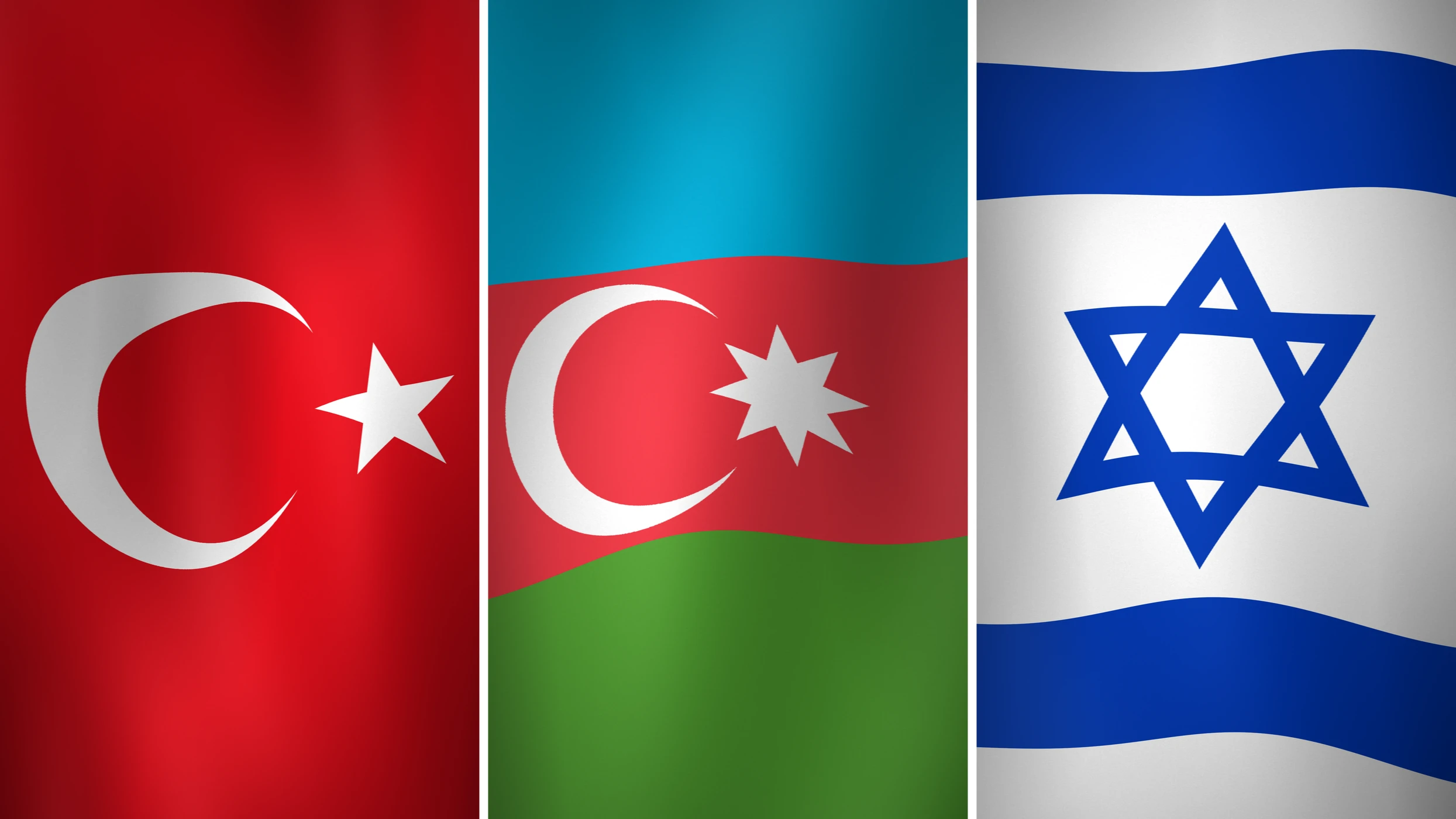
Fifth: The Türkiye–Azerbaijan–Israel geopolitical triangle has been, over the last 15–20 years, one of the most complex and, at the same time, most functional regional mechanisms at the intersection of the Middle East and the South Caucasus. The structure of this system, its operating logic, and the structural crisis it has faced since 2023 become clearer through several main arguments.
The Karabakh War (2020) is the peak of this triangular architecture. The Azerbaijani Armed Forces synchronized, in a single command-and-control chain, Türkiye's "Bayraktar TB2" strike UAVs along with Israel's "Harop" and "Orbiter" kamikaze drones, reconnaissance systems, and "LORA" operational-tactical missiles. While Türkiye provided doctrinal, intelligence and electronic warfare ("KORAL") support, and in general the management of combat, Israeli systems strengthened the precision strike and air defense components.
This mechanism showed that even if there were political tensions between Ankara and Tel Aviv ("Mavi Marmara", etc.), Baku had the capability to harmonize the resources of both partners in the name of its own interests.
However, the Gaza war that began in October 2023 put the balance within this triangle to the test:
After the 2023 Gaza events, when Ankara openly declared Israel a "regional threat" and a "terror state" and suspended trade relations, the issue moved beyond diplomatic discontent and turned into an ideological and existential confrontation. This situation limited Baku's room for maneuver; because Ankara expected solidarity from a brotherly country, while Tel Aviv expected the uninterrupted continuity of security and energy supply.
With this, the backbone of the triangle came directly under political risk:
While Türkiye's religious\Sharia-minded public opinion demands the halting of oil transport from Türkiye to Israel, Ankara tries to manage the public pressure by citing that it cannot violate international transit agreements.
The anti-Aliyev rhetoric now observed in Türkiye's political circles and media, with expressions such as "Azerbaijani oil moves Israeli tanks", in fact began long ago. This is a clear indicator of the collision of economic interests with political narratives in the trilateral mechanism.
The events of the last two years clearly show that official Baku can no longer pursue a policy of balance between Türkiye and Israel. Therefore, it makes its choice in the direction of not damaging its high-level relations with Israel. Baku views the open tension with Ankara as a payable price for preserving this choice.
The first basis of this choice is threat perception. The Azerbaijan–Israel partnership rests not only on trade and energy, but on the unparalleled support of the Jewish lobby for Azerbaijani authoritarianism, and at the same time on shared geopolitical concern. For example, according to the thinking of official Baku, unlike in the 2000s (at that time Ankara had openly demonstrated that it was ready to protect Baku against the Iranian threat), the side that creates a real balance against the main threat on the southern border is no longer Ankara, but Tel Aviv. According to official Baku, Erdoğan's Türkiye, with its high religious sensitivity, will not go into confrontation with Iran for the sake of Azerbaijan.
The second main reason is the decrease in strategic dependence. The resolution of the Karabakh issue has weakened Türkiye's role as an irreplaceable military pillar for Baku. According to official Baku, the period when Türkiye was needed most has been left behind. The high technologies, intelligence and energy cooperation offered by Israel, and political support in Washington and Brussels, respond more to the needs of the new era.
The third and clearest basis is Baku's recent behavior. At a time when Israeli leaders see Türkiye at the same level as Iran in terms of threat, Aliyev organized Israeli President Herzog's visit to Baku via Türkiye, and this visit took place during the most acute days of tension with Türkiye over the hijab and Israeli ties. Despite this, Azerbaijan's ruling party accused Erdoğan's chief adviser, over his "hijab" tweet, with a harsh statement. Baku even succeeded in having Oktay Saral removed from office. Finally, Ilham Aliyev did not even attend the OTS Ankara summit. This is an unprecedented level in relations with a “brotherly country” and reveals official Baku's choice in favor of Israel: by carrying the hidden tension between Ankara and Baku onto the religious plane through a planned decision, Aliyev wraps his own Israel choice in the attractive narrative of "protecting the secular state model from Ankara's religious-political influence".
Because Baku is confident that Ankara's strongest lever will not be activated. Even during the war, Azerbaijani oil flowed uninterruptedly through Türkiye to Israel. This shows that Türkiye is not ready to put its relationship with Azerbaijan at risk. Baku reads this asymmetry and bets that Ankara will endure indefinitely.
Thus, official Baku's choice is in favor of Israel, but it is not a renunciation of Türkiye. It is a refusal to recognize Türkiye's right of veto. Baku openly demonstrates that the Israel line is a strategic asset that needs to be protected, and that even if its price is a lasting coldness with Ankara, this price is worth paying.
Note: The article you have read was originally written in the Azerbaijani language. Artificial intelligence tools were used only in the translation.
References
APA, October 2026. Why did President Ilham Aliyev not go to Türkiye? https://apa.az/siyasi/prezident-ilham-eliyev-turkiyeye-niye-getmedi-tehlil-1009548
mfa.gov.az. Bilateral diplomatic relations between the Republic of Azerbaijan and the State of Israel. https://www.mfa.gov.az/en/category/asia-and-oceania/israel
The Washington Institute for Near East Policy, 1995. The U.S.-Iran Confrontation: Dissecting Tehran's Strategy. https://www.washingtoninstitute.org/policy-analysis/us-iran-confrontation-dissecting-tehrans-strategy
Hurriyet, 2018. Who is Azerbaijani President Ilham Aliyev? https://www.hurriyet.com.tr/gundem/azerbaycan-cumhurbaskani-ilham-aliyev-kimdir-40991579
FP, 2012. Israel’s Secret Staging Ground. https://foreignpolicy.com/2012/03/28/israels-secret-staging-ground/
Yousef Bardouka, 2025. Azerbaijan supplied Israel with 40% of its oil during Gaza war, report finds. https://oc-media.org/azerbaijan-supplied-israel-with-40-of-its-petrol-during-gaza-war-report-finds/
Caroline Rees, 2011. UAV Production Started in Azerbaijan. https://www.unmannedsystemstechnology.com/2011/03/uav-production-started-in-azerbaijan/
Ilham Aliyev, 2016. Press statements by Ilham Aliyev and Prime Minister Benjamin Netanyahu. https://president.az/en/articles/view/22148
SIPRI, 2021. TRENDS IN INTERNATIONAL ARMS TRANSFERS, 2020. P.11-12. https://www.sipri.org/sites/default/files/2021-03/fs_2103_at_2020_v2.pdf
