(The article was prepared by the "Khar Center" within the framework of research on Azerbaijani authoritarianism)
Author:
✍️ Elman Fattah – Head of "KHAR Center"
Explaining the development of political regimes solely through the expansion of the apparatus of violence is a methodologically incomplete approach. The lifespan of an authoritarian governance system depends on the unequal harmony between the society's future hopes and the state's power of control.
The political process Azerbaijan has experienced since 1993 is an exemplary laboratory of this model. Aliyevism, over a period of approximately thirty years, has created its strongest phase of resilience through the principle of low hope and high control. However, in the new phase that began in 2020, the regime, by rolling towards the nullification of hopes and a system of total control, is bringing itself closer to a natural end - the vacuum of the post-political era.
1993–2020 – The classic model. "Low hope, high control"
The authoritarian political architecture, whose foundation was laid starting in 1993, never confronted society with a feeling of completely depressive helplessness. On the contrary, the regime turned into the main monopolist regulating and distributing the dose of hope. Authoritarian resilience was maintained precisely on these foundational pillars, which hindered the massification of discontent and prioritized individual interests over collective ones:
- Oil revenues stratified society and broke the bond of accountability between the citizen and the state. The growth of the state budget turned the state apparatus into the main source of livelihood and status for the broad masses; teachers, doctors, military personnel, and low-ranking bureaucrats chose passive loyalty because they knew their personal incomes depended precisely on this mechanism;
- The punishment for oppositional political activity (dismissal from work, expropriation of business, imprisonment) was made excessively severe. In return, microcredits and unofficial earning mechanisms were preserved as a reward for personal loyalty. As a result, the citizen accepted the struggle for common rights as an irrational risk, and "fending for oneself" within the regime as the only rational path.
This political application is, in fact, not new. In his 2012 work The Oil Curse: How Petroleum Wealth Shapes the Development of Nations, Michael Ross clearly evaluated the intentions of autocrats with the statements: "oil revenues allow autocrats to minimize taxes, increase budget expenditures and state subsidies. In this way, the state builds a broad patronage network, making society dependent on the budget and eliminating the citizen's demand for political freedom and accountability" (Michael Ross, 2012).
Periodic "reform" imitations
The regime quelled legitimacy crises (for example, the social tension that arose after the 2015-2016 devaluations) with cosmetic changes and merely a partial renewal of the showcase (Farid Mehralizadeh, 2019). Through "young cadres" and "Western-educated managers," an idea was implanted into society that the issue was not with the system, but only with the executors.
- Problems in governance were blamed on the oligarchs, while the primary political will was presented in the image of a leader "who wants to make reforms but is hindered by those around him," and even opposition intellectuals were drawn into the process. This manipulation diverted the energy of the disgruntled masses from radical demands against the government, directing them simply to wait for the next personnel appointment and presidential decrees.
The Karabakh trauma
The postponed consensus on democracy: The military defeat and chaos that occurred in the early 1990s deeply shook people's minds, making it possible to present authoritarian stability as progressive governance (Leila Aliyeva, 2006). One of the main ideas thrown before public opinion was this: internal political struggle, free elections, or protests could weaken the state's power, which could lead to the loss of new territories. This guaranteed the strengthening of the regime's security organs, the inviolability of the flourishing of corruption in all areas, and allowed critical opinions to be stifled with the label of being "contrary to national interests." Public discontent remained in the shadow of an important and urgent goal like the liberation of the lands; enduring a lack of rights was imposed on society as a patriotic duty.
Managed pressure: Instead of completely eliminating alternative opinions, the system limited their spread and weakened their impact. Although traditional opposition parties were occasionally allowed to organize rallies and the right to criticize on social media was recognized, the influence of these activities over the legislative and executive branches was completely destroyed.
Neutralization of protest energy: This partially open situation acts, on one hand, as a valve that safely reduces tension in society. On the other hand, it presented arguments of pluralism to international organizations. Consequently, society, thinking that it was not under total pressure and that a small possibility for maneuvering existed within the system, shied away from supporting calls for political change.
The regulated nature of control
There was repression in this phase as well, but its nature was surgical and selective. Although political parties were squeezed, their headquarters and, to some extent, their operational capabilities still continued. Even though the critical press was smothered with fines and pressures, it was not entirely eliminated. Although independent civil society faced legal restrictions and difficulties, a blind eye was turned to its activities. Fear did not rule completely; it simply kept society within a certain boundary.
All of this was the golden age of authoritarian adaptation. Society was in a cage, but inside the cage, there was food, water, and the illusion that one day the door might be opened.
Post-2020: The breaking point
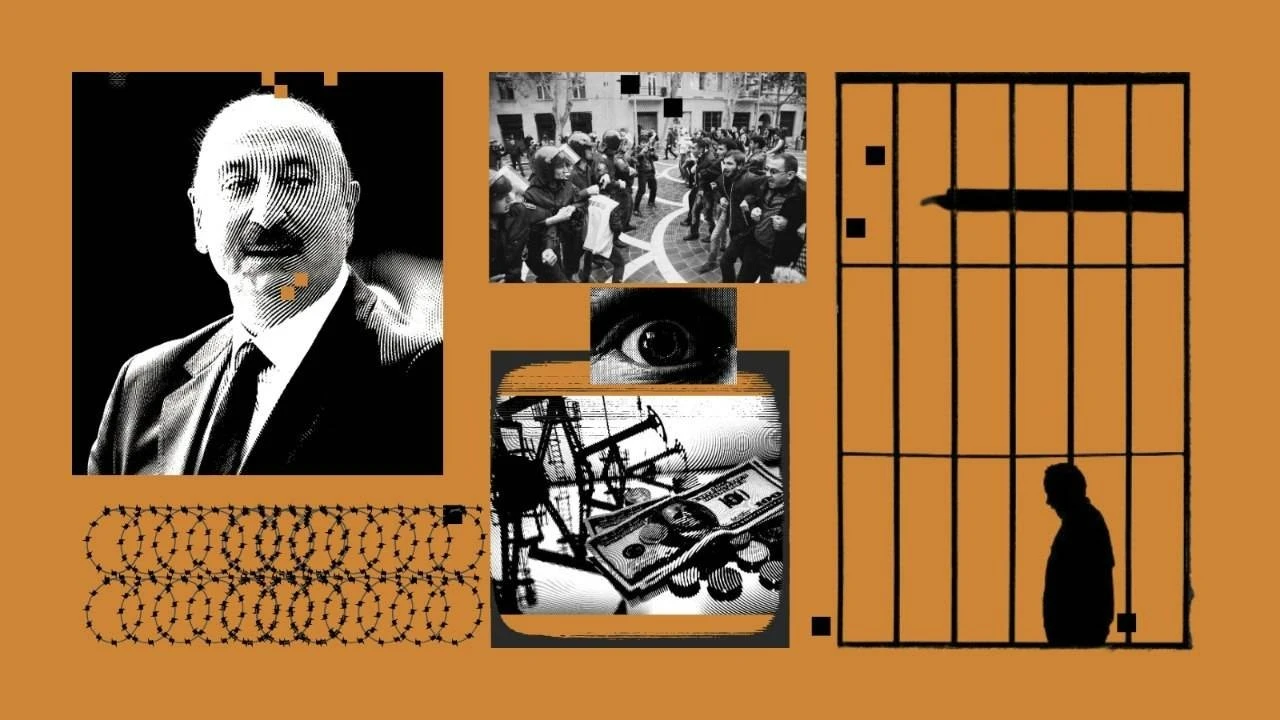
The Second Karabakh War that took place in 2020 and the 2023 Khankendi operation radically changed thoughts regarding the regime's existence. The restoration of territorial integrity brought the government crucial legitimacy, but at the same time, it deprived the regime of the nationwide consensus and the exploitation of hopes that it had used as its primary governance tool for many years. In the post-war period, instead of liberalization or establishing a new social contract with society, the regime chose a completely different path: zero hope, total control.
The collapse of reform myths: The concept of "young technocrats" did not turn into real structural reforms; the corrupt and monopolistic nature of the governance system remains exactly as it was. On the contrary, against the backdrop of declining incomes and rising prices, social elevators have been completely shut down. Moreover, the land borders that have been kept closed for years have strengthened the impression of an "open-air prison" for ordinary people. Even people's only freedom—the ability to move freely—has been taken away from them.
Social lack of prospects: The public understood that the benefits brought by the military victory were directed not at the welfare of ordinary people, but solely at the further enrichment of a select elite group. The regime no longer has a convincing "grand fairy tale" that it can promise to society.
Total control and continuous repression
The regime raised the dose of fear to the maximum:
With the reactionary laws "On Political Parties" and "On Media," no differing critical structure was allowed to remain in the legal sphere. Independent investigative journalists, public activists, trade union leaders, and even activists who voiced the slightest criticism were incapacitated by an indiscriminate, sweeping wave of arrests.
In summary, the regime abandoned even the imitation of any dialogue with society or listening to it. Governance was reduced to a "victorious commander - private soldier" subordination.
Why will this situation end the regime's resilience? (Forecast)
A superficial analysis shows that today the Azerbaijani government is experiencing its strongest period, alternatives have been destroyed, and the broad masses are in complete submission. However, the functioning mechanism of political systems is different: a regime of zero hope and total control does not strengthen the regime; it makes it repressively fragile.
The main arguments that this fragility will cause the system to collapse are as follows:
The irrelevance of fear
When people have no positive expectations for the future and realize that the system leaves them no way out, the deterrent effect of repression is lost. Fear is effective only when the individual has status, a job, or minimal welfare to lose. In a society that has lost everything and been left without a future, repression accumulates deep, explosive resentment.
Loss of flexibility
In an environment of total control, the flow of critical information stops completely. State structures lose the ability to receive accurate information about the mood of society, because everyone presents only the information the leadership wants to hear. The pot is boiling, but since the lid is welded shut, there is no way for the pressure to release other than an explosion. Such systems lose their adaptability; they cannot respond to a changing reality, but only repeat the same reflex — more arrests and more prohibitions.
Decrease in economic and political resources
The costs of keeping society under total control are extremely high. The natural decline in oil production and the massive expenditures required for the restoration of Karabakh reduce the economic rent the regime can offer to society. In a zero-hope system, however, the mechanism of total control increasingly becomes a heavier economic burden.
The breaking point of the monolith
The illusion of total control is a typical indicator of the period of decline of authoritarian systems. The authoritarianism that guided society through the filter of individual hopes between 1993 and 2020, skillfully balancing fear with expectations, has yielded its place to a steel tower relying solely on violence. This tower may look massive when viewed from the outside. However, because it lacks adaptability, a reserve of legitimacy, and most importantly, public hope on the inside, it will crack at the first test it faces. Whether in intra-elite struggles, acute geopolitical crises, or moments of unexpected economic collapse, the system's lack of means to react flexibly will lead to serious consequences. Because in a zero-hope environment, society will not lift a finger to protect the regime, and the total control apparatus will be paralyzed at the first moment of confusion. That is, the regime, previously strong as iron, hardening like steel, will protect it from bending, but will not be able to save it from breaking. In short, by killing hope, Azerbaijani authoritarianism has demolished its strongest load-bearing wall.
Note: The article you have read was originally written in the Azerbaijani language. Artificial intelligence tools were used only in the translation.
References:
Michael Ross 2012. The Oil Curse: How Petroleum Wealth Shapes the Development of Nations. Chapter 3: Petroleum Perpetuates Authoritarianism. https://ciaotest.cc.columbia.edu/journals/it/v14i4/f_0026782_21872.pdf
Farid Mehralizadeh, 2019. Structural Reforms in Azerbaijan. https://bakuresearchinstitute.org/en/structural-reforms-in-azerbaijan-2/
Leila Aliyeva, 2006. "Azerbaijan's Frustrating Transition". Carnegie Papers, No. 68, Carnegie Endowment for International . P, 6-7
